How Can Hobbled Aaron Rodgers Attack Legion of Boom?
The Seattle Seahawks secondary is the best in the NFL, when breaking down the mix of personnel and scheme in Pete Carroll’s defense. A unit that leans on technique with top-tier talent at both the cornerback and safety positions, this secondary can suffocate opposing teams playing base coverages.
The throwing windows are small, and the speed of this unit is constantly on display given its ability to identify route concepts, close on the football and challenge receivers at the line of scrimmage.
Can Aaron Rodgers and the Green Bay Packers produce versus this secondary on Sunday in the NFC Championship Game? And given the limited mobility of the quarterback due to a calf injury, what type of route combinations should we expect to create opportunities for Jordy Nelson, Randall Cobb, rookie Davante Adams and tight end Richard Rodgers?
.jpg?w=2560 "Colts Football")
I’m looking at middle-of-the-field throws, three-deep beaters and concepts that allow Rodgers to make plays from inside the pocket to compensate for the injury.
After watching the tape, here are three routes I would put near the top of the Packers' game plan as they prep for a Seahawks secondary led by Richard Sherman, Earl Thomas and Kam Chancellor.
1. Switch Verticals
Run from a 2x2 formation out of Posse/11 personnel (3WR-1TE-1RB), Switch Verticals puts stress on the Seahawks’ three-deep coverage (Cover 3, 3 “Buzz”) as it creates a one-on-one matchup versus the curl-flat defender with the cornerbacks removed.
Let’s take a look at this example from the Philadelphia Eagles with Chip Kelly’s offense using this route to produce a touchdown versus 3 “Buzz” (safety drops down as an inside-hook defender).
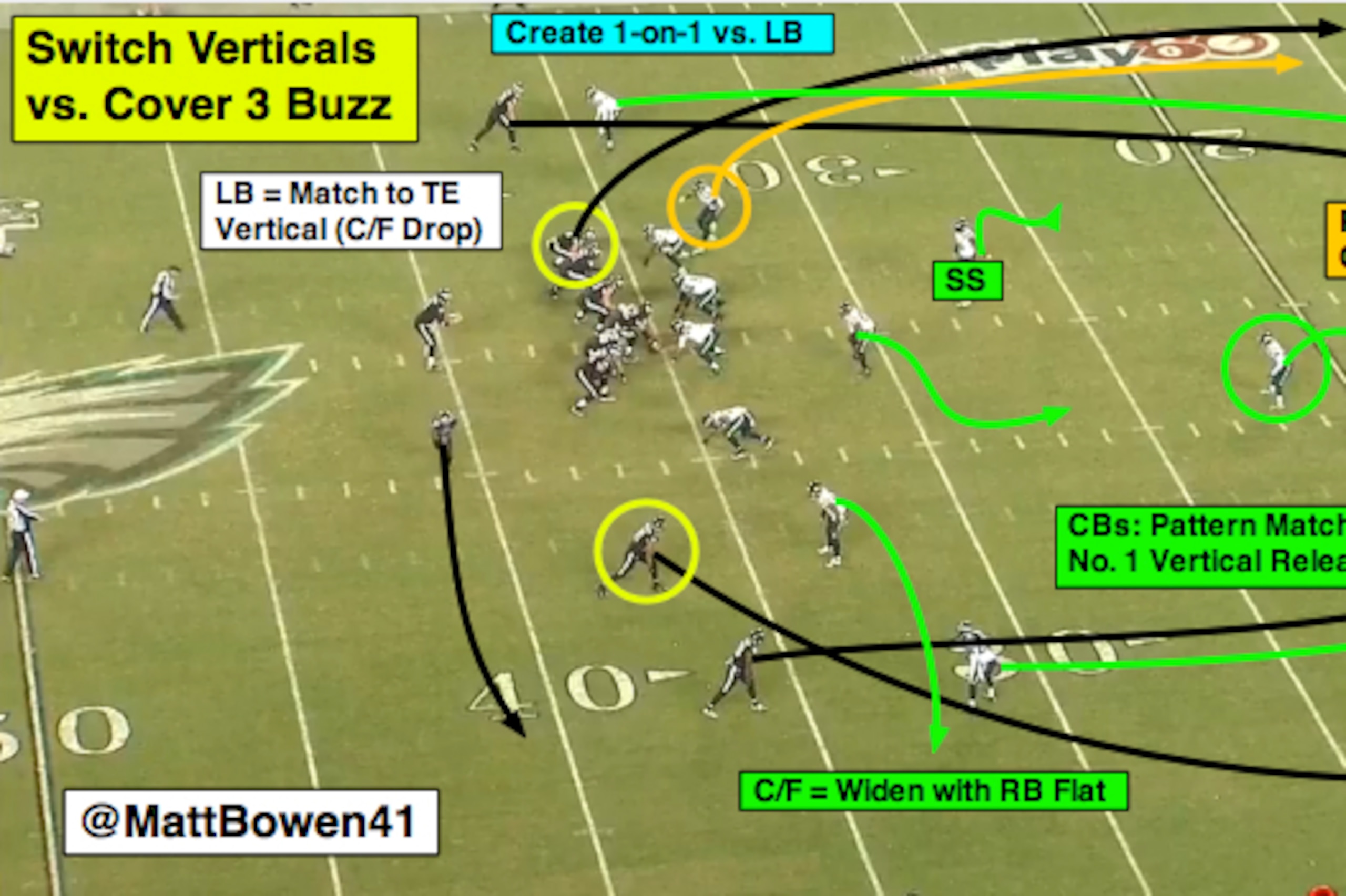
In this concept, the Eagles can remove the cornerbacks with the No. 1 receivers (count outside-in) taking a hard inside release and pushing up the field on the post routes (Seattle will pattern-match the vertical release with its cornerbacks in Cover 3). This removes the cornerbacks while also occupying Thomas in the deep middle of the field.
That allows the No. 2 receivers (tight end and slot) to take a hard outside release (can also be used as a rub route) before stemming to the numbers.
To the closed side of the formation, the curl-flat defender (linebacker K.J. Wright) has to match (or carry) the vertical from No. 2 (tight end Zach Ertz). To the open side, the Eagles send the running back to the flat (widens the curl-flat defender) and get a free release down the field from the slot receiver.
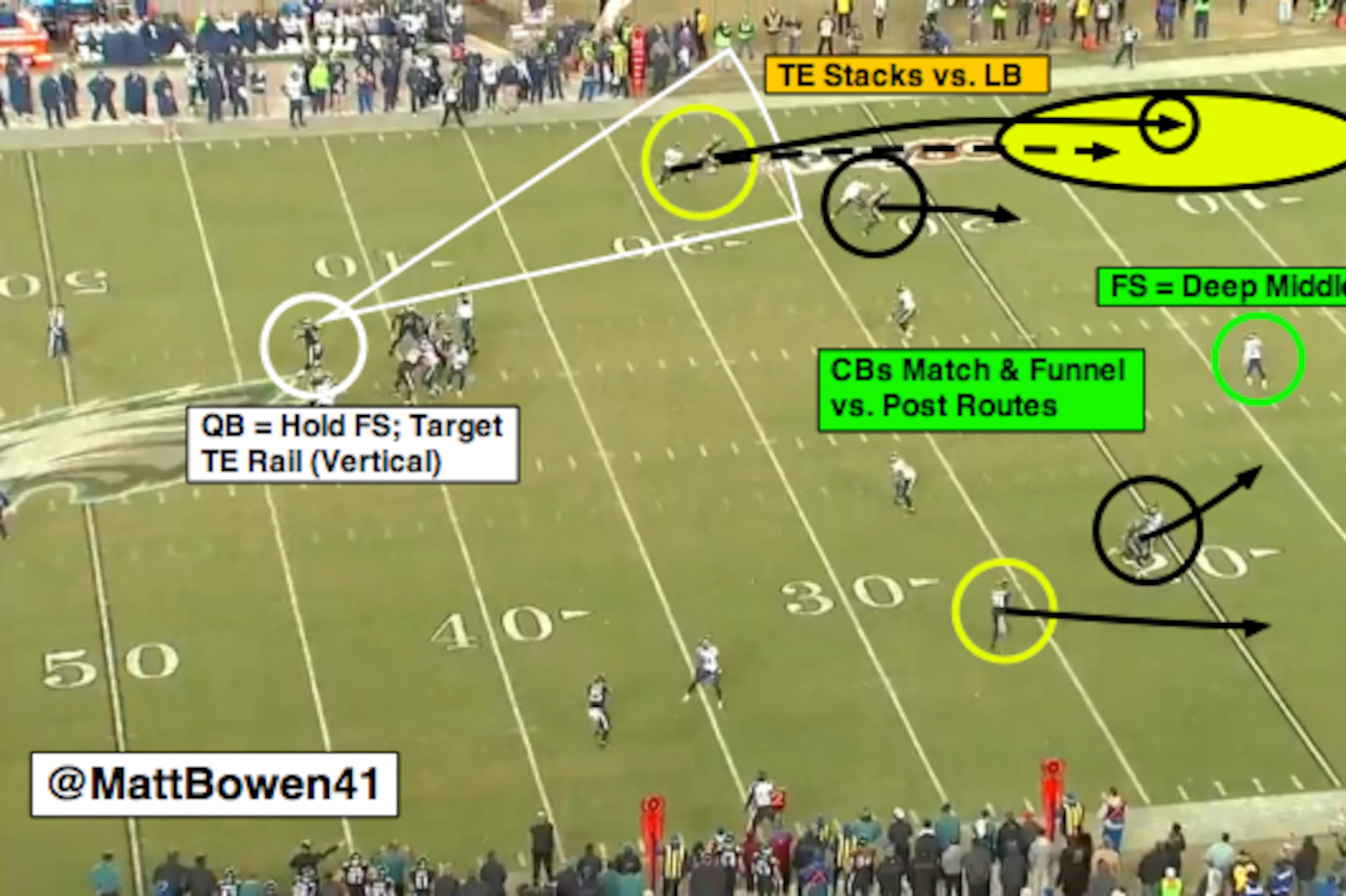
With the cornerback now removed versus the post route (squeezing the route to the free safety) and Thomas playing the deep middle of the field, quarterback Mark Sanchez has the one-on-one matchup he wants with Ertz versus Wright.
This allows the tight end to stack on top of the linebacker and carry the route down the field. And because of the technique the Seahawks use at the cornerback position (press and pattern match), the cornerback will be late to overlap to the outside third of the zone coverage.
Take a look at the film as Sanchez targets Ertz on the outside vertical with the cornerback removed.

2. Semi-Curl
The Semi-Curl is another route combination that allows the offense to occupy the cornerback with a curl route while creating an inside throwing window to target the vertical seam versus three-deep.
Here’s an example from the divisional playoffs with Carolina Panthers quarterback Cam Newton targeting tight end Greg Olsen out of Ace/12 personnel (2WR-2TE-1RB).

With the Panthers in a Doubles Slot formation (3x1), Olsen aligns at No. 3 to the closed side of the field. This allows the tight end to take an outside stem on the seam route while No. 1 runs the curl. To the open side, the Panthers pair the dig route with the shallow drive (underneath crosser) to give Newton a two-level read.
The key here is the curl route, as the Panthers want to force Sherman to squat to the closed side of the field while Olsen splits the cornerback and free safety on the seam route.
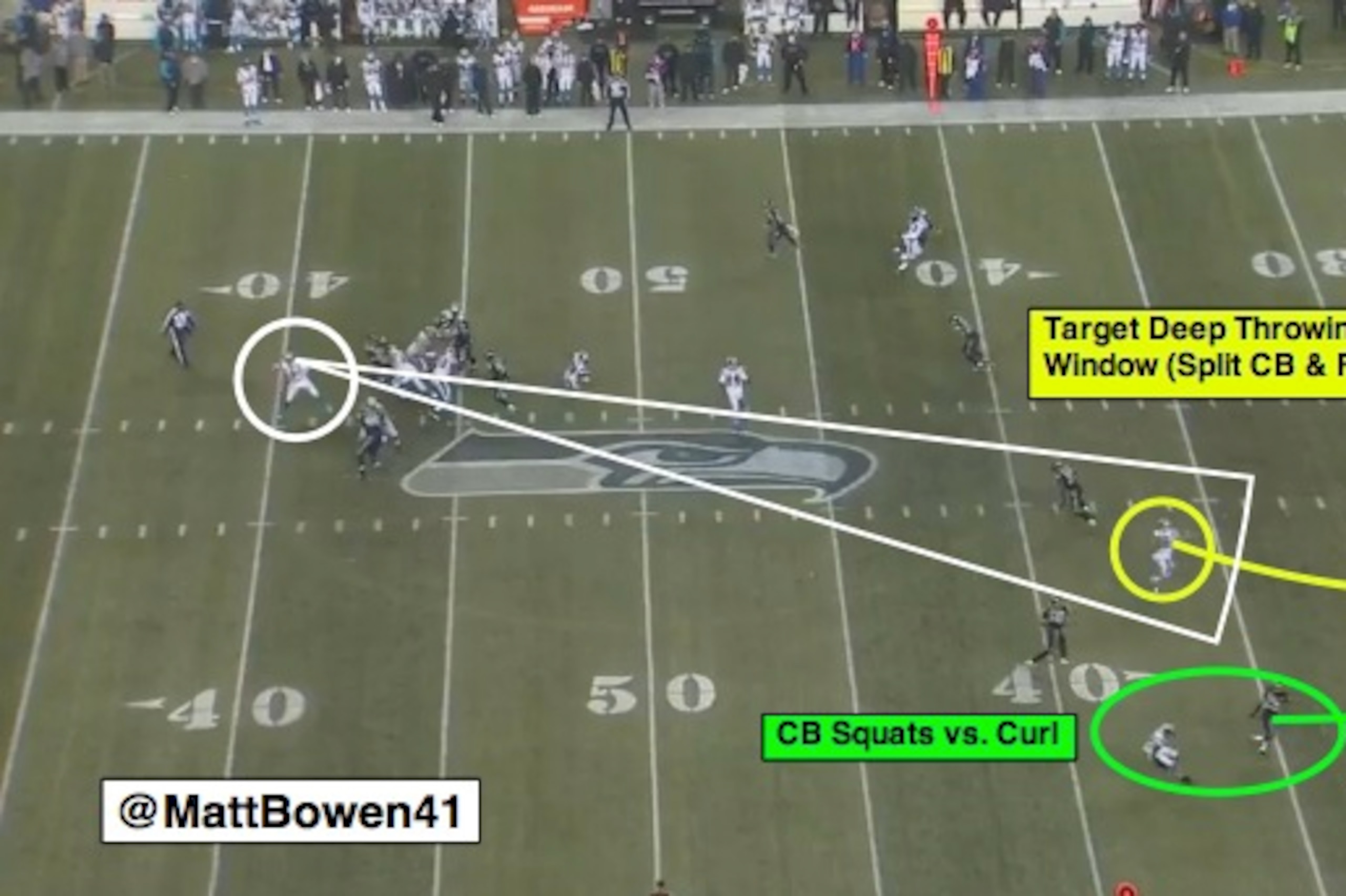
With Sherman occupied by the curl route and Olsen clearing the underneath buzz defender (Chancellor), Newton has a deep throwing lane to target the seam route as the tight end splits the top of the secondary.
This is a basic combination, but it creates an opportunity for the offense to scheme Cover 3 while taking a shot down the field to produce an explosive play.
Check out the end-zone angle from the tape with Newton holding Thomas in the deep middle of the field (pump) prior to finding Olsen on the seam route before Sherman can overlap to the throw.

3. Levels
The Level concept (two-level read on inside breaking routes) can be run from a 2x2 or 3x1 formation versus Cover 3 with No. 2 clearing the hook defender on the intermediate dig route.
This example is from the Packers-Seahawks matchup back in Week 1 with Posse/11 personnel on the field in a Doubles Slot “Orange” formation.

Three inside breaking routes with Nelson on the outside smash, Cobb (No. 2) on the dig (can also convert to the seam) and the tight end running the crossing route.
This creates an opportunity for Rodgers to read the hook defender (linebacker) and Thomas (“buzz” defender) before targeting Nelson in the second-level throwing window.
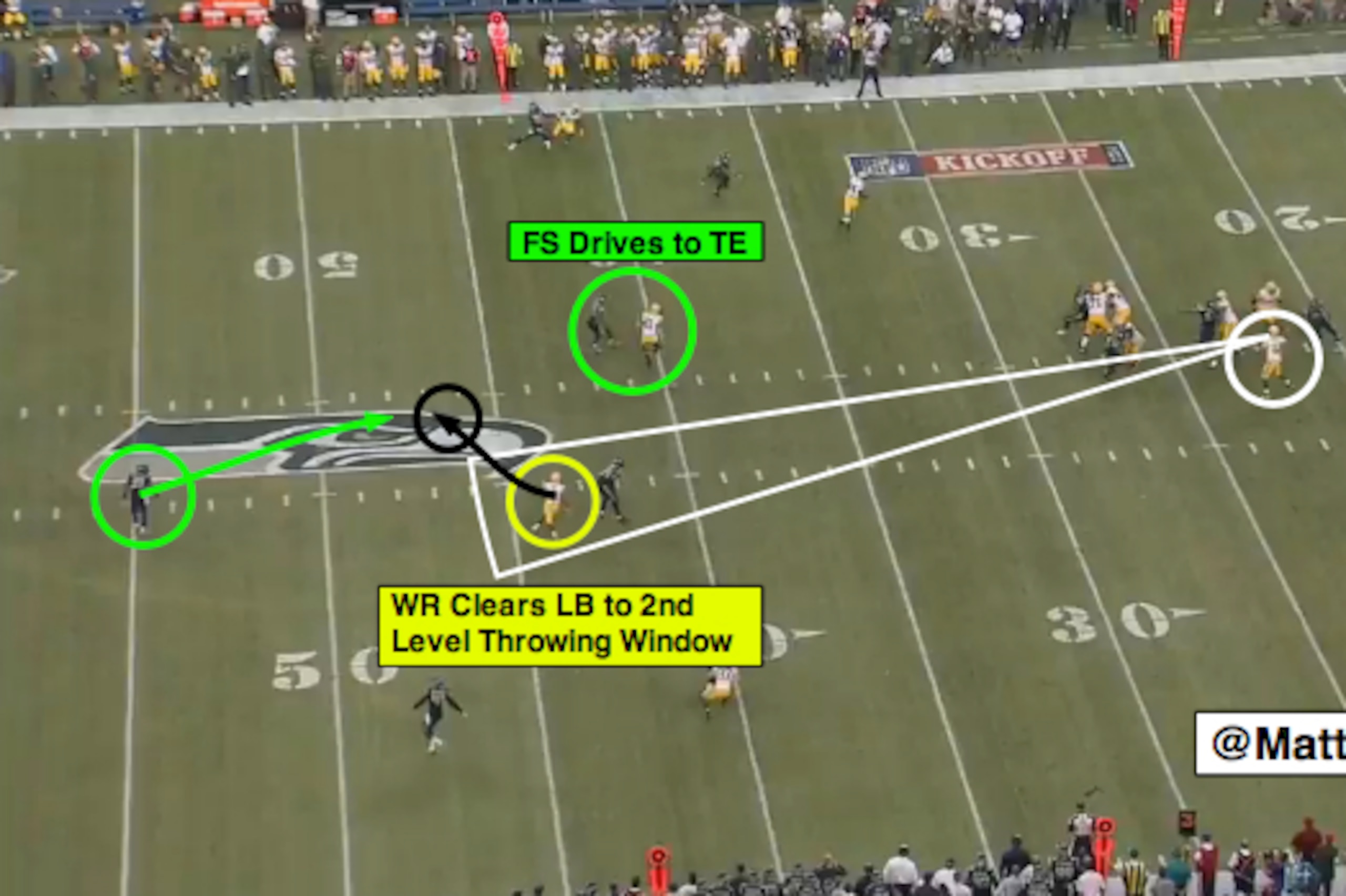
With Thomas driving downhill to account for the tight-end crossing route, Rodgers can wait for Cobb to clear the hook defender—creating a throwing window to the dig route.
That allows Cobb to catch the ball in front of the deep-middle-of-the-field safety (Chancellor) for a 15-to-20-yard gain on an inside breaking route.
Take a look at the film with Rodgers sliding in the pocket to create an angle to deliver this ball to the middle of the field.

I had to dig pretty deep in the film to find situations where the Seahawks secondary gave up explosive plays, but there will be opportunities for Rodgers to target this defense when the Packers use route combinations designed to create throwing windows versus single-high-safety defenses (Cover 3, Cover 1).
These are only a few examples, but the routes do allow the quarterback to attack the defense with throws from inside the pocket. And given the limitations that Rodgers will have this Sunday due to his injury, I would focus on two- and three-level reads (along with there-step concepts) that put the Packers quarterback in a position to challenge the best secondary in the NFL.
Seven-year NFL veteran Matt Bowen is an NFL National Lead Writer for Bleacher Report.
.jpg?w=2560 "Vikings Lions Football")
.jpg?w=2560 "Lions Eagles Football")