Breaking Down How Timofey Mozgov Changes the Cleveland Cavaliers' Defense
Once Anderson Varejao went down for the season with a torn Achilles, the Cleveland Cavaliers scrambled to find a replacement on the trade market. Two first-round picks later and the Cavs have Timofey Mozgov, formerly of the Denver Nuggets.
Mozgov is no Varejao. He's nowhere near as active or laterally athletic, and his defensive instincts aren't always on point. He's a classic big body that uses his length to disrupt floaters and layups at the rim, but otherwise doesn't like to venture out onto the perimeter and guard.
That said, Mozgov has never been one to shy away from contact. He's always willing to stick his neck in the thick of things in the paint and shows a knack for remaining vertical to avoid fouls.
TOP NEWS
Buzz: 'Several' Teams Interested in Simmons
Don Nelson Dies at 86
Wolves Take Trip to Paris 🇫🇷
In the grand scheme of team defense, having a presence down low to somewhat deter penetration and make paint finishes that much more difficult can make a multibasket difference over 48 minutes.
Schematically, it appears Cavs head coach David Blatt has slotted Mozgov into his most natural pick-and-roll defensive role: dropping deep into the paint.
What Mozgov provides in pure size he inversely concedes in foot speed. He's simply not quick enough to stick with guards for multiple seconds and gets blown by if he's confronting ball-handlers above the free-throw line.
The drop, which has Mozgov retreating to defend the rim once the screen is set, hopes to offset this issue.
Denver head coach Brian Shaw is a proponent of the hard show, a pick-and-roll coverage in which the defensive big lurches out perpendicular to the ball-handler and tries to stop him from turning the corner.
Mozgov struggled with this style of defense and often got burned. When Denver switched to a deeper drop, he was much more comfortable and capable.
When the Minnesota Timberwolves' Gorgui Dieng and Mo Williams run a pick-and-roll on this play against the Nuggets, Mozgov is in his conservative drop.
The Timberwolves run a very basic side out of bounds set that most NBA teams have in their arsenal. Williams starts at the strong-side block before darting out to the perimeter off a down screen from Thaddeus Young.
This "zipper" cut is immediately followed by an on-ball screen from the opposite big, in this case Dieng:
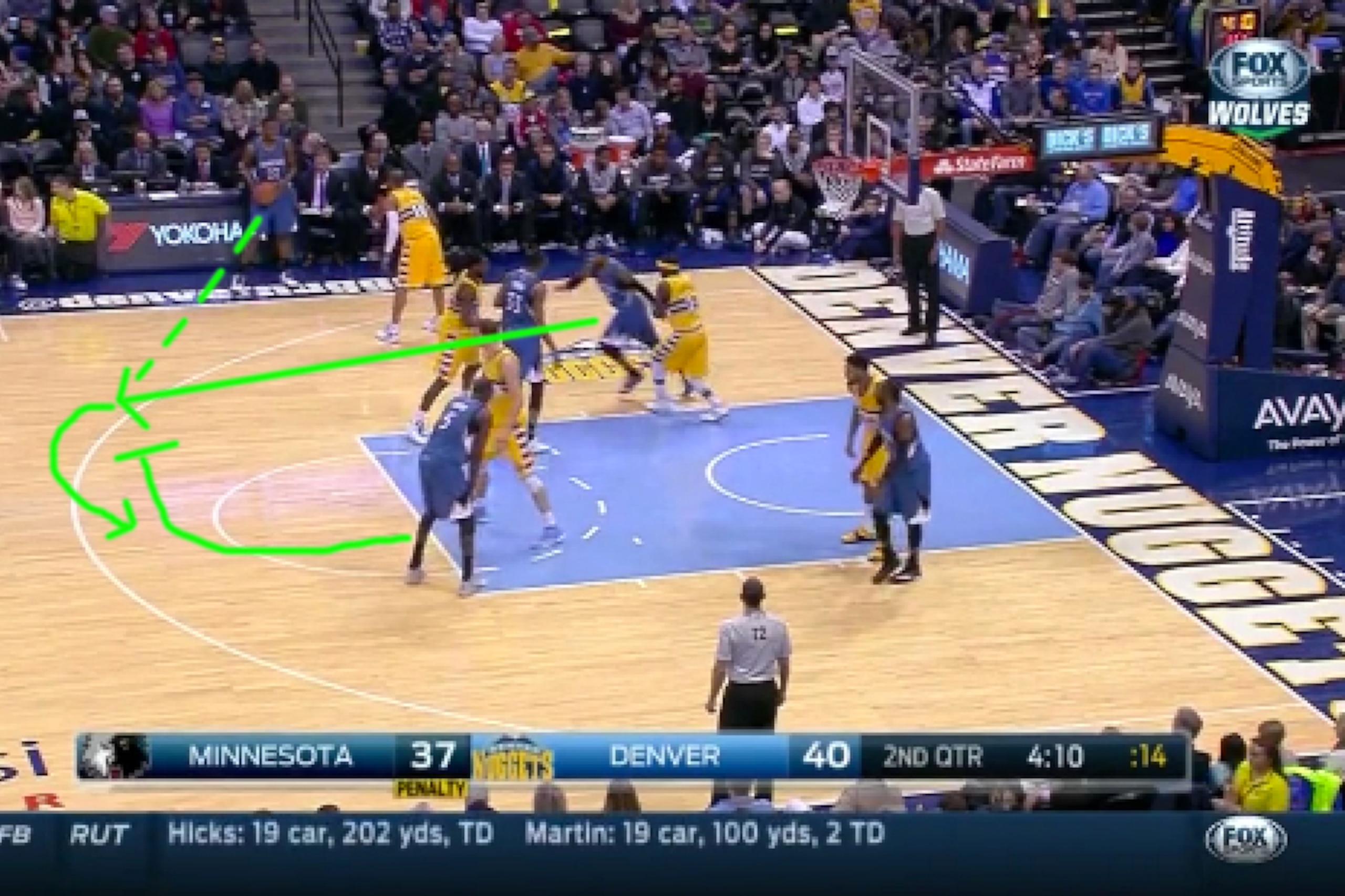
With precision timing, this play can be difficult to guard. The momentum of Williams' defender, Ty Lawson, is carrying him away from the rim when he all of a sudden has to put on the brakes, shift sideways and fight through a screen.
More often than not, the man guarding the zipper cut is unable to avoid the pick and finds himself in a trail position. Here, Lawson has to sliver around the contact and Mozgov is left to cover the roller and the ball-handler.
Solid weak-side defense from Kenneth Faried prevents a dump-off pass to Dieng, but Mozgov does a nice job staying big and containing the ball:
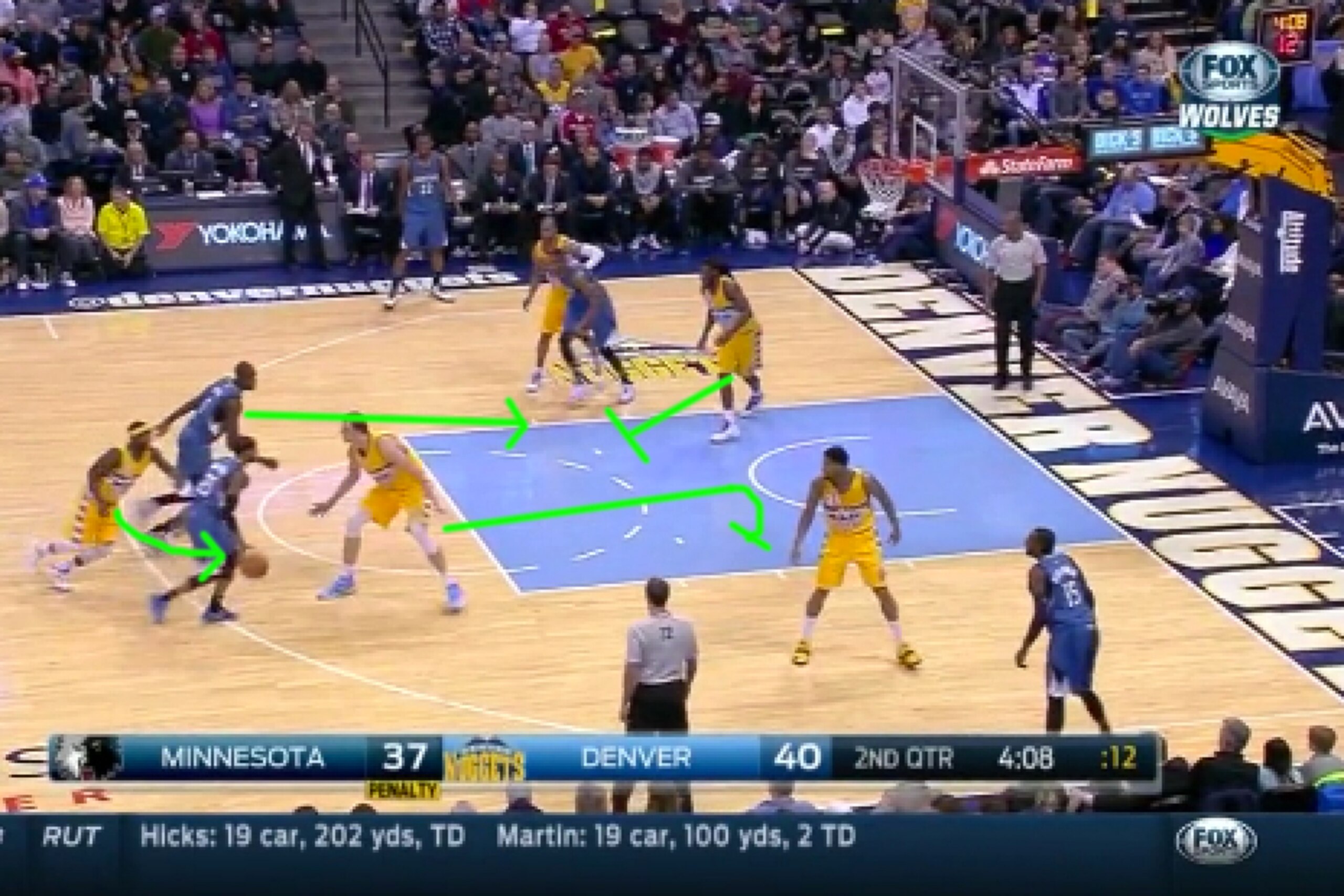
Even though he initially confronts the ball at the elbow, notice how he's in a constant drop with a hand in the air. Mozgov's quick backpedal leaves Williams with very few options in terms of attacking the rim, which subsequently forces him to slow down.
The resulting domino effect plays right into Denver's hands. Williams' more controlled pace gives Lawson time to fight back into a guarding position, and Williams takes a tough floater over a high hand:
This is where Mozgov can really help the Cavaliers. He's not going to block many shots, but he's active with his arms and understands how to leverage his greatest defensive asset (his length) to make up for his main deficiency (speed).
In the small sample size of Mozgov's minutes thus far with the Cavaliers, he's stuck with this prototypical drop.
Though Blatt has utilized the hard show this season, he's had the luxury of Varejao, Kevin Love and Tristan Thompson—all of whom have the mobility to jump out at ball-handlers without getting beaten.
Blatt's coverages, therefore, will have to be personnel dependent. This isn't uncommon in defensive game plans, as teams will adjust their style both to fit their own players as well as counter the strengths of opponents.
It's possible, then, that Cleveland could hard show 1-4 middle pick-and-rolls between the wings, but drop 1-5. On side pick-and-rolls they've shown an "ice," which guides the ball-handler down to the corner while simultaneously preventing pocket passes.
And in all cases in which the big is late getting into position, he's in a drop.
The key, no matter the specific game plan, is that Mozgov doesn't hard show. Shaw experimented with it in Denver because he prefers an aggressive style of defense, but it generally failed with Mozgov rumbling out to 30 feet.
Check out how easily Kyle Lowry of the Toronto Raptors squirts by Mozgov as he cannot get out on the perimeter in time:
The drawback of the drop is that it almost invites dribble penetration. The defense must be disciplined in pushing over toward the ball to help contain it, but also quick in its rotations should a throw out to a shooter occur.
For a Cleveland team that is having trouble keeping ball-handlers in front, Mozgov could find himself in foul trouble as he's constantly having to deal with players flying downhill at him with little resistance.
What Mozgov's presence does do, however, is create more defined roles for Cleveland's other defenders. Thompson's effort at the center position has been valiant, but ultimately the Cavs had to send swarms of players to the ball on any drives to the bucket.
There was simply too much danger despite Thompson's best efforts. But with that extra cavalry flooding the paint came three-point shots, and Cleveland was stuck in the unfortunate place between a three-point barrage and a feast at the rim.
Mozgov somewhat unburdens the Cavs' team defense by shouldering the rim protection load by himself. He can't play 48 minutes every night and fouls might be a real issue, but for a solid 30 minutes per night Cleveland has a workable defense.
Love in particular should be able to do what he does best now that Mozgov is around: Rebound.
On this play against the Sacramento Kings, Mozgov parks himself in the restricted area before rotating to various players in a help position. The ball eventually finds its way to DeMarcus Cousins, who tries to score at point-blank range:

Mozgov wards him off with a solid, vertical contest and does not require any help from additional players.
When you watch the play below, keep your eye on Love.
Notice how, after containing the ball in the right corner, he sneaks his way back toward the rim and plants himself directly between Jason Thompson and the rim:
This is what makes Love such a savvy rebounder: He quietly earns position to grab the board while everyone else is staring at the shot. Without someone else defending shots in the paint, this is a major weakness of Love's game. He sometimes sacrifices defense of the basket to get in a better rebounding position.
Playing alongside Mozgov, however, alleviates the pressure on Love to both defend and rebound. At the 5, he's expected to do both. At the 4, there's simply less responsibility.
Most NBA power forwards aren't back-to-the-basket types and are more likely to be pick-and-pop bigs or athletes with a specific skill. And even if he's matched up against a traditional big, NBA offenses keep the 5 down low and the 4 elevated (or vice versa). Love is always going to guard the more perimeter-oriented player.
This frees him up to be the rebounding monster that he is by playing his natural power forward position.
Ultimately, the Cavs probably gave up too much for Mozgov, but the move is understandable considering the dire circumstances Varejao's injury left them in.
Will he make them a championship contender all of a sudden? Probably not. But he'll certainly make them better on the defensive end.
.jpg?w=2560 "Lions Try Out Trevon Diggs")
.jpg?w=2560 "Richardson Unsure of Future With Colts")
.jpg?w=2560 "Buzz: Terrion Arnold Visits Seahawks")