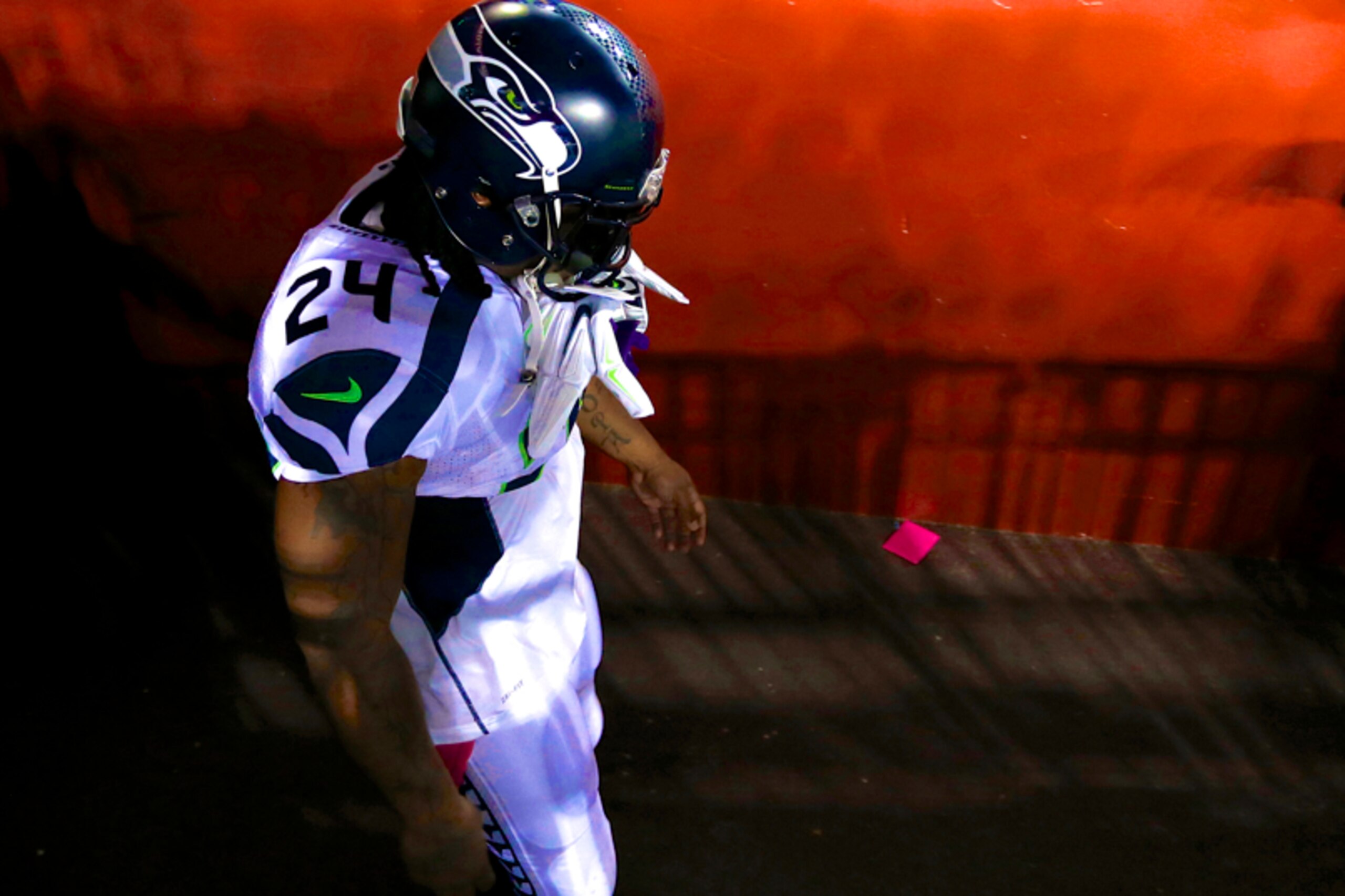

Retiring on Top May Be What's Best for Marshawn Lynch
Jim Brown retired at the height of his career in 1966 because he was fed up with the NFL life. Hollywood offered opportunities, glamor and control over his future. The NFL offered $1,500-per-week fines for missing training camp and the drudgery of absorbing hundreds of hits per year for a penny-pinching boss. Brown decided to finish The Dirty Dozen instead of heeding Art Modell's beck-and-call. The rest is history.

Barry Sanders retired at his peak in 1998 because he had lost the "drive, determination and enjoyment" for football, in his own words. Always a bit of an eccentric—private, introverted and notoriously frugal—Sanders didn't like what he saw from the rebuilding Detroit Lions and suddenly vanished from the NFL.
TOP NEWS
.jpg?w=2560 "Saints Lions Football")
Rap: Lions, LaPorta End Contract Talks
.jpg?w=2560 "Vikings Buccaneers Football")
Report: Baker May Miss Up to 6 Weeks
.jpg?w=2560)
EVERY Fantasy Football Update
Ricky Williams retired after a 1,372-yard season in 2003, later calling the decision the "most positive thing" he had done with his life. Dogged by the NFL for failed marijuana tests and haunted by a social anxiety disorder that made locker room interviews a constant source of misery, he studied holistic medicine for a year instead of enduring 400 tackles by hostile opponents. He returned to the NFL for a series of on-again, off-again seasons between suspensions and injuries, always with one foot and part of his heart in India, or anywhere else he could be his introspective self instead of a battering ram for hire.

There have been others. Tiki Barber left the NFL after a 1,662-yard 2006 season when television news magazines promised an opportunity to be about more than handoffs. Robert Smith, who quit the Ohio State football team as a collegian because he preferred to concentrate on his studies, retired after rushing for over 1,500 yards in 2000 because he understood the toll football took on his body, and because his passions were elsewhere. "It wasn't just about playing in the NFL," Smith said. "It provided me the freedom to study the world in a way most people don't have the opportunity to do."
Marshawn Lynch may be planning to retire at the height of his career at the conclusion of this season. If so, he will be in both elite and familiar company. Lynch will be among the quiet, private, complex, defiant men, and philosophical men, who turned their backs on riches to escape life as a high-profile plow horse.
Good for Lynch if he hangs up the spikes after the season. If he hates NFL life as much as he appears to, he shouldn't make himself miserable for the money.
The Lynch retirement rumor is almost pure speculation. NFL Network's Ian Rapoport cited "sources with direct knowledge of Lynch's thinking" as saying the running back is "weighing the possibility." Lynch himself does not speak to reporters unless the barrel of a six-figure fine is placed at his head. I have never pursued him for an interview, even during the clamor of Super Bowl week last winter, because I am not eager to speak to anyone willing to spend $100,000 to avoid me.

Lynch did recently grant an interview to former teammate Michael Robinson, the Tim McCarver to his Steve Carlton, and he gave the retirement story a terse deflection. "I'm still under contract," he said. "I ain't even made it through this year." Lynch pointed to Robinson's Super Bowl ring. "I'm chasing after another one of these right here."
Brown, Sanders and most of the others were under contract when they retired. When a great running back is fed up, the money stops mattering much.
Lynch's pursuit of a second Super Bowl ring will involve at least six more games, but more likely seven (a first-round Seahawks bye is still possible but will take many breaks), at a 2014 rate of 20.6 touches per game. That's 144 more opportunities to get gang-tackled. Lynch is not just the Seahawks' leading rusher this season, but also second on the team in receptions; it's Lynch and Russell Wilson against the NFL when the Seahawks have the ball. With a chicken-wire offensive line, the Seahawks cannot trust backups Robert Turbin or Christine Michael to do much of the dirty work. It's Lynch's job to fight past the line of scrimmage, burst through the first tackler, drive the second one backward, move the chains and preserve the narrow lead, Sunday after Sunday.
If he succeeds, Lynch's reward will be Super Bowl week, where my colleagues and I will hound him for the one thing he loathes to provide: prefab sound bites to insert into articles and video spots as we see fit.
Media Day and the daily hype sessions were nonstop dental surgery for Lynch last winter; the shriller we became when demanding the usual droning football cliches from Lynch, the more determined his silence. Teammates like Robinson rallied to protect and defend him as if every press conference was 4th-and-goal from the 1-yard line. If he reaches the Super Bowl this year, Lynch will find Robinson no longer belly-flopping on interview grenades for him, but lobbing them in his direction.
Lynch gave Robinson a simple reason for his reticence. "I ain't got nothing to say," he said. "All that is superficial to me." There are echoes of the other great rushers who quit while on top in Lynch's actions and few words: Williams' social anxieties, Sanders' naturally quiet disposition, Brown's willingness to scoff at fines and threats to preserve his fierce independence. And there is something they all shared: a dawning realization as youth faded that sacrificing their bodies was not enough. Football wanted a little piece of their souls as well.
Running backs do not get to be cerebral father figures, like quarterbacks. They don't enjoy the high spotlight-to-punishment ratio of diva wide receivers. They rarely acquire the wizened-samurai reputations of veteran defenders, or even the workaday anonymity of linemen. Running backs must be both grunt infantry and merchandising commodities. We brand the unique ones with personality caricatures: the '60s rebel, the spacey hippie who wears his helmet to interviews and a dress on magazine covers, the candy-crunching Beast. The thoughtful young men of the profession—the Arian Foster, Rashard Mendenhall and Rashad Jennings types—chafe against the stereotypes. The eloquent Foster often criticizes the media. Mendenhall took the message of his retirement at age 26 to The Huffington Post instead of enduring one more cliche-laden press conference. Lynch, no orator or philosopher, just wants a live-and-let-live detente with the press, but that is not what is written into his contract.
One thing you rarely hear from the running backs who went out on top is a regret. Sanders has stated contentment with his decision many times. Ricky Williams said that he would choose another profession if he could do it all over again. "Some people are built for the NFL and some people aren't, and I don't think I was a person who was really built for success in the NFL," said the running back who gained over 10,000 yards.
Robert Smith missed football enough to return to the game as a college broadcaster, but he is glad he did not subject his body to further punishment. "I couldn't be happier [with my health] considering what I went through for eight years," he said in a 2011 interview.

Jim Brown? He had already earned a permanent slot on pro football's Mount Rushmore, but he would not have become the iconic figure who still looms symbolically over the NFL if he tucked tail and returned to Browns camp in 1966. Early retirement did not make Brown a great actor; it made him something much more.
The Seahawks made no long commitment to Lynch. The team responded to his brief July holdout by juggling a few dollars without extending his contract a minute beyond the 2015 season. Lynch is due to earn $7 million next year, $5 million in salary and $2 million more in roster bonuses. That's a lot of money, and the Seahawks may be reluctant to pay it. Lynch may be nearly as reluctant to receive it, if that money represents another year of misery: fines, hostile media relations, a lifestyle he may not be built for and 400 more body blows as he carries half the Seahawks offense on his back with every stride.
The Seahawks need Lynch more than Lynch needs the Seahawks, but both sides may be better off after a mutual parting, whether or not Lynch drags the team across the finish line in February.
Unlike Jim Brown, Lynch is no aspiring actor. He may not study nontraditional (and traditional) medicine like Ricky Williams or the sciences like Robert Smith. It is hard to imagine him managing a chain of auto dealerships like Barry Sanders. Lynch is so enigmatic that it is hard to imagine him doing anything except breaking tackles, eating Skittles and waving off reporters with a sly sneer.
If Lynch retires at the end of this season, whatever he does next with his life will likely be private and unpublicized, something that is entirely and exclusively his business.
And that is precisely the point.
Mike Tanier covers the NFL for Bleacher Report.
.jpg?w=2560 "Titans Giants Football")

_0.png?w=2560 "Week 5 Winners & Losers 📊")