

5 Ways to Fix the NY Giants' Front Office and Coaching Staffs
Normally at the end of the week before a regular-season game, I list the top five New York Giants players who are worth keeping an eye on for the upcoming game.
With the season in shambles, it’s probably a good idea to start looking ahead to how ownership might be planning to fix what has become a gigantic mess.
In this analysis, the front office and coaching staff come under the magnifying glass. Who should stay, and who should go? Read on.
Keep General Manager Jerry Reese
1 of 5
The composition of the annual roster begins with the front office, specifically with general manager Jerry Reese, once a scout (and a good one at that) who rose through the ranks to his current position.
As the man in charge of the entire football operation, when it fails, he needs to be held accountable.
After all, he is the one who rubber-stamps his approval on the draft picks, free-agency acquisitions, player contracts and personnel transactions.
No, Reese hasn’t been perfect—far from it in fact. The biggest blemishes on Reese’s record as a general manager is that the team’s 2008-2012 draft classes have been horrendous.
Regardless of the reason for the classes’ failures, the poor drafts are a big reason why the Giants, especially over the last two seasons, have had to load their roster with one-year stopgap solutions.
Another flaw in Reese’s tenure has been some of the contracts he’s handed out to veteran players, such as the five-year, $27.5 million deal that center David Baas received, per Spotrac, which counted for $3.225 million of the team’s dead money in 2014.
Speaking of dead money, four player contracts—Baas, offensive lineman Chris Snee, cornerback Corey Webster and tight end Brandon Myers—account for $10.15 million of the Giants $12.486 million in dead money, according to Over the Cap.
So why should Reese stay on the job?
To clean up the mess that has developed under his watch.
First Giants ownership has been reluctant to overhaul the entire organization, instead preferring to keep at least one piece of the puzzle for transitional and stability purposes.
(That, however is a shortsighted argument as when the organization has fallen apart in five out of the last six years, it’s difficult to justify that retaining any one or two individuals will provide “stability” that really hasn’t been there.)
Still, Reese inherited head coach Tom Coughlin, who was Ernie Accorsi’s pick for head coach (backed by ownership’s stamp of approval).
While Reese and Coughlin have been successful throughout the years and have been to the playoffs five out of Coughlin’s 11 years as a head coach, winning two Super Bowl championships, it’s hard to imagine that ownership won’t give Reese an opportunity to pick a head coach before removing him from his position.
When that day does happen—and given Coughlin’s age, it could happen sooner than later—that choice will be critical.
If Reese fails to provide a strong leader to drive the franchise out of its despair that could end up being the final blow to his legacy.
Replace Vice President of Player Evaluation Marc Ross
2 of 5
When you look at the Giants’ draft failures, a large chunk of the blame belongs squarely on the shoulders of Marc Ross, the team’s vice president of player evaluation.
While Ross can’t be faulted for picks such as David Wilson and Chad Jones, both of whom saw their NFL careers end due to serious injuries, he can be blamed for reaching for projects, such as linebacker Clint Sintim, an intriguing 3-4 college defensive player who didn’t fit into the Giants’ 4-3 defensive scheme.
Other players who haven’t worked out for the Giants under Ross’ regime include cornerback Jayron Hosley (third round), defensive tackle Marvin Austin (second round), receiver Jerrel Jernigan (third round) and any drafted linebacker not named Devon Kennard.
So who is Ross and what made him qualified for the responsibilities he’s held with the Giants?
According to his team bio, Ross served three years as a scout with the Buffalo Bills before becoming the league's youngest college-scouting director with the Philadelphia Eagles in 2000.
Interestingly, in 2013, USA Today reported that Ross, described as a “hot general manager candidate,” despite his drafting shortcomings, had interviews with the New York Jets, Carolina Panthers, San Diego Chargers and Jacksonville Jaguars.
This past offseason, Ross was linked to the general manager searches by the Miami Dolphins and Tampa Bay Buccaneers, according to Jordan Raanan of NJ.com.
That Ross can’t take that next step up to general manager despite getting opportunities says a lot about other teams’ willingness to take a chance on him.
Will Ross be sent to the chopping block?
If he hasn’t by now, he probably won’t, considering that his last two draft classes have shown the most promise since that special 2007 class that saw all but one member (offensive lineman Adam Koets) contribute to the team’s first Super Bowl championship under Coughlin.
Still, let’s not deny the obvious, and that is the Giants' poor drafts are a big reason why they have struggled.
That falls on Ross’ shoulders.
Shake Up the Assistant Coaching Staff
3 of 5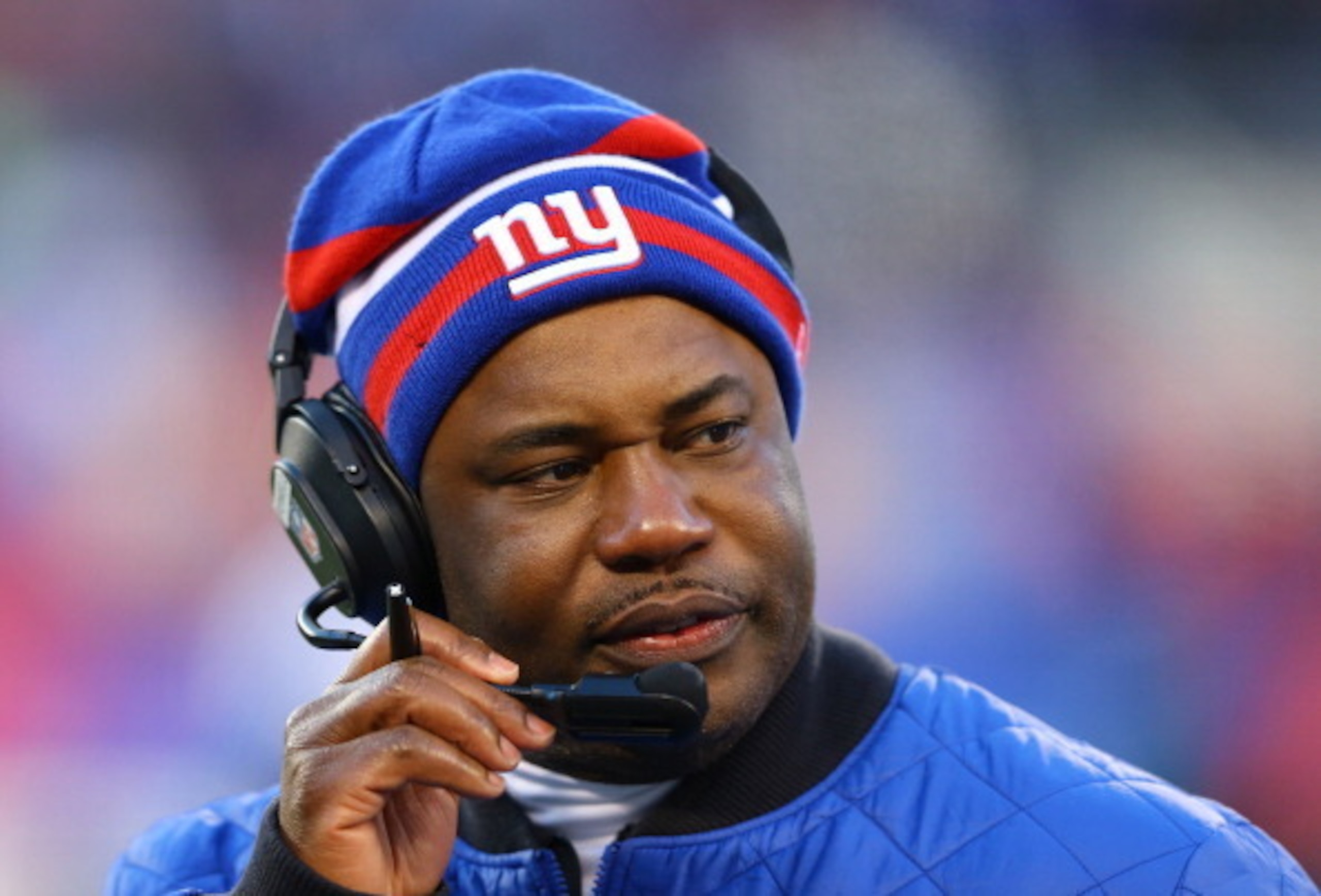
After having team co-owner John Mara declare the offense as bring “broken” last year, longtime offensive coordinator Kevin Gilbride retired, giving way to a young and upcoming assistant coach named Ben McAdoo.
So far, the results have been promising for McAdoo, a first-year offensive coordinator. Through 13 weeks, the Giants have the NFL’s 15th-best offense, including the 15th-best passing game.
That is not horrible considering that the Giants are without Victor Cruz, their top receiver, who never got a chance to line up on the same field as rookie sensation Odell Beckham Jr., or given that the Giants' only true receiving threat out of the backfield, running back Rashad Jennings, has missed four games this year.
They are also holding their heads above water—barely—despite the multiyear renovation project on the offensive line.
No the run game hasn’t been solid, but four out of the five pieces for a solid offensive line are in place, albeit not in the right position. More on that in a future installment.
With the offense on track to being fixed, the same thing can’t be said of the defense or special teams.
On defense, coordinator Perry Fewell’s unit has hovered at or near the bottom of the league overall in three of his five years as the coordinator, including this season.
While his unit has been hit hard this season by injuries, there are still breakdowns happening at an alarming rate, as there are instances of players making assignment errors—all things that shouldn’t be happening this late in a season.
The players won’t admit to it, but all signs point to Fewell’s system being too complex to fully master.
The result is that guys sometimes do what they think is required of them, only to end up out of position (and hence entice a teammate to compensate for the teammate who is in error).
Add to the fact that Fewell can’t seem to figure out how to get his guys into the right position to defend against a read-option offense that doesn’t look like it’s going anywhere soon, and the time just seems right for a change in leadership on that side of the ball.
As a side note, if Fewell is indeed on the way out, it would not necessarily be a surprise if some of the defensive assistants followed him out the door.
The two positional assistants who seem to be most vulnerable (based on their unit’s development and/or lack of results) are defensive line coach Robert Nunn and linebackers coach Jim Herrmann.
Of course, if a new defensive coordinator is brought on board, chances are he’s going to want his own guys working for him. So no defensive assistants are necessarily safe.
As for special teams, the mark of a strong coordinator is that he has to be able to adjust to the weekly challenges that come with gaining and losing personnel on his units.
Tom Quinn hasn’t been able to do that with any consistent success, though ever since the Giants switched to Odell Beckham Jr. on punt returns, his presence has helped the Giants' special teams unit rise in the rankings to No. 15, according to Football Outsiders.
Still, the last and only time the Giants had a top-10 special teams unit under Quinn, who has been the special steams coordinator for eight seasons, was in 2012.
Otherwise, Quinn’s special teams have mostly hovered at or below 16th in the league, according to the data at Football Outsiders.
When one sees the impact that successful special teams units such as the Eagles, Baltimore Ravens and New England Patriots have on games, it’s amazing that a change has not been made sooner. This might be the year it finally happens.
.jpg?w=2560 "Bills Browns Football")
Keep Head Coach Tom Coughlin
4 of 5
Some believe that if the Giants are going to get back on track, 68-year-old head coach Tom Coughlin needs to be sent packing.
While there is some merit in that argument, technically the Giants are in a transitional phase right now, and it’s probably best to keep some continuity among the coaching staff.
Under Coughlin, two key segments of the franchise’s rebuilding process took shape this year.
The first was the addition of offensive coordinator Ben McAdoo, who as mentioned in the previous slide, has done a good job of fixing the “broken” offense.
Some believe that McAdoo might be Coughlin’s successor. If that is indeed the plan, it makes no sense to promote McAdoo to that spot after his first year as an NFL coordinator.
In an ideal situation, the Giants maybe look to get another one or two years out of Coughlin and then promote McAdoo if they are convinced at that time that McAdoo is indeed their man of the future.
The other rebuilding project that has begun under Coughlin is the makeover of the offensive line.
No, the results are not there, and that is because the pieces to the puzzle aren’t in the proper order, and all the pieces are not there.
However the offensive line is probably a lot further along that most think to where another starter and a couple of solid depth players will go a long way toward restoring this unit to a team strength.
Coughlin continues to drop hint that he still has a lot left in his tank—last week when he was asked about coaching in his 300th NFL game during his daily press briefing, he joked, “For a young guy, it’s hard to believe 300 games. I must have started when I was 15.”
However, four more weeks of emotionally draining losses could ultimately sway his decision. Then there is always the possibility that management tries to coax him into retiring, something that Coughlin, who has always been selfless when it comes to the team, might agree to do.
If Coughlin wants to continue coaching, he should get at one more year to leave the franchise in better shape than how he initially found it.
Change the Weight-Training and Conditioning Approach
5 of 5
If the Giants want to finish a season with pretty much the same roster it begins with, then they really need to rethink their approach to weight training and conditioning.
For two straight years, the Giants have been among, if not at the top of the leaderboard in team injuries, a fact that is difficult to label as a coincidence.
As Ralph Vacchiano of the New York Daily News noted, head coach Tom Coughlin, who famously declared injuries to be “a cancer” when he was hired in 2004, lost 18 players to IR in his first season and 47 players on IR in his first four seasons.
Coughlin can talk all he wants about the “next man up,” but there is a clear distinction between starters and backups.
The “next man up” usually isn’t always going to offer the same skill set or talent level as the man he has to replace in the lineup.
How bad have injuries affected the Giants?
In a 2013 research project done by the Dallas Morning News, author Rick Gosselin concluded that New York had 91 games lost by starters due to injuries, the most of any team in the NFL.
Meanwhile based on the running total of the injury situation for each team this season as kept by CBSSports.com, the Giants appear to be the leader with the most (20) players lost to injured reserve.
While football is a violent game that puts the body through situations for which it’s not built to endure, it certainly appears to be a legitimate question to ask if the workout program the team has the players go through is lacking.
Perhaps moving forward, the Giants might want to take a page out of Eagles head coach Chip Kelly’s book.
Per Pro Football Talk, Kelly hired a former Navy SEALs trainer to orchestrate various training and conditioning programs that were adapted to help his players for his up-tempo style on offense.
According to an article on military.com, the Navy SEAL training program is extremely demanding, and it is not simply designed to get a candidate in shape, but rather to help a candidate who meets a minimum physical-fitness level take his conditioning to the next plateau.
If the Giants players are working out on their own prior to the start of the offseason conditioning program, which, thanks to the recent CBA, now begins in mid-April instead of mid-March, then shouldn’t the next step in the program be to get the “in shape” to that next level regarding strength and endurance?
The results have certainly been there for the Eagles since they changed their approach.
In 2013, the DMN report noted that Philadelphia only had 29 games lost by starters due to injury, the fourth-fewest in the NFL. This year, the Eagles have just four players on injured reserve, per the CBS Sports list.
While Coughlin recently told reporters they have gotten a little deeper into the sports-science aspect of things, it obviously hasn’t been deep enough to stop the constant flow of injuries.
Patricia Traina covers the Giants for Inside Football and The SportsXchange. All quotes and information obtained firsthand unless otherwise sourced. Follow me on Twitter @Patricia_Traina.
.jpg?w=2560 "Cardinals Lions Football")
.png?w=2560 "Bills Browns Football")
.jpg?w=2560 "Source: Freedom, White Not Eligible for WNBA Draft (AP)")
.jpg?w=2560 "LSU Lands 2nd NFL Commit")
.jpg?w=2560 "Grading WWE Raw 🔠")
.jpg?w=2560 "Players with Shocking Career Earnings 👀")