

Flip Saunders' Message to Rookie Studs: 'You Get What You Earn'
LOS ANGELES — There's something tantalizing about teenagers in the NBA. Something about the innate talent that brought them to basketball's biggest stage at such a young age, and the prodigious potential that could keep them there.
But turning 19-year-old boys into reliable, responsible men requires much more than simply rolling the ball onto the court and hoping that maturation naturally follows.
"Sometimes, I think players, especially when they’re younger, they think part of their development is just going out and playing, just playing minutes, that’s it," said Minnesota Timberwolves coach Flip Saunders. "That’s not part of it."
TOP NEWS
Jayson Tatum's dad blunt about Celtics roster
Shams: Shaedon Sharpe (Meniscus) Out 6 Months
New Jalen Duren Trade Idea 💡
He should know. It's been nearly 20 years since Saunders eased a young Kevin Garnett into active NBA duty. Garnett didn't earn his first pro start until his 32nd game—his 12th under Saunders, who came down from the front office to replace Bill Blair as head coach in Dec. 1995—and didn't start regularly until his 39th.
"Basically, we’d go by the line where we gave him enough responsibility," Saunders explained of his previous star pupil. "He could choose to accept that responsibility and keep on improving. And if he didn’t, we pulled some of that back.
"Some of that responsibility might be playing time. Some of that responsibility might be running the offense through him. The more comfortable he gets, the more responsibility you give him."
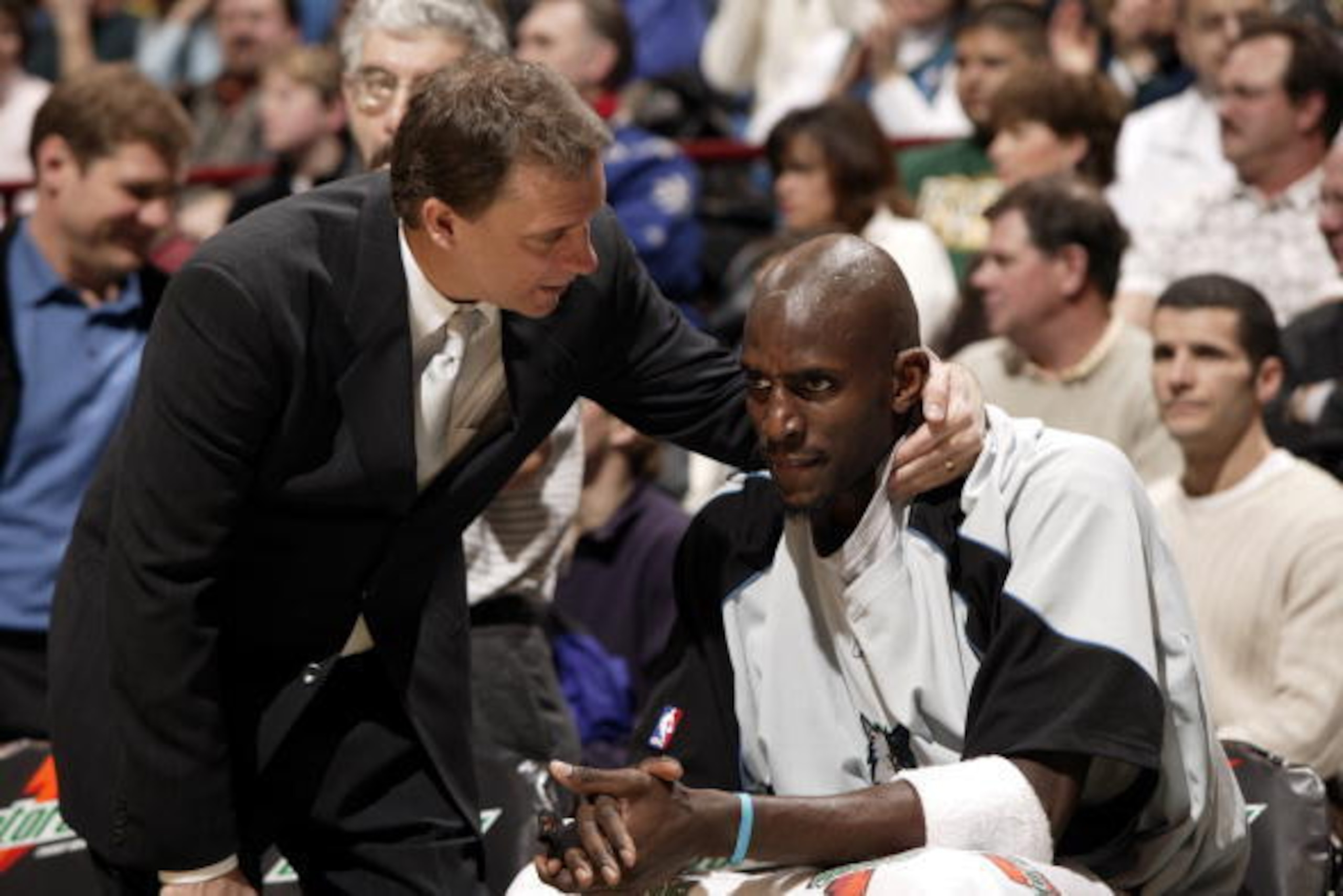
In time, Garnett became not only a reliable fulcrum for the Wolves but also one of the game's best players. With Saunders' gradual guidance, Garnett developed into an MVP and a perennial All-Star in Minnesota before he was traded to Doc Rivers' Boston Celtics, with whom he won a championship in 2008.
"I think people think you should just play the young guys," said Rivers, now the head coach of the Los Angeles Clippers. "But if you’re not teaching them how to win or be a winner, then what are you doing to him? He’s just getting minutes."
Andrew Wiggins and Zach LaVine are getting plenty of minutes with the Wolves these days. The two 19-year-olds, both products of the 2014 NBA draft, have seen their playing time increase, along with their responsibilities, since Minnesota lost its more reliable core to injury.
The results so far have been mixed. The T-Wolves have lost 15 of their first 19 games. Of those defeats, 10 have been by double digits, including four 20-plus-point poundings. According to NBA.com, only the Philadelphia 76ers have lost by more points per 100 possessions this season than the T-Wolves.
And against whom, pray tell, did the Sixers earn their first win of the season? The T-Wolves, of course.
"When it gets out of hand, it gets out of hand," veteran guard Mo Williams said after the T-Wolves' blowout loss to the Clippers in L.A. on Dec. 1. "It’s a snowball effect. We’re young and we’re learning how to play basketball, really."
It wasn't supposed to be this way, even after three-time All-Star Kevin Love officially found himself with LeBron James' revamped Cleveland Cavaliers this past summer.
Ricky Rubio seemed ready to put his contract disputes, poor shooting and previous partnership with Love behind him in pursuit of his own fulfillment as a wunderkind-turned-20-something passing savant. Nikola Pekovic was supposed to destroy defenders down low. Kevin Martin would be the veteran sharpshooter and all-around perimeter scorer.
Each has succumbed to a serious injury of some sort: Rubio's ankle, Martin's wrist and Pek's usual spate of sprains and sores.
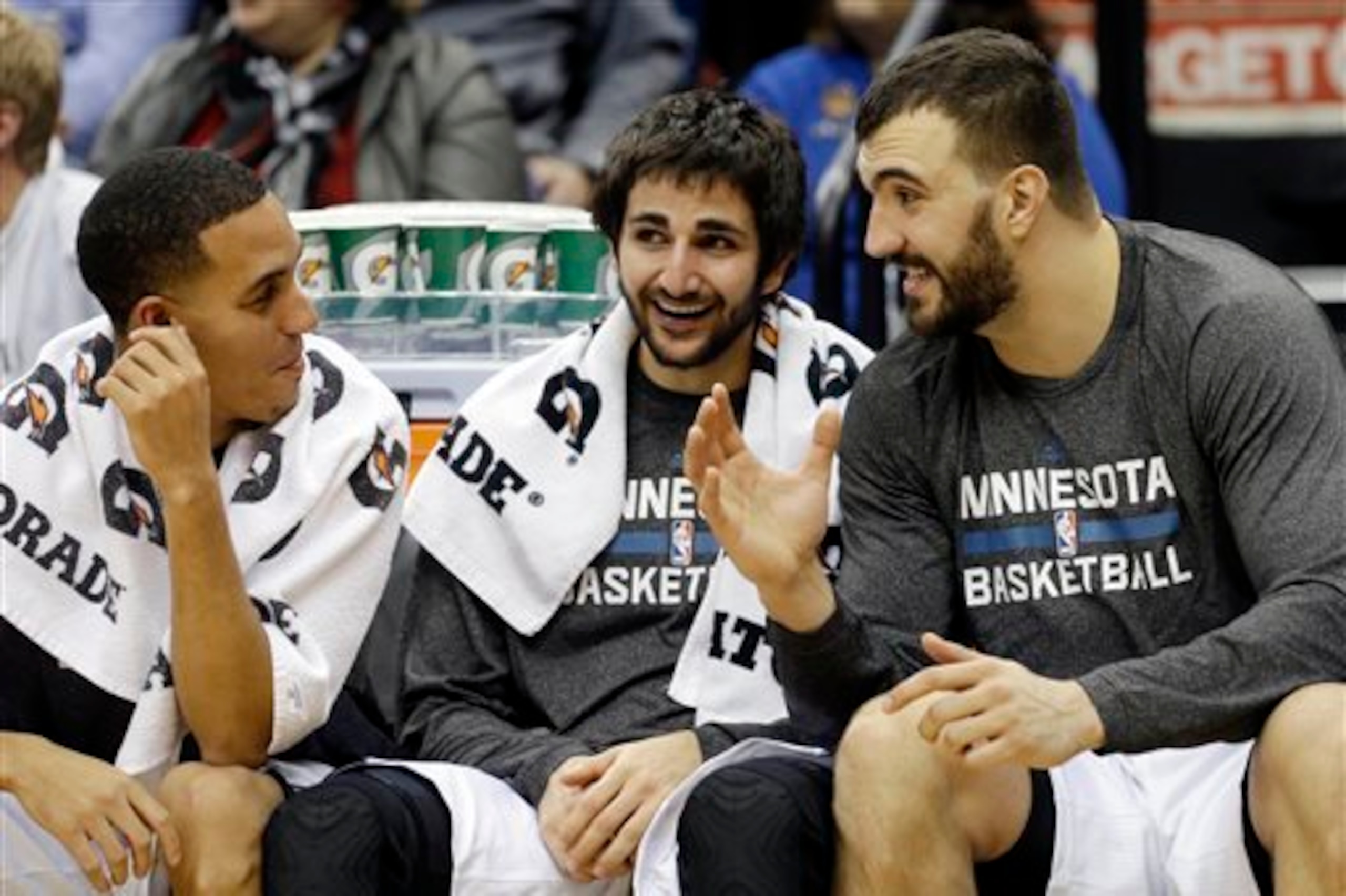
That's turned what was a 40-win team in 2013-14 into a bona fide bottom feeder in 2014-15, all the while thrusting Wiggins and LaVine to the fore—far sooner than anyone expected and, more importantly, well before their time.
With so many key players out, Saunders hasn't had the luxury to bring Wiggins and LaVine along slowly like he once did with Garnett. Wiggins has been a starter since the first game. LaVine was pressed into such duty in his third game but has since seen his leash tightened considerably.
And for good reason. To watch Wiggins and LaVine is to experience basketball at its most embryonic. The mistakes are there: the turnovers and the bad fouls and the confusion on defense and the contested, early-clock shots. The game is, in a sense, doing what it always does to rookies, but especially to exceedingly young ones: beating them down.
Against the battle-tested Clippers, Wiggins often seemed shaky and unsure of himself with the ball in his hands. His wiry 6'8" frame frequently failed to fend off grown men like Matt Barnes. His mind, however sharp, clearly lagged behind his quick feet when confronted with the craftiness of Chris Paul. He was a new sweater in the spin cycle, shedding lint with every revolution.
| Andrew Wiggins | 29 | 11.4 | 10.8 | 38.5% | 8.4 |
| Anthony Bennett | 12.8 | 4.2 | 4.3 | 35.6% | 6.9 |
| Anthony Davis | 28.8 | 13.5 | 10.6 | 51.6% | 21.7 |
| Kyrie Irving | 30.5 | 18.5 | 14.6 | 46.9% | 21.4 |
| John Wall | 37.8 | 16.4 | 14.1 | 40.9% | 15.8 |
"In the NBA, you’ve just really got to find your pace, find your spots on the floor where you can impact the game," Wiggins said.
Where Wiggins struggles to assert himself amid the chaos, LaVine is hardly shy—or not shy enough. He gambles with quick pull-up jumpers on offense and lunges on defense. According to NBA.com, 36.3 percent of LaVine's shots have come within the first nine seconds of the shot clock, and 49.2 percent of them have been pull-ups off the dribble.
| Minutes | Points | FGA | FG% | PER | |
| Zach LaVine | 22.6 | 8.9 | 7.8 | 43.5% | 10.5 |
| Kelly Olynyk | 20 | 8.7 | 7.2 | 46.6% | 15.2 |
| Kendall Marshall | 14.6 | 3.0 | 3.1 | 37.1% | 7.8 |
| Markieff Morris | 19.5 | 7.4 | 6.9 | 39.9% | 12.1 |
| Ed Davis | 24.6 | 7.7 | 5.7 | 57.6% | 15.8 |
Together, the self-proclaimed "Bounce Brothers" have combined to average 20.3 points on 40.4 percent shooting in 51.6 minutes of work.
Wiggins certainly has the raw tools to be special: his first step, his fluidity, his ability to float and fly and dart all around like a hummingbird, his bouncy step-back that doesn’t always go in—and sometimes doesn't even graze iron—but will once he really gets the hang of it.
"[Wiggins] doesn't know how athletic he really is yet, I don’t think," teammate Corey Brewer told Bleacher Report, "because he does some stuff and it’s like wow, it’s amazing. There’s a lot of great players like that."
With LaVine, it’s the juke. The swagger. The shooting range. That same hummingbird essence.
Those physical abilities have afforded Wiggins and LaVine the leeway to explode when given opportunities. Wiggins torched the up-and-coming Sacramento Kings for 29 points. LaVine piled up a game-high 28 off the bench against his favorite player (Kobe Bryant) and his favorite team (the Los Angeles Lakers) a few days prior to taking on the Clippers.
"I had a little chip on my shoulder," said LaVine of his breakout game against the Lakers. "That was my first time back, being that I came from UCLA. I wanted to put on a little bit of a show."
Minnesota's roster sports seven players in either their rookie or sophomore seasons. All but one (Glenn Robinson III) have sauntered their way into Saunders' regular rotation at some point through the first quarter of the current campaign.
"With their team, you never know who’s going to be the guy that night," Clippers guard J.J. Redick remarked. "They’re all young, they’re trying to find themselves in the league. I don’t know who will emerge as the most consistent guy, but they all showed flashes of talent and great play."
The onus is on Saunders, in his second go-round with the T-Wolves, to turn those flashes into consistent contributions, to mold man-children into actual men. Unlike his time as Garnett's mentor, though, Saunders now shoulders the added responsibility for bringing Wiggins and LaVine to Minnesota, as team president, and the praise or blame that will entail.
Succeeding under these circumstances requires striking a tenuous balance between experience and exposure, between past, present and future.
"It’s a very fine line," added Rivers, who walked it with a rookie Rajon Rondo in 2006-07. "And for the coach, it’s a brutal line, because if you start playing the young guy over a veteran and the veteran is playing better, you lose a lot of respect in your locker room."
Saunders seems well aware of that line. He's danced around it for nearly two decades in the NBA, from Minnesota to Detroit to Washington and back to Minnesota.
"You can learn enough sitting on the bench as you can on the floor sometimes," Saunders went on. "I’m a firm believer that you get what you earn. We’re not going to give you something, so that’s how we approach it.
"If we have to play other guys more minutes because they can’t learn, then they’ll eventually learn the right way to play."
Josh Martin covers the NBA for Bleacher Report. Follow him on Twitter.

.jpg?w=2560 "Report: Texans Trade for Pats WR")
.jpg?w=2560 "Source: Freedom, White Not Eligible for WNBA Draft (AP)")
.png?w=2560 "Latest MLB Power Rankings 📊")
.jpg?w=2560 "Biggest Rumors Ahead of Roster Cuts 👀")
.jpg?w=2560 "Shedeur's Reaction to Browns' QB Decision")
.jpg?w=2560 "WWE Raw Live Grades 🔠")
.jpg?w=2560 "Money Holding Donald Decision")