

Houston Rockets Have Quietly Become a Defensive Team
The Houston Rockets became one of the best defenses in the NBA while no one was watching. And while it’s easy to dismiss that as just early-season anomaly, there are valid basketball reasons to suggest it’s going to be the same at the end of the year.
The change isn't as dramatic as some would think. Failures in late game situations and James Harden's deficiencies made things seem worse than they really were. Per NBA.com/Stats, they were 12th in defensive rating last season.
Increased focus, personnel changes and schematic improvements are all reasons why Houston suddenly is one of the league’s elite stoppers. In fact, per , it has the best defense in basketball.
TOP NEWS

Yao Ming Next to Şengün 😅
AJ, Trae Continue to Turn Heads with Wizards 🧙♂️
Kings Expected to Start Ben
When the top-ranked offense, belonging to the Dallas Mavericks, came calling on Nov. 22, it was a test of strength against strength. And the Rockets, sans Dwight Howard, passed with flying colors, holding the Mavericks to just 92 points. The game was a testament to just how far the Rockets have come and highlighted Houston’s improvements.
Increased Focus
If you talk to anybody who knows anything about the Rockets, one of the first things that is going to come up is general manager Daryl Morey and his philosophy of basketball, which emphasizes scoring inside the restricted area and outside the three-point line.
While that philosophy has famously been applied to the Rockets offense, we can now see it being placed on the defense. Per Basketball-Reference.com, only the San Antonio Spurs give up a lower field-goal percentage from deep, and Houston is also sixth-best at defending the rim.
The first reason for that is Kevin McHale has helped everyone to focus. Consistent effort really does help.
Patrick Beverley, who was second-team All-Defensive team, leads the way here. He’s one of those guys you love if he’s on your team and hate if he’s on another one. He plays aggressively, both physically and verbally. A game rarely goes by without Beverley getting under the opposing point guard’s skin.
He told Bleacher Report’s Jared Zwelling last year that he does more than just play with a chip on his shoulder:
"I think that some people call it a chip. Mine was more like a mountain. I just had so much aggression and so much built up and so much anger, especially because many other teams passed up on me.
I just wanted to go out there and every single night just make it hard for the opponent to dribble the ball up the court—be fearless out there and do whatever it takes to try to put my team in a position to win basketball games.
"
The rest of the defense—even James Harden—has “chipped in” and is helping to carry the mountain now. The entire unit plays aggressively, closing out hard, running back in transition, making the effort to recover quickly when players are beaten and generally doing all the little things that make the difference on defense.
Personnel Changes
The biggest change on defense is the upgrade from Chandler Parsons to Trevor Ariza. Having two elite perimeter defenders is a huge asset. I describe in more detail how much difference Ariza makes here, but for this article, I want to emphasize who’s not there.
The Rockets don’t have Parsons, an average defender, or Jeremy Lin, a below-average defender.
And that’s putting things nicely. When Harden was sandwiched between those two, it only served to magnify his weaknesses.
Harden has poor lateral quickness, so he’s just not cut out to stop penetration from elite ball-handlers. That was exacerbated by a lack of interest in doing so, and that made him a “star” on YouTube, as a montage highlighting some truly awful defense was seen by millions.
Viral videos notwithstanding, he was hardly the only problem.
Last year, six of the seven worst three-man lineups with 500 minutes played featured Parsons, according to Basketball-Reference.com. Four of the six worst featured Lin. Two of the four worst had both Lin and Parsons. The sixth-worst lineup contained both of them along with Harden.
Surprisingly, the two best lineups included Harden, and the best trio with 1,000 minutes played was Beverley, Harden and Howard.
In other words, Harden showed he could be hidden in a good defensive lineup, but only if the right guys were around him. A big part of the upgrade in their defense was addition by subtraction. Jettisoning Parsons and Lin made the defense better.
Adding Ariza helped even more.
And while Omer Asik was a tough loss to take, Tarik Black, the undrafted rookie from Kansas, has done shockingly well as the backup 5. No, he’s not Asik, but as replacement parts go, you can’t do much better.
Schematic Changes
I hear people say that defense is mostly, “Just about effort,” and I groan. Of course, it requires effort, but so does offense. It’s the “just” part I take issue with.
Many times, “just effort” results in what I like to call “Chihuahua defense.” That’s when you have a guy jumping around all over the place, exhibiting a ton of energy and accomplishing nothing. To have a great defense requires more than just effort. It means trying to do the right things.
And that presupposes there is a “right thing” to do. That mandates a good scheme, and that’s something the Rockets have improved. The primary way they’ve done that is utilize—and this is not a typo—Harden’s help defense.
The Rockets are using him differently—evenly effectively. Rather than have him operate primarily like a traditional 2, they have him frequently dropping down and operating out of the low post, like this:

Harden’s lack of lateral quickness isn’t an issue here, so the deficiency is hidden. On the other hand, he does have good straight-ahead speed which enables him to close out quickly and defend the three, which he has done well. Opponents are shooting just 25.5 percent from deep against him, 8.9 percent below their normal rates.
He’s also much bigger and stronger than his 6’4” height may suggest. In fact, per Draft Express, his 6’10.75” wingspan is the same as seven-footer Cody Zeller’s. He's able to use that strength and length to make defensive plays, such as blocking shots, robbing the passing lane and grabbing misses. Believe it or not, only Anthony Davis has more steals, blocks and defensive rebounds than Harden.
Harden is also a powerful 220 pounds with great upper-body strength. As a result he’s able to defend the low post. That means the area of court Harden can be responsible for, especially on the weak side.
With Harden able to virtually take care of the entire weak side, it allows the Rockets to overload the strong side and keep the ball out of the paint.
When opponents try to exploit Harden being all alone, as he is here, he is able to meet the challenge. Here, the Mavericks kick it out to Monta Ellis, but Harden closes hard and distracts Ellis’ shot enough to force the miss.
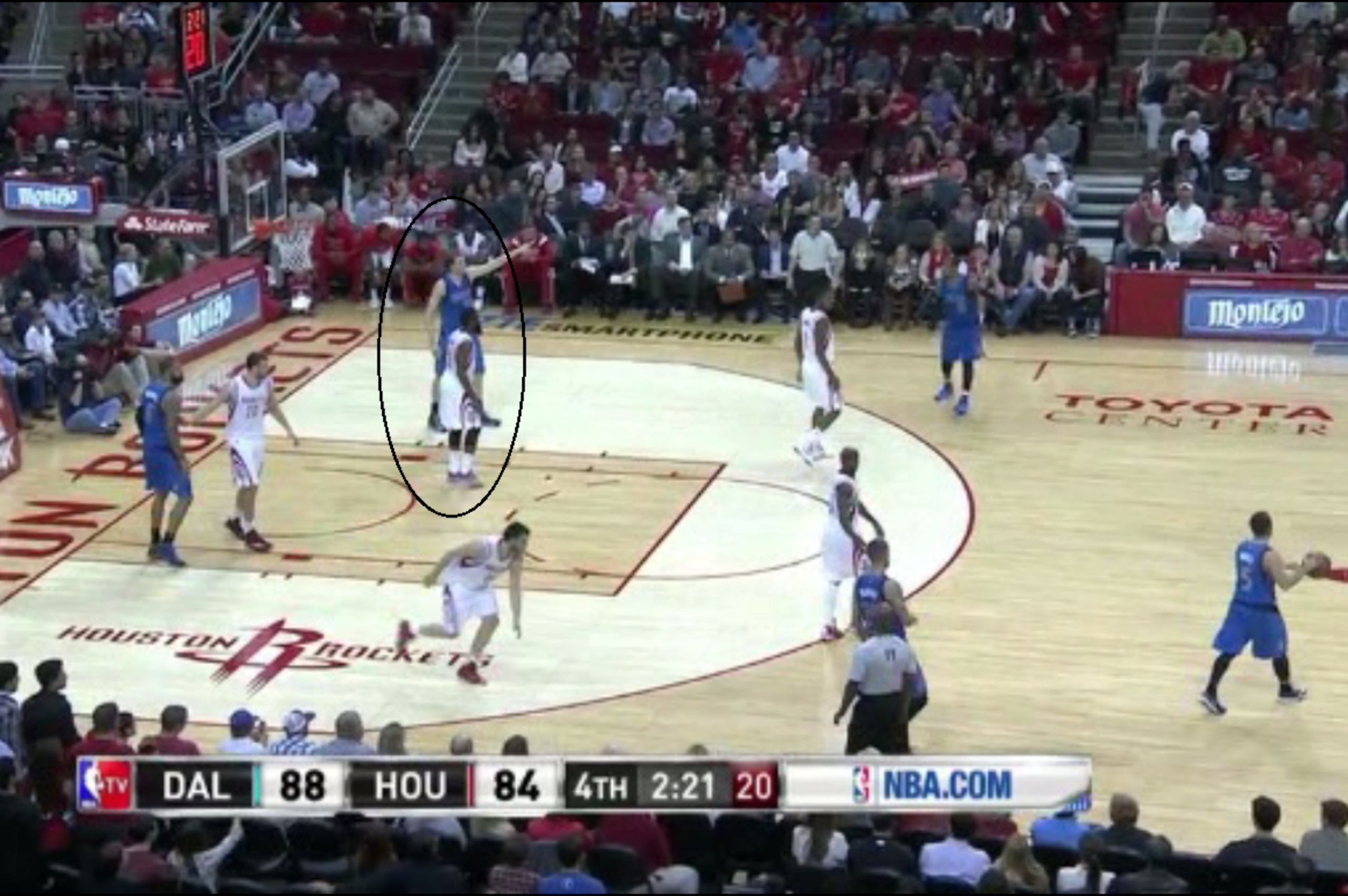
Likewise, when they try and exploit him in the post, he holds his own. Here he is pitted against Dirk Nowitzki, who’s all like, “Wir haben eine Maus im Haus” which is “We have a mouse in the house” in German.
Nowitzki backs down Harden a little bit, but Harden bodies up, forcing Nowitzki to shoot a contested jumper, which clanks harmlessly off the rim.
Because Harden takes care of the weak side, that allows Beverley and Ariza to seal off the rest of the perimeter. The pair are both exquisite at keeping the ball-handler in front of them. Beverley only allows 27.9 percent of the shots against him to come from within six feet of the rim, while 55.8 percent come from at least 15 feet. With Ariza, those numbers are even better: 21.0 percent and 61.0 percent.
Then Howard mans the middle, and he does so extremely well. Opponents within six feet of the rim shoot just 50 percent against Howard, a full five percent below their normal rate.
It leaves the power forward, be it Terrence Jones, Donatas Motiejunas or Kostas Papanikolaou to provide help defense. That can mean running out to trap the ball-handler, staying home to defend the post-up or frequently diverting the shot from the weak side. This actually works well because all their power forwards are athletic and long.
The brilliance of Houston’s scheme is it that uses the things its weaker defenders do well to fill in the few holes the stronger ones leave open. As a result, the Rockets keep the most efficient areas of the court secured.
Now they just need to get their offense back to where it was, and they’ll be a dangerous team come playoff time.
Stats for the is article were obtained from NBA.com/Stats and Basketball-Reference.com. They are current through games of Nov. 23.
.jpg?w=2560 "Grading WWE Raw 🔠")
.png?w=2560 "Allen's BRUTAL 1H Stats 🫤")
.jpg?w=2560 "Aaron Donald Fights Bills OL😳")