Packers vs. Vikings: Breaking Down Minnesota's Game Plan
The beleaguered Minnesota Vikings return home on Sunday for another divisional showdown against the NFL’s hottest team, the Green Bay Packers.
Aaron Rodgers and the Packers offense have been scoring points at will as of late, rattling off six wins in their last seven games. Rodgers has an incredible 1,074 passing yards over the last three games. The offense as a whole has gone over the 50-point mark in each of its last two, so Mike Zimmer and the Minnesota defense may be in for a sour treat.
Offensively, the Vikings will look to get back on track after an absolute clown show in Chicago. These are the keys for Minnesota to go toe-to-toe with Green Bay on Sunday, starting with the offensive side of the ball.
.jpg?w=2560 "49ers Eagles Football")
.jpg?w=2560 "Jets Dolphins Football")
Tailor to Teddy
The plug-and-play experiment with Teddy Bridgewater in Norv Turner’s offense is getting stale. Bridgewater lacks the sheer power to drive the ball down the field into tight windows, something Turner’s offense needs from him in its current state. Even worse is that the pieces around Bridgewater are falling apart and may be an even worse fit for the offense, especially at the receiver position.
Defense’s ability to generate pressure without blitzes is also causing problems, because Bridgewater stares down the field into thicker coverage, often with two deep safeties, which leads him to checkdowns over and over.
Instead of trying to bombard coverages with various iterations of four verticals, Turner and the Vikings need to tailor the attack to Bridgewater’s strengths. Those strengths are pocket manipulation and making short to intermediate throws over the middle of the field.
When routes exploit holes in coverage at the 10- to 15-yard level, Bridgewater excels at locating the soft spots and releasing quickly.
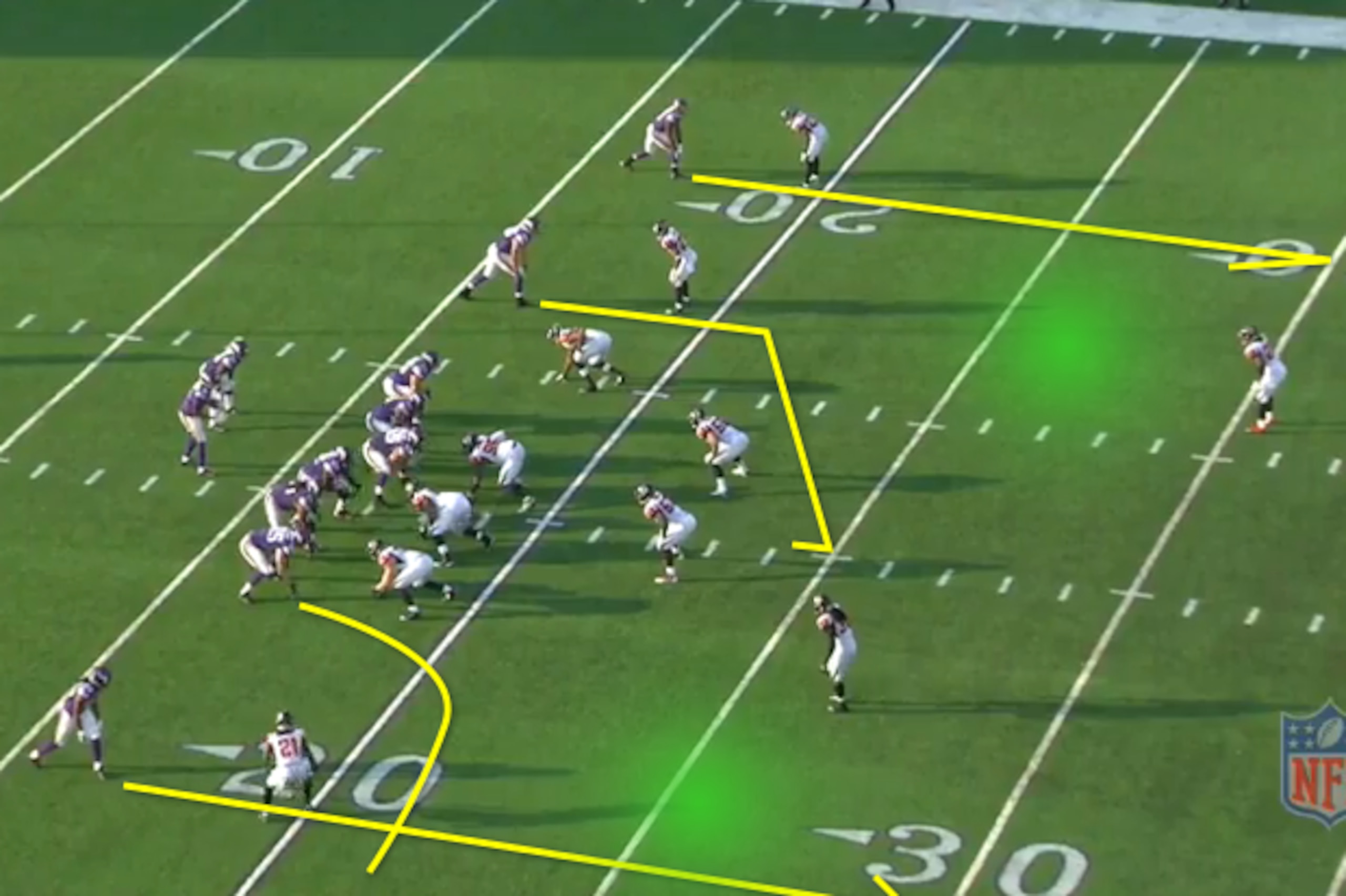
The downfield reads Turner prefers and so heavily utilizes ask much more of Bridgewater as a pure thrower but also ask much more of an offensive line that has not been up to the task, especially on the rookie’s blind side.
Turner will continue to attack defenses with vertical routes. His offense is built around these concepts, and Bridgewater has now been well-schooled in them. Making slight adaptations to aid a struggling unit is sorely needed at this point, though.
More Charles Johnson
Ever since the Vikings plucked him off the Cleveland Browns’ practice squad, wide receiver Charles Johnson has slowly grown into a viable target for Bridgewater. His performance hit new highs in Chicago with six catches for 87 yards, including a crucial fourth-down conversion in the fourth quarter.
Johnson provides a bigger target that Minnesota lacks otherwise (6’2”, 215 lbs) and is also a burner in terms of straight-line speed. An increased role is in order.
The Vikings have slowly integrated him into the offense from week to week.
| Week 5 | Week 6 | Week 7 | Week 8 | Week 9 | Week 11 |
| 19% | 19% | 1% | 29% | 27% | 53% |
Last Sunday was his first opportunity with more than 50 percent of snaps, per Pro Football Focus (subscription required), and he rewarded the Vikings handsomely. That figure should jump again in Week 12, especially if the Vikings end up chasing the game from behind.
Bridgewater has shown an affinity for Johnson in throws to intermediate areas of the field. More reps for Johnson means the rookie quarterback has more options to throw to that he trusts will be open. Johnson has been nothing if not open.
Sprinkle in Ben Tate
As reported by ESPN.com, the Vikings claimed former Browns running back Ben Tate on Wednesday, aiming to aid a group of backs that has failed to make a significant impact of late.
Expectations should be tempered with Tate. His recent history suggests his best days as an NFL back may be behind him. Justin Higdon of DraftBrowns.com quantifies his struggles in Cleveland:
"Ben Tate's carries the last 5 weeks went down 16,15,10,10 and 2. He totaled an almost impossible 53 carries for 90 yards (1.7 per carry)
— Justin Higdon (@afc2nfc) November 19, 2014"
Hopefully a change of scenery does Tate some good, though Cleveland was supposed to be that in the first place.
If Tate is active on Sunday, rushing him into double-digit carries would be unwise. The Vikings can still rely on Jerick McKinnon as an early-down option and Matt Asiata as a third-down and short-yardage back. Tate might have a role to play in a rotation through, providing fresh legs and a specific skill set the Vikings can use.
Tate was at his most effective as an NFL player in a lesser role with the Houston Texans, spelling Arian Foster in an offensive scheme that centered on the zone-blocking scheme. Turner utilizes similar concepts, so Tate has rotational value to the Vikings on early downs. As long as he has a baseline understanding of responsibilities in the offense, Tate can be a plug-and-play back in the right role from day one.
Corral Lacy
The Vikings defense was ripped to shreds by Green Bay’s rushing attack in Week 5, especially when Eddie Lacy toted the rock. He scampered for 108 rushing yards on 13 attempts, plunging into the end zone twice. The performance still stands as highs for him in rushing yards, touchdowns and yards per carry in 2014.
Inability to disrupt the backfield with any kind of penetration and inability to get off blocks undid the Minnesota front seven. Lacy gashed the Vikings over and over in the zone-blocking scheme, taking advantage of gaping holes.

The first example is an inside zone off the left side. That leaves each Packers blocker with a one-one-one task, putting the onus on Minnesota defenders to beat the blocks and make the play. They all failed.
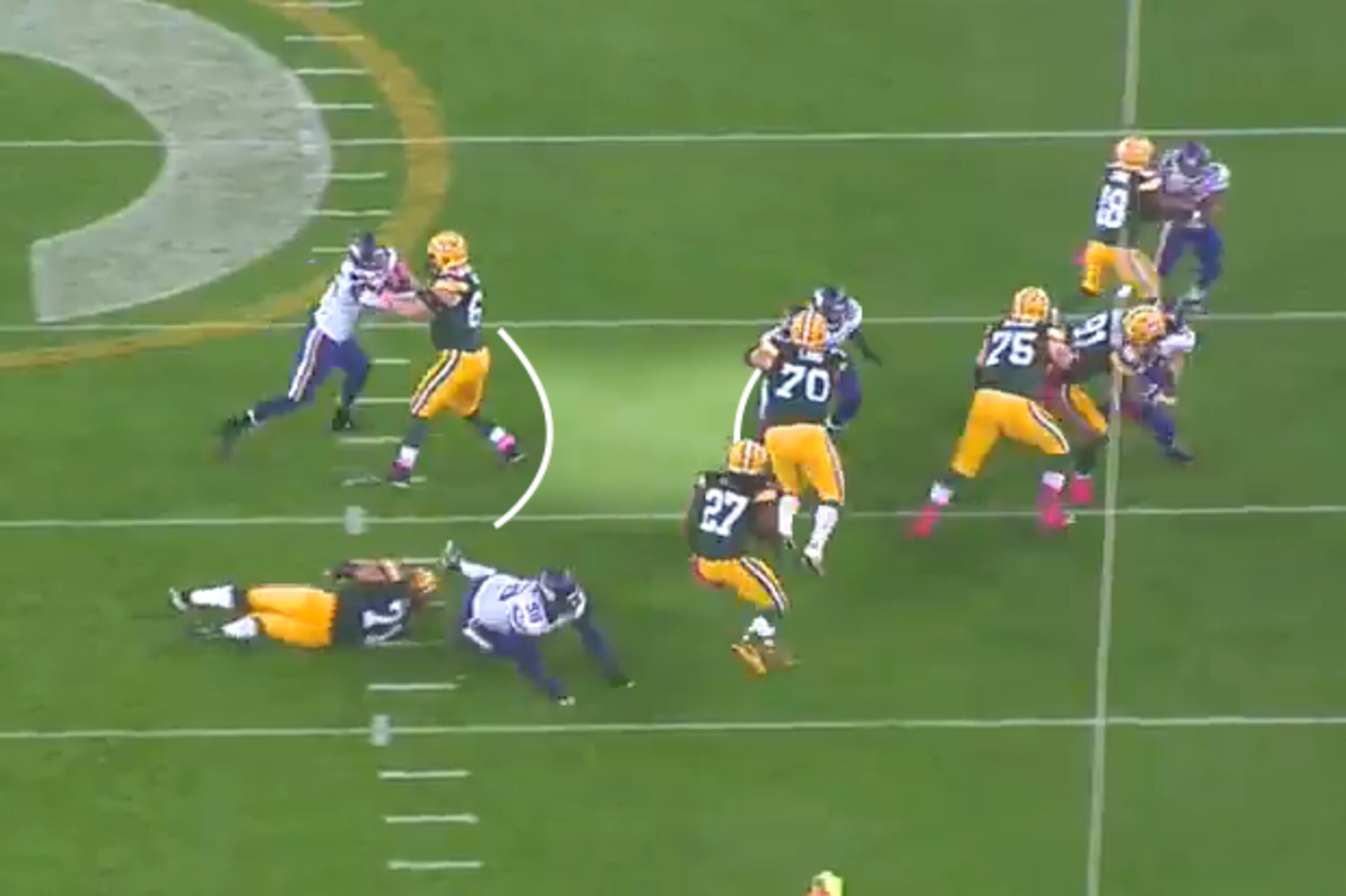
Green Bay varies its point of attack with outside zones, which gets blockers moving laterally but also up the field. Linval Joseph gets chopped down too easily here, freeing up Lacy to take advantage of more sticky blocking and another truck-sized hole.
Failings fell on the shoulders of Joseph and Sharrif Floyd on multiple occasions. The defensive tackles have a big responsibility in the way they handle zone blocks. Failure to come off the ball with enough force to reset the line of scrimmage often gets tackles turned. That leaves linebackers exposed to blockers as well, which is why you see Anthony Barr plastered by the center in the second example.
The trick is to fire through gaps or into blockers with hands out and eyes up. Lacy and James Starks make their cuts based on positioning of blockers, so affecting the backfield and locating the ball-carrier consistently is the way to shut it down.
No secret recipe is needed. The Vikings must control the line of scrimmage, and when they get to Lacy, more than one defender needs to arrive.
Rush or Bust
Minnesota’s pass rush must come to play on Sunday after a disappointing showing against Chicago. If it doesn’t, expect the defense to hemorrhage big plays through the air.
This should sound familiar. Despite sketchy coverage, delayed pass rush was the biggest reason Rodgers picked apart the Vikings defense in Week 5, especially when he found Jordy Nelson on a 66-yard bomb in the first quarter.
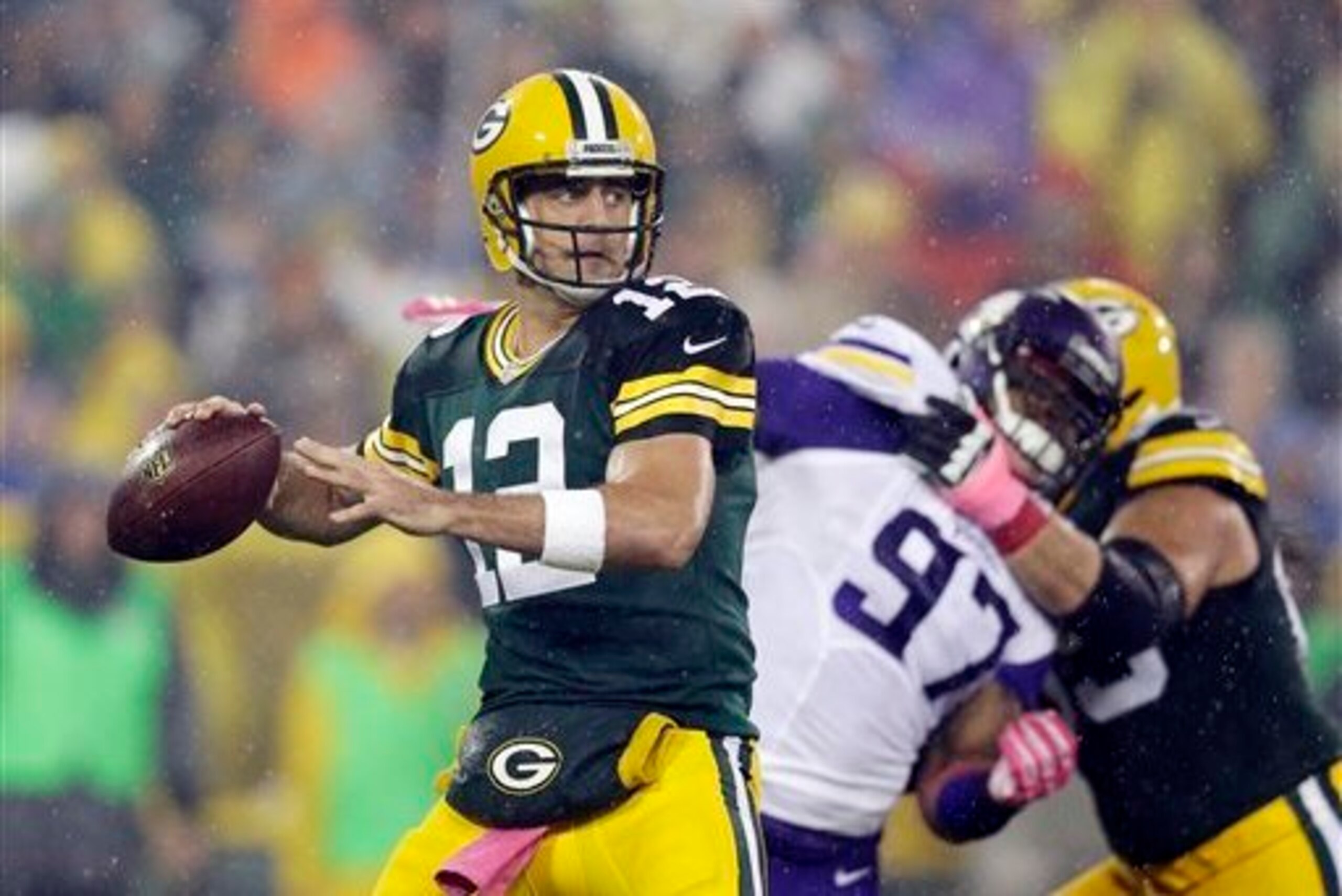
By my count, Rodgers took between 4.5 and 4.6 seconds to throw the ball on the big play. That’s an eternity in the mental clock of a QB. According to Pro Football Focus premium statistics (subscription required), the average sack of Rodgers has occurred in 3.77 seconds this year, almost a whole second quicker than he took to release on his big play from Week 5.
With Rodgers’ cannon for an arm and his improvisational ability, delayed pass rush will lead directly to big plays. Coverage can only hold out so long.
Everson Griffen and Brian Robison carry the torch for the entire rush unit. Each and every rush must be to-the-whistle with the way Rodgers likes to freelance and let his receivers ad lib down the field. If Griffen and Robison are continuously coming free to force the ball out of Rodgers’ hands quickly, the Vikings can count it as a success.
Technique Wins
Green Bay boasts a highly accomplished group of wide receivers, headlined by Nelson and Randall Cobb. In Xavier Rhodes, Captain Munnerlyn and Josh Robinson, the Vikings don’t match up well on paper. Technically sound cornerback play can be a great equalizer.
When Minnesota aligns with a single safety over the top or are in “quarters” coverage with two safeties deep, Rodgers will take his shots because he gets one-one-one looks on the perimeter.
Josh Robinson did an perfect job defending a go route on the sideline against Green Bay in Week 5. The technique he utilized against the route in this example is exactly the type of technique that must be replicated by Vikings cornerbacks this week.
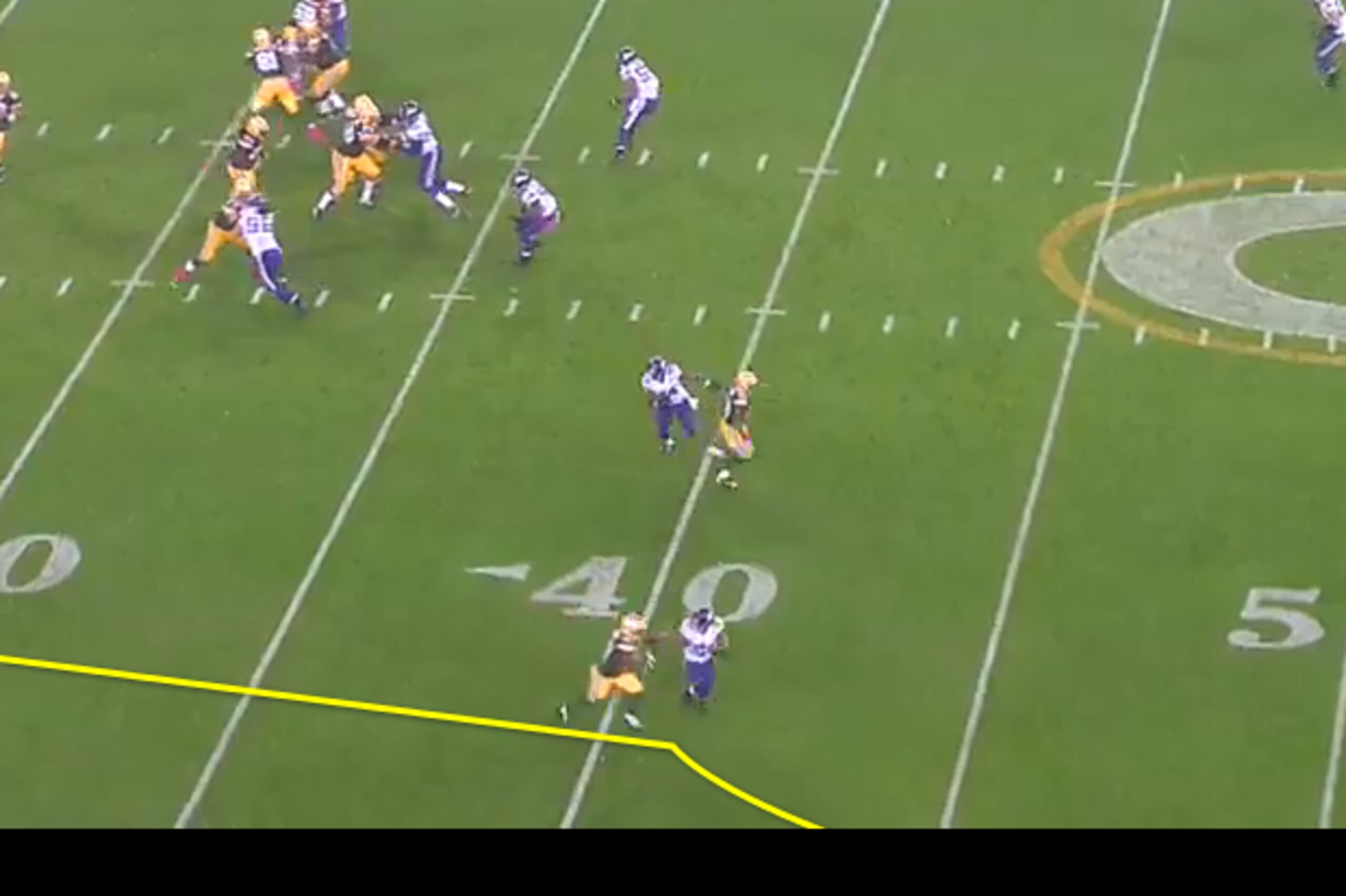
After taking his initial steps backward, Robinson turns his hips and faces toward the receiver early in the route. Then at about 10 yards down the field, he fires a quick jab with his right hand, as seen in this screenshot. While technically this contact is illegal, a quick, subtle touch rarely gets flagged and can disrupt a receiver’s rhythm just enough for the CB to get to full speed and run with him.
Also notice Robinson’s positioning. He is on top of the route when he makes his contact, not in a position that makes him grab cloth.
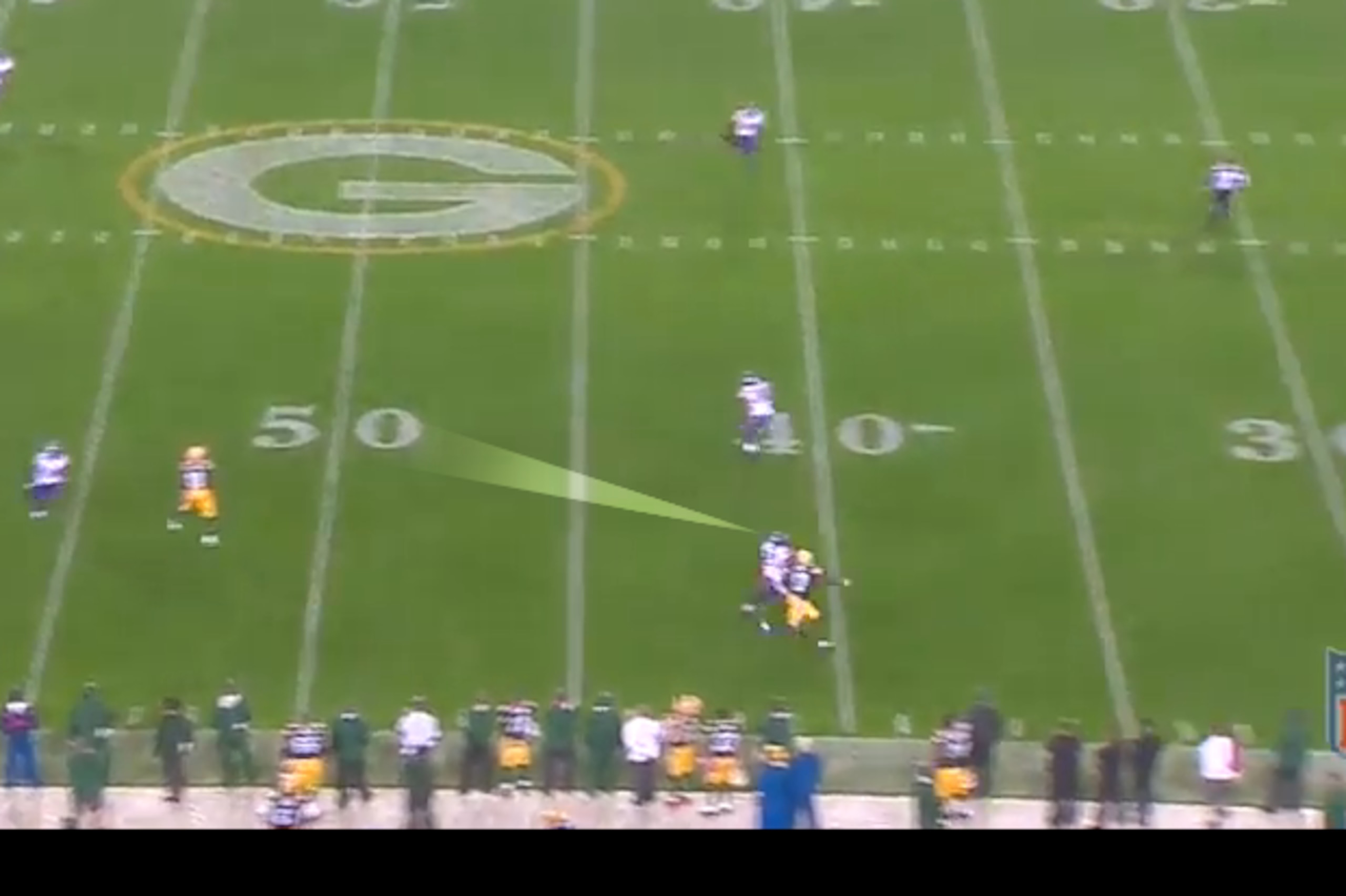
Locating the ball is the last step and it depends on the positioning of the CB. Robinson has stuck himself right to the inside hip of the receiver, enabling him to turn and find the ball while feeling the WR with his right hand.
Rodgers throws deep on Robinson here, but his pass falls harmlessly to the ground. Everything the CB did to defend the deep route was textbook fundamentals for the position. Those are what will give Vikings defenders a chance against the likes of Nelson, Cobb and any other receiver Green Bay lets fly down the field.
Make Aggressive Decisions
The final key to a Vikings victory comes from the department of obvious information. To beat the Packers, you better score points and then score more points after that.
Here are the records of the Packers’ opponents dating back to the beginning of the 2012 season with Rodgers starting, including playoff games. They are sorted by points scored to emphasize how many points it takes to expect a victory over Rodgers and the Packers.
| Points Scored | Opponent Record |
| 0-10 | 0-5 |
| 11-19 | 2-14 |
| 20-29 | 1-5 |
| 30+ | 9-1 |
The average score of the 12 opponents who beat Green Bay is 32. Nine of those needed 30 or more. In fact, of opponents that scored 30 points against a Rodgers-led Packers team, only a single team lost. That was the 2013 Vikings in their 44-31 loss at Mall of America Field.
What does that mean for the Vikings?
Mike Zimmer will be forced to make some risky decisions to seek maximum points, such as going for it on 4th-and-short instead of settling for field goals or punts. The Vikings offense will only have so many drives to score points, something they haven’t done all that efficiently of late, so extra steps may need to be taken in expectation that Minnesota needs to score at least 28 points to win.
If it seems like a lot has to go right for the Vikings to snatch a victory on Sunday, that’s because a lot does have to go right. It could happen, though. At the very least, Minnesota must show improvement from last week’s debacle against the Chicago Bears and Week 5’s embarrassment against the Packers.
Statistics accumulated via ESPN.com unless noted otherwise.
.jpg?w=2560 "Top 5 Running Backs Football")
.png?w=2560 "Ranking the Best Shooters of All Time 🎯")

.png?w=2560 "Lane's Son Trolls His QB Play 😭")
.jpg?w=2560 "Lindor Trade Packages 📦")