Andre Ellington Is the NFL's Next Great Pass-Catching Running Back
When we talk about speed in football, we talk about being fast and being quick.
The former is top-end speed and the maximum velocity a player is capable of achieving at his size. The latter is acceleration and a player’s ability to dart back and forth in a confined space.
Arizona Cardinals running back Andre Ellington is fast and quick. He can quickly get by you and run far away fast.
.jpg?w=2560 "Packers Vikings Football")

Through six games, everyone’s favorite small guy who makes much larger defenders flail and flop has 653 all-purpose yards for the NFC West division leaders for an average of 108.8 yards per game. Only four Cardinals players since 1960 have accumulated more yards from scrimmage than Ellington over the first six games of a season, according to The Arizona Republic (dating back to the franchise’s former home in St. Louis).
So he’s already historically talented, and in his second season Ellington is quickly becoming a multifaceted weapon who can be used creatively. That ascent was anticipated when he averaged 5.5 yards per carry last year and had 11 gains for 20-plus yards (including an 80-yard run in Week 8) on only 157 touches.
And now powered by that speed and quickness, he’s rising to become one of the league’s best pass-catching running backs.
Ellington has caught 25 passes for 260 receiving yards this season. That overall yardage puts him fourth among all running backs, and his 10.4 yards per catch is second behind only Washington Redskins RB Roy Helu.
| Matt Forte | 52 | 436 | 8.4 |
| Le'Veon Bell | 36 | 339 | 9.4 |
| Fred Jackson | 33 | 261 | 7.9 |
| Andre Ellington | 25 | 260 | 10.4 |
| Roy Helu | 20 | 249 | 12.5 |
In his second season and his first with consistent touches, Ellington finds himself among a group of far more established pass-catchers out of the backfield. While watching him weave and cut effortlessly, it’s easy to forget he was the Cardinals’ primary running back in only one game last year.
His production even in that limited role led to Cardinals head coach Bruce Arians sticking his hand into that cool dad hat he’s always wearing and pulling out a number range: 25-30.
That’s how many touches he said Ellington should get per game this season while speaking to Josh Weinfuss of ESPN.com last May. At the time those digits seemed downright comical given Ellington’s size (more on that in a minute) and the reality that any team wanting to keep a lead back in one piece should steer far clear of Arians' estimate.
Even on the low end, 25 touches weekly still ends in 400 over the course of a season. Last year Philadelphia Eagles running back LeSean McCoy led the league with 366 touches, a per-game average of 22.8.
Ellington’s workload so far in 2014 hasn’t quite met that initial Arians projection, but it’s not far off either. He’s getting 21.7 touches per game, managing the physical abuse through plenty of less punishing work as a receiver either out of the backfield, split wide or pretty much wherever Arians pleases.
He’s the tiniest huge workhorse you’ll ever see.
Ellington has logged only one game this season with more than 20 carries, which came in Week 7 in a win over the Oakland Raiders (24 carries total). Any effort to minimize the pounding he takes as a runner works out nicely, because Ellington in space as a receiver is a frightening sight for any defender.
As we approach midseason, he’s averaging just over four catches per game and 43.3 receiving yards, and his high-volume usage as a pass-catcher has led to an even more impressive pace.
| Jamaal Charles (2013) | 70 | 693 |
| Danny Woodhead (2013) | 76 | 605 |
| Darren Sproles (2013) | 71 | 604 |
| Andre Ellington (2014 pace) | 66 | 692 |
In his short NFL career so far with limited use in his rookie season (only one start), Ellington already has 64 career catches, four of which have resulted in gains of 30-plus yards.
He belongs in the same pass-catching conversation as McCoy and Kansas City Chiefs running back Jamaal Charles because of his elusiveness, which was on full display during Sunday’s win over the Raiders. A 37-yard reception which should have been at most a five-yard gain showed how easily he can turn a routine play into something spectacular.
There was nothing unique about this play design. Ellington is the focus, but it’s not a screen where he has to set up and read his blockers. He has no blockers, and although the wide receiver in front of him (John Brown) impedes Raiders safety Usama Young momentarily, that was more happenstance than intent. Brown ran a route and wasn’t downfield purely as a blocking body.

It was a 1st-and-10 play from the Cardinals’ own 26-yard line. At worst it would have resulted in a fine gain on first down, maybe getting half of the required distance to move the chains. But with Ellington there’s always a possibility for more.
He was one of five receivers spread out with quarterback Carson Palmer in shotgun. Starting from the slot to Palmer’s right, Ellington ran a simple short route to the flat. When he caught the ball, he was a mere three yards downfield.
Usually the end of this play is a standard thud: The running back chugs ahead for a few more yards, leaves a dust cloud and then lines up again after making sure all of his body parts are still in the proper position.
That’s especially true when Ellington’s view looked like this after he turned around:
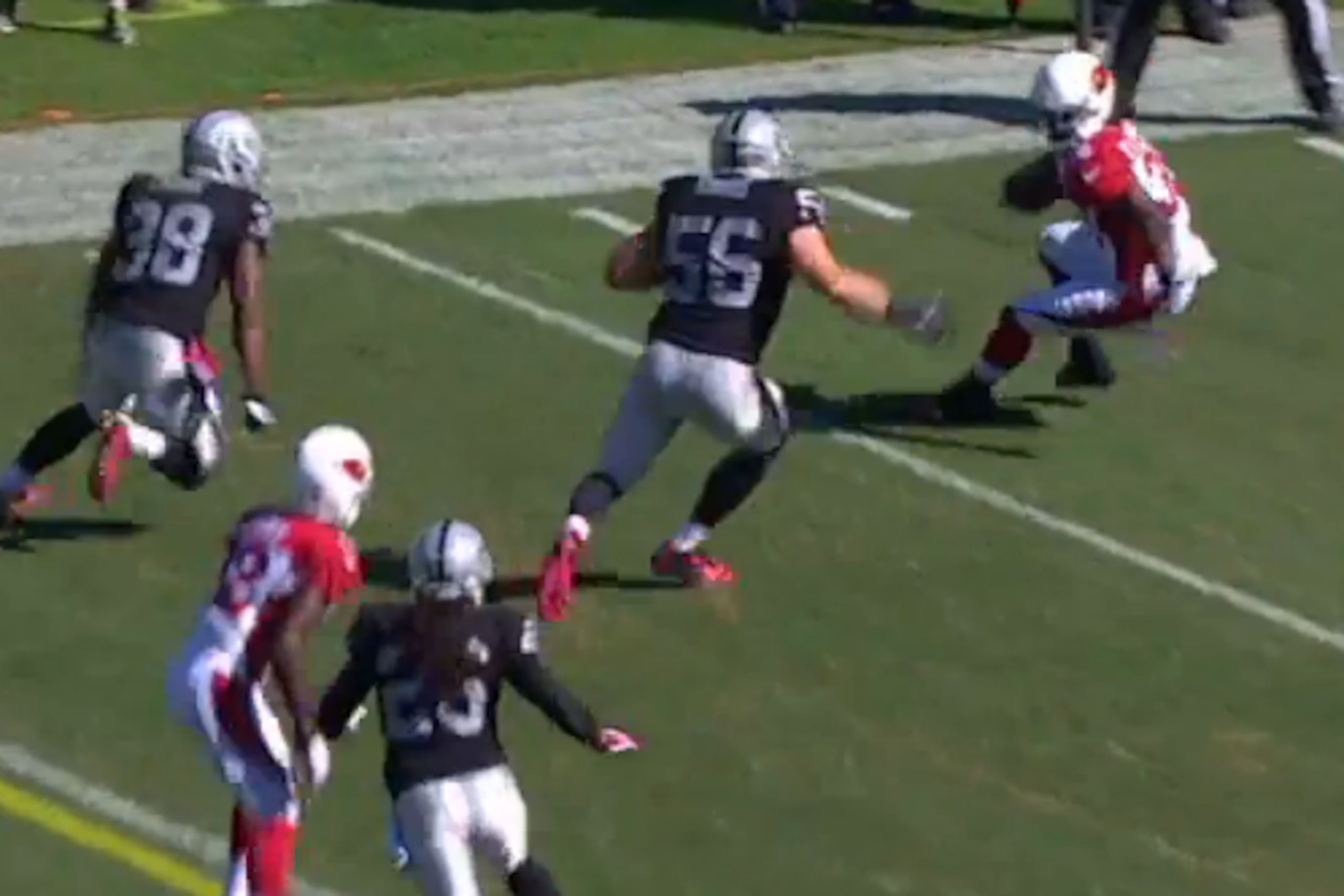
Seeing two large men one yard away immediately after a catch—and another defender behind closing in—typically means game over. But then Ellington planted, changed direction in a beat and left two would-be tacklers in a heap with a third joining their pile shortly.
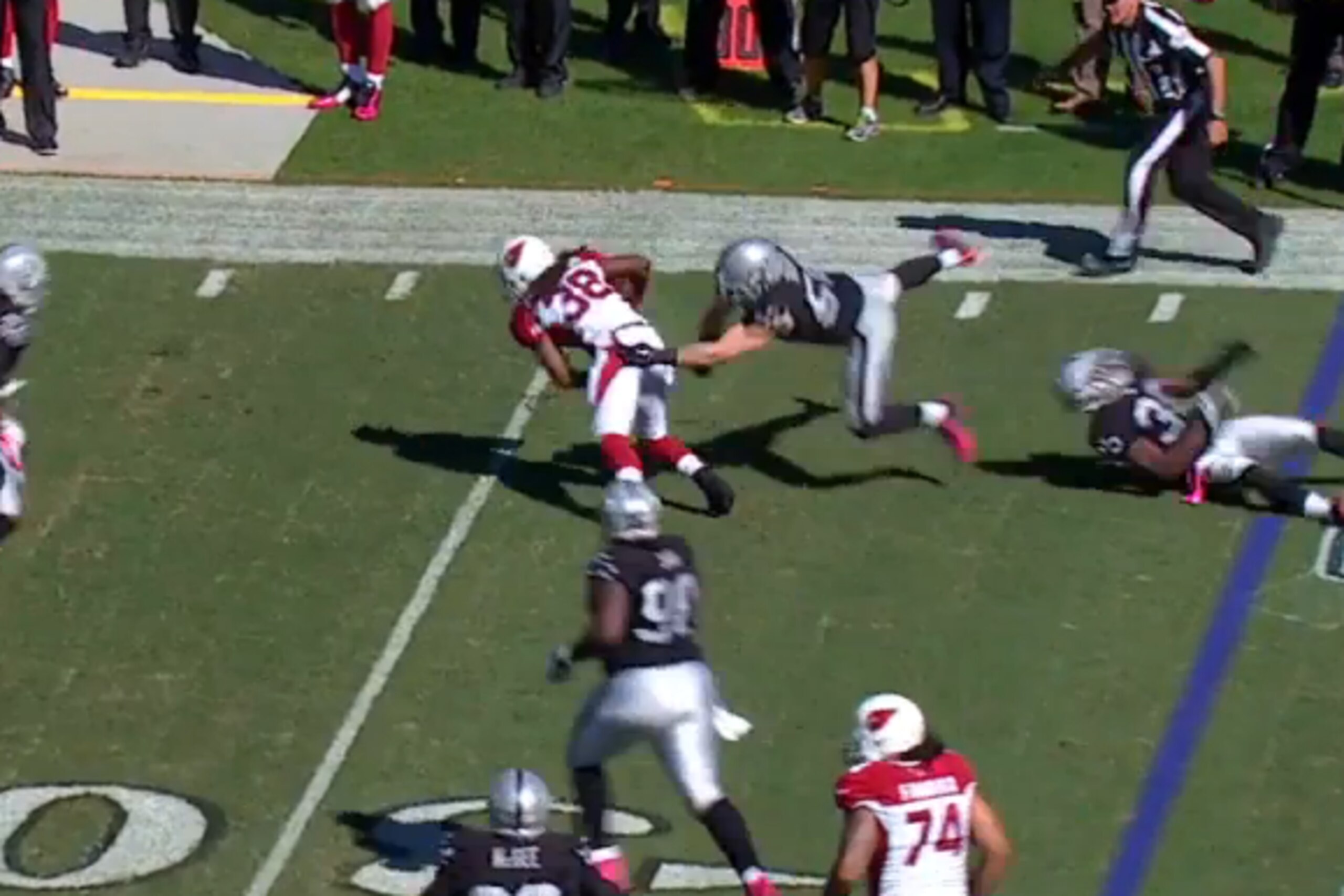
Yes, Raiders linebacker Miles Burris took an angle that was (ahem) less than desirable. But at minimum he was still in position to impede most running backs long enough for help to arrive. Ellington isn’t most running backs because he often achieves a buttered banana level of slipperiness.
He’s forced five missed tackles as a receiver this season, according to Pro Football Focus (subscription required), the sixth most at his position. During his rookie season in 2013, Ellington forced 31 total missed tackles despite his limited touches, again per PFF. For perspective, San Francisco 49ers running back Frank Gore forced 25 missed tackles on 292 touches last year, while Tennessee Titans running back Chris Johnson induced 27 misses on 321 touches.
He also has the hands and concentration to make the catch pictured below against the Denver Broncos in Week 5. Because he’s Ellington, he then accelerated to eliminate every possible tackling angle, sprinting 81 yards for a touchdown that briefly restored hope during the Cardinals’ only loss this season.

Later Ellington told Cardinals.com that because the ball flew between the shadows and through the arms of Broncos linebacker Nate Irving, he relied almost purely on instinct: "I saw when he threw it initially, but I didn’t see it after that. I lost it into the sun. At the last second I saw the ball. It kind of died out of the sky. I was able to adjust. It was all reaction."
But there’s always a concern hovering around Ellington because of his size, or lack of it.
Remarkably, he’s posted all the aforementioned impressive numbers and made those slippery plays with a partially torn tendon in his left foot. So it’s possible we haven’t even seen the real Ellington yet this season, which is exciting or scary depending on your fan affiliation.
But will we ever see that guy? There will always be a cloud of concern hovering over Ellington because of his pint-sized stature (5’9”, 199 pounds). Weekly injuries seem to pile up, including sore ribs after the Oakland game.
Those injuries have consistently led to missed practices. During a Monday press conference, head coach Bruce Arians said that despite his success as a receiver, Ellington’s absences on the practice field have contributed to some mistakes and a lack of rhythm between quarterback and receiver. Ellington has dropped four passes this year, already creeping up to his total of six in 2013.
That problem of practice participation may not improve anytime soon, as Arians also said Monday his primary running back won’t get much work in this week if he “can’t hardly walk.”
Two of his drops came against the Raiders during a game when he finished with 72 receiving yards, prompting Arians to tell Arizona Sports 98.7 FM that his receiving touches and production should have been even higher.
"That was probably a 200-yard game potentially for him," he said. "Missing Wednesday's and Thursday's practices is setting him back, especially in the passing game."
The injury-prone label is tossed around far too liberally, and we should be careful not to paint Ellington with that thick brush so early in his career.
A running back’s weight is the number that matters most when we attempt to assess his durability, which is always a flawed and difficult process. Like Ellington, Charles also tips the scales at 199 pounds. Between 2012 and 2013 he survived 622 touches just fine. The only major injury in his career was an ACL tear in 2011, which is a chaotic rip by nature and has little connection to size (hulking New England Patriots tight end Rob Gronkowski suffered the same injury last year).
Breaking is Ellington’s main hurdle, a problem largely out of his control. But if he can heal and dodge the randomness of injury, Ellington has shown the elusiveness and versatility to develop into one of the league’s most dynamic running backs.
.jpg?w=2560 "Broncos Raiders Football")