

Dolphins Coaching Staff Is Allowing Talent to Shine
With Week 8 approaching and the Miami Dolphins sitting at 3-3 on the season, the Dolphins’ coaches deserve recognition for their recent adjustments. The Dolphins have a talented roster, but that roster can only accomplish so much if the coaching staff doesn't put in a position to win by properly using its skill set.
For the better part of the last three games, the Dolphins’ coaches have been excellent in utilizing their talent. That statement seemed to be far from the truth earlier in the season, when head coach Joe Philbin and his coordinators, Bill Lazor and Kevin Coyle, failed to prepare the team properly against Buffalo and Kansas City.
.jpg?w=2560 "Rams Seahawks Football")
Those two consecutive blowout losses were worrisome, because the offense was sputtering, and the defense allowed an average of 26.5 points per game to the Buffalo Bills’ and Kansas City Chiefs’ mediocre offenses. Just a few weeks later, the reality is that Miami is playing at a much higher level, and their close loss to the Green Bay Packers in Week 6 was one Aaron Rodgers drive away from being another victory.
There were notable coaching issues in Miami’s loss to Green Bay, but on a macro level, there were a lot of positive indicators that the Dolphins could steamroll the Chicago Bears and emulate their dominant performance against the Oakland Raiders.
We’re going to look forward to the Dolphins’ upcoming game against the Jacksonville Jaguars by seeing how the coaching staff has improved their usage of the Dolphins’ roster.
Offense
The key to quarterback Ryan Tannehill’s improvement in the last three games is impossible to whittle down to either the player or coach, as the reality is, both Tannehill and Lazor have greatly improved thus far.
For Lazor, the improvement has come slowly but surely. He had the recipe for success in Week 1 against the New England Patriots, as the Dolphins executed at a high level throughout the game. For reasons unbeknown to us, Lazor didn’t stick with the formula to run as often as throw the ball, leading to the Dolphins offense being unbalanced and Tannehill struggling to adjust to the new offensive scheme.
In London, Lazor found gold once more, dominating a lesser-skilled Raiders team by using Tannehill’s legs to spark the offense. By using rollouts, play-action fakes, and more intermediate routes, Tannehill and the offense surged.
Since then, we’ve seen a different, more dangerous offense. Instead of forcing the vertical throws that have evaded the Dolphins offense this year, Miami began using those deep routes to be a distraction for Charles Clay and Jarvis Landry over the middle.
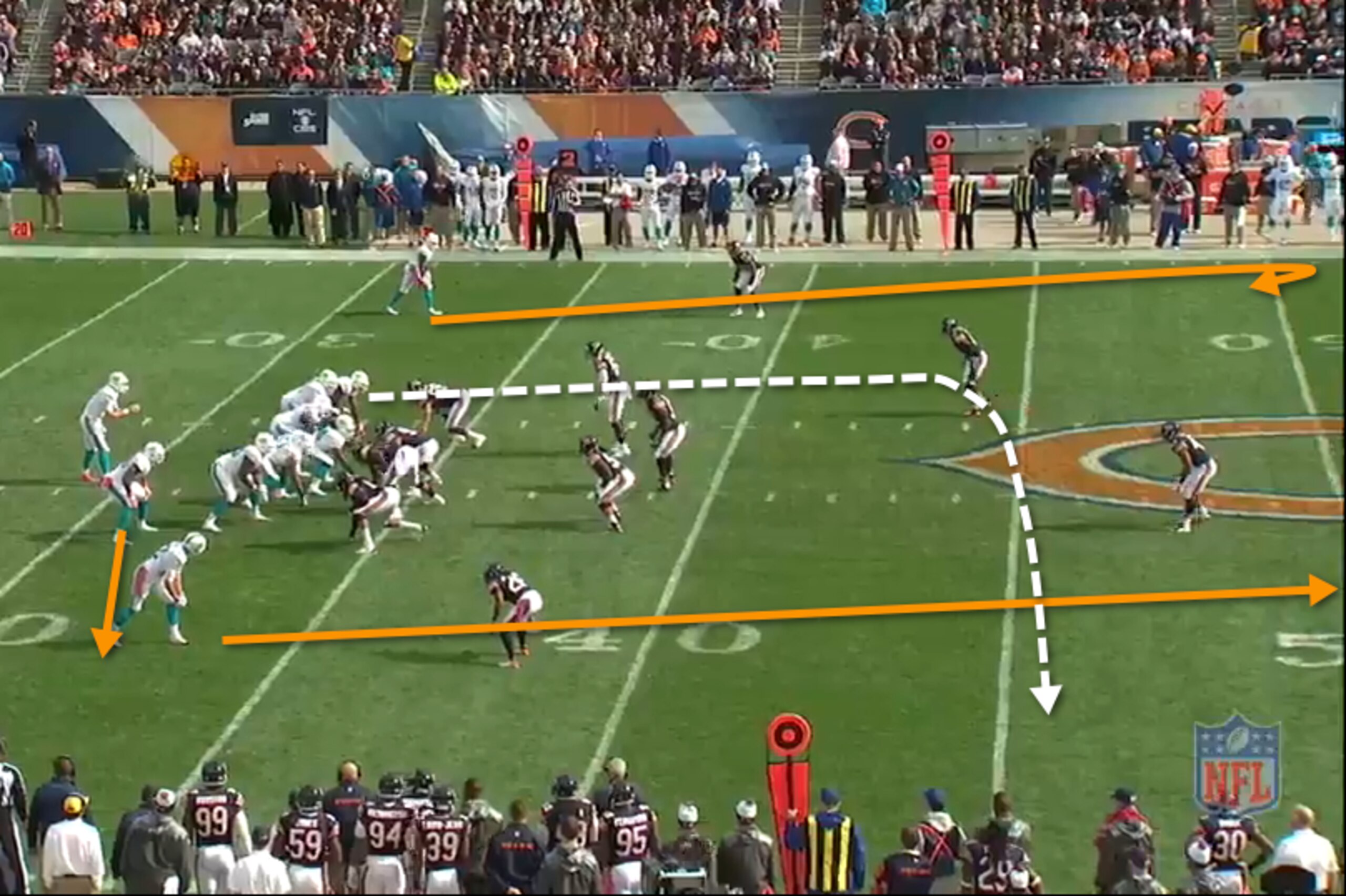
Against the Bears, Tannehill completed his first 14 passes, thanks in large part to the offense being built around his strengths. Lazor called route progressions that were logical and easier for Tannehill to digest as he scanned the field.
On Tannehill’s touchdown pass to Mike Wallace in the second quarter, he made three clear reads, starting with the shortest route on the left side of the field, over to the middle and finally leading Wallace to the back-right corner of the end zone.

Lazor has also built in more checkdown throws that will allow Tannehill to get rid of the ball quickly. With Clay making more of an impact than earlier in the season, defenses will resort to zone coverage to give deep help on Wallace’s side but also to cover the middle of the field to protect against deep crossers. That leaves the slot receiver and tailback to break the zone by finding the holes and settling in.
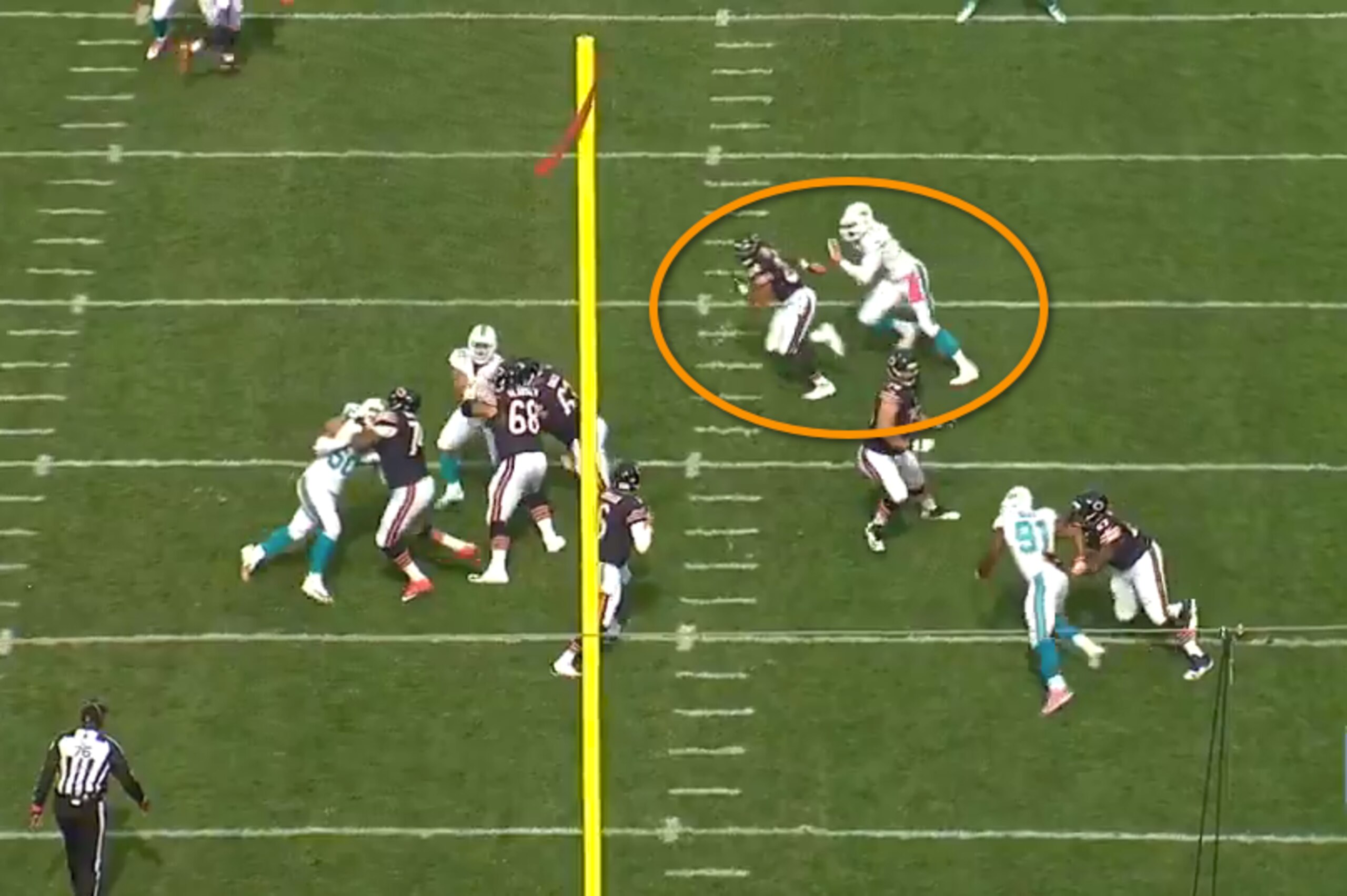
On the play below, Thomas does just that. We can see that the Bears are dropping back into Cover 6, with all back-seven defenders in a soft zone shell. Off the play action, Thomas scoots up the middle of the line to find the open space. The result is an easy eight-yard gain, setting the Dolphins offense up for an opportunity to make the defense uncomfortable with just two yards to advance the chains.
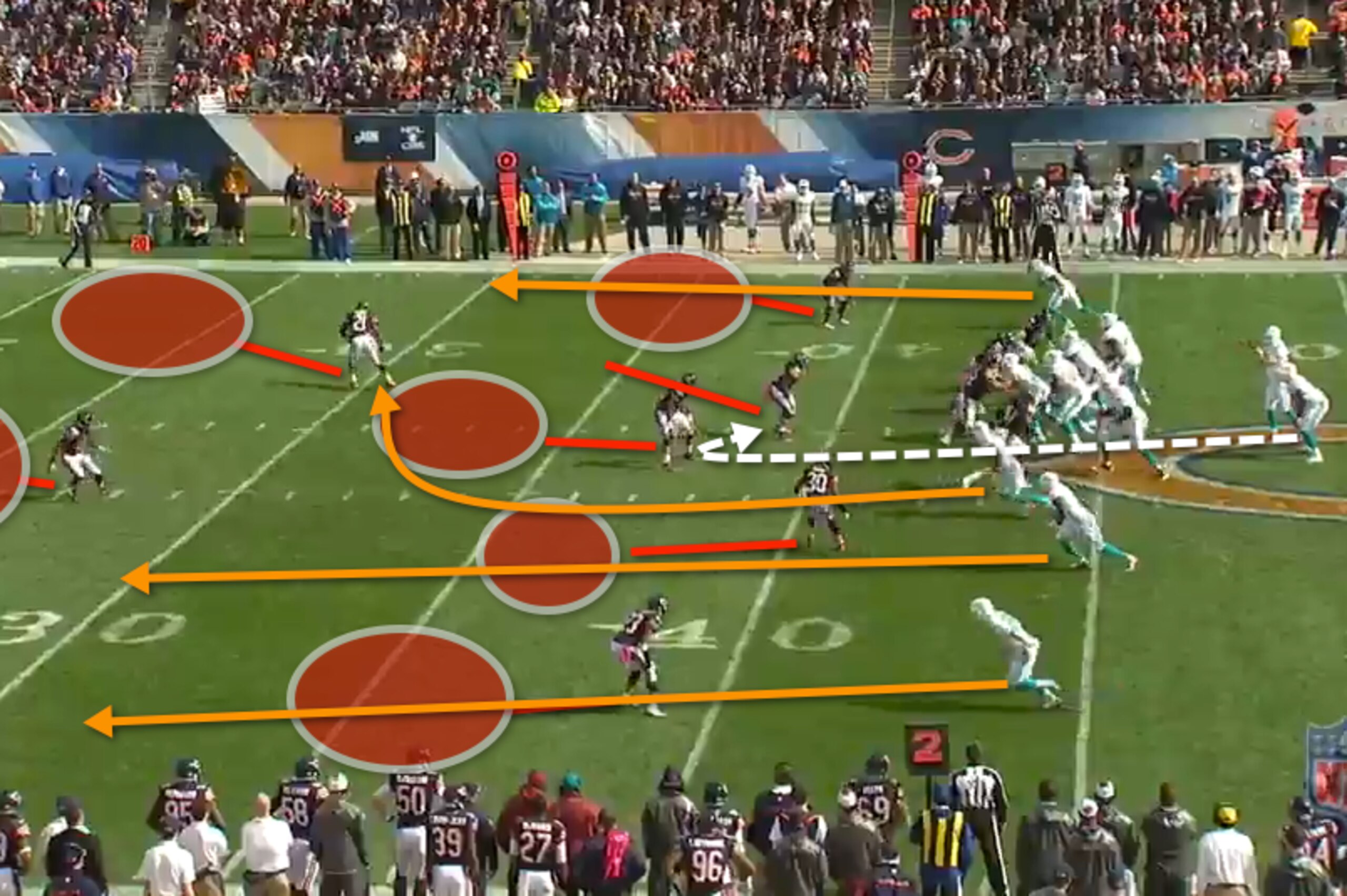
It’s small adjustments like giving Tannehill a late-releasing receiver that help the offense move the ball downfield. Tannehill is very good when he’s in rhythm, and by de-emphasizing the deep ball, there is less thinking and more playing. Lazor deserves significant praise for that, and he must continue that trend against the Jacksonville Jaguars.
One minor adjustment that Lazor made at halftime against the Bears that made an impact on the Dolphins’ offensive effectiveness was using center Samson Satele as a help blocker for right guard Mike Pouncey more often.
Pouncey has really struggled since he returned from injury, allowing far too much pressure and not getting enough push as a blocker. He is certainly still not completely back to pre-injury form, but he was left in one-on-one situations far too often against the Packers in the first half of the Bears game, and he was worked consistently.
Satele hasn’t been good as an individual performer, but as a help blocker in the zone system Miami uses, he has been effective. Instead of helping left guard Daryn Colledge as much, he was buffering the inside shoulder of Pouncey, giving needed reinforcement. The strategy worked, as Pouncey did not allow a sack or hurry in the second half of the Bears game, per Pro Football Focus (subscription required).
Defense
Defensive coordinator Kevin Coyle has been tremendous recently, not only limiting opponents to 18.3 points a game in the last three contests but also integrating Koa Misi, Reshad Jones, and soon Dion Jordan into the defense.
Although it was ultimately the defense that cost Miami a win against the Packers, Miami held one of the best offenses in the league to just 20 points for 58 minutes of the game. Moral victories don’t exist, but that is an effort that only Detroit has bested since Week 1, when the Lions limited the Packers to seven points.
More importantly, the Dolphins recovered in a major way against the Bears, who have four elite pass-catchers in their offensive personnel.
Despite the advantage Chicago had with their tall playmakers around Jay Cutler against the small cornerbacks for Miami, the Dolphins’ defensive line once again owned the trenches. That allowed Coyle to drop the linebackers into coverage, muddying the middle of the field and taking away the Bears’ intermediate passing game.

The use of Jones at safety with Louis Delmas has been critical as well. Jones is a smart player, and he's very instinctive. Those are traits that separate him from the pack of mediocre safeties across the league. In his return to the Dolphins defense, he’s been the impact player Miami last saw in 2012. His interception of Cutler in the third quarter epitomized his work ethic and talents.
Jones explained his strategy in getting the interception, per CBS Chicago's Dan Durkin:
"Reshad Jones on Cutler: "He was always looking at his receivers and never looking off. I tried to take advantage of that and it paid off."
— dan durkin (@djdurkin) October 19, 2014"
Coyle has also done well to utilize his personnel in situations where they will win. Putting players where they’ll succeed is absolutely critical, because there is a dearth of well-rounded athletes in the world who can handle any responsibility.
Enter in players such as rookie Chris McCain. McCain is an undrafted rookie with tremendous potential as a pass-rusher, but he is also fluid enough in coverage to limit opposing tight ends and receivers to short gains.
Coyle allowed McCain to show an A-gap blitz, lining up directly over Forte, and then dropping into coverage on the talented back. Forte is the best receiving back in the NFL, but McCain limited him to just a five-yard gain.
Although not an interception, McCain was trusted to make the open-field play, and he properly executed it. In 2013, Miami was desperate for such a skill set on the roster, but now, Coyle is showing the willingness to use it.
With Dion Jordan returning to the team, Coyle will need to use him in a variety of roles. Jordan is an athletic freak who has been vastly underrated to this point in his career. He’s a solid defensive end and could likely start for numerous teams around the league. His development of a bull rush in the offseason was evident as he battled Dallas Cowboys’ left tackle Tyron Smith in the preseason.
But Jordan has potential to be a bookend linebacker for the Dolphins, if Coyle will allow him to move to strong-side linebacker.
The Dolphins have found their weak-side linebacker of the future in Jelani Jenkins, but the other side has been troublesome with Philip Wheeler manning the position. Jordan has no physical limitations and is now strong enough to set the edge as a run defender and long enough to be a mismatch on pass plays.
How Coyle unleashes Jordan in the coming weeks will be a major focus because of the potential Jordan has. For the Dolphins to maintain their rank as a top-five defense in yards allowed, Coyle must continue to be versatile and allow the defensive talent to shine.
As Miami prepares for the improving Jaguars, the Dolphins’ coordinators must continue to exploit the weaknesses and magnify the strengths of their players to continue winning. That’s what this organization will be judged on more than anything else, and it is expected.
If the last three weeks are any type of indicator, the Dolphins are trending upward due to what the coaches are making happen throughout the week, not just what the players are making happen on Sundays.
All stats used are from Pro Football Focus' Premium Stats (subscription required) or Sports-Reference.com. All contract information is courtesy of Spotrac.
Ian Wharton is a Miami Dolphins Featured Columnist for Bleacher Report, contributor for Optimum Scouting, and analyst for FinDepth.



.jpg?w=2560 "🔴 Live: WWE NXT 👊")
