

Michael Kidd-Gilchrist's Third Season Will Define His NBA Future
There's only so long you can play the "he's still young" card. For every year that Michael Kidd-Gilchrist regresses or plateaus, his NBA ceiling drops another story.
Sooner or later, coaches and general managers are going to start ignoring the fact that he's just 21-22 years old and a former No. 2 pick. That's because they'll be fixated on a blank resume that reflects minimal progress or production.
Kidd-Gilchrist's scoring average fell from 9.0 to 7.2 last year. His assist percentage was nearly cut in half—he averaged less than one a game playing over 24 minutes in each.
In 140 career games, he's made three total three-pointers.
Kidd-Gilchrist isn't there yet, but he's been put on "bust watch" entering his third year in the league. You just don't see too many zero-to-100 breakouts from fourth- and fifth-year players.
The Charlotte Hornets (Bobcats at the time) passed on some pretty darn good prospects to reach on Kidd-Gilchrist in the 2012 NBA draft. Bradley Beal, Dion Waiters, Damian Lillard and Andre Drummond were all still on the board.

At the time, Kidd-Gilchrist was ironically considered one of the safest picks in the draft—a 6'7" top-shelf athlete with a charged motor and fearless mentality. His perceived basement floor reflected the type of play we've seen from him through two years in Charlotte. Worst comes to worst, he's good for defensive energy and offensive slashing.
The assumption was that he'd eventually start making his way up toward his NBA ceiling.
No luck so far.
Kidd-Gilchrist was a project out of Kentucky—a guy taken primarily based on potential and the hope his ball skills would catch up to his athleticism. Only his ball skills have remained at around roughly the same level. He's still just so limited when it comes to creating, whether it's a shot for himself or a play for a teammate. He actually took 2.2 fewer shots per game last year than he did as a rookie.
Realistically, Kidd-Gilchrist will probably never develop into a one-on-one type of scorer on the wing. That's just not his game—which is why that awkward, ineffective jumper has been such a concern.
You won't find many successful small forwards who can't shoot to begin with. And Kidd-Gilchrist's inability to create his own scoring chances makes shooting even more of a must-own skill.
Last season, he shot only 27.7 percent on catch-and-shoot jumpers, per NBA.com.
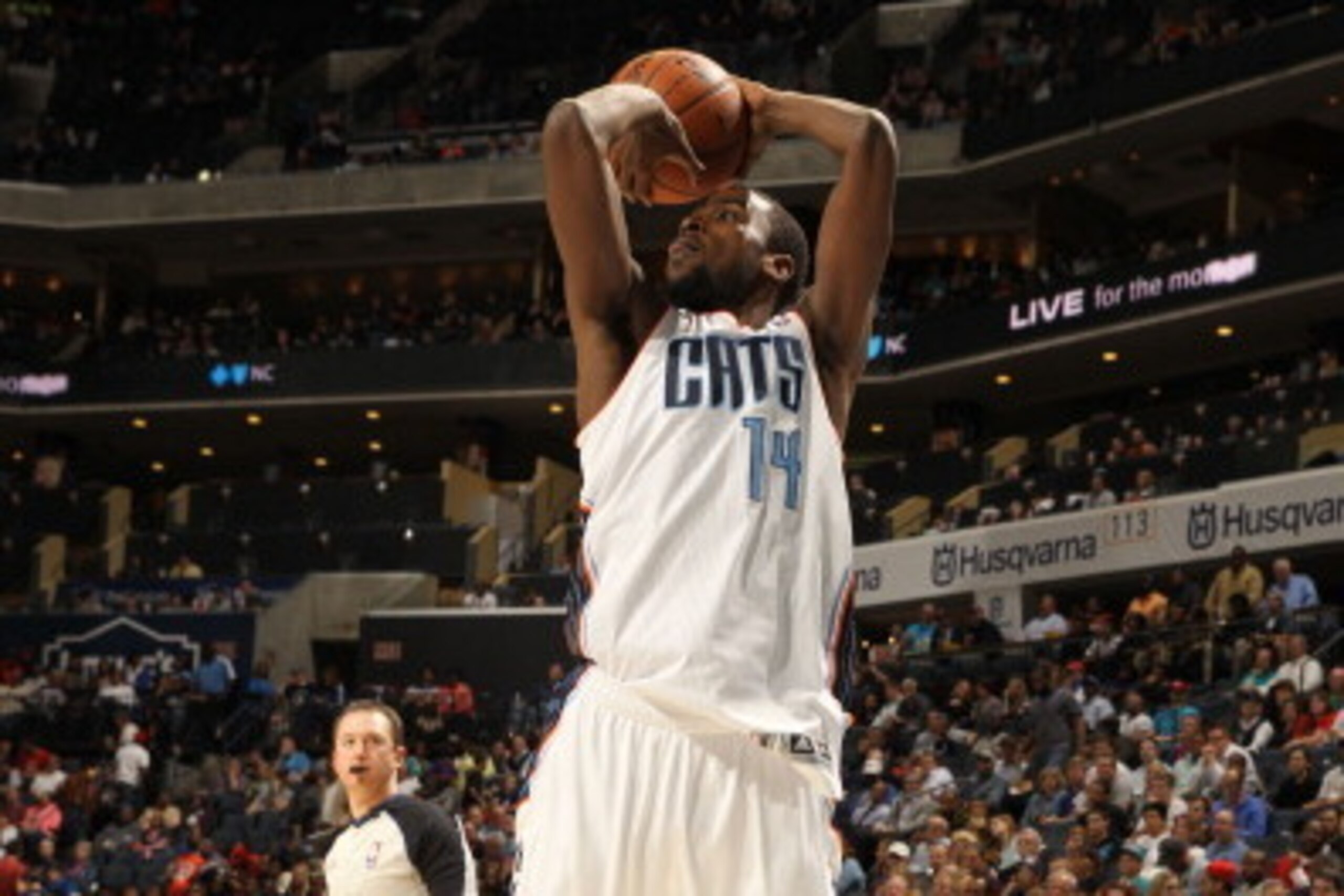
There's just no way Kidd-Gilchrist will be able to stay effective offensively without the ability to create or knock down shots around the arc. You can get by for a while stinking at one, but not both—not for a small forward, a position that operates on the perimeter.
“Obviously Mike was such a great athlete that he could have success at other levels, Kidd-Gilchrist's shooting coach Mark Price said via Rick Bonnell of the Charlotte Observer. "But for the success Mike wants to have at this level, he’s got to improve his shooting and nobody knows that more than Mike."
Having made just 26 shots outside the paint all last year, improving his jumper has been a huge point of emphasis for Kidd-Gilchrist this summer. And according to coach Steve Clifford and some newly released footage from practice, there might be reason to believe.
“I’ve never seen anybody’s shooting mechanics change more drastically, in the year or so Mark has worked with him,” Coach Clifford told Bonnell.
“Does it feel that different? Well, it’s going in a lot more,” Kidd-Gilchrist said. “I believe in the process. I started in April and it feels great.”
With bizarre elbow placement and a strange release point, you sometimes used to question what hoop he was shooting at. At least now it's starting to look like an actual jump shot, though maintaining his form while contested will be a whole other challenge in itself.
I suppose the new shooting mechanics will buy him some time, but we're still going to need to see results this season, even if changing his jumper is considered a "process."
This is a huge year coming up for Kidd-Gilchrist, especially when you look at the developmental track record of previous small forwards out of college. It's a skill position in the NBA. And unlike big men, those who lack the necessary skills usually have trouble making a significant impact. Some don't even stick around at all.

Since 2003, there have been 21 natural small forwards taken in the lottery. The good ones, like Luol Deng, Paul George, Rudy Gay, Andre Iguodala, Kevin Durant and Gordon Hayward, all showed legitimate gradual progress from their first to third years.
Of those 21 small forwards drafted, none of them had breakout fourth years in the league. It either happened by then or it didn't. For those who showed little-to-no improvement following their first three seasons, it was pretty clear they weren't coming close to reaching their NBA ceilings.
Based on recent small forward history, you are what you are by year No. 4. Josh Childress, Luke Jackson, Adam Morrison, Martell Webster, Ronnie Brewer, Julian Wright, Joe Alexander—these guys couldn't get it to click through three years in the league, and though some of them have stuck around, their value has plummeted since their rookie seasons.
At this stage, Kidd-Gilchrist might be looking at a similar career path as Corey Brewer's, another wing with limited skills, only one's who's been able to make a living by offering defensive versatility and the ability to finish drives and cuts.
Another disappointing year from Kidd-Gilchrist won't mean he's out of the league looking for work. But it could shatter his perceived value—from two-way prospect with upside to reserve energy specialist.
After two underwhelming seasons, I think it's safe to say that becoming a "star" is out of the question for Kidd-Gilchrist. However, a strong year in 2014-15 could land him a long-term starting job in Charlotte, given the team's need for an additional wing and Gerald Henderson's unconvincing play and outlook.
It's going to require knocking down a few extra jumpers, but that starting small forward position is what he'll be playing for in year No. 3. Otherwise, he might be playing for a contract in year No. 4.
.jpg?w=2560 "Report: Saints Trade For 49ers RB")
.jpg?w=2560 "Jeanty Avoids Major Injury")
.png?w=2560 "MLB Playoff Picture Shaping Up")
.jpg?w=2560 "Predicting Biggest NFL Names Who Could be Roster Cuts")
.jpg?w=2560 "NFL's Biggest Rumors Ahead of Roster Cuts Deadline")