Aaron Rodgers Is Root Cause of Packers Offensive Struggles
Despite his cool demeanor, Aaron Rodgers can't be enjoying himself right now.
The Green Bay Packers' starting quarterback hasn't played his best football during the first three weeks of the season, as his side has flopped to a 1-2 start. Rodgers' performances have come under scrutiny, with some questioning if he is less focused/healthy than he has been in previous times.
Rodgers' reply to those concerns was as predictable as it was calm: "R-e-l-a-x," Rodgers said on an ESPN Milwaukee radio show. "Relax. OK? We’re going to be OK."
TOP NEWS
.jpg?w=2560 "Commanders Eagles Football")
Commanders May Change Logo 👀
.jpg?w=2560 "Saints Lions Football")
Rap: Lions, LaPorta End Contract Talks
.jpg?w=2560 "Seahawks Football Owners")
Seahawks Have No Plans to Move
The Packers have every reason to be calm. They have made the playoffs in each of the past five seasons. Twice during that stretch the team has started the regular season 1-2, so there is precedent to point to. However, there is very little precedent for Rodgers to point to for his individual performance.
Rodgers is the most talented quarterback in the NFL.
He is as physically talented as every starter in the NFL save for Colin Kaepernick and maybe Cam Newton. He combines that physical talent with the mental acumen and refined technical ability to be one of the most productive players in the league.
The soon-to-be 31-year-old is the kind of player who elevates his teammates and isn't perturbed by whatever the opposition does to him. There isn't a blueprint to stopping Rodgers. Instead you must hope he doesn't play to his full potential for four quarters.
When Rodgers played to his full potential for four quarters and four games a few seasons ago, the Packers won an improbable Super Bowl.
Through the first three games of this season, Rodgers hasn't played like that quarterback. He has been making some uncharacteristic mistakes and hasn't addressed some minor flaws that were evident in his play last season.
While it's not always the case, Rodgers' statistical output does match his performance to this point in the season.
His 5-1 touchdown-to-interception ratio highlights how effective he is at taking care of the football. It's the kind of ratio you would expect from him. However, how that ratio has come about is in stark contrast to what we would typically expect from Rodgers.
Since becoming a full-time starter in 2008, Rodgers has never finished a full season with a completion percentage lower than 63.6. That mark came during his first season as a starter and continuously improved over the next few years. His lowest completion percentage since his first season as a starter is 64.7.
Through three games this year, Rodgers has completed just 62.7 percent of his passes.
Part of this drop can be attributed to drops from his recently revamped receiving corps, but it's largely a result of his own uncharacteristically poor accuracy. That accuracy has helped to limit Rodgers to just 697 passing yards this year, 346 of which came in his only home game against an overmatched New York Jets secondary.
Unless the offense around him has completely imploded, which it hasn't, Rodgers should never expect to have a three-game stretch that sees him finish two games completing less than 60 percent of his passes and two games with less than 200 passing yards.
Even considering that he faced the Seattle Seahawks in Seattle and the Detroit Lions in Detroit, there isn't really an excuse for Rodgers' poor start to the season.
Week 1 vs. the Seattle Seahawks
This chart tracks every throw that Rodgers attempts except for throwaways, spikes and obvious quarterback-wide receiver miscommunications. The green ticks are accurate passes (not completions), and the red crosses are inaccurate passes (not incompletions).

Against the Seahawks in Seattle, Rodgers was going to have to play a perfect game to give the Packers a chance to win. Ultimately, the Packers were comfortably beaten, and Rodgers didn't perform to his best. He wasn't awful, and his accuracy overall was good, but the problem was that he missed open receivers in important situations.
Rodgers missed a potential touchdown throw midway through the second quarter when the Packers would have had a chance to take a four-point lead.
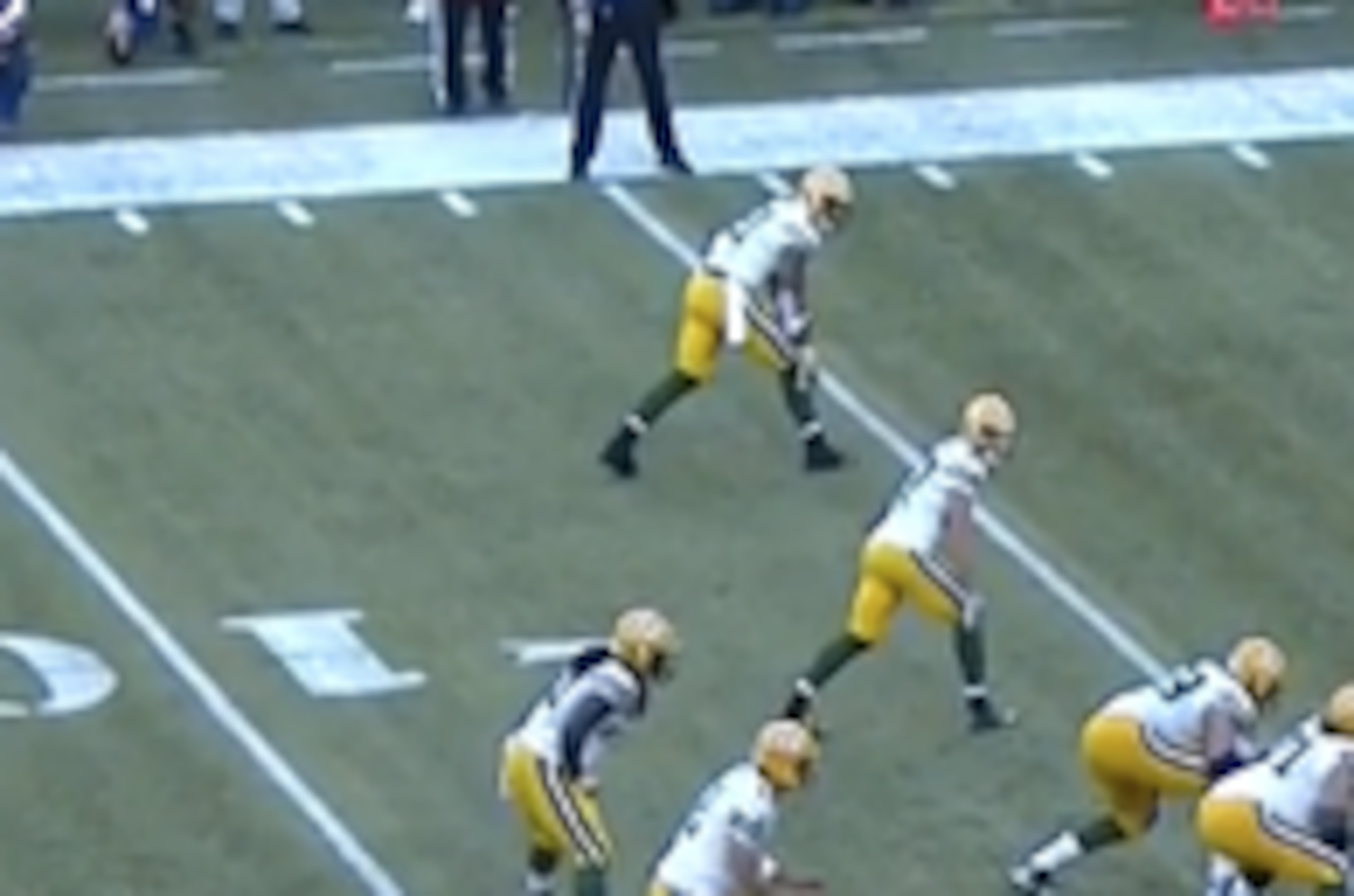
On third down in the red zone, the Packers spread the field with two receivers to either side and Eddie Lacy in the backfield alongside Rodgers. As they so often do, the Seahawks leave Earl Thomas as the lone deep safety and expect him to cover between the highlighted area of the field.
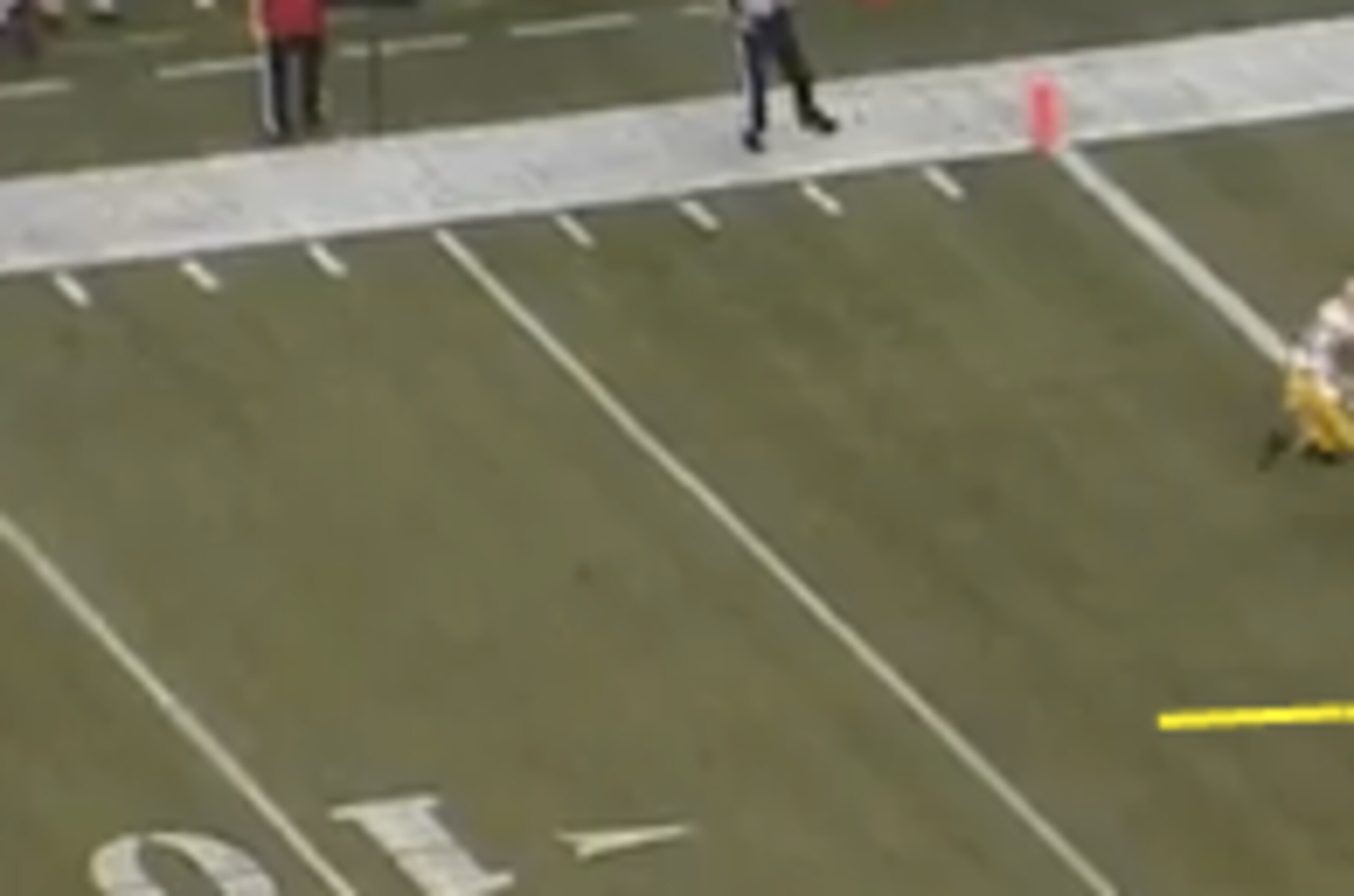
Rodgers initially looks to Randall Cobb in the right slot, but Cobb is well-covered because the Seahawks keep multiple defenders aligned at the goal line in zone coverage. Meanwhile, Thomas is reading Rodgers' eyes, so he moves slightly toward that side of the field.
While this is happening, Jordy Nelson is running down the opposite seam and into a large pocket of space in the end zone.
Because the pocket closes on Rodgers and Cobb is covered, he is forced to scramble into the opposite flat. Rodgers is slow to sort out his feet, so he doesn't recognize Nelson open in the end zone and set up quickly to throw him the ball.
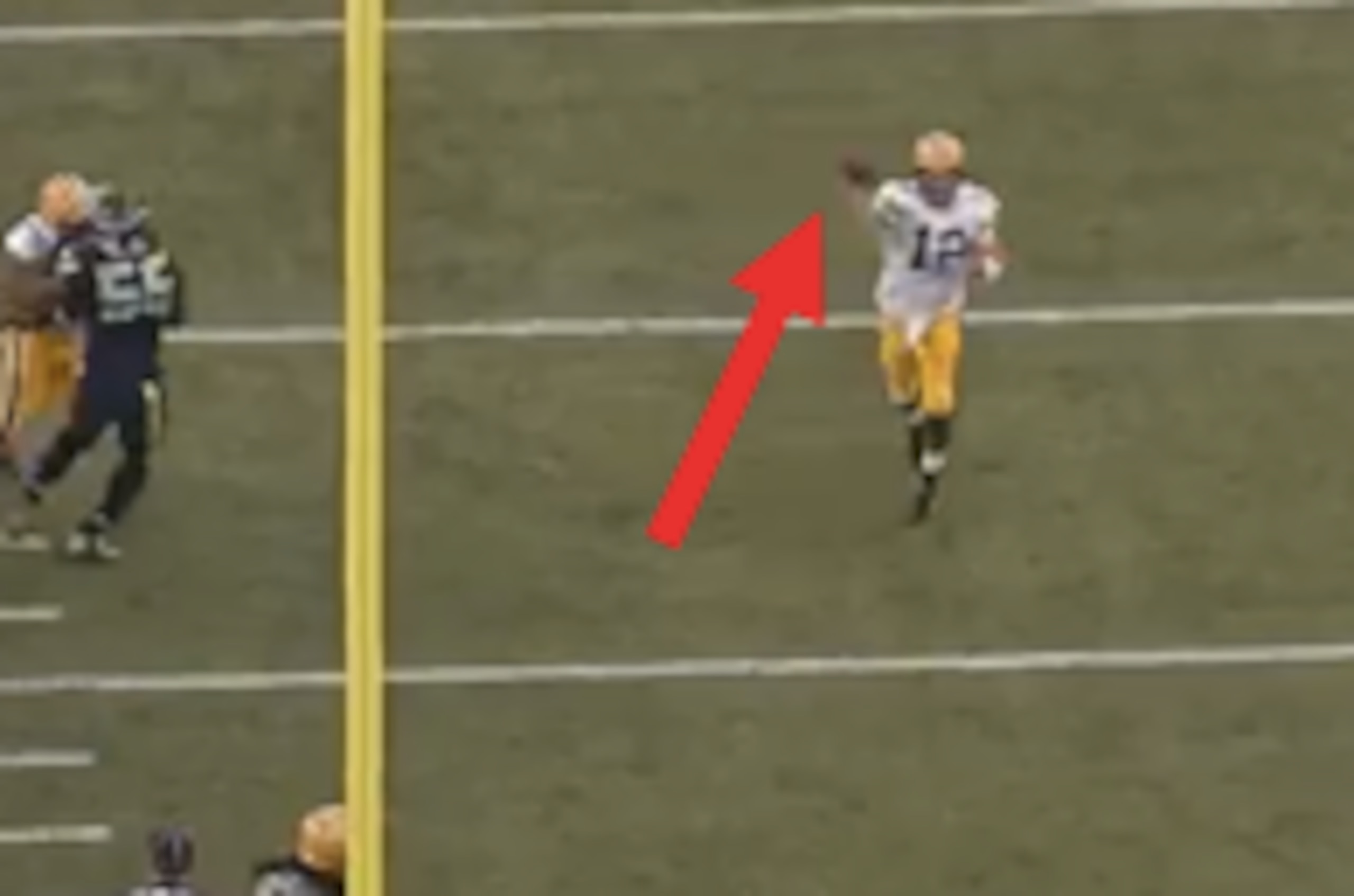
This slowed process gives Thomas time to recover position but not enough time to get to Nelson. When Rodgers begins his throwing motion, he should have plenty of time to fit the ball into his receiver. Rodgers throws one of the fastest balls in the NFL, so even Thomas shouldn't be able to disrupt this play.
Rodgers badly misses the throw.
His accuracy wasn't what it should have been, and that was because of his footwork.
Throwing the ball with precision and velocity while moving to the left as a right-armed quarterback is very difficult. Throwing the ball with precision and velocity while moving to the left as a right-armed quarterback is nearly impossible when you don't set your feet.
Rodgers never set his feet to throw the ball. He relied solely on his arm strength and hopped into the air when releasing the ball. This is the kind of sloppiness that can negate anyone's accuracy, regardless of how much arm talent he has.
Mechanics are vitally important for throwing the ball. You need to be balanced and establish a strong base no matter what kind of throw you are making.
When you have a very strong arm, you are more likely to become sloppy with your mechanics, and this appears to be something that is afflicting Rodgers at this stage of his career. It's not something that has only cropped up this season though. He showed the same disregard for his feet on a number of short throws last season.
His first throw of this game was a carryover issue from last year:
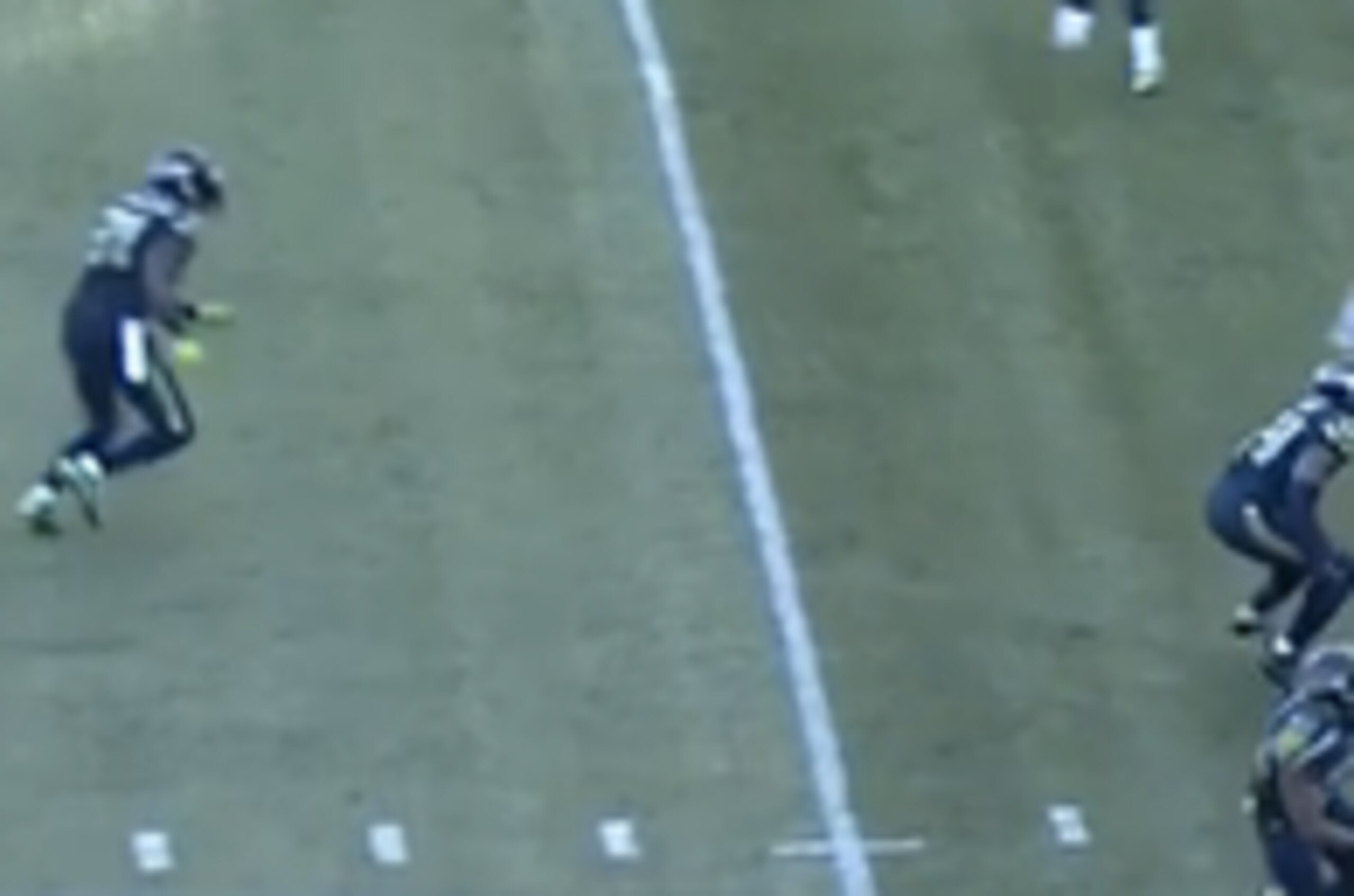
On screen plays, Rodgers is regularly moving backward or has his feet in the air. This is likely because he wants to get the ball out as quick as possibly, but it also causes him to miss throws. This screen to Nelson results in a two-yard loss but could easily have gone for a first down with an accurate pass.
Rodgers' pass is low and behind Nelson when it should arrive in the green area to lead his receiver toward the highlighted space down the seam. His inaccuracy is caused by his footwork and because he is moving backward as he releases the ball.
There is no real need for Rodgers to rush these throws. He has the quick release and accuracy to afford him enough time to set his feet and step into his throw. Placement is much more important than haste.
On 3rd-and-3 just before halftime, when the Seahawks were leading by seven points, Rodgers was again throwing on the move without setting his feet. This time he was moving forward with a defender closing on him from behind, but the throw itself proved to be awful.
Nelson was wide open for what would have been a routine first-down catch.
These plays, along with a missed throw on a two-point conversion attempt in the fourth quarter, weren't a result of the quality of the defense. They also weren't a result of poor pass protection or poor receiver play. Rodgers simply wasn't executing the way he would regularly expect to execute.
Week 2 vs. the New York Jets
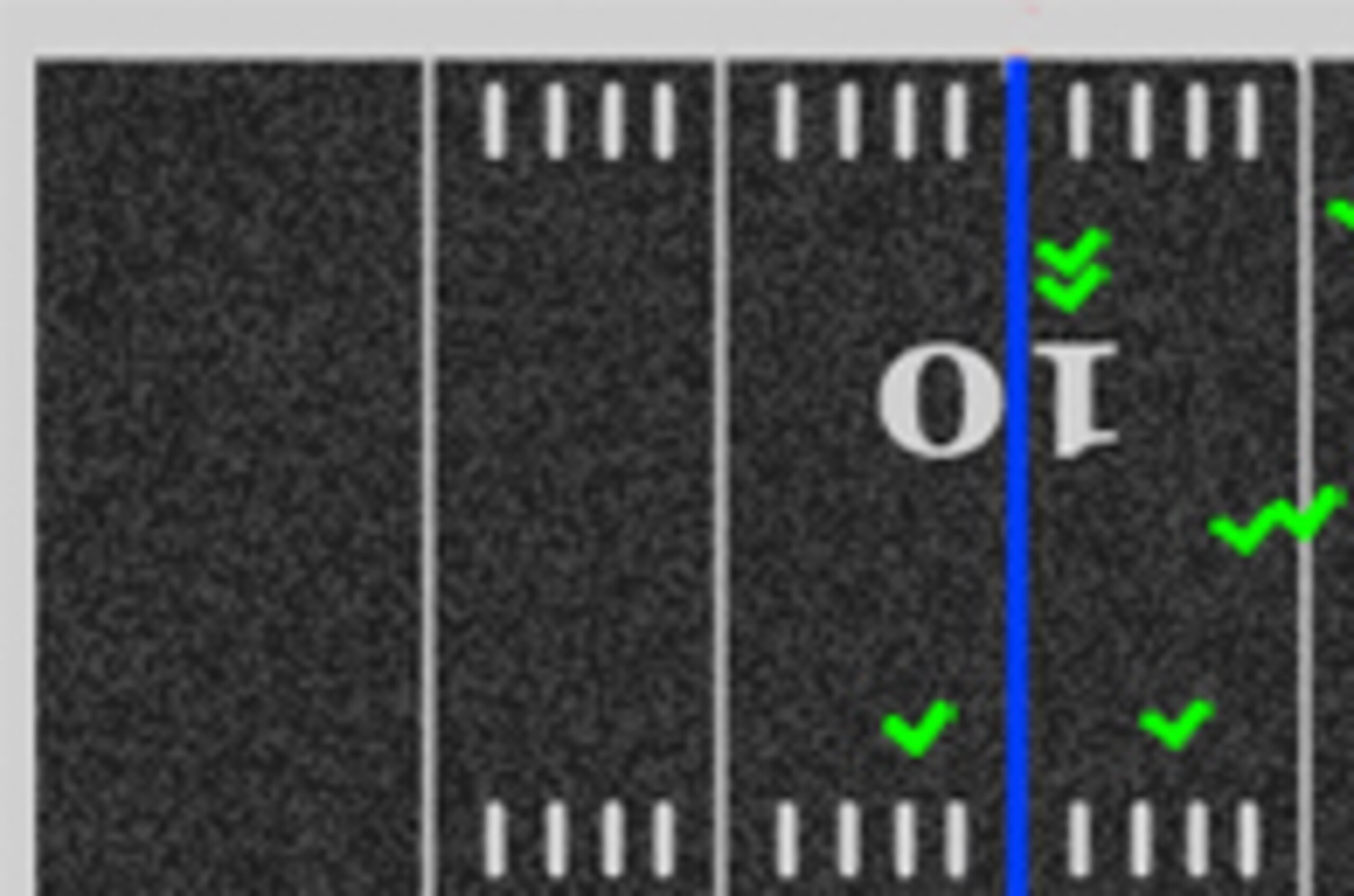
This was comfortably Rodgers' most productive game of the season so far and also his most impressive game of the season so far. That said, he still wasn't playing to the standards he had established in previous seasons.
Only one play of significance arose.

Rodgers initially fumbles the snap, but when he recovers it he is still sitting in a clean pocket. He adjusts slightly to find his rookie tight end, Richard Rodgers, wide open. The rookie appears to misjudge the play, and he fails to stop in his route.
If we give Aaron the benefit of the doubt, we can say he missed the tight end because he was trying to lead him away from the incoming defender.
However, it should also be noted that Aaron's footwork is again poor on this play as he throws the ball off his back foot with his front foot off the ground completely. The tight end is able to get a hand to the ball, but that only serves to deflect it to the ground.
Week 3 vs. the Detroit Lions
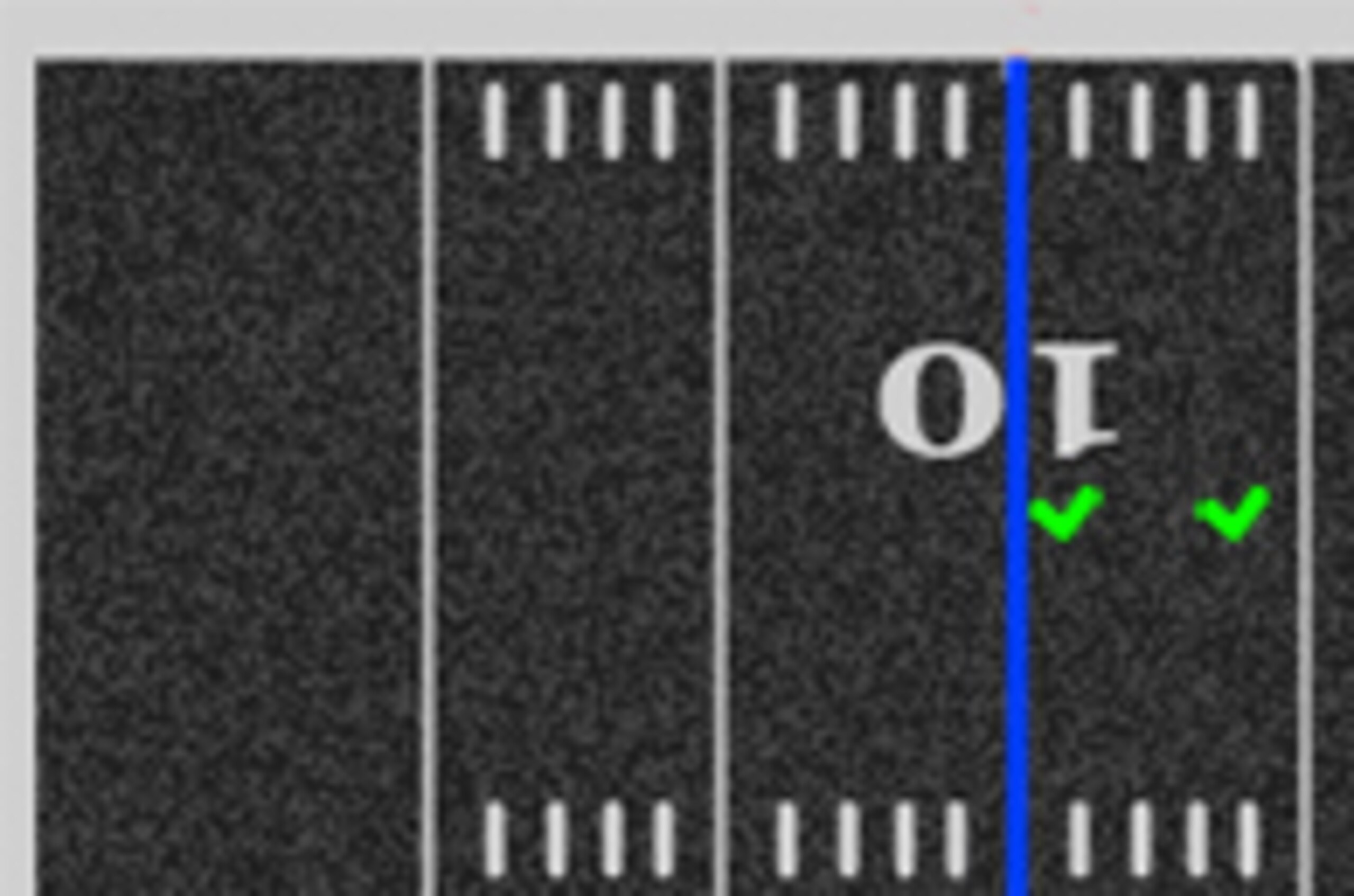
Rodgers' mechanics and accuracy are a concern but not a major one. He was able to be effective last year while still ignoring some of those issues. Now, those issues become greater when paired with another flaw. A flaw that a fellow NFC North quarterback is routinely scrutinized for.
Much like Matthew Stafford often does with Calvin Johnson, Rodgers has become too fond of forcing the play to Nelson.
This is likely a result of playing with a relatively new group of supporting options behind Nelson, but it's not a good excuse for poor quarterback play. It's especially not a good excuse when Rodgers is turning down opportunities to throw to Randall Cobb.
According to Pro Football Focus (subscription required), Nelson has been targeted 37 times through three games. That is four more targets than Calvin Johnson and the most of any receiver in the NFL.
Rodgers isn't seeing the field well, and that was apparent throughout this game.

On this 3rd-and-10 play from midway through the first quarter, the Lions come out showing Cover 2. Cover 2 in this situation with the Lions' caliber of players on the defensive line makes a lot of sense, so Rodgers shouldn't expect the coverage to shift at the last second.
Against Cover 2 man, Rodgers understands that it will be very difficult to throw the ball down the field. He either has to extend the play or get the ball to a receiver underneath with the chance to run for the first down.
At the snap, Rodgers only needs to be concerned with figuring out what the spare defender over the middle is going to do. The Lions ultimately rush four defenders, so that spare linebacker vacates the space underneath over the middle of the field.
This is where Rodgers should be throwing the ball, as his tight end is running a shallow-crossing route into space, and he gets a step on the linebacker attempting to cover him.
Throwing to that player isn't a guaranteed first down if the ball is caught, but it's his best opportunity considering the circumstances of the play call and defensive personnel. Instead, Rodgers attempts to scramble and is brought down before he can escape the pocket.
Later in the first quarter, Rodgers is successful when he attempts to extend the play into the flat, but he stares down his running back underneath instead of looking downfield.
That running back, James Starks, is open with space to run into, but he drops the ball when he is thrown to, and he was never likely to get a first down. Meanwhile, Andrew Quarless had run a nice route to find a huge throwing lane for Rodgers past the first-down marker.
It was 1st-and-10, so Rodgers didn't desperately need to get the first down with this throw. However, there was no real benefit to throwing the ball to Starks. Rodgers would likely have picked up more yards if he had continued to scramble down the sideline.
Therefore, if he had kept his eyes downfield where you would expect them to be in this situation, he would have had two options for better gains.
It's always very easy to credit the quarterback for reading his progression when he looks from one receiver to another on a given play. However, it's not always a good decision for the quarterback to move off his first read, and this is something that often goes unnoticed.
On this play, Rodgers' first read was Cobb in the slot. The Lions are playing press coverage underneath with two-deep safeties in coverage behind them. Cobb is exceptionally quick, and he is running a route that if well-executed should put him in space over the middle of the field against Cover 2 man.
Rodgers looks directly at Cobb for a moment. Cobb takes a hard outside step before quickly angling back infield. As Cobb is moving infield, the defensive back covering him is not in a position to turn with him. Therefore, Rodgers should be throwing the ball to his slot receiver here and leading him into the space over the middle of the field.

Instead, Rodgers turns away to the other side of the field and looks for Nelson.
From the moment that Cobb turned infield, he was open and in position to get a first down. Cobb extended his route across the field to catch up to Rodgers and get in his line of sight as he looked downfield to Nelson. The diminutive receiver was open, but Rodgers overthrew him.
He overthrew him because of his poor footwork.
There were more examples of Rodgers' sloppy mechanics in this game, but this was his worst play of the game. He compounded an awful decision not to throw the ball from the pocket by showing poor accuracy on the move.
In Week 4, Rodgers has the opportunity to fix these flaws. He is still a very talented quarterback, and even in his current form he is an above-average player. The Packers need him to be better than above-average though, because their roster as a whole isn't as talented as other NFC teams.
One of those teams is the division rival Chicago Bears, who they face on Sunday.
The Bears defense is not one of the most talented in the NFL. It was revamped after last season because of how porous it proved to be. What the unit has proved to be to this point is opportunistic. New additions Kyle Fuller and Willie Young have excelled despite not being full-time players.
Fuller is a rookie cornerback who has three interceptions and two forced fumbles despite not starting in Week 1 or Week 2. Defensive end Willie Young has had to earn his playing time after being a bit-part player in Week 1, but he has stockpiled four sacks already this year.
Along with Young and Fuller, the Bears have also brought in Ryan Mundy, Jared Allen, Lamarr Houston, Ego Ferguson, Will Sutton, Danny McCray and Brock Vereen, so this unit isn't one that Rodgers is familiar with.
Because the game is in Chicago and not Lambeau Field, expectations for Rodgers shouldn't be for him to cut the defense apart, but he's certainly capable of doing that if he eradicates his issues from the first three weeks of the season.
.jpg?w=2560 "Chargers Mack")
.jpg?w=2560 "Green Bay Steelers Football")
_0.png?w=2560 "Week 5 Winners & Losers 📊")