

How Much Will New York Knicks Miss Tyson Chandler's Defense?
Tyson Chandler's defense will be missed by the New York Knicks.
Scapegoats are to the Knicks' 2013-14 season what reality television is to impressionable minds: excessive, unavoidable and somewhat toxic, offering little insight into the very reality it's supposed to portray.
Quickly, and not at all quietly, Chandler devolved into one of New York's most prominent can-carriers. When team president Phil Jackson shipped him back to the Dallas Mavericks, the impression left was not one of depression or sense of loss. His departure was a relief.
TOP NEWS
Jokić Pops Out at CU Game 🦬
Watch: LeBron's 1st 76ers highlights

NBA Power Rankings Entering Preseason 🔢
Yet while comfort may be found in the Knicks' new dawn, there's no warding off the obvious: Chandler's defensive presence will be missed whether he overstayed his welcome or not.
The only thing left to be seen is just how much.
Departed Linchpin

Last season was a defensive disaster for the Knicks. They ranked 24th in efficiency—points allowed per 100 possessions—and switched their way to the draft pick-less lottery.
Blame was dispersed in imbalanced fashion. Head coach Mike Woodson fell on his own sword, his defensive instruction at the heart of New York's destruction. Chandler himself even identified the coach's clipboard convictions as ineffective and desperate:
Others were put to task too. That's how these things work. One person is never the lone fall guy. But after Woodson, a brunt of the criticism was thrown Chandler's way.
Jackson cited chemistry issues as the driving force behind New York's trade with Dallas, per ESPN New York's Ian Begley. His comments were interpreted as a subtle dig at Chandler—one that the big man took exception to.
Said Chandler, via ESPN Dallas' Tim MacMahon:
"So to judge my character and what I've done, you can go look at all my teammates and ask all of my teammates in the past, and the coaches I've played for, and I've never been a problem and never had a problem. So that was a shock to me that I didn't appreciate.
It makes no sense. If you call holding people accountable daily being a bad influence, then hey, I'm a bad influence. But I'm going to be that as long as I'm going to strap up my shoes and step on the basketball court. And that was the big problem there.
"
Both sides have cases. It's ignorant of anyone to attribute the Knicks' defensive ineptness to Chandler alone. At the same time, he must be held accountable for his role in their collapsing circus.
This was the 2011-12 Defensive Player of the Year charged with New York's defensive livelihood. And he failed, in part because his body failed him once again.
Chandler missed 27 games last season after sitting out 16 the year before. There's only so much one can do in limited and inconsistent action. He didn't always look healthy when playing either.
Most of the time, you could sense something was wrong or off. Was it a lack of effort and will? Was it the decline of a 31-year-old big man with 13 years of wear and tear on his treads?
Whatever it was that ailed Chandler—health, organic decline or otherwise—he still held value.

Opposing offenses routinely torched the Knicks within pick-and-rolls. They ranked dead last in pick-and-roll prevention, both against ball-handlers and roll men, according to Synergy Sports (subscription required).
Constant switching left the Knicks susceptible to recurrent screens and any kind of ball movement whatsoever. Chandler proved integral in curbing—not corking—the bleeding.
He finished in the top 55 of defense against roll men, allowing just .88 points per possession while holding opponents to 42.4 percent shooting. The Knicks let up 1.19 points per possession as a team. Roll men also converted 58 percent of their attempts against them.
Spot-up shooters torpedoed the Knicks as well. They gave up 1.01 points per possession in those situations (23rd).
Somewhat surprisingly, Chandler was rather effective in such scenarios. Nearly 32 percent of the shots he defended were spot-up opportunities, and only 27 players allowed fewer points per possession (.81) than he did.
Losing him will be an open invitation for New York's opponents. Chandler cannot step out on the perimeter and defend face-up sets, but his ability—when zeroed in—to help off rotations and close out shooters is matched by few centers. The Knicks forfeited a commodity there.
One they're going to miss.
Common Misconceptions
Defensive value of Chandler in mind, his departure isn't the death knell some will see it as.
First off, the Knicks weren't—and still aren't—built to be a good defensive team. Chandler wouldn't have changed that on his own.
Part of what's lost here is the marginal impact Chandler has had over the last two years:
Nothing above paints Chandler as some luck-looting liability. Then again, it's not supposed to.
Centers who cannot create their own offense and are valued primarily for defense—so, Chandler—should have a more profound impact. That the Knicks allowed fewer points per 100 possessions with him off the floor over the last two years doesn't make him a sieve. It just means he wasn't doing his job.
Fellow bigs posted an average player efficiency rating of 19.1 against him last year, well above the league average of 15, per 82games.com. He doesn't excel when guarding post-ups nor did he shine where the Knicks defense didn't, well, stink something awful.
Even though much of their time was devoted to not defending point guards and screens, the Knicks ranked sixth in points allowed in the paint per game, according to TeamRankings.com. They were also pleasantly middling when it came to protecting the rim—the use of "pleasantly" a token of how far they've fallen—allowing opponents to hit 51.7 percent of shots at the iron (12th).
For all of last season, Chandler didn't help the Knicks fare any better there.
Of the 140 players who appeared in 30 or more games and faced a minimum of three shots at the rim, Chandler ranked 61st in individual protection. Notable players who finished ahead of him include Carmelo Anthony (58th)—yes, that Carmelo Anthony—David Lee (41st) and...Amar'e Stoudemire (48th).
If that's the level of interior protection Chandler can give the Knicks, they'll make due with Stoudemire and Samuel Dalembert—who ranked 78th—and whomever else they field (Cole Aldrich!) down low. It doesn't mean they'll be better, but given Chandler's gradual decline, they're not in line to be much worse.
An Indifferent Goodbye?
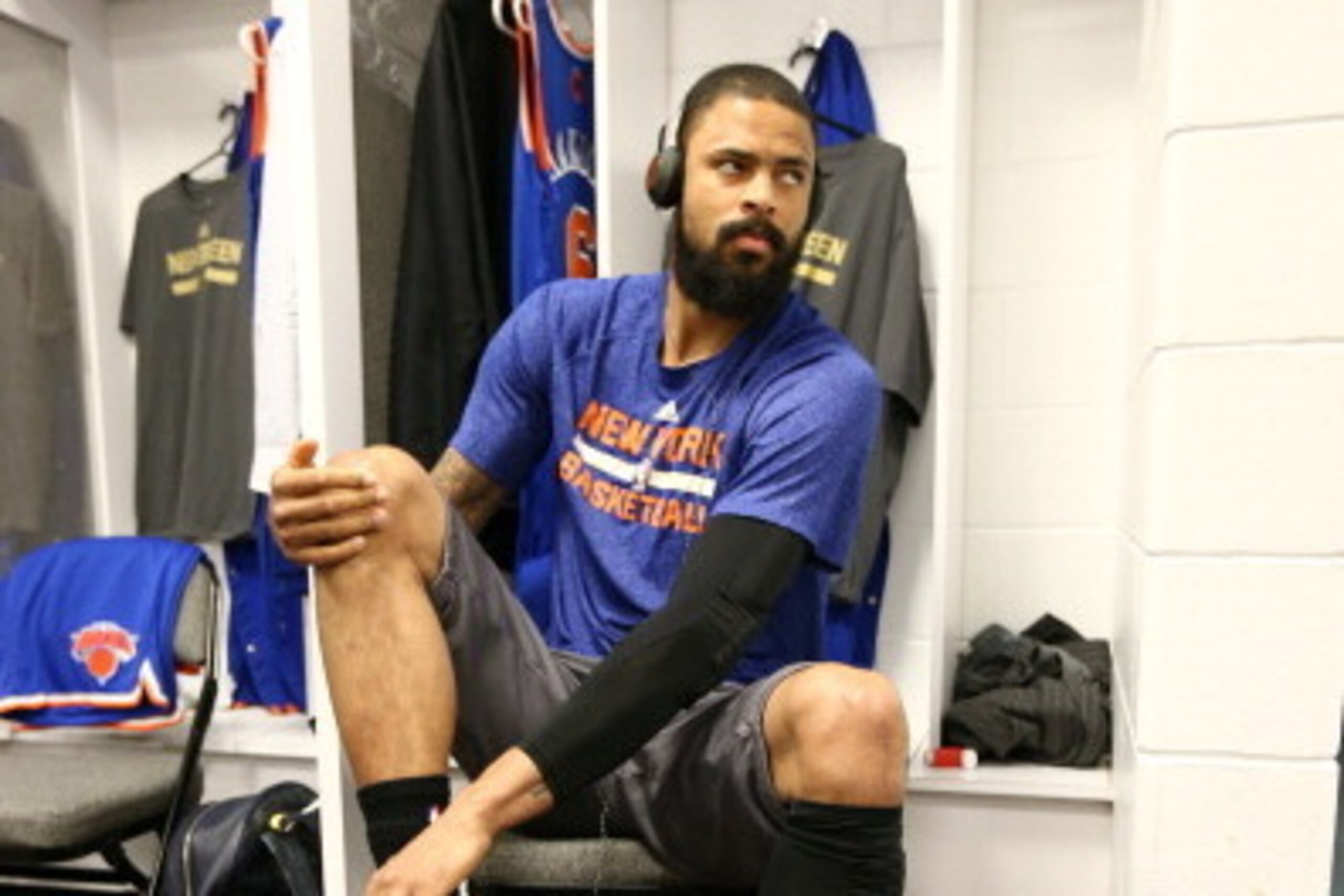
By no means can the Knicks and their fans look at Chandler and say "good riddance" without fear of sounding brash and misinformed.
Hearing Chandler speak ill of the Knicks' defensive culture stings, but like CBS Sports' Matt Moore dutifully explained, he has a case of his own:
"Bear in mind, this is consumate professional, NBA champion, and former Defensive Player of the Year Tyson Chandler. The New York Knicks still employ J.R. Smith. And you want to look at trading Chandler and saying 'Hey, we improved the chemistry?'
Chandler has a right to feel offended here. Jackson could have talked about future flexibility, about a need to get younger, about fitting the team to the system, about trying to find their way into a draft pick for the Knicks for the first time in years.
"
What Jackson may or may not have meant when discussing New York's broken chemistry is irrelevant as it relates to Chandler's true value. Even if he misspoke, it doesn't mean the Knicks didn't need Chandler. It doesn't mean they won't miss Chandler. They will.
To an extent.
And this is where everything changes. The Knicks didn't succeed in curing their most deadly malady by trading Chandler, but they didn't fork over an effective lifeline either.
As the numbers show, Chandler wasn't himself the last two seasons. He didn't have the impact the Knicks desired; he couldn't bear the bulky burden they needed him to carry.
Once 2014-15 tips off and they begin struggling defensively—as they're constructed to do—they won't miss the injury-infested underachiever of the last two years. They'll lament the absence of 2011-12 Chandler. They'll lust after the Defensive Player of the Year they bet big on.
Next year, whatever happens, they'll wish not for the version of Chandler they recently traded away, but for the player they lost long before he ever left.
*Stats courtesy of Basketball-Reference, NBA.com and Synergy Sports (subscription required) unless otherwise cited.

.jpg?w=2560 "Rap: Lions, LaPorta End Contract Talks")
.jpg?w=2560 "Commanders May Change Logo 👀")
_0.png?w=2560 "Week 5 Winners & Losers 📊")

.jpg?w=2560 "EVERY Fantasy Football Update")