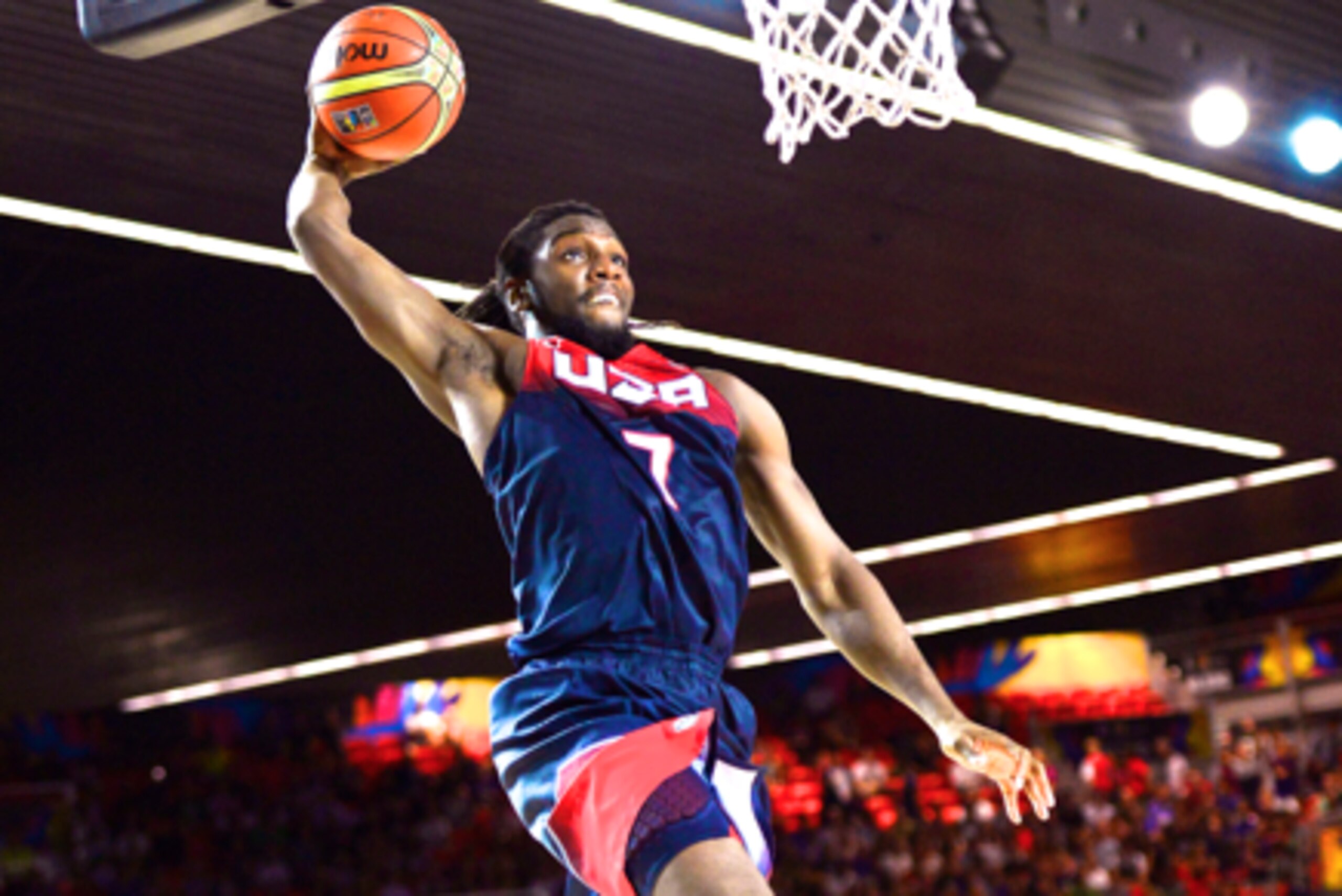

What's Behind Kenneth Faried's Leap?
When the Denver Nuggets drafted power forward Kenneth Faried, he was already known as a ferocious rebounder; it was the rest of his game that was lacking. Most notably, Faried needed a go-to skill on the offensive end and a more methodical approach on defense.
Thus far, the defensive improvement has lagged.
Though his elite quickness, timing and strength enable him to handle any type of pick-and-roll defense and guard multiple positions, Faried still relies on his athleticism to make up for split-second indecisiveness in diagnosing and reacting to an offensive play.
TOP NEWS
Jokić Pops Out at CU Game 🦬
Watch: LeBron's 1st 76ers highlights

NBA Power Rankings Entering Preseason 🔢
Offense has been a different and better story.
Particularly during Team USA's run in the FIBA World Cup this summer, Faried has demonstrated a new type of awareness that has vastly improved his effectiveness as a scorer. But his improvement all started during the stretch run of last season when he figured out how to productively repurpose his role.
In years past, Faried has served as a pick-setter and offensive rebounder, with his presence generally mucking up spacing. He couldn't shoot, he had no post-up game and he certainly couldn't blow by defenders off the bounce.
Grantland's Zach Lowe succinctly summed up how he has made an offensive impact in his three years in the league:
"He’s an undersize power forward who has struggled on defense and relied mostly on cuts, offensive rebounds, and other forms of scavenging for his points.
"
Bigs who guarded him strayed accordingly, patrolling the paint to pressure drivers as Faried hovered harmlessly. Every so often, he was handed a drop-off pass for a dunk, but otherwise, his team mostly played four-on-five on offense.
There are plenty of starting-caliber NBA bigs who fit this mold. Very few are 6'8" and play the power forward position. This is a trait more commonly found among centers, and it's usually a tradeoff for post defense and rim protection.
Due to his smaller stature, Faried provides none of these advantages on defense. That forces coaches to pair him with a true center.
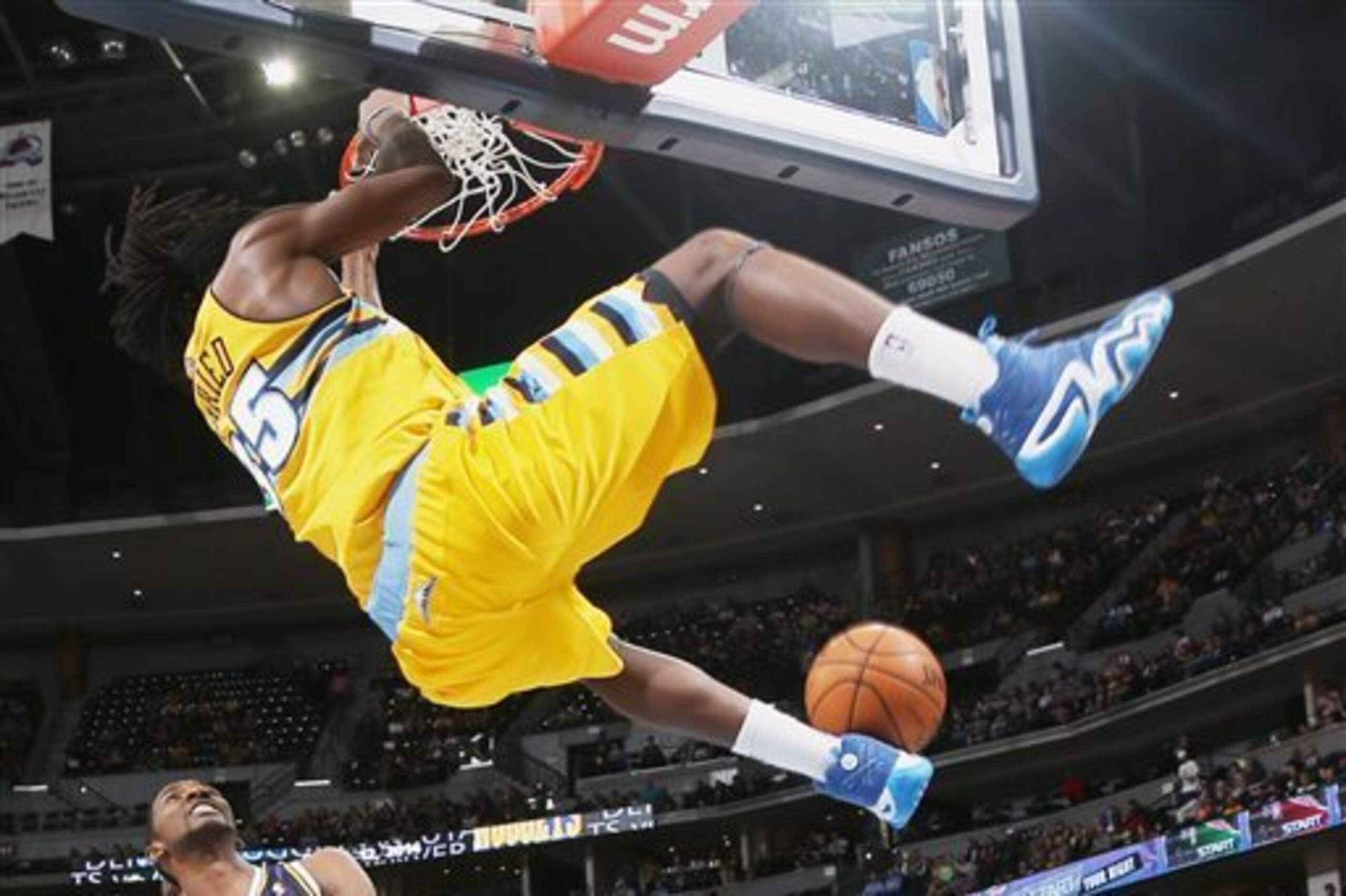
In certain NBA cases, this isn't problematic. The Memphis Grizzlies' tandem of Marc Gasol and Zach Randolph is a prime example of the continuing functionality of the two-big dynamic.
But it only works because Gasol is such an effective passer from the high post/free-throw line area and has a serviceable mid-range jumper. He cannot be ignored when he's lurking on the elbows.
That's all it takes for multiple bigs to share the floor. As long as one of the two is a threat to score or create points, defensive bigs cannot sag off and focus elsewhere.
In Faried's case, his limited positional versatility often handcuffs the offense. Since most NBA centers don't have any mid-range game, they're ignored as well. That means two players in the Nuggets offense, the power forward and the center, can be overlooked without repercussion.
In those early years, Faried's frontcourt running mate was often either Kosta Koufos or JaVale McGee—two centers worth little on offense. That led to countless possessions like the one below in which attacking the rim was deterred by multiple bigs focused solely on the ball.
Notice how Hakim Warrick and Marcin Gortat of the Phoenix Suns are glaring at the ball with their backs to Koufos and Faried. The Denver duo doesn't have anywhere useful to go on the floor and just hang out on the baseline, leaving the Suns' bigs completely free.
When Ty Lawson sizes up Steve Nash, what does he see? Two opposing bigs staring him down and nowhere to go with the ball should he drive and look to kick. He's left with a single option: drive to shoot a floater or take a pull-up jumper.
He chooses the former and misses.
Former Nuggets head coach George Karl counteracted some of this stagnation by having his team play an uptempo style that thrived in transition, but he couldn't completely avoid half-court basketball. In those moments, Denver struggled.
The difficulties can't be solely tied to Faried, but he certainly didn't help matters.
With offensive talents such as Lawson, Danilo Gallinari, Wilson Chandler and Arron Afflalo, the Nuggets should have been better than 13th in half-court offense during the 2012-2013 season and 23rd during the 2013-14 campaign, according to Synergy Sports (subscription required).
In Denver head coach Brian Shaw's inside-out offense last year, Faried began to develop a sharper understanding of how to position himself as a relief valve for drivers. Because his previous focus had been on cleaning up the offensive glass, he would give himself a few feet of room before flying in to grab the board.
Kind of like this play from April against the Memphis Grizzlies:
It's certainly a lot easier for Faried to grab an offensive rebound from a moving position given that it's less likely a defensive player will box him out. Unfortunately, that mindset comes with a sacrifice.
What if Lawson's penetration was cut off by Randolph and he needed to drop the ball off to Faried?
That would have been impossible with Faried stalking the rebound from the free-throw line.
What we're now seeing out of Faried is two-fold—a more calculating move to the rim on the pick-and-roll as well as more clever movements within the tight quarters around the rim.
Previously, Faried's pick-and-roll default was to roll only if a clear path to the hoop existed. Otherwise, he would revert back to his offensive rebounding habits of attacking the basket moments before the shot attempt.
His timing in these moments is actually phenomenal but ultimately detrimental to the offense. By not completely rolling, he's neither sucking in perimeter defenders to open up the three-point line nor providing a safety net for ball-handlers.
The newer version of Faried is rolling with an intuitive purpose.
Unlike an Andre Drummond, who can recklessly roll to the rim and catch lob passes with ease, Faried must be measured in his cuts. While it's still important to dive with speed, the angles must be precise.
The power forward's now looking for those cracks in the defense where a pocket pass might sneak through or a wraparound pass might catch an overcommitted big.
Faried does an excellent job reading the pick-and-roll as it evolves during this sequence from an April game, also against Memphis. Because the Grizzlies force Nate Robinson to reject the screen and go left, Faried properly "slips" the screen—diving to the paint before actually setting the screen—instead of trying to make contact with Mike Conley.
By design, Conley is giving up his left and forcing Robinson into his waiting help, Ed Davis. Both seem to have read their scouting reports, and they know that Faried won't do anything at the free-throw line.
Davis therefore thinks he's free to focus his complete attention on Robinson. Faried shrewdly dives a step farther at the exact moment Davis commits to Robinson, creating a nice passing lane to receive the ball and lay it in.
This type of nuance has also extended to Faried's play in the dunker spot—that area on the baseline just outside of the paint where bigs tend to hang out.
Most will creep in closer during basket attacks, waiting for a ball-handler to feed them the ball.
But now Faried is becoming more resourceful in how he makes himself available. Instead of stepping in and waiting, thereby creating more clutter for the driver, he's waiting for the ball-handler to get deep before wrapping around the frontside.
That's what he does below against the San Antonio Spurs when Randy Foye gets to the rim and draws help from Faried's man, Tim Duncan.
Faried is in the right dunker spot, and the average big will wait for Foye to hoist up a shot before attacking the rebound. Or maybe if he's lucky, Foye might sneak a pass by Duncan's hands to Faried for a finish.
Either way, that's a difficult play to execute. Faried's actual approach is more proactive, as he waits for Duncan to commit to Foye before looping back to the front of the rim into the vacated space.
Duncan expects Faried to be behind him and is ready to contest the shot or swing his right hand down to swat any baseline pass. What Duncan is not prepared for is a Faried cut middle.
Look at how Duncan's hands flail on the Foye pass, with his right hand remaining wide and low to deflect anything baseline. By ducking in behind, Faried gives Foye room to float a pass right between Duncan's arms.
Faried's measured cuts make all the difference. They've helped him find countless points both with the Nuggets and the FIBA World Cup, and it's why Shaw, his Nuggets head coach and Team USA assistant, knows he's a crucial component of any offense (via NBA.com):
"When Kenneth’s out there, he’s going to hold his defender accountable with his energy. They’ve got to respect him and honor him or he’s going to make them pay for it.”
"
Watching these movements on film and executing them in a game are two completely different realities. It takes practice and discipline to make the correct read and react properly in less than a second, and only a handful of bigs are well-versed in this art.
Because Faried will most likely play in a two-big offense for the rest of his career, these subtleties are even more critical.
If he can build on his progress from the end of last season as well as his FIBA breakout, he'll be a weapon that defenses must account for moving forward.


.jpg?w=2560 "Commanders May Change Logo 👀")
_0.png?w=2560 "Week 5 Winners & Losers 📊")
.jpg?w=2560 "Rap: Lions, LaPorta End Contract Talks")

.jpg?w=2560 "Seahawks Have No Plans to Move")