New York Yankees: Judging the Trades, 2008-09 Edition
In the (long-awaited) second installment of a multi-part series, we look at the trades the Yankees made starting in the 2007 offseason through the 2009 regular season.
Trades are assessed not only on how each player fared on their successive teams (be it the Yankees or the team they were traded to), but also on any future deals those players were a part of.
Chase Weems for Jerry Hairston, 7/31/09
1 of 11New York traded light-hitting catching prospect Weems for utility man Hairston at the trade deadline.
Hairston was a top defensive replacement for the Yankees on the road to their World Series victory. Although he hit only .237 in 45 games for the Yankees, Hairston played all three outfield positions, as well as second, third and shortstop.
Hairston also scored the winning run in New York’s extra-innings ALCS Game 2 victory.
Weems, the Yankees' 2007 sixth-round draft pick, hit .260 for the Single-A Charleston Riverdogs before the trade.
In 2009, Weems hit only .179 in 18 games for Cincinnati's Single-A affiliate. In 43 games at Single-A in 2010, Weems batted .220 with no home runs and five RBIs.
Cincinnati released him in May this year after he hit .167 in four games for the Advanced-A Bakersfield Blaze.
Verdict: NYY
Casey Erickson and Eric Fryer for Eric Hinske, 6/30/09
2 of 11In June 2009, New York traded for former Rookie of the Year Hinske, sending catcher Fryer and minor league pitcher Erickson to Pittsburgh to complete the trade.
Erickson went 15-8 in four seasons with the Yankees’ minor league system and 11-3 in two seasons with Pittsburgh’s affiliates. However, he never made it higher than Advanced-A, spending the majority of his five professional seasons at the Single-A level.
Erickson was invited to major league spring training by Pittsburgh in 2011, but was released. His career likely over, Erickson returned to his alma mater as a pitching coach for the 2011 season.
Fryer was acquired by the Yankees in February 2009 for pitcher Chase Wright. In 59 games for Advanced-A Tampa, Fryer hit .250 with two home runs and 24 RBIs.
After the trade to Pittsburgh, he began to ascend the Pirates minor league system, reaching Triple-A Indianapolis by the end of May this year. He was promoted to the majors for the first time in 2011 after injuries to regular catchers Ryan Doumit and Chris Snyder.
In 10 games as backup catcher, Fryer hit .269 in 29 plate appearances, but was demoted back to Indianapolis, where he’ll begin the 2012 season.
Hinske became a backup rightfielder and third baseman for the Yankees in their run to the World Series. In 39 games for New York, Hinske batted only .226, but hit seven home runs and 14 RBI.
Hinske walked in his only plate appearance in the playoffs and scored a run in the World Series against Philadelphia.
New York released Hinske after the 2009 season.
Verdict: NYY
Eric Hacker for Romulo Sanchez, 5/16/09
3 of 11The Yankees moved pitching prospect Hacker to the Pirates for reliever Sanchez, opening a spot on New York’s 40-man roster.
At the time, Hacker was a 26-year-old minor leaguer who missed all of 2004 recovering from Tommy John surgery and all of 2006 with a shoulder injury. He made his major league debut with Pittsburgh in 2009, making three relief appearances at the end of the season.
He was released by Pittsburgh and signed with San Francisco’s Triple-A affiliate in 2010 and Minnesota’s Triple-A affiliate in 2011, where he briefly returned to the majors.
Sanchez was an international free agent signee in 2002 but spent three years playing in the Dominican Republic and Venezuela.
He made his debut in the American minor leagues for Pittsburgh in 2005 and pitched in 26 games for Pittsburgh between 2007 and 2008. Sanchez pitched 10 games for the Triple-A Indianapolis Indians before the trade to New York.
New York attempted to convert Sanchez, who spent most of his time in Pittsburgh’s organization as reliever, to a starter. He went 5-5 in 13 starts and six relief appearances in 2009 and 10-8 in 17 relief appearances and 14 starts in 2010, both for Triple-A Scranton.
He did make a brief appearance in the Bronx in 2010, pitching four innings in two relief appearances.
New York sold him to the Tohoku Rakuten Golden Eagles in Japan just before the start of the 2011 season.
Verdict: Push
.jpg?w=2560)

Chase Wright for Eric Fryer, 2/4/09
4 of 11New York moved Wright, a minor league starter who had earned an early season promotion to New York in 2007, to the Brewers for minor league catcher Fryer.
Wright had spent six seasons in the minor leagues before he earned his first (and to date only) call-up to the majors in April of 2007.
Coming off a season where he had gone 12-3 with a 1.88 ERA and struck out 100 batters at the Advanced-A level, Wright was thrust into New York’s starting rotation after injuries hit Chien-Ming Wang, Mike Mussina, and Carl Pavano.
Wright went 2-0 with a 7.20 ERA in two starts and a relief appearance before he was sent down.
In 2008, Wright was 10-3 with a 2.72 ERA and 78 strikeouts across three levels of New York’s minor league system.
But in two-plus seasons for Milwaukee’s Triple-A affiliate, Wright didn’t have nearly the same level of success as he did in New York.
Wright was released after the 2009 season, but re-signed with Milwaukee in February. Wright went 22-22 for Triple-A Nashville and his ERA never dropped below 4.51 in each of the three seasons he was in Nashville.
He was released in July this year, but quickly re-signed with Milwaukee, and was again released after posting an 8.90 ERA for their Double-A affiliate.
He never reached the majors in his three seasons with the Brewers.
Fryer, a 10th round draft pick by the Brewers in 2007, wasn’t in the Yankees farm system for long, being included in a trade deadline deal for Eric Hinske.
Before joining the Yankees farm system, Fryer had exploded offensively for the Single-A West Virginia Power in 2008. In 104 games, Fryer batted .335 with 10 home runs and 63 RBI—all minor league career highs.
He played 59 games for Advanced-A Tampa in 2009 before the trade to Pittsburgh, batting .250 with two home runs and 24 RBIs.
After nearly two full seasons worth of minor league play in Pittsburgh’s organization, where he rose from Advanced-A Bradenton to Triple-A Indianapolis, injuries necessitated his call-up to the majors.
He played 10 games for Pittsburgh before a demotion to Indianapolis in August.
After Ryan Doumit’s and Chris Snyder’s departures, Fryer had an inside track to the backup spot behind Michael McKenry, but he was designated for assignment and outrighted to the minors in November to clear room for new starting catcher Rod Barajas.
Verdict: Push
Jeff Marquez and Jhonny Nunez for Nick Swisher and Kanekoa Texeira, 11/13/08
5 of 11New York packaged minor league pitchers Nunez and Marquez along with utility infielder Wilson Betemit for Swisher and pitching prospect Texeira in one of its first moves in a busy 2008 offseason.
Nunez, acquired from the Nationals in a deadline deal for Alberto Gonzalez, was 1-0 with a 1.86 ERA in eight appearances for Trenton. Chicago continued to use him as a reliever in 2009, with great success in the minor leagues.
In a combined 42 appearances with the Double-A Birmingham Barons and Triple-A Charlotte Knights, Nunez was 5-0 with a 2.55 ERA and 79 strikeouts in 70.2 innings.
He reached the majors in August, pitching in seven games, but his ERA ballooned to 9.53 after he gave up six runs in 5.2 innings.
So far, those seven games have been the extent of his major league career.
Chicago attempted to convert Nunez back to a starter in 2010, but he was 1-4 in 10 starts for Birmingham before he was moved to Charlotte to be a full-time reliever. In 2011, he made five starts for the Knights, but was still primarily used as a reliever, going 4-4 with a 4.75 ERA in 29 games.
Released by Chicago in November, Nunez promptly signed with the Rays.
Marquez was a 2004 first round draft pick by the Yankees, who had reached Triple-A at the start of 2008 only to fall back to Double-A by season's end.
In 2007 he went 15-9 with a 3.65 ERA at Trenton, giving New York the impetus to move him up to Triple-A Scranton.
He struggled for Scranton and finished the season at Trenton, going 8-8 with a 4.47 ERA in 18 starts and a relief appearance. Despite his struggles at the Triple-A level, Chicago put Marquez at Charlotte to start the season.
His 2009 season was a disaster—a 2-8 record and 9.85 ERA in 11 starts—but he still started 2010 in Charlotte. He improved, going 8-9 with a 4.48 ERA, and he earned a call-up in July after Jake Peavy suffered a season-ending injury.
He would last only one inning in his only major league appearance that season, giving up two runs in a win. He started the 2011 season with Charlotte, but Chicago placed him on waivers in June.
The Yankees claimed him and he made three late-game relief appearances in June for New York, but he was released after the season.
Betemit was a utility infielder who had been acquired by New York in a 2007 trade for Scott Proctor. In two seasons in the Bronx, Betemit played 124 games in all four infield positions.
He would play just 20 games for the White Sox in 2009. He batted .200 in 50 plate appearances before Chicago designated him for assignment to clear roster space for Gordon Beckham.
He spent the rest of the season with Charlotte and was released before signing with Kansas City in the offseason.
Texeira was a 2006 22nd-round draft pick who reached Double-A before the trade to New York. He spent all of the 2009 season with Trenton, going 9-6 with a 2.84 ERA and 88 strikeouts in 41 games.
Seattle took Texeira in the Rule V Draft in the 2009 offseason, and he made their opening day roster. After 16 appearances with the Mariners, he was designated for assignment and claimed by the Royals. Texeira pitched in 27 games for Kansas City, going 1-0 with a 4.64 ERA and 19 strikeouts in 42.2 innings.
He pitched in six more games for the Royals in 2011 before he was designated for assignment. New York picked him up off waivers, but they released him in July after his ERA climbed to 22.85 through five games in Scranton.
He re-signed with New York later in the season, but his performance, a 10.64 ERA in 11 games, did not improve in Trenton. He was released after the season and signed a minor league contract with the Reds.
Swisher was coming off his worst statistical season a year removed from a trade from his original club, the Oakland A’s.
In addition to a career low .219 batting average, Swisher had career lows or near career lows in hits, doubles, RBI, OBP, OPS and slugging percentage.
New York traded for Swisher as a replacement for Jason Giambi at first base, but he was pushed to the bench after Mark Teixeira’s signing.
He wouldn’t stay on the bench for long, capitalizing on a starting opportunity after Xavier Nady went down with a season-ending injury.
Swisher hit .249 with 29 home runs and 82 RBI in New York’s championship season. In 2010, Swisher had a career high .288 batting average and career high .870 OPS, along with 29 home runs and 89 RBI.
He made his first All Star team, being voted in as the final player on the AL roster.
Although he struggled mightily to begin the 2011 season, he rebounded and batted .260 with 23 home runs and 85 RBI.
Barring the Curtis Granderson pickup, the deal for Swisher (which cost virtually nothing) is New York’s best in recent memory.
Despite his low average and high strikeout totals, New York picked up his option for 2012, meaning that the fan-favorite will be in pinstripes for at least another year.
If the Yankees are able to swoop in and grab Yoenis Cespedes this offseason, Swisher’s days in the Bronx are likely numbered.
Verdict: NYY
Alberto Gonzalez for Jhonny Nunez, 7/31/08
6 of 11New York, which acquired Gonzalez in the Randy Johnson trade in 2007, moved the reserve infielder to Washington for relief pitching prospect Nunez.
Gonzalez made his MLB debut as a September call-up for the Yankees in 2007 and spent his time with the club as a late-game infield replacement.
In 40 games for New York over the 2007 and 2008 seasons, Gonzalez batted .152, playing mostly at third base and shortstop.
Gonzalez played 17 games for the Nationals in 2008 after the trade, mostly at shortstop.
In 2009, he was part of a platoon at second base, along with Anderson Hernandez and Ronnie Belliard, and was Cristian Guzman’s backup at shortstop. In 102 games for the Nationals, he batted .265 with one home run and 33 RBIs.
He would play in 114 games for Washington in 2010, but in a diminished role, seeing most of his time as a defensive replacement. Washington traded Gonzalez to the Padres just before the start of the 2011 season for minor league pitcher Erik Davis.
Gonzalez spent the entire 2011 season with San Diego.
Nunez was signed as an amateur free agent in 2003 and traded to Washington for second baseman Marlon Anderson in 2006. Nunez began 2008 as a starter, which was his primary use in the Dodgers’ farm system, but he went just 2-8 with a 5.22 ERA for Advanced-A Potomac early in the year.
Washington converted him to a reliever, and in five appearances for the Double-A Harrisburg Senators before the trade, he had a 1.12 ERA and eight strikeouts in eight innings.
He would make eight appearances for Double-A Trenton after the trade, going 1-0 with a 1.86 ERA and 26 strikeouts in 19 innings.
His time with the Yankees was short, as Nunez was included in the deal for Nick Swisher in the 2008 offseason.
Verdict: WAS
Kyle Farnsworth for Ivan Rodriguez, 7/30/08
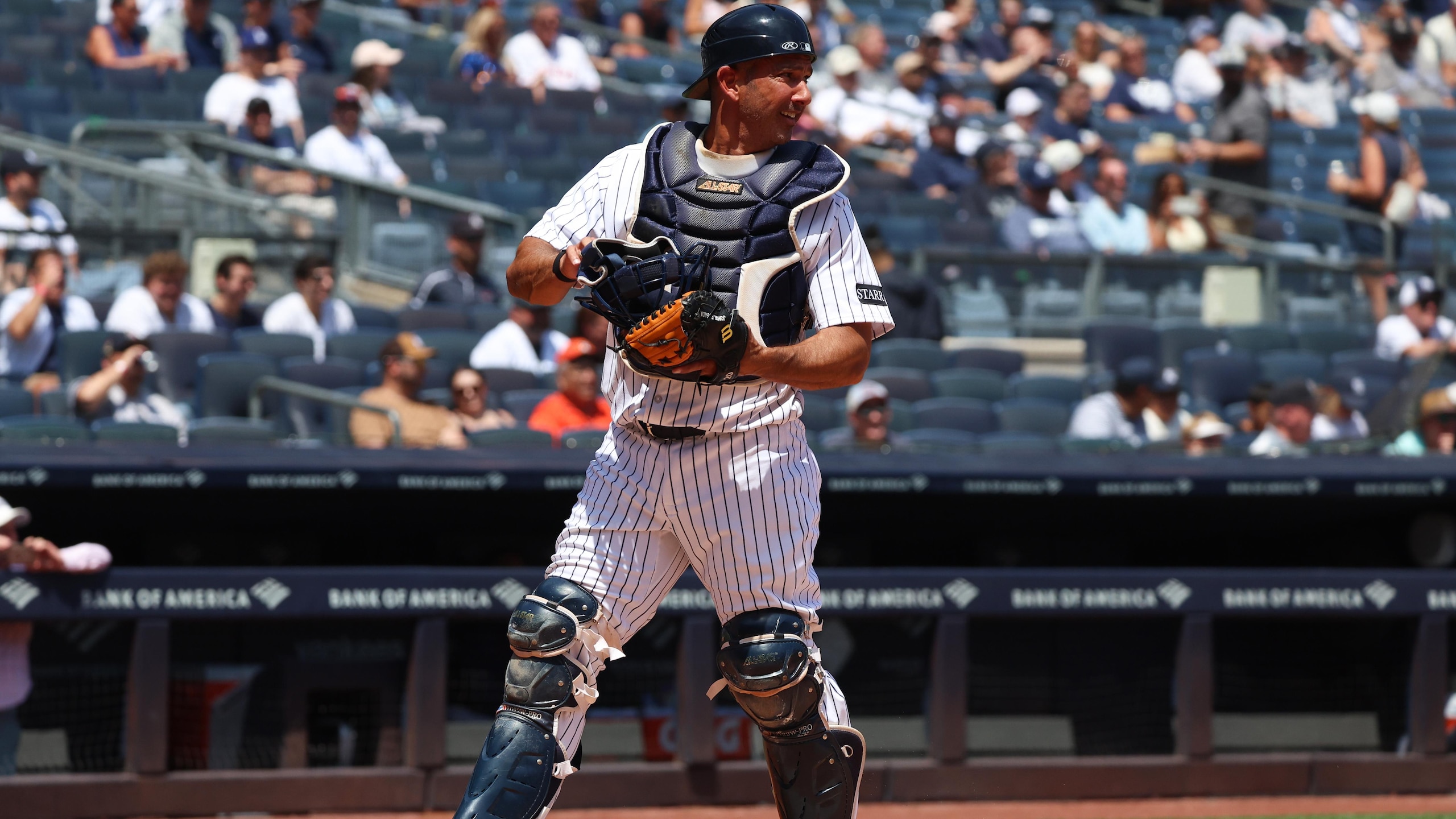
7 of 11After Jorge Posada underwent season-ending surgery to fix a torn labrum in his shoulder, the Yankees traded Farnsworth for Rodriguez, who was expected to assume New York’s starting catcher duties.
However, Rodriguez batted only .219 with two home runs and three RBIs in 33 games. He ended up splitting the role with career backup Jose Molina.
New York released Rodriguez after the season and he signed with the Astros, while Molina was kept for the 2009 season.
Farnsworth’s return to the Tigers went worse than his first stint with the club; his struggles with the Yankees carried over in Detroit.
Having racked up a 6-9 record and 4.33 ERA in 181 games for New York, Farnsworth went 1-1 with a 6.75 ERA in 16 games for Detroit.
Farnsworth was released after the season and signed with the Royals, where he spent 2009 and most of 2010 before a trade deadline deal to the Braves.
Verdict: Push
LaTroy Hawkins for Matt Cusick, 7/30/08
8 of 11The Yankees traded veteran reliever Hawkins to the Astros for minor league infielder Cusick just before the 2008 trade deadline.
In 33 games for New York, Hawkins posted a 5.71 ERA, the highest in his career since 2001. He enjoyed more success in Houston, going 3-4 with a 1.71 ERA in 89 games between 2008 and 2009.
Houston released Hawkins after the 2009 and he signed with the Milwaukee Brewers, where he pitched the last two seasons.
Cusick, a 10th-round draft pick by Houston in 2007, joined Advanced-A Tampa after he was traded. Although he only hit .174 in seven games in 2008, a .313 batting average through 63 games in 2009 earned him a promotion to Double-A Trenton.
He started 2010 with Triple-A Scranton, but was demoted to Trenton in June.
He was sent to the Indians after the season as one of two players to be named later to complete the trade for Kerry Wood, but he never appeared in the Indians’ farm system.
Verdict: Push
Jeff Karstens and Jose Tabata for Damaso Marte and Xavier Nady, 7/26/08
9 of 11New York packaged three pitching prospects (Karstens, Daniel McCutchen, and Ross Ohlendorf) and one outfielder prospect for veteran reliever Marte and outfielder Nady at the 2008 trade deadline.
Karstens, a starting pitcher, had broken into the majors late in the 2006 season, going 2-1 with a 3.80 ERA in six September starts. In 2007, injuries necessitated his promotion to the majors, but he struggled, finishing just 1-4 with an 11.05 ERA in 11 games.
In that same year, he made nine starts in the minors across five levels of New York’s farm system, appearing at every domestic level except Single-A. He never pitched for the Yankees in 2008 and was 6-4 for Scranton when he was traded.
He struggled out of the gate for the Pirates, going 2-6 in nine starts for Pittsburgh in 2008. His ERA jumped from 4.03 in 2008 to 5.42 in 2009 and Karstens finished 4-6 in 39 games.
His ERA would drop 50 points in 2010, to 4.92, but he finished the year just 3-10 in 26 games. However, Karstens rebounded with a strong 2011, going 9-9 with a 3.38 ERA in 26 starts and four relief appearances.
Karstens struck out a career high 96 batters in 162.1 innings and was named National League Player of the Week in the middle of July.
McCutchen was a 13th round draft pick by the Yankees in 2006 and was used almost exclusively as a starter. In 2007, McCutchen went 14-4 with a 2.47 ERA for Tampa and Trenton.
He started 2008 with Trenton, but rose to Triple-A by the time of the midseason trade. He finished the year 11-12 with a 3.57 ERA and started 2009 in the minors, but was able to earn his first major league promotion on the last day of August thanks to a 13-6 record and 3.47 ERA in Triple-A ball.
In six starts for the Pirates, he was 1-2 with a 4.21 ERA.
McCutchen was able to make Pittsburgh’s opening day roster as a starter, but after he struggled he was sent down to the minors, where he made 13 starts.
Despite a 4-8 record, he was promoted back to the majors to take a spot in Pittsburgh’s bullpen.He finished 2010 2-5 with a 6.12 ERA in 19 relief appearances and nine starts.
He completed his transition to full-time reliever in 2011, making 73 appearances for the club. In those appearances, he pitched 84.2 innings, compiling a 5-3 record, 3.72 ERA, and 47 strikeouts.
McCutchen will start the 2012 season in that same role.
Ohlendorf was one of the prospects sent to the Yankees in the trade that returned Randy Johnson to Arizona.
He made his MLB debut for the Yankees in 2007, pitching six games in relief. In 2008, he made 25 more relief appearances for the Yankees before the trade, going 1-1.
Pittsburgh immediately began using him as a starter and he finished the year 0-3 in five starts for the Pirates.
Ohlendorf blossomed as a starter in 2009, making 29 starts for Pittsburgh and pitching a career high 176.2 innings. In those 29 starts, he went 11-10 with a 3.92 ERA and 109 strikeouts against just 53 walks.
He was viewed as a cornerstone for Pittsburgh’s rotation in 2010, but he finished the season with a spectacularly bad 1-11 record in 21 starts. Despite his atrocious record, Ohlendorf did finish the year with a respectable 4.07 ERA and 79 strikeouts.
Ohlendorf did little to bounce back from his 2010 season in 2011. In nine starts, he was just 1-3 with an 8.15 ERA, the highest mark of his career. 2011 also included his first extended minor league service time since 2008.
Pittsburgh released Ohlendorf after the season.
New York signed Tabata as a 16-year-old international free agent during the 2005 season. A high-average hitter, Tabata batted .314, .298, and .307 in his first three stops in the Yankees’ farm system.
By 2008, he had reached Double-A, but at the time of the trade he was hitting a career-low .248 in the 79 games he played for Trenton.
The change of scenery seemingly restarted Tabata’s accelerated path to the majors.
In four games for the Gulf Coast Pirates he hit .455, which pushed him back up to Double-A Altoona, where he finished the season batting .348 in 22 games. He began 2009 with Altoona but was promoted to Triple-A after 61 games, in which Tabata batted .303.
His average would dip to .276 in the 32 games he played at Triple-A in 2009, but it jumped back up to .308 in 53 games in 2010, earning him a major league promotion.
Tabata played 102 games for Pittsburgh in 2010, batting .299 with four home runs and 35 RBIs. Although he briefly returned to the minors in 2011, Tabata played 91 games, batting .266 with four home runs and 25 RBIs.
Despite the dip in his stats, Pittsburgh viewed him as their left fielder for the long term, offering him a $14.75 million contract extension that will keep him under club control potentially through the 2019 season.
Nady was acquired to add a right-handed power bat to a lineup depleted by season-ending injuries to Hideki Matsui and Jorge Posada.
Pittsburgh had originally acquired Nady at the trade deadline in 2006 from the Mets for veteran reliever Roberto Hernandez and starter Oliver Perez. Over parts of three seasons Nady played 269 games for the Pirates, mostly in right field, batting .301 with 36 home runs and 152 RBIs.
After the trade, Nady batted .268 in 59 games for the Yankees, hitting 12 home runs and 40 RBIs. His combined .305 average, 25 home runs, and 97 RBIs in 2008 are all career highs.
Nady entered the 2009 season as New York’s starting right fielder. After seven games in 2009, in which he batted .286 in 29 plate appearances, he suffered an elbow injury. It would turn out to be season-ending, as he underwent Tommy John surgery (the second of his career) July 8.
He was released after the season, having lost his starting right field spot to Nick Swisher while on the disabled list. Nady signed with Chicago in 2010, but in both that stop and his most recent one (Arizona) he’s been restricted to first base primarily.
For Marte, this trade was the opposite of one he was a part of in 2001, in which the Yankees had traded him to the Pirates for infielder Enrique Wilson. The left-handed reliever began his second stint for the Pirates after the White Sox traded him to Pittsburgh following their World Series win.
In two-plus seasons in Pittsburgh, he compiled a 7-7 record and five saves in 187 appearances. He made 25 appearances for New York immediately after the trade in 2008, going 1-3 with a 5.40 ERA. His acquisition necessitated the movement of LaTroy Hawkins, who was traded four days later.
In 2009, Marte followed up a terrible regular season (1-3 record, 9.45 ERA) with a legendary postseason. After allowing two singles in his only appearance in the ALDS, Marte pitched 1.1 innings of perfect relief in three games of the ALCS.
Then, in the World Series against Philadelphia, Marte pitched 2.2 innings of perfect relief in four games. On the mound for eight at-bats in the World Series, Marte earned five strikeouts: two apiece by Ryan Howard and Chase Utley and one by Jayson Werth.
In 2010, Marte had a 4.08 ERA in 17.2 innings across 30 appearances before suffering a season-ending shoulder injury. Surgery and rehab cost him all of the 2011 season as well.
His injury was likely a major factor in the Yankees’ decision to sign lefty reliever Pedro Feliciano, who may never see major league action in pinstripes after missing all of the 2011 season with an injury and presumably missing all of the 2012 season rehabbing from rotator cuff surgery.
New York declined Marte’s 2012 option and offered him a buyout after the season. Although Marte’s excellent 2009 postseason brings up some debate here, it’s hard to argue for the Yankees in a trade that gave the Pirates a dependable starter, a serviceable reliever and their left fielder for the near future.
Verdict: PIT
Tyler Clippard for Jonathan Albaladejo, 12/4/07
10 of 11New York moved Clippard, a starter, to the Nationals for Albaladejo, a reliever.
Albaladejo broke into the majors with the Nationals in 2007, pitching in 14 games. He was 1-1 with a 1.88 ERA with Washington and made New York’s opening day roster in 2008 on the strength of his strong showing.
He pitched in seven games for New York in 2008, going 0-1 with a 3.95 ERA before his season ended because of an elbow injury. Albaladejo pitched in 32 games for the Yankees in 2009, going 5-1. His effectiveness was limited, though, as his ERA ballooned to 5.24.
He pitched just 10 times for the Yankees in 2010 and asked to be released to pursue a career in Japan, where he signed with the Yomiuri Giants.
Clippard started six games for the Yankees in 2007, going 3-1. He would start two more games for Washington in 2008, but he was switched to reliever in 2009, to great success. In his first two seasons in D.C., he was 15-10 with a 2.91 ERA in 119 games.
Neither season compared to 2011, when he was named an All Star. Clippard went 3-0 with a 1.83 ERA in 72 games for Washington in his All Star year.
Verdict: WSH
Conditional Deals
11 of 11Although they aren’t technically trades, there’s still a place for these conditional deals:
Chris Basak
Basak was a career minor leaguer for the New York Mets, spending six years in their farm system before he was released after the 2006 season.
He signed with the crosstown Yankees and spent nearly all of the 2007 season with the Scranton/Wilkes Barre Yankees. He did make his major league debut in July, playing in five games.
After just one plate appearance in those five games, the Yankees designated him for assignment and the Twins claimed him off waivers.
He rejoined the Yankees on a conditional deal on June 18, 2008, but never appeared in a game for the Yankees and was out of baseball after the season.
Chris Stewart
Stewart played 23 games combined over the 2006 and 2007 seasons with the Rangers and White Sox before he signed a minor league deal with the Yankees for 2008.
Stewart appeared in one game for the Yankees that year, going 0-for-3 with a strikeout. The Yankees released him after the 2008 season and he returned to the White Sox, his original club.
New York reacquired Stewart on a conditional deal on March 21, 2009, but he never made an appearance for the big league club and was released after the season.
After playing in two games for San Diego in 2010, he signed with the Giants, where he took on a more inclusive role following Buster Posey’s season-ending injury.


.jpg?w=2560 "Goff's 'Waterboy' Costume 💧")