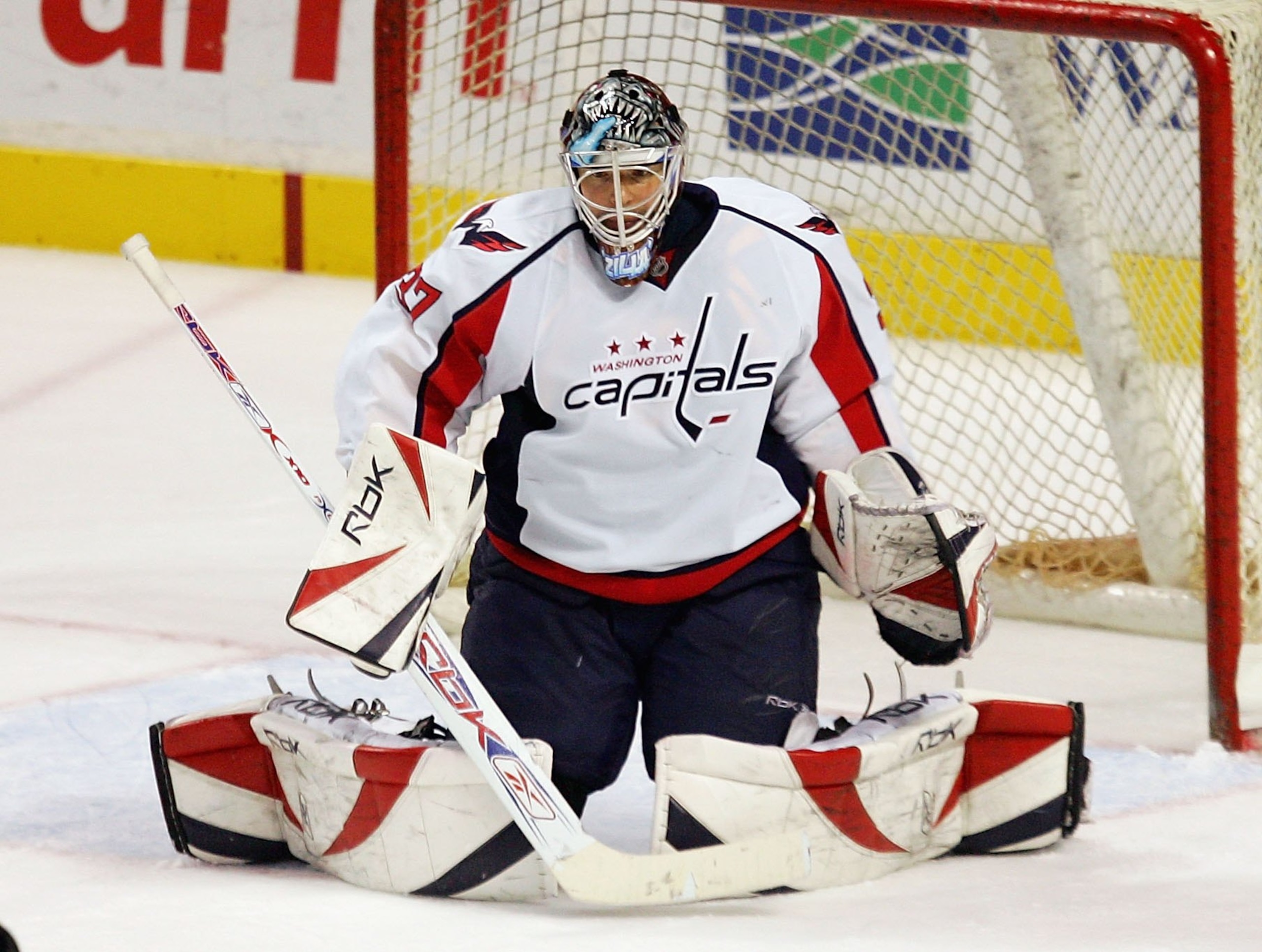

Washington Capitals Punishment: 10 Worst Losses for the NHL's Snake-Bitten Team
Many franchise fanbases feel they've had the gravest misfortunes deny their dream to watch their team win the Stanley Cup. Fans in the Vancouver, Toronto, St. Louis and Boston metropolitan areas are certainly to be envied for their enthusiasm and pitied for their team's shortcomings.
Other sports also have their fair share of snake-bitten franchises: the Detroit Lions and Minnesota Vikings can swap stories twice every year when they play each other. The Cleveland Browns can boast both a heartbreaking 1980's melodrama, starring John Elway, and the loss of their beloved original franchise, which relocated to Baltimore.
While Cleveland fans who root for those frowny Brownies can perfectly empathize with heartache, there is NO NHL franchise that has been as consistently great for the last three decades with nothing to show for it as the Washington Capitals.
They are easily the most snake-bitten (or, should I say frostbitten?) franchise in the National Hockey League.
The Capitals can be summed up fairly succinctly.
Capital regular seasons.
Lower-case playoffs.
To add to the misery of repeated postseason failure is the knowledge that more often than not, Washington's hockey heroes have been on the verge of thoroughly beating the teams who ultimately beat them. Rarely are the playoffs a simple exit in ol' D.C.
Instead of being out-classed and ousted again and again, the Caps find new and unique ways to find defeat from the jaws of victory. They do this repeatedly. It's like staring down an alley cat. You can back it down the alley and into the corner, but who has the cajones to step in and take it out after it shows its claws and realizes it can only escape right through one's own eyeballs?
In order to fully comprehend the magnitude of the Capitals fanbase's April and May (and, ever so rarely, June) plight, I have prepared a countdown that recalls the most hear-breaking endings in the franchise's history.
After reading, please find a fan of the team, give them a warm embrace and tell them you're proud of their team's commitment to making the postseason with such regularity.
BUT BE WARNED! Don't tell them, "maybe next year." They simply know better.
Capital Punishment: Honorable Mentions
1 of 11Most Capitals fans would agree that the majority of their frustration centers around two teams, both who scourged Washington in their own respective eras.
The Pittsburgh Penguins have beaten Washington on a regular basis, including four comebacks from two-game series deficits, since the 1990's.
The New York Islanders were an expertly-crafted hockey team in the 1980's, and Al Arbour's squad dispatched Washington with regularity. The first honorable mentions leaks out of the 80's and the peak of the rivalry, as well as bleeding into 1993:
- 1993 vs. New York Islanders
This is the classic series best known for the Game 6 incident where Dale Hunter checked Pierre Turgeon after he scored the series-clinching goal.
I wonder how awkward a few of those NBC telecasts were with Pierre between the benches with his microphone and Hunter behind the Capitals' bench as coach? Years may pass, but fate brings all back together! Right?
Late in the third period, a decade of frustration bubbled over into unsporstmanlike conduct, and Hunter was suspended for 21 games the following season due to the incident. While not as heartbreaking as their other losses to New York, the aggravation in this series for Capitals fans was that they lost three consecutive overtime decisions in Games 2, 3 and 4 after taking the series lead. If they score in any of those overtimes, the series would have been tied. As it stood, the Islanders had a commanding 3-1 series lead.
- 1986/1988 vs. New York Rangers and New Jersey Devils
As mentioned, the Capitals had fits with the Isles in the 1980's. In 1986, however, they swept the Isles, and played "New York Light" in the Rangers. Confident after their success, Washington Mike Gettner and Bobby Carpenter, who both had 50-goal seasons, had to feel strongly that they'd advance ot the Eastern Conference Finals. Nevertheless, despite outscoring the Rangers 14-4 in Games 2 and 3, they lost consecutive gut-wrenching decisions in three straight games, including two overtime losses. While goalie Pete Peeters played well, the offense stagnated in a six-game loss.
Two years later, the Caps avoided the Islanders when the Devils "upset" them. The lowly Devils had never won the Norris Trophy. Nevertheless, in a gutsy effort, they pulled out a 3-2 victory in Game 7, and the Capitals lost to an underrated opponent once agian.
- 2008 vs. Philadelphia Flyers
In their first playoff series in six years, Washington actually reversed fortunes and came back form a 3-1 series deficit to tie Philadelphia. While they lost in overtime, the prevailing notion was that the young Capitals and Alex Ovechkin would be back to contend for years to come. And, that may still be true. But, it'll have to wait for at least another year because of.....
- 2011 vs. Tampa Bay Lightning
The sweep.
Capital Punishment 10: Division Champs Meet Penguins' Clamps
2 of 11vs. Pittsburgh Penguins (2000 and 2001)
At the turn of the century, the Capitals had a lot going for them. Great stars Adam Oates, Peter Bondra and Joe Juneau were in their prime. Olaf Kolzig was a stellar net-minder who catapulted to the NHL's elite in the team's 1997 Eastern Conference Championship run.
In 2000, the team won the Southeast division with 102 points, securing a top-seed billing and a favorable matchup. Certainly, coming off of such heartache against the Penguins in the 90's, they were happy to avoid them. There was one issue: They didn't.
The Penguins barely finished above .500 despite the great Herb Brooks being behind their bench. The Capitals would simply have to hope for a better outcome, not a new matchup.
To rile the Capitals up even more, the NHL (due to scheduling complications) revised the series format to a 1-2-2-1-1, meaning that the Capitals would have to travel to Pittsburgh for two games immediately after Game 1. Many criticized the Capitals, noting that no victor could be determined without Washington having the same number or more home home games, much like any other series.
In near-defiance to their criticisms, Pittsburgh won Game 1 in Washington 7-0. Two one-goal victories in Pittsburgh game the Penguins a 3-0 series edge. Washington came back home for a two-game stanza, winning Game 4 at home. Suddenly, if the Caps won Game 5, they would be a lone win in Pittsburgh away from forcing a seventh game. Stale-mated at 1-1 in the third period, Tyler Wright threw a desperate puck toward the net from the far boards that bounced off of a defender's leg and into the net, and the Penguins won the series.
2001 ended in similar fashion, with a brand new opportunity for the Capitals. They again won the Southeast (96 points) and were favored to disband the Penguins, who were galvanized by the return of Mario Lemieux to the line-up.
Game 1 saw Washington in a complete turnaround from the start of the 2000 series, winning 1-0 in a goal-tending exhibition. The Penguins won a hard-fought Game 2, and returned to Pittsburgh for a decisive Game 3. Johann Hedberg was the talk in Steel-town, and at the Igloo (Mellon Arena), he played like ice. Cold, and unforgiving. A 34-save shutout and 3-0 Pens victory later, and Washington was again on the ropes despite the home-ice advantage afforded to them. This game was the first time that the "mooooose" chant (Hedberg's nickname for his play with the minor league Manitoba Moose) was heard on a national level.
Despite goals by Jagr and Lemieux, the Penguins lost Game 4 in overtime. Despite losing in Washington for the second time in the series, the Capitals had a 3-2 lead late in Game 6, but the Penguins tied the score. In overtime, Martin Straka stole the puck from future Pen, Sergei Gonchar, and the rest was history.
While neither of these series quite stand with the series' leads Washington had squandered in the past (and future), the most heartbreaking element of these back-to-back series for the Capitals was that they were widely regarded as a stellar team with Cup ambitions following their trip to the finals in 1998. Fans were abuzz at the turn of the century, ready to turn the page on past failures and looking forward to a brand-new championship era of hockey in the District of Columbia.
Ironically, they drew the same team both years that had tortured them throughout the 1990's. Instead of this being a great opportunity to bookend their struggles, the outcome was eerily familiar, and two consecutive stellar seasons ended in first-round heartache to the hated Penguins.
Capital Punishment 9: Struck by Lightning
3 of 11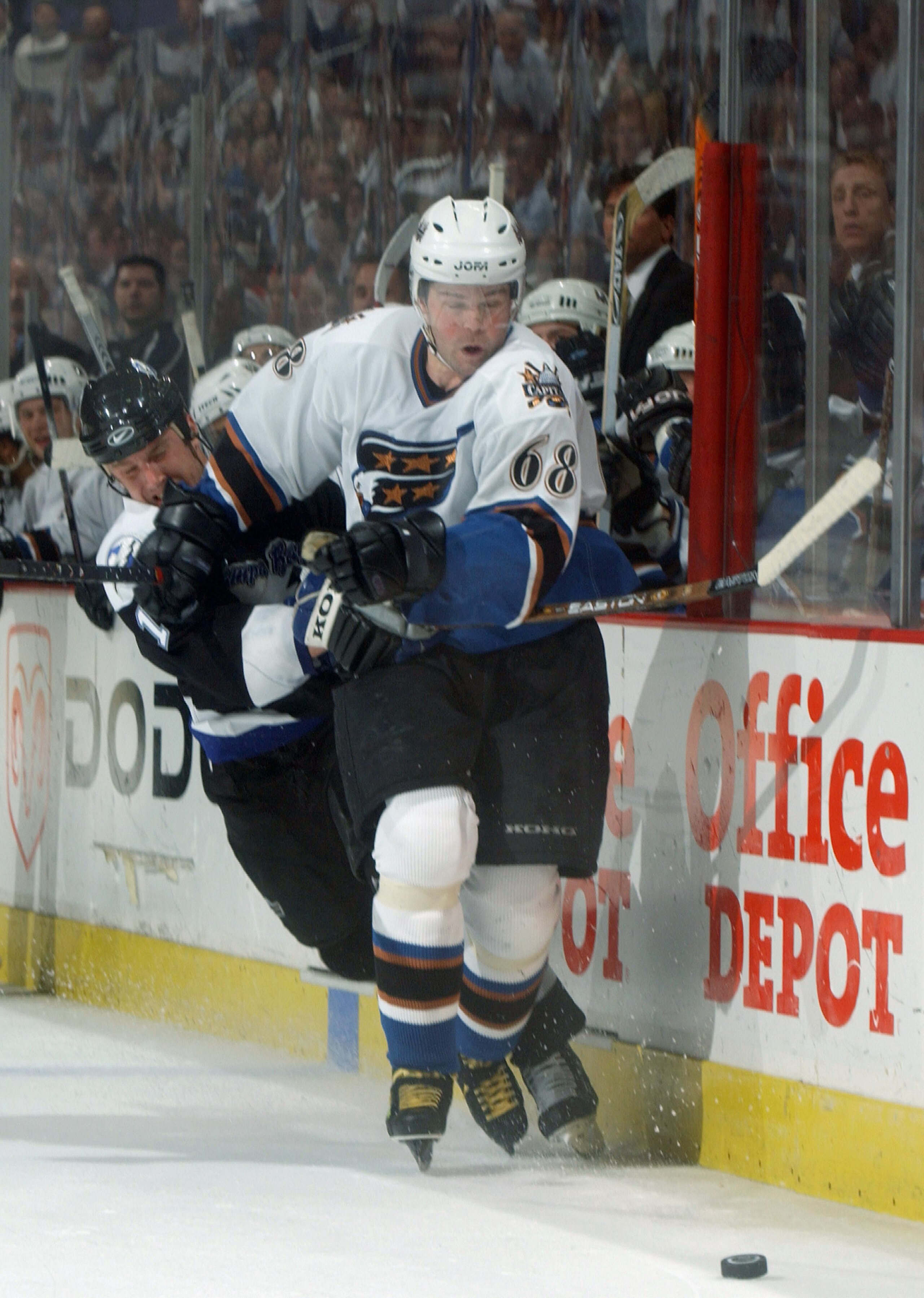
vs. Tampa Bay Lightning (2003)
When Jaromir Jagr exited Pittsburgh to play for Washington in 2001, it was easy to be optimistic as a Capitals fan. After three consecutive division titles, the Capitals had exited the playoff in the first round each of the previous two seasons, losing to the Penguins. So, obviously, as the saying goes, "If you can't beat em...."
"Take them from the franchise you're looking to destroy!"
For their commitment to excellence (I feel obligated at this time to give Al Davis credit for the statement that I just used in order to avoid litigation), the Capitals didn't make the playoffs in 2001?
After missing the playoffs as the ninth-seed in the East, the Capitals 2002 season saw a return to form for the team, but they missed out on a division title by a single point, 93-92. This set up a division matchup in the first round against the young, talented Tampa Bay Lightning. The combination of Martin St. Louis and Vinny Lecavalier catapulted the Lightning from the NHL's depths to competitiveness in the blink of an eye.
The Capitals dominated Tampa Bay in Florida, winning both of the first two games and taking the feared (only in Washington) 2-0 series lead back home.
When your postseason sensitivity level is that of the Washington Capitals, any squandered opportunity only magnifies as years pass. Each new lost chance seems like the end of the world, and a self-fulfilling prophecy takes place as doubt seems to fester in the mind of the team. I can think of no other way to explain what happens to this franchise.
At home in Game 3, they played 60 minutes of competitive hockey and headed to overtime. Enter: Vinny Lecavalier, self-doubt initiator, whose goal in overtime brought Tampa back into the series. They subsequently answers the Capitals road-sweep with one of their own, winning 3-1 to tie the series.
After losing both Games 5 and 6 by 2-1 margins, Capitals fans saw their team exit the playoffs in the first round for the third straight time. Game 6's triple overtime defeat was likely a practical certainty to any Capitals fan who had endured the previous two decades. Washington, fully armed and with Jagr on their side, scored six goals in Game 2. They only scored half that tally in the final three games combined.
-(1).jpg?w=2560 "Bleacher Report")
Capital Punishment 8: Nedved Scores in Fouth Overtime
4 of 11vs. Pittsburgh Penguins (1996)
By 1996, the Capitals had already blown two two-game series leads to Pittsburgh in previous playoffs. If that is a spoiler for things to come, you obviously are not a Caps or Pens fan, as they realized before clicking "Start Slideshow" that 50 percent of this list would be a march of the Penguins on the team's heartbeat.
Washington came out smoking, whistling white-hot blasts and firing pucks past Tom Barrasso as through he were having a 2-for-1 fire sale. The Capitals won the first two games in Pittsburgh, only needing a split back home to have a commanding 3-1 series lead, or, as they call it in Washington, a 3-1 series lead.
Ken Wregget replaced Barrasso in net, and the Pens shaved the lead to 2-1 with a desperate win in Washington.
Game 4 would be a game for the ages. The Capitals future looked incredibly bright as Mario Lemieux was ejected from the game in the second period for an unsportsmanlike altercation. As the game entered overtime, Capitals fans anxiously knew that the next 20 minutes would decide their fate. Would they:
A) Take the 3-1 series lead
B) Allow Pittsburgh to tie the series and, as such, inevitably win
It turned out 20 minutes would not be enough. Nor 40. Not 60.
After playing an additional hockey game after regulation, the game entered the wee hours of the morning, and the fourth overtime saw the Penguins on the powerplay. An attempted shot was blocked, but the puck stayed in the zone, and Nedved received a gentle pass. He skated toward the left circle, deaked a defender sliding to block his shot, and sent a soft wrist shot through a mass of bodies in front of the net.
The Penguins would win the series in six games.
Capital Punishment 7: Long Island, Long Offseason
5 of 11vs New York Islanders (1985)
When Washington lost Game 5, 2-1, at home against the New York Islanders in 1985, little did they know what a heartbreaking and gut-wrenching trend they had just started.
The Capitals entered the playoffs with two 50-plus goal scorers in Mike Gettner and Bobby Carpenter. This was nothing new for the team to enter Stanley Cup playoffs versus the former champion Islanders. After being dominated in prior playoff seasons by the Al Arbour dynasty, the Capitals entered 1985 with a determination to change their destiny against the Long Island squad.
Washington took a commanding 2-0 series lead in the best-of-five series, but they dropped both games at Long Island, setting up a decisive Game 5. Never before had the Capitals had the Islanders in their grasp or gone so deep into a playoff series against them. A home win would change their stigma of exiting to the Isles.
The Capitals played a tough game against New York, but they lost 2-1 on goals from Islanders Brent Sutter and Anders Kallur. This marked the first time a team came back in the NHL from a 2-0 deficit in a best-of-five format.
Capital Punishment 6: Capitals Fall Apart in Game 2 of the Stanley Cup Finals
6 of 11vs. Detroit Red Wings (1998)
This countdown focuses primarily on the series themselves opposed to the magnitude of the games and the round in which they occur (though that clearly has to have some influence).
Nevertheless, to not mention the sweep of the Capitals in 1998's Stanley Cup Finals would be a glaring oversight and prove me to be remiss.
The 1997-98 season was never full of promise for the Washington Capitals. After fielding teams that were favorites to contend for the Stanley Cup in the late 80's and, especially, the early 90's, the franchise had begun to fall off. Despite production from heavies such as Adam Oates, Joe Juneau, and Peter Bondra, the Capitals missed the playoffs in the 1996-97 campaign. Many questioned if they'd simply lost "IT." After all, the talent was still in place, but the wins were no longer coming!
The Capitals finished with 92 points, 15 points behind conference heavyweight New Jersey. Entering as the fourth seed, the Capitals hosted the Bruins in the first round, having a 3-1 series lead. The Bruins won 4-0, and ugly feelings began to set in. In Boston, the Capitals won in overtime to end the series. It was a nice change of pace, and a series victory helped their confidence.
If their good fortune in Boston wasn't enough, the Eastern Conference playoffs in 1998 was a field of upsets, and the Capitals had home-ice for the entirety of the tournament, dispatching Ottawa and Buffalo (with Dominik Hasek). Domination over Ottawa gave the Capitals legitimacy, and an overtime win in Buffalo seemed to exorcise some demons of playoffs in the past. While other great Capitals teams fell short, this underrated band of Caps was going to the Stanley Cup Finals, largely due to the marvelous play of "Ollie the Goalie."
Unfortunately, there are no magic carpets in real life, and this ride came to an end against the Red Wings. While a sweep made it appear as though Detroit was overwhelmingly superior, the Capitals had the opportunity to make the series enticingly close. Each of the first three games was decided by one goal. Leading Game 2, Washington had an opportunity to tie the series. Detroit cut a 3-1 Capitals lead to 3-2 in the third period. A split in Detroit seemed inevitable when a power play goal game Washington a 4-2 lead and reestablished their cushion. Detroit came back, and the game went to overtime. Despite their chances in the extra session, a great opportunity was already squandered. Who knows how things may have changed if they'd held the lead? The Red Wings won and used the momentum to win the Stanley Cup.
Capital Punishment 5: Penguins Rally from 3-1 Series Deficit (Part 1)
7 of 11vs. Pittsburgh Penguins (1992)
The 1992 Washington Capitals had it all. Offense. Goal-tending. Defense. They were playing on top of their game. Great stars from the 1980's like Dale Hunter were coupled with new, rising stars, especially Peter Bondra to create a team that many felt was a front-runner to win the Eastern Conference.
The Pittsburgh Penguins had beaten the Capitals handily en route to their first Stanley Cup one year earlier, but they struggled to make the playoffs in 1992 and entered as a third-seed in the Prince of Wales Conference. The Capitals only knew heartache from the Islanders in the 1980's. They were ready to turn the page, beat the defending champs and enter a new era of glory and success.
After taking a commanding 2-0 lead in the series in Washington, the Capitals entered Pittsburgh seeking a split,which they achieved in a demolition of the Pens in Game 4, 7-2.
Washington had a complete swagger, and Pittsburgh appeared as the struggling team that barely qualified for the playoffs. Indeed, the Penguins were going to fall to the Capitals, and they would not defend their title as the NHL's best. The public eye had Lemieux's golf clubs shined and polished.
After a great game by Bob Errey in Game 5, the Penguins left Washington a victor and returned to Pittsburgh for a decisive Game 6. Tied at four, Mario Lemieux showed why he is one of the greatest hockey players to ever lace his skates, even when he could barely bend down to do so later in his career. His two goals in the final minutes earned the Pens a 6-4 victory. Surely, Capitals fans couldn't help but to relive memories from 1985 and 1987 against the hated Islanders.
This served an accurate premonition, as Lemieux and Jagr both tallied goals in Game 7, a 3-1 Penguins victory. A new age, a new collapse, a new opponent.
Capital Punishment 4: Penguins Rally from 3-1 Series Deficit (Part 2)
8 of 11vs. Pittsburgh Penguins (1995)
A strike-shortened 1995 campaign saw the Washington Capitals start the season 3-10. While a few of the faces (such as Dale Hunter) remained from the regime of the 1980's, the Capitals were beginning to fully transition into the team that would be the Capitals of the 90's. Obviously, there were some growing pains.
The team picked up goaltender Jim Carey, and together with Peter Bondra's magnificent play, the Capitals rallied for a 19-8 finish to the season. They secured a playoff spot and entered as one of the NHL's hottest teams. Their slow start cost them, however, and they would begin their playoff journey at Pittsburgh.
Washington earned a split in the Steel City, winning Game 1, 5-4. Accomplishing their goal up north, the Caps travelled back to Maryland hoping to take a stranglehold on the series.
They did exactly that! The Capitals destroyed Pittsburgh in consecutive 6-2 blowouts. While they'd blown series leads in the past, this year's 3-1 Penguins deficit seemed insurmountable. Simply, they were being outgunned and outclassed.
With an opportunity to win the series, Washington and Pittsburgh played to a 5-5 stalemate in regulation of Game 5. Overtime began, and one fortunate shot by the Capitals would end the series and exact vengeance of the beleaguered Penguins. As always, fate saw things differently. Luc Robitaille scored for Pittsburgh, sending the series to a sixth game. The Capitals had blown series leads in the past, but never after such domination, and not with such a rich opportunity to put away an opponent.
Eager fans in the nation's capital welcomed the return of their white-hot hockey club with optimism. They had destroyed the Penguins by a cumulative 12-4 score in the two-game set days before. That domination would pale in comparison to the prowess the Penguins would demonstrate in Games 5 and 6.
The moral of the 1990's for the Capitals: When you have a chance to put Mario Lemieux, Ron Francis and Jaromir Jagr down, you'd better do it.
The Penguins won the final two games of the series by a combined score of 10-1, including a 7-1 demolition in Washington. In Game 6, the Penguins scored 6 goals on their first 13 shots, all but ending any chance of avoiding Game 7.
Capital Punishment 3: Ovechkin vs. Crosby
9 of 11vs. Pittsburgh Penguins (2009)
There's no denying the fury of both fanbases heading into this series.
The Capitals sported new-wave stars: Alex Ovechkin, Mike Green, Alexander Semin.
The Penguins sported new-wave stars: Sidney Crosy, Marc-Andre Fleury, Evegeni Malkin
Both teams had risen from the ashes of the middle decade to reclaim their status as first-rate, elite NHL franchises.
There were two ties to the old rivalry that saw Capitals fans so often heartbroken. Ironically, former Capitals defenseman Sergei Gonchar now sported the black and gold. The other tie was the fanbases and their long memories.
The top two stars in the NHL were being used to promote the product in campaigns galore, and a furious debate raged regarding the top superstar in hockey. Was it the Capitals' goal-scoring extraordinare? Or was it the Penguins' meticulously rounded tactician, Sidney Crosby? It seemed evident that the devate would continue until one of the stars won the Stanley Cup.
In 2009, the Capitals won their division and hosted the defending Eastern Conference Champions. For both squads, this was an opportunity to demonstrate superiority in the most critical juncture of their reinvigorated rivalry.
For the Capitals, it was a chance to erase the pains of the past and to move on in an exciting new era.
For the Penguins, it was about proving that while faces change, the franchises' fates would be exactly the same.
The Capitals struck first, winning Game 1 by a 3-2 tally. The game was highlighted by an amazing save by goaltender Varlomov on the NHL's "biggest" star.
Game 2 saw both franchise elites score hat tricks, as Ovechkin and Crosby awed the Verizon Center crowd in Washington in what many would bill the playoff game of the year, if not the decade. The Capitals went on to win by a score of 4-3.
Returning to Pittsburgh, the Capitals played the Penguins to a 2-2 stalemate in regulation. The circumstances were eerily similar to 1995, where an overtime win in Pittsburgh would give the Capitals a three-game lead in the series (in '95, it would have won the series). The Penguins, almost in chorus with the history of the rivalry scored in overtime and followed with a victory in Game 4 to tie the series.
Critical Game 5 was also won in overtime by Pittsburgh, 4-3. Malkin's intended pass across ice deflected off of the Capitals and into the net, like 2000's Game 5. History seemed to be repeating itself, so it was clear, in the same vein as 1996, that the Penguins would crush the Capitals in Pittsburgh.
Game 6 saw the Capitals answer the Penguins overtime successes. A late Washington goal sent the game to overtime, where they won. This was counter-intuitive to the results of earlier series between the clubs, setting an uncertain stage for Game 7.
Would there be an exorcism of the past in Washington?
Would there be an exercise of domination in Pittsburgh?
As if we all knew the answer, Marc-Andre Fleury began the game with an amazing save on an Ovechkin breakaway, and the Penguins carried their momentum (and two goals by Sidney Crosby) to a blowout 6-2 win.
The new-age Capitals made like the old days, losing to the Penguins despite a two-game series lead, and watching the best player in hockey win the Stanley Cup. Lemieux and Crosby were bringing both Pittsburgh and Washington full circle.
Capital Punishment 2: The Easter Epic
10 of 11The 1980's saw the original rise of the Capitals to hockey competitiveness. In the early part of the decade, a strong Islanders team disbanded Washington throughout the early playoff years, sending the talented squad home annually. This included a 2-0 series lead that was squandered in 1985 that saw the Islanders come back and win Game 5 by a single goal.
By 1987, the Capitals were considered strong Cup contenders. They had all of their talent in place, and they solidified in key areas defensively. Scott Stevens and Larry Murphy, both future all-time greats, anchored Washington. Although they had a mediocre record (they were below .500 at various points of the season) they gelled late in the year, winning their final eight games.
Naturally, their first-round opponent would be the Islanders, whose descent from the NHL's elite was in progress but not complete.
Washington split the first two games at home. In Nasseau, it seemed very clear that Washington was on the precipice of turning their struggles against New York into a momentous series victory. In two games, they gave up only a single goal, dominating the Islanders in 2-0 and 4-1 outcomes. A 3-1 series lead gave the Capitals full control of the best-of-seven series.
The Capitals dropped to 1-2 at home in the playoffs in Game 5, losing to the Islanders 4-2. Hope was still very much alive as they travelled to New York, where they dominated the home team Isles days before. The Islanders gut check came in the form of a narrow 5-4 victory, forcing Game 7.
If the Capitals were going to fully send a message to the rest of the NHL that they were truly on the verge of greatness, they would have to shake the Islanders second two-game rally in the postseason against them. The solution: Win Game 7. Win the game, win respect. It was that simple.
Overtime after overtime after overtime, tension grew. Children attending the game with fathers expected their first Easter memory of 1987 to include visions of baskets, chocolate, mystical bunnies and holiday heartwarmth. Not heartache. As the fourth overtime began, midnight had passed, and Easter Sunday had arrived.
Twice in their history, the Capitals have lost critical games in four overtimes in front of their home faithful. This marked the first such occasion. The Islanders destroyed Washington hopes to right the ship in their rivalry with Pat Lafonatine's goal in the fourth overtime. Washington's season ended in stunning disbelief as New York solidified their domination between the two teams in the 1980's.
Capital Punishment 1: The Montreal Meltdown
11 of 11
Years of making heartache a science made it possible. Practice makes perfect, but wiser souls know perfect practice makes perfect. And, nowhere else in sports has the practice of losing playoff series leads in gut-wrenching, soul-emptying fashion been perfected like it has in Washington.
In 2010, the outcome of the greatest Capitals regular season in franchise history was clearly the result of years of rehearsal. The Caps knew how to blow it with the best of them, and this new team had figured out the art in the previous two years vs. the Flyers and Penguins. Now, it was time to eclipse them all! It was time for the single greatest meltdown in Capitals playoff (if not NHL playoff) history.
The Capitals and Alex Ovechkin destroyed the rest of the NHL, dominating to earn 121 points. A 14-game win streak was the highlight of their season, including a riveting comeback win in overtime against hated Pittsburgh, 5-4. It was during a Saturday afternoon Game of the Week, and it demonstrated the team's offensive prowess, rallying from a 4-1 third period deficit.
For their production, the Capitals earned top seed in the Eastern Conference and would play a seemingly mediocre Washington Capitals squad. The opposing goalie was Jaroslav Halak, and Canadian hockey fans believed a great performance in net could make the series competitive.
Montreal won Game 1 in overtime, and most fans labelled the victory as a fluke. The Capitals firepower only needed to get going, and the onslaught would be too much for Montreal to handle.
In Game 2, the Habs scored early and often, and they had a 4-1 lead late in the 2nd period. It appeared as though Washington heartaches of prior seasons was rearing its ugly head. Suddenly, the offensive onslaught predicted by so many occurred. The Capitals rallied from both this deficit and a 5-4 Montreal lead late in the third period. In overtime, the Capitals dominated, earning a 6-5 victory in 30 seconds. Jaroslav Halak appeared entirely pedestrian.
Washington would test its offensive caliber against fresh blood in Montreal, as Halak would be pulled and Price would replace him in goal. Washington soared to a 5-1 victory in Game 3 that wasn't even that close. Game 4 saw Hab's fans energetic after Montreal took a 2-1 lead late in the third period. It seemed Price was the answer in net, until Mike Knuble scored a shorthanded goal with seconds to go in the period to tie things at 2-all. Montreal attempted to fight back late, but the Caps' firepower and two empty net goals resulted in a 6-3 win. Washington looked as dominant in the postseason as it had all year, leading 3-1 in the series.
Then, on a gut decision, Halak returned to the cage for Game 5, and everything just changed. History in Washington has been that simple. It just changes. Halak stayed composed, the Capitals stopped scoring goals, and the dynamic of the series shifted more severely than any of the previous times the Caps came up lame. The drop-off comparison below showcases the extreme nature of the Capitals' offensive implosion:
Games 2 (3rd period)—3 goals.
Game 3 (2nd period)—4 goals.
Game 4 (3rd period)—4 goals.
Games 5-7 combined—3 goals.
As Washington continually got shut down at the net, Halak gained more and more confidence, propelling Montreal to the eventual Eastern Conference Championship.
Washington lost twice in the final three games by scores of 2-1. Even at their peak, the Capitals couldn't start a new chapter to their history, an era where important games are their forte and winning that fourth game is their habit.
Fans left Verizon Center with broken hearts and lumps in their throats. A new era. A new pain.

.jpg?w=2560)

.jpg?w=2560 "McCarthy 'Not Surprised' to Be QB1")
.jpg?w=2560 "Breaking News")

.jpg?w=2560 "Porziņģis Trade Packages 📦")