
And Another Thing... | Gareth Southgate Is England's Brightest Young Manager
This might not be an earth-shattering revelation, but it can’t be much fun being a Premiership manager.
They know this when they take the job, of course, but it still catches many unawares. Often what gets them is the the very essence of the job; You take all the criticism when things go wrong, and continue largely unnoticed when things go right.
If you happen to be an English manager, however, that rule is even more apt. In the modern media it is fashionable to ridicule English coaching methods, so the slightest error will be mercilessly picked apart. And at the other end of the scale, any success that does not include something tangible (trophies) will be routinely ignored.
TOP NEWS
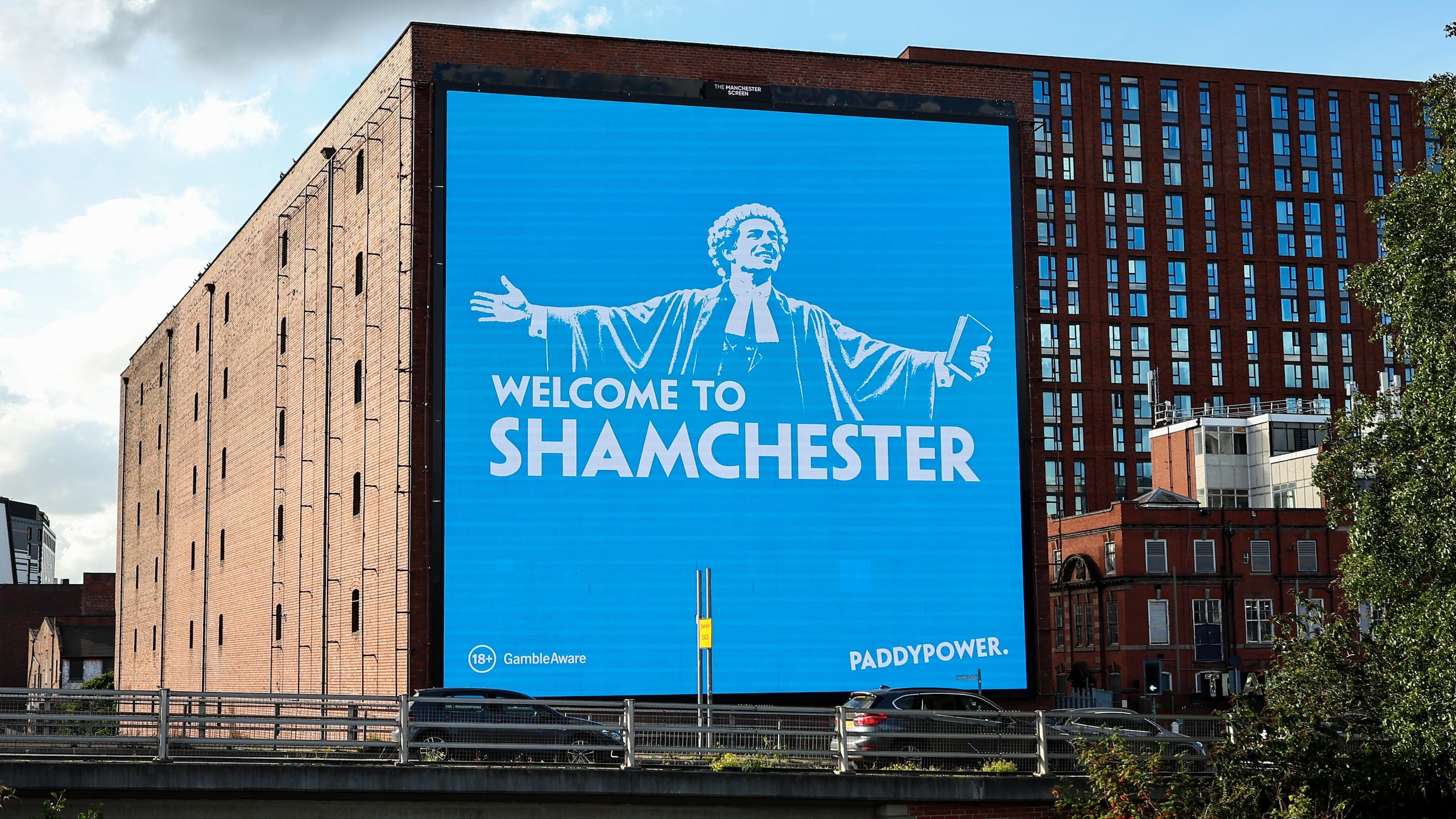
Billboard Trolls Man City 👀

New NFL contenders starting to emerge after Week 4
.jpg?w=2560 "Cardinals Giants Football")
NFL investigating 2 referees for separate viral exchanges
Take Gareth Southgate, for example. The current Middlesbrough manager has worked tirelessly since he was appointed to the job, in May 2006.
Since then, partly as a result of the Teeside club’s unfashionable reputation, the former England international has received little media coverage, other than a period of criticism surrounding his initial appointment.
This might not be surprising, until you consider that the 38-year-old has probably gone on to mastermind one of the most impressive revolutions of any top flight club.
It is easy to forget that Southgate succeeded Steve McClaren as Boro’s manager, after the “Wally in the Brolly” departed for his ill-fated spell as England manager. McClaren hardly left him a great squad, either.
Yes, the team had reached the UEFA Cup final that season, but it had been more a result of Stewart Downing and Massimo Maccarone’s consistent last-ditch heroics than any tactical acumen on McClaren’s part (few could argue it was his plan to go 4-1 down in every game).
More pertinently, during McClaren’s last season at the club supporter morale reached an all-time low. One fan, outraged by the consistently poor performances he saw from the team (they lost 7-0 to Arsenal that season), entered the Riverside pitch during one game, approached the manager, and threw his season ticket at him in disgust.
He simply could not take it anymore.
While things did improve slightly as the season ended, this was basically the environment into which Southgate entered. Even for an experienced manager it would have been a daunting task, never mind for a rookie who didn’t even have the requisite coaching licenses.
Nevertheless, Southgate took on the job with vigour. Having only just ended his playing career, the former defender had to find someone to fill his old role, as well as reinvigorate his aging side. After all, he inherited a squad that relied on the likes of Ugo Ehiogu, Colin Cooper, Gaizka Mendieta, Doriva, Ray Parlour, and Jimmy Floyd Hasselbaink for success—all men coming to the twilight of their careers.
Fast-forward three years, to Saturday’s match against Portsmouth. At Fratton Park, Southgate’s new look Middlesbrough fielded a team consisting of no players over 28 years of age.
Blending the best of the old regime (Emmanuel Pogatetz, Stewart Downing) with his own signings (Mido, Afonso Alves, Gary O’Neil, Didier Digard), Southgate presented a solid and attractive team, that was ultimately only foiled by an in-form Jermain Defoe.
What is arguably even more impressive, however, is the way Southgate has successfully included home-grown and youth talent into his setup. On Saturday, 23-year-old Ross Turnbull started in goal—the youth product gaining his chance after veteran Mark Schwarzer was allowed to leave—and all seven substitutes could trace their development to Boro’s youth ranks.
Of them, many are predicted to go on and push for full England honours. If they continue at the Riverside, they could form the spine to an extremely talented and effective team.
Only yesterday, Mike Ashley came out and revealed how he had intended to copy Arsenal’s football development programme—scouting and acquiring talented youngsters who could potentially develop into first team stars. Compared to the rest of the “Big Four”, he insisted it “has to be” the only way to compete.
Gareth Southgate would doubtless agree with his sentiments. After all, he too has tried to emulate the Arsene Wenger’s much lauded strategy.
In part, this has been done in the easiest (and laziest) way—by buying Arsenal’s youth “off-cuts”. On Saturday, both Jeremie Aliadiere and Justin Hoyte started the game, each man having learnt his trade at a certain North London club.
However, Southgate has not stopped at that. He has taken on some of Wenger’s other traits—especially in placing faith in his own countrymen. Most of the youngsters under his gaze are English, and he has not been afraid to give them opportunities.
This is especially true in defence, where the likes of David Wheater and Andrew Taylor have flourished as a result of Southgate’s expertise. Wheater will doubtless gain England recognition soon enough (he has already been included in one of Fabio Capello’s squads), and Taylor will hope to follow suit.
Obviously, Southgate cannot take all the credit for the prolific work of Middlesbrough’s youth system, as it was churning out talent even before he arrived at the club as a player—the likes of Stewart Downing are a testament to that. But he deserves credit for continuing that good work and, like Wenger, giving the resulting players the chance to show what they can do at the highest level.
In another nod to the Frenchman, Southgate has also shown a ruthless streak, something that has enabled him to discard youth players who he doesn’t believe will make the grade. This can be seen in the sale of Lee Cattermole, the 20-year-old moving to Wigan Athletic after Southgate deemed their £3.5m transfer bid to be sufficient recompense for the club’s development of his talent.
Arguably, it is this trait that will serve him best as he continues his managerial career—there is simply no room for sentimentality in the modern game.
Ultimately, Southgate has done a great job since Middlesbrough chairman Steve Gibson decided to put his faith in his respected former captain. In both seasons at the helm, he has finished higher in the league than McClaren managed in his final outing (12th and 13th, compared to McClaren’s 14th), no mean feat for a man without managerial experience.
In a matter of three years, he has also overseen the rejuvenation of the club’s squad. When Arsene Wenger stated Southgate was “good enough” to manage England, it is difficult to disagree.
There is now a genuine optimism surrounding Middlesbrough these days, something that could not be said of the last few years. That has to be credited to their manager.
Despite this, the media have often failed to acknowledge his achievements. Never one for controversy, he has regularly been forgotten about in the back pages of newspaper. It is another injustice that highlights the failings of the modern English media.
As Paul Ince gets heavily linked to the vacant Newcastle post, questions must be asked. What, in all honesty, has the former Manchester United man actually achieved in management? In his four Premiership games so far, he has been on the end of three heavy defeats, and managed one fortuitous win—does this deserve consideration for another career promotion?
He has done nothing of note, yet finds himself fending off questions about his availability for other jobs, while managers like Southgate sit around and twiddle their thumbs. No one is suggesting Southgate would definitely want the job, but surely he warrants more consideration for it than a manager who is unproven at the top level?
Maybe it is his media profile, maybe it is the fact he is not one of Sir Alex Ferguson’s former charges, maybe it is another reason entirely that makes Southgate less fashionable than Ince, Mark Hughes, or Steve Bruce when managerial vacancies are discussed. But Southgate has produced concrete results, something only Hughes can also claim.
He deserves recognition.
Another example of this is Roy Hodgson. The Fulham manager enjoys massive respect on the continent, to the point where Inter Milan have publically stated that he will always have a role at the club, should he want it. Yet, due to one poor spell in charge of an already declining Blackburn Rovers, Hodgson is considered to be an unfashionable manager in England.
His heroics in saving Fulham from relegation last season have gone some way to restoring his reputation on these shores, but the respect is still lacking. If he were foreign, the media would be singing his praises from all corners.
Ultimately, if Ashley is serious about his vision for Newcastle, then he will be considering Gareth Southgate, not Paul Ince, for his managerial vacancy. It would show a foresight and judgement that has been all to lacking in his disastrous tenure.
Southgate is the Premiership’s brightest young managerial prospect. People just haven’t realised it yet.
But you won’t hear Middlesbrough fans complaining.
You can read the previous And Another Thing, about England's relationship with the media, here.

.jpg?w=2560 "Hill Injury Update Football")
.jpg?w=2560 "OBJ Calls Out Giants After Release")
.jpg?w=2560 "Tyreek makes another cryptic post amid Chiefs rumors")


.jpg?w=2560 "Greenlaw Talks Payton Exchange")
