The 50 Greatest Miami Hurricanes
By (Correspondent) on April 28, 2010
47,183 reads
There have been several top 10 lists put out recently, and compiling a top 50 list only seemed right. The rankings of these players were not just based on their time at UM, the rankings are based on their overall impact to the University of Miami Football Program.
No list is ever without flaws, but here is my submission, enjoy, debate, and discuss.
There were a lot of players who did not make the list, but were close.
Horace Copeland
Damione Lewis
Don Bosseler
Kevin Williams
Bill Miller
Fred Marion
Burgess Owens
Don Latimer
Jim Burt
William Joseph
Vince Wilfork
Joaquin Gonzalez
Brian Blades
Rusty Meaderis
Brett Romberg
Many others deserve to be mentioned as well, but there are only 50 spots. My hopes are that this list will be modified and tweaked by the community over time, and we get to see a true community built top 50.
You can check out my other articles at http://www.thesportssession.net
Sources:
http://www.wikipedia.com
http://umsportshalloffame.com/
http://hurricanesports.cstv.com/
http://www.scout.com
http://miami.rivals.com
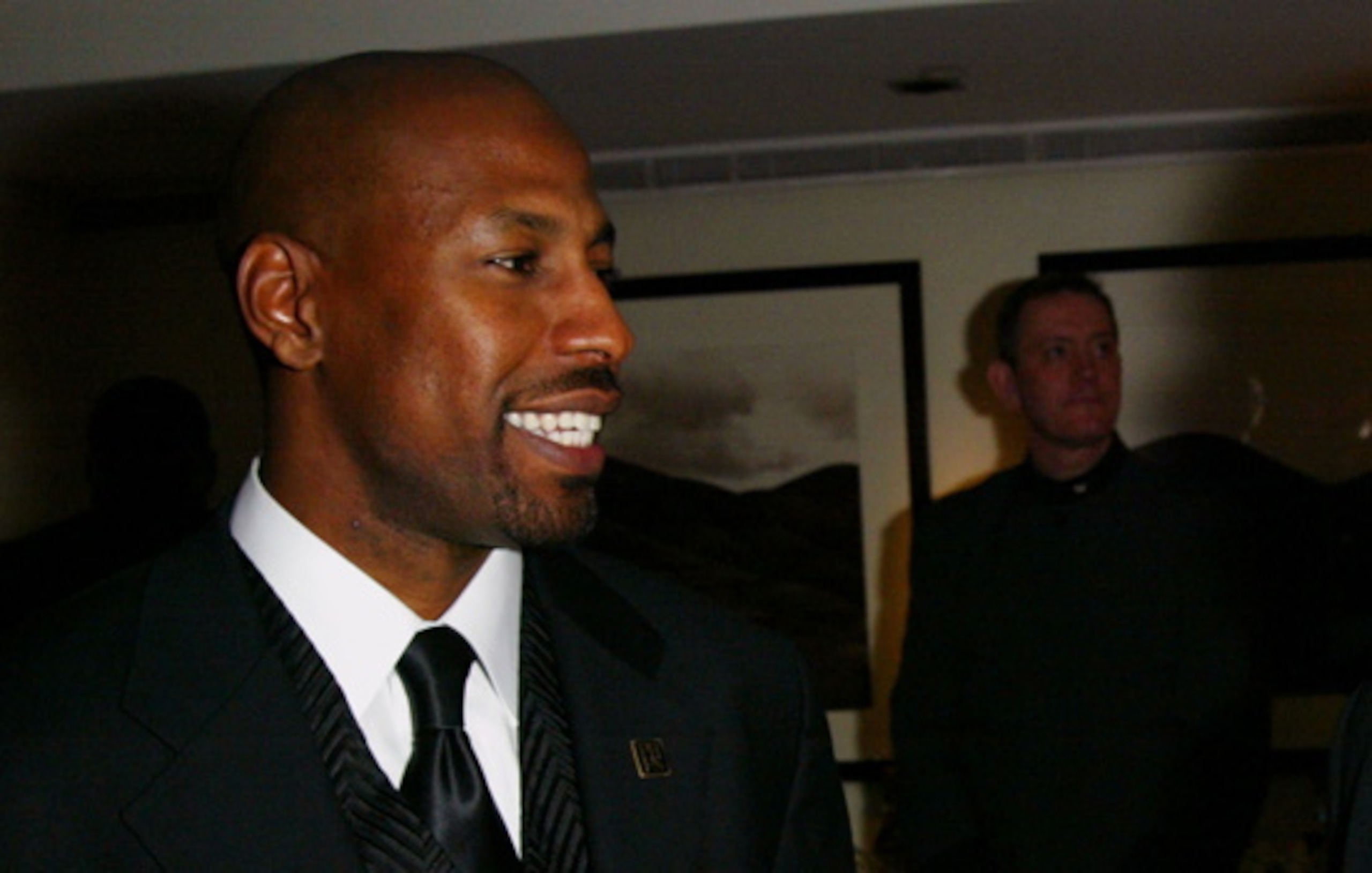
No. 50 Kenny Phillips
Phillips ultimately chose to attend the University of Miami over Tennessee, Florida State and North Carolina State.
In his freshman year, Phillips was named to the All-ACC Freshman Team after starting 11 games at free safety. He ranked third on the team with 93 tackles (58 solo), recovered two fumbles, broke up four passes and recorded one interception. Phillips interception came against the Clemson Tigers in triple overtime and sealed the win for the Hurricanes.
As a sophomore, Phillips was named to the All-ACC 1st Team and 2nd team All-American by Rivals.com. He started 10 games out of 10 at strong safety, missing only three games due to a torn ACL. He ranked fourth on the team in tackles with 71 total, broke up six passes, and recorded four interceptions. Phillips earned "ACC Defensive Back of the Week" honors for his play against Duke in which he tied a University of Miami record with three interceptions in one game.
Phillips was also named to the 2006 All-ACC Academic Football Team.
As a junior, Phillips was named to the All-ACC 1st Team for a second straight year, and 2nd team All-American for a second straight year. He started 12 games out of 12 at safety. Phillips ranked second on the team with a career high, 95 tackles(69 solo), made 6.5 tackles for loss, forced three fumbles, broke up five passes and intercepted two passes.
No. 49 Carlos Huerta
Carlos Huerta was one of the first true great stories of the Hurricanes' storied era of dominance in college football.
Huerta, the starting kicker on Miami's 1991 National Championship team, emerged as a walk-on and became a consensus All-American and First-Team All-BIG EAST selection. Huerta, who later played with the San Diego Chargers and Chicago Bears, established an NCAA record with his 157 consecutive point after attempts (PATs) during his career as a four-year starter (1988-91).
He ranks second on the NCAA's all-time scoring list with 397 career points, including 73 field goals. Additionally, Huerta still holds Miami records for career PATs, career field goals, career points, the top three records for consecutive PATs in a season, the top four records for field goals in a season, the top three records for points scored kicking in a season and field goals in a game.
During his four years as a starter Huerta led the team in scoring each season. His foot was a significant reason in historic victories, such as hitting a field goal with 43 seconds remaining to give UM the 31-30 edge over the Michigan Wolverines in Ann Arbor in 1988.
Huerta also hit game-winning field goals over Arkansas in 1988 and Michigan State in 1989. A local product out of Christopher Columbus High School, Huerta garnered numerous accolades as a Hurricane, including All-American honors from the Associated Press, Walter Camp Football Foundation, The Football News and The Sporting News.
Huerta earned his degree in business and was later inducted into the Iron Arrow society. Following his NFL career, Huerta kept on kicking in the Canadian Football League with the Grey Cup Champion Baltimore Stallions and later in the Arena Football League.
No. 48 Jon Beason
Beason played his college football at the University of Miami. He began his career at fullback but shifted to linebacker as a red shirt freshman. During his career he collected 187 tackles, three-and-a-half sacks, and one interception. He majored in sports administration.
He was drafted by the Carolina Panthers in the 1st round of the 2007 NFL Draft with the 25th pick. He still plays for the panthers today and has accumulated over 400 tackles during his NFL Career.
No. 47 Randal Hill
Randal's path to the Hurricanes began early in life, when his father, Ransom Hill, coached him, and future UM roommates, Alex Johnson and Robert Bailey in little league football. By the time he left Miami's Killian High, he had already earned the nickname "Thrill Hill" and was ready to make his mark in college football.
As a true Freshman on the 1987 National Championship team, he set a then school record for kickoff return yardage with 497 yards on 19 returns. He saved some of his finest moments for the big stage.
In 1989, Miami faced No. 1 ranked Notre Dame in a late season contest at the Orange Bowl. In the second half, with the score tied, and the Canes facing an almost impossible 3rd and 43 from their own seven-yard line, Randal streaked down the right sideline, stretched out, and grabbed quarterback Craig Erickson's pass for a 44 yard gain, in one of the most electric moments in the venerable old stadium. The first down broke the back of the Irish defense and Miami went on to win 27-10, sending the Canes to another National Championship!
In the 1991 Cotton Bowl, he was on the receiving end of a 48 yard Erickson touchdown pass that set the stage as the Canes crushed Texas, 46-3.
He holds the UM record for career kickoff return yards with 1,169 yards on 54 returns. He ranks in the Top Ten lists for season kickoff return attempts and yards, career receptions (107), career receiving yards (1,643), and career touchdown receptions (11).
After graduating Miami in four years with a degree in Sociology, he was a first round draft pick by the Dolphins (23rd overall) and played 7 seasons in the NFL with Miami, Arizona and New Orleans, catching 262 passes for 3,849 yards and 14 touchdowns.
When he hung up his cleats for good, he got into law enforcement in South Florida, as a police officer, sheriff's deputy, and currently as a special agent for the U.S. Government. He also works part-time for the NFL. Married to his college sweetheart, Dr. Michelle Hill, the first female in UM's Phi Beta Kappa for Chemistry, they have two children.
No. 46 Kevin Patrick
Patrick was an All-American defensive end, and a Big East defensive player of the year while at Miami (89-93).
He also helped lead the Hurricane team to the 1992 National Championship with a win over Nebraska in the Orange Bowl.Patrick also played in the Cotton, Sugar and Fiesta Bowls during his career.
After his career with Miami he spent some time in the NFL. He graduated from Miami in 1994 with a degree in business administration, and he is currently on the coaching staff at South Florida.
No. 45 Craig Erickson
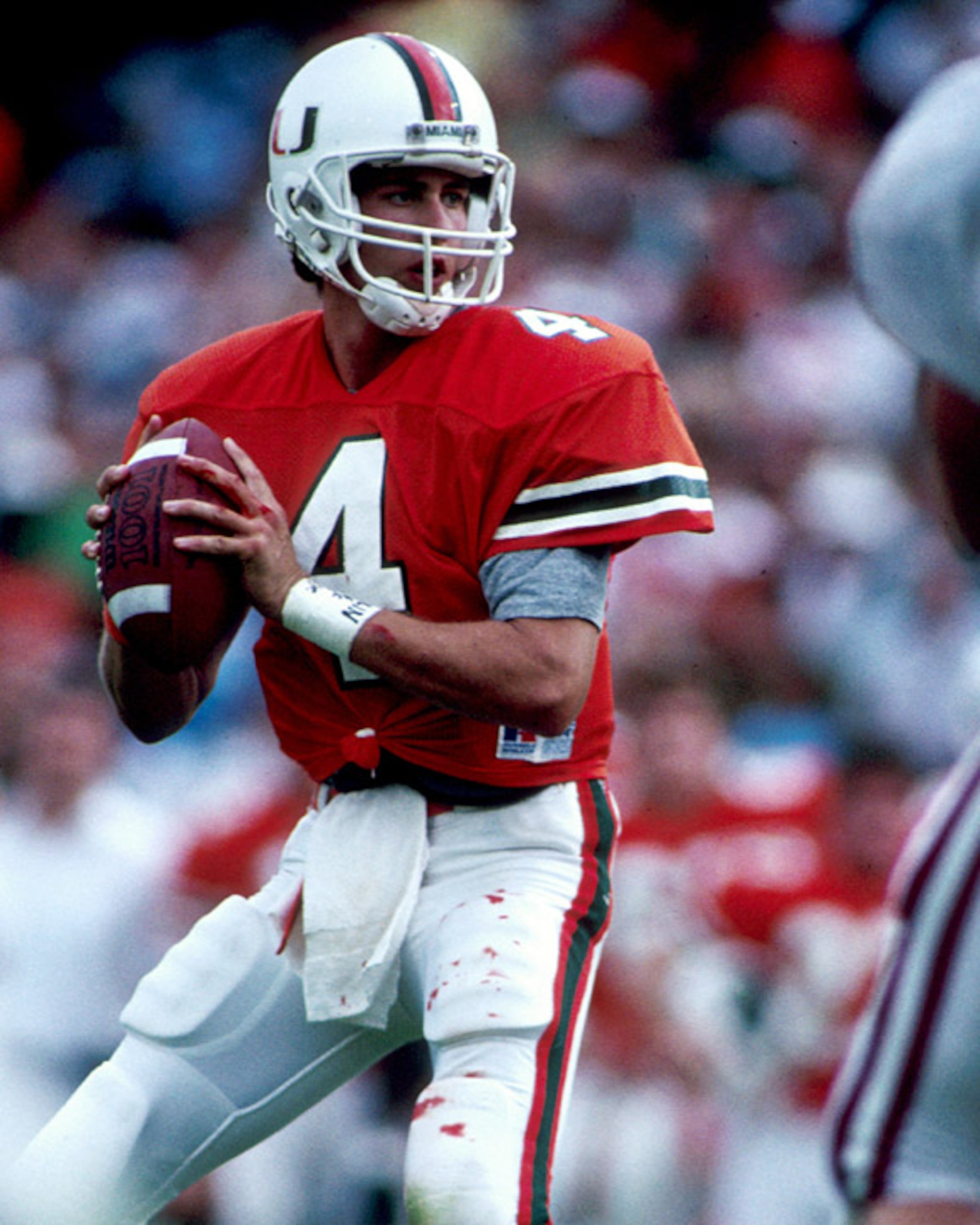
An eighth-place finisher in the Heisman Trophy balloting of 1990, Craig Erickson produced some of the most memorable performances in Miami football history during the Hurricanes' dominant seasons from 1987-90.
Starting the final 18 games of his career, spanning the 1989 and 1990 seasons, Erickson led the Hurricanes to the 1989 national championship in his first season as a starter. With Erickson as the starting quarterback, the Hurricanes were a remarkable 16-2 and captured bowl victories over Alabama (in the 1990 Sugar Bowl for the national title) and Texas (in the 1991 Cotton Bowl Classic). Erickson firmly etched his name among Miami's elite list of great quarterbacks by passing for 6,056 yards and 46 touchdowns in his career while completing 55.9 percent of his passes.
During his senior season of 1990, Erickson won the Johnny Unitas Award recognizing college football's outstanding quarterback and placed second in the balloting for the Davey O'Brien Award.
Erickson left UM the owner of single-game records for pass completions and yardage and total offense, along with single-season marks for attempts, completions, passing yards, total offense and touchdown passes thrown. Erickson went on to a career in the National Football League, playing with Tampa Bay (1992-94), Indianapolis (1995) and the Miami Dolphins (1996-99).
No. 44 Jerome McDougle
One of college football's finest defensive ends during his time at Miami, a pass rushing force his last two seasons for Miami racking up 14 quarterback sacks over that span. A two-time First Team All-BIG EAST selection by the league's head coaches, and a finalist for the 2002 Ted Hendricks Defensive End Award which went to Terrell Suggs.
McDougle was an integral part of Miami’s National Championship run in 2001. Although his Professional career has been average McDougle was one of the best defensive lineman to play at Miami during his time there.
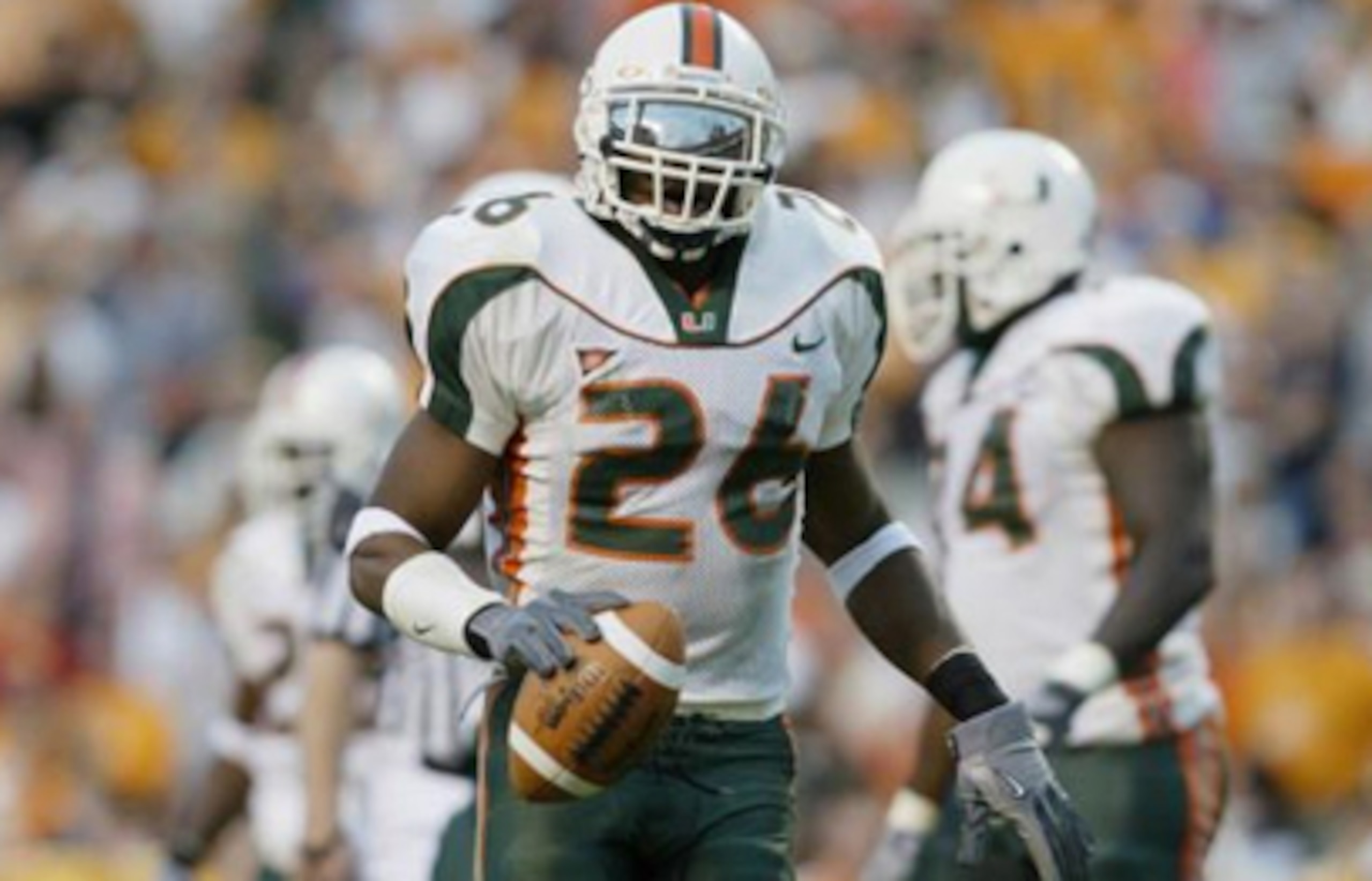
No. 43 Antrel Rolle
Rolle was an All-American CB at Miami where he especially excelled in press-coverage. Notable performances included shutting down future All-American receivers Larry Fitzgerald (three catches for 26 yards) and Calvin Johnson (two catches for 10 yards).
In 2001, his freshman season, Rolle was one of four true freshman to letter at Miami. He appeared in eight games, recording eight tackles and an interception. Rolle started 11 games as a sophomore in 2002, earning All-Big East first-team honors. Rolle totaled a career-high 66 tackles with two sacks, six tackles for a loss, seven pass deflections, and an interception for the season.
In 2003, as a junior, Rolle recorded 51 tackles, 3.5 tackles for a loss, seven broken up passes, and two interceptions on the year. In his final season, 2004, Rolle was a consensus All-American. He recorded 58 tackles his senior year, 6.5 tackles behind the line of scrimmage, six pass deflections, and an interception. He was hurt late in the 2004 season and missed the Virginia Tech game because of a foot sprain.
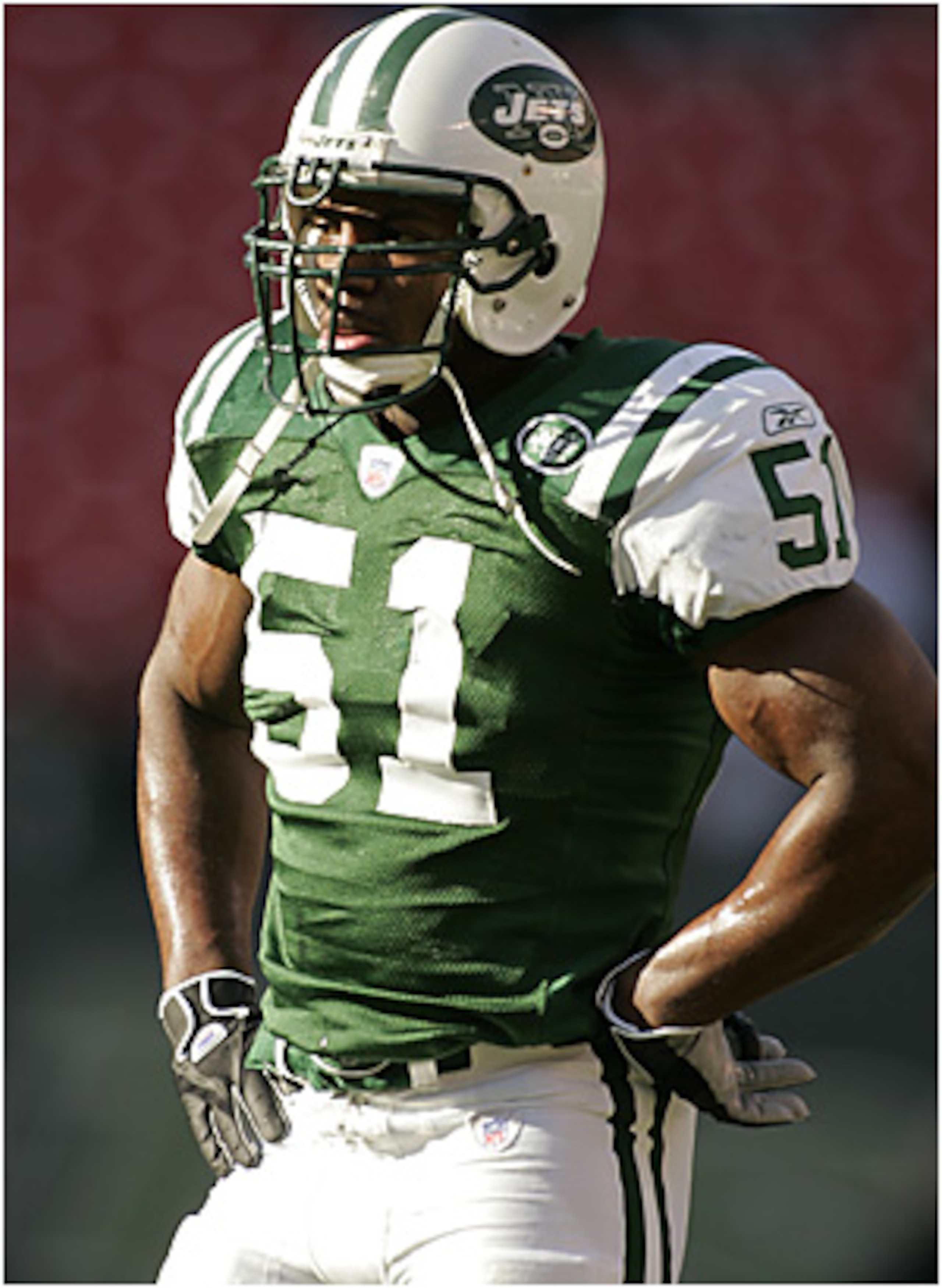
No. 42 D.J. Williams
Williams started his collegiate career at the University of Miami at fullback due to a logjam at the linebacker position.
Although he was used sparingly in his freshman year, he recorded 18 career rushes for 142 yards (7.9 avg.) with two touchdowns while catching 12 passes for 153 yards (11.9 avg.) over his career.
Williams switched back to his favored linebacker position in 2001 and was quiet but productive member of the National Championship team. He compiled 51 tackles (25 solo), and one crucial forced fumble in the Rose Bowl against Nebraska.
In 2002, he was one of 11 semi-finalists for the Butkus Award along with teammate Jonathan Vilma was also a second-team All-Big East selection. He registered 108 tackles (55 solos) to rank second on the team, notched four sacks, forced two fumbles, and broke up eight passes.
In his final year at Miami he blossomed into one of the best players in the country, finishing his senior year in 2003 as a semifinalist for the Butkus Award.
He also a named third-team All-American by the Associated Press and a first-team All-Big East Conference choice. Williams' finished second on the team with 82 tackles (44 solo) and tie for the team-lead with six sacks, forced a fumble and recovered another.
His highlight of the season was a 61-yard run for a touchdown off a fake punt.
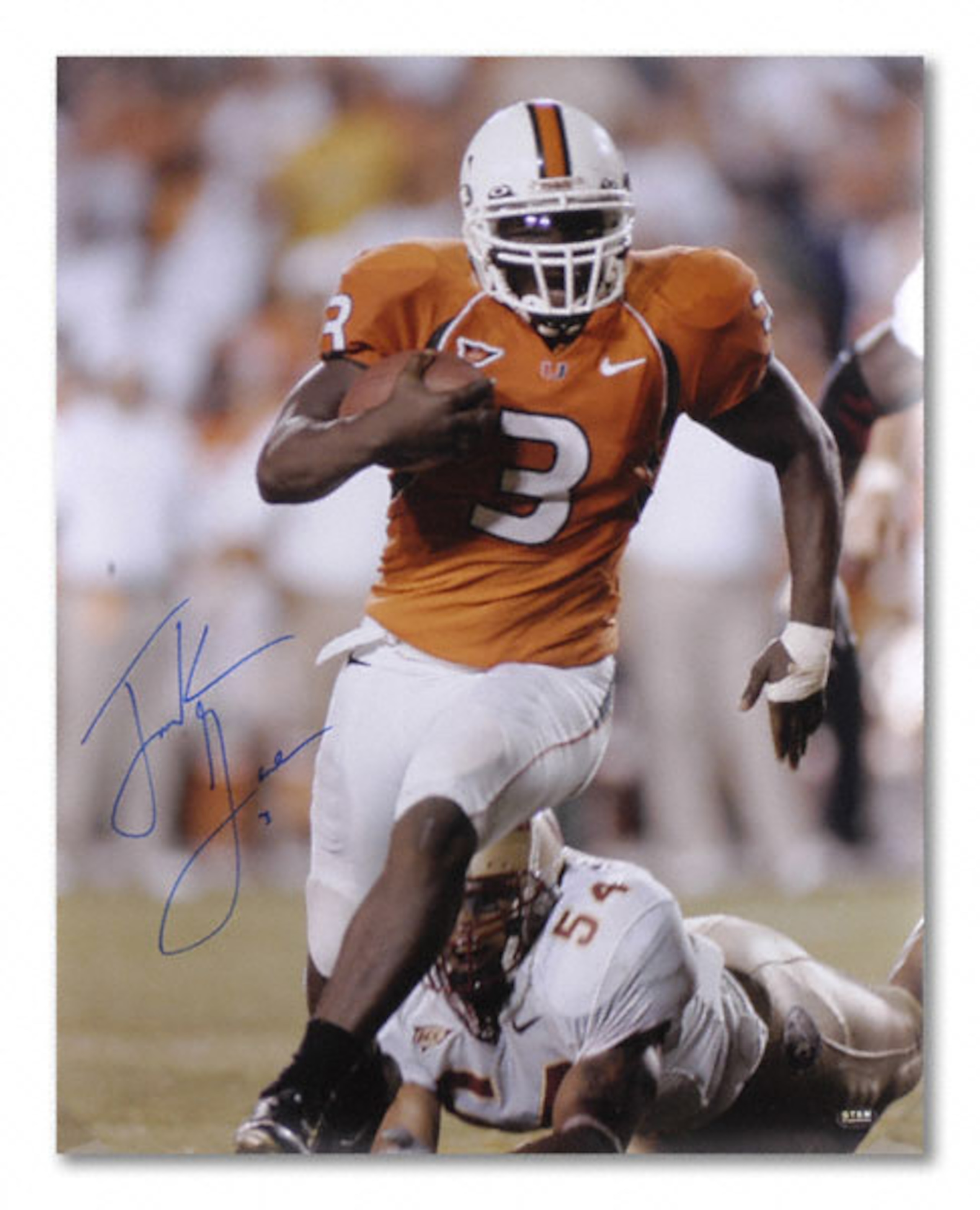
No. 41 Frank Gore
As a true freshman for the University of Miami in 2001, Gore totaled 575 yards with 5 touchdowns on 62 carries (a 9.3-yard avg), the third-best season total in school history by a freshman and was named Sporting News' Big East Freshman of the Year.
He suffered a torn anterior cruciate ligament in his left knee before spring practice in 2002 and spent the following season recovering from knee surgery. Before his injury that year, Gore beat out Willis McGahee in the spring of 2002 for the role as the Hurricanes' starting running back.
Gore returned in 2003 and rushed for 100 yards in each of his first three games of the season. He also returned for his senior year in 2004, when his cousin, Kim Gibson, asked him to change his uniform number from #32 to #3 for better luck. He then ran for nearly 1,000 yards during the season.
In 28 total games with the Hurricanes, Gore rushed 380 times for 1,975 yards (a 5.7 rushing average) and seventeen touchdowns. His 1,975 yards rank seventh on the school's career-record list and his seventeen scores are tied for tenth. He also caught 23 passes for 225 yards (9.8 avg), returned two kickoffs for 48 yards and recorded five tackles on special teams.
No. 40 Lamar Thomas
With the University of Miami Thomas set a then-school record for most receptions in a career (later eclipsed by Reggie Wayne). He was the victim of "The Strip", George Teague's strip of the football at the 10 yard line in the 1993 Sugar Bowl that continued a massive Alabama rout of the University of Miami.
Thomas was interviewed about his time at Miami for the documentary The U, which premiered December 12th, 2009 on ESPN.
No. 39 Jonathan Vilma
The leader of the Hurricanes defense at middle linebacker for two seasons. Was an impressive player since the beginning of his UM career, an excellent student-athlete, led the team in tackles both of the years he started, he was an excellent scholar-athlete who earned Big East All-Academic Team honors in 2001 and 2002, one of a league-high 10 Hurricanes to earn that accolade during the 2001 and 2002 seasons.
He was a Butkus Award Semi-Finalist in 2002, a unanimous first-team All-BIG EAST selection by the league's head coaches. He was also a first-team Verizon Academic All-American in 2002, as well as the University of Miami's Scholar-Athlete of the Year for the 2002-03 academic year. He received the the 10th Annual Walter Kichefski Football Scholarship Endowment Award, presented annually to the top scholar-athlete of the football program by the Kichefski family and the UM Athletic Hall of Fame. He was rated the nation's no. 3 middle linebacker and a second-team Preseason All-American by The Sporting News for 2003.
He currently plays for the New Orleans Saints and is a Super Bowl Champion.
No. 38 Jeremy Shockey
Shockey attended the University of Miami, where he was part of the school's long tradition of star tight ends along with teammate Douglas Scappa.
As a Hurricane, Shockey first rose to national attention as a sophomore in Miami's 2000 game versus rival Florida State, catching what proved to be the game-winning touchdown pass with 46 seconds remaining in the fourth quarter as Miami defeated the then-top ranked Seminoles, 27–24. The Hurricanes went 11–1 and Shockey received first team All-Big East honors from the league's coaches, The Sporting News, and College Football News.
In 2001, Shockey was an integral member of the national championship Miami team. Shockey led the team with 45 receptions and had 604 yards receiving and eight touchdowns (including bowl statistics). He was one of three finalists for the Mackey Award, and was named a first team All-American by CNNSI, and a second team All-American by the Associated Press, CBS Sportsline, and ABC Sports. Having reached the status of national champion and All-American, Shockey declared himself eligible for the NFL Draft following the 2001 season.
Shockey currently plays for the New Orleans Saints and is a Super Bowl Champion.
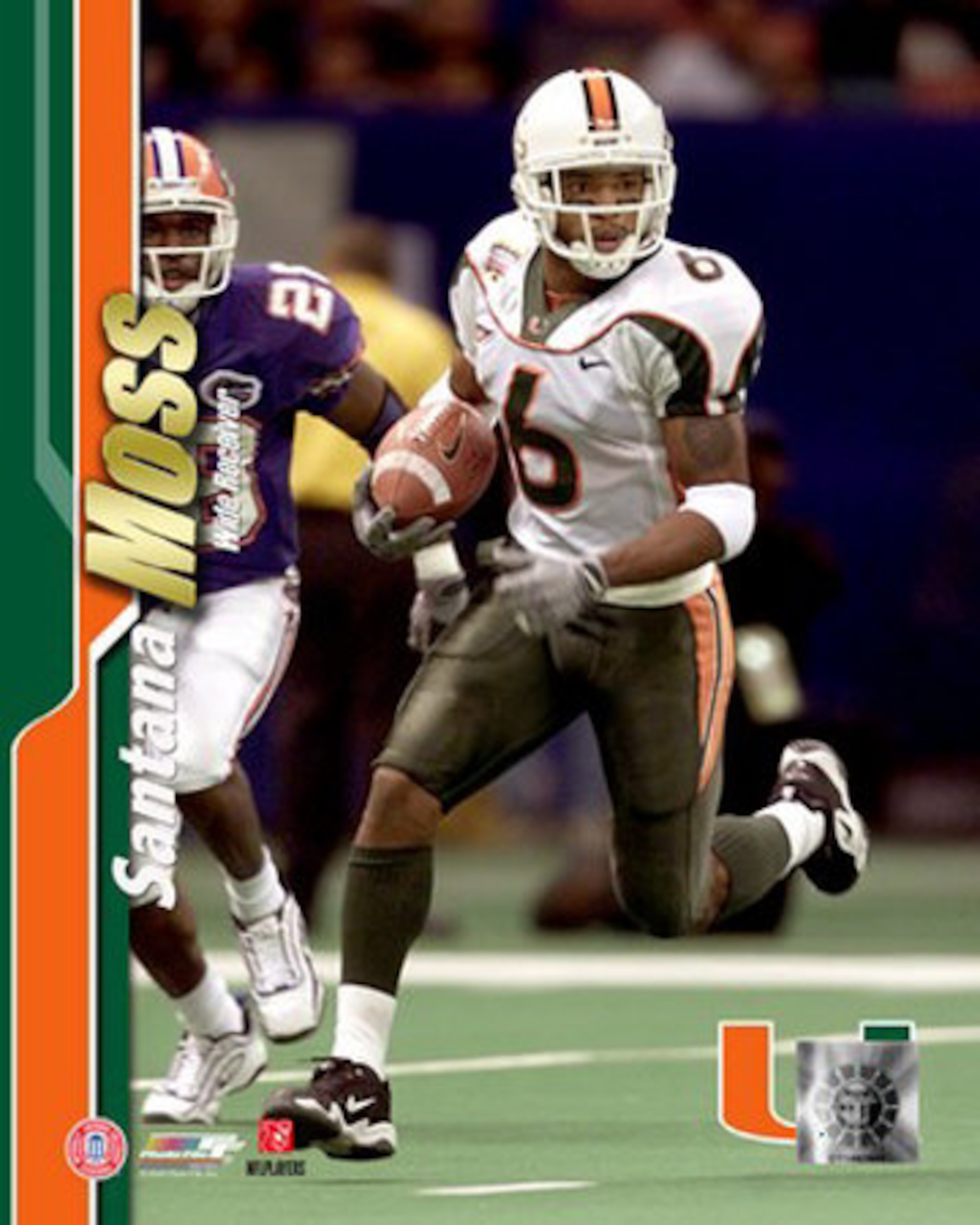
No. 37 Santana Moss
Moss joined the Miami Hurricanes in 1997 as a walk-on, before being awarded a scholarship after the season's third game.
He went on to break the school's record (previously held by Michael Irvin) for most receiving yards (with 2,546 yards). He finished the 2000 season with 1,604 all-purpose yards. He was chosen to the "All-Big East Conference First Team" as a senior.
Moss was the first player to earn Big East Offensive and Special Teams Player of the Year honors in the same season.
Moss also ran track at the University of Miami, and was named the "Most Outstanding Field Performer" for the 2000 Big East Outdoor Track and Field championships. In 1999, Moss finished the 60-meter dash in 6.83 seconds.
Moss is an important figure in Miami Hurricanes football history, generally considered (along with Michael Irvin) one of the most accomplished wide receivers in the university's history. He graduated as the school's all-time leader in receiving yards (2,546), punt return yards (1,196), and all-purpose yards (4,394).
Moss was interviewed about his time at Miami for the documentary The U, which premiered December 12th, 2009 on ESPN.
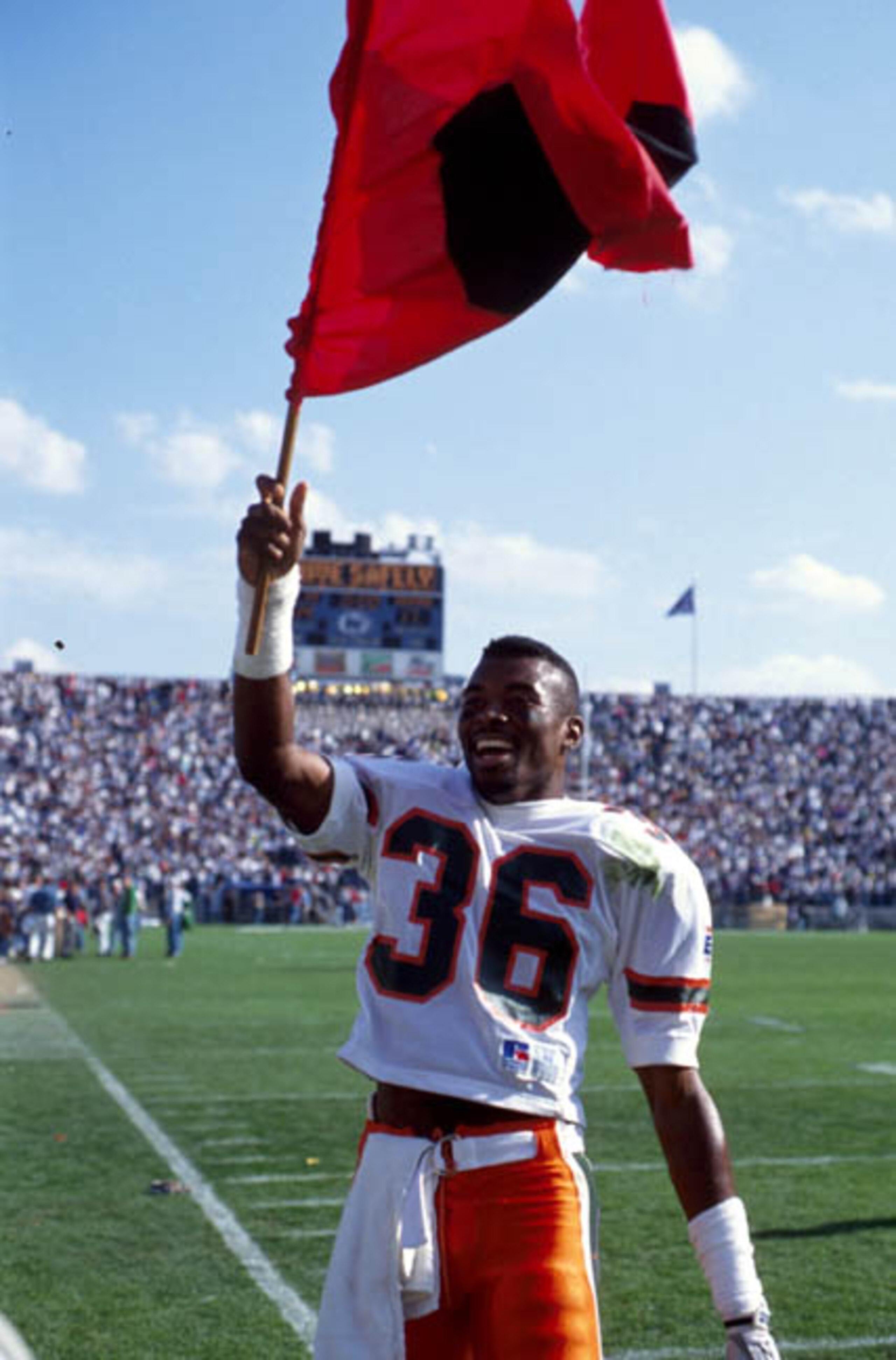
No. 36 Kellen Winslow
Kellen Winslow Jr. came to Miami in 2001 backing up All-American Tight End Jeremy Shockey. The Hurricanes won the National Title that year, and Winslow became the starter. He set single season records for a Miami Tight end with 57 catches for 726 yards and 8 touchdowns.
He was a two time All-American and left early for the NFL after his Junior season. He was selected with the 6th pick in the first round by the Cleveland Browns. He is best known for his “soldier” rant while he was at UM and his Motorcycle accident while he was with the Browns. Winslow is currently playing for the Tampa Bay Buccaneers.
No. 35 Ryan McNeil
Arriving from Fort Pierce to the "U" in 1988, this born-to-be-a-'Cane left an indelible mark at the cornerback position. As part of the dominating Hurricane defenses of the early 1990s, Ryan McNeil was named All Big East after both his junior and senior seasons, and a semi-finalist for the 1992 Jim Thorpe Award.
McNeil was named first-team All American by Kodak, Football News and the Walter Camp Foundation following his senior season. McNeil's leadership on the field as a starting CB contributed to two national championship titles, after the 1989 Sugar Bowl and the 1991 Orange Bowl. The 1991 season saw hard-hitting McNeil lead the team with five interceptions.
A second-round draft pick of the Detroit Lions in 1993, McNeil's 12-year career exceeded the average length of an NFL career by more than eight years. McNeil brought his dominating style of play to the pro gridiron, logging over 600 solo tackles and 31 career interceptions.
Not one to rest on his playing laurels, the versatile and enterprising McNeil founded the Professional Business and Financial Network, an organization for professional athletes to make their post-playing days as successful as their on-field careers. The PBFN and companion magazine, OverTime, are both premier resources for pro football players and business executives looking to partner with high-profile athletes.
McNeil's extraordinary success in both the real estate and business world is no surprise to anyone who knew him in his days laying sweat down on the Greentree Practice Field and in the U's Business School classrooms.
No. 34 Steve Walsh
Steve Walsh is one of the long string of Hurricane signal callers, whose success from the early 80's into the 90's, helped Miami gain the nickname "Quarterback U."
He led the Hurricanes to its second national championship in 1987 by defeating the Oklahoma Sooners in the 1988 Orange Bowl Classic 20-14. In his two years as starting QB, he compiled a 23-1 overall record.
As a junior, he was named first team All-American quarterback by the Associated Press, the Football Writers Association of America and ESPN, and was The Football News College Player of the Year. He was fourth in the 1988 Heisman Trophy balloting.
Walsh finished his career at UM tied with Vinny Testaverde for 1st in TD passes thrown with 48, now 2nd. He is currently 3rd in career completion percentage and in the Top Ten in pass attempts, completions, passing yards and total offense.
Steve and his 1988 offensive line hold the NCAA record for fewest sacks allowed with four.
Was drafted in the first round of the NFL supplemental draft after his junior year by the Dallas Cowboys, he also played for the Tampa Bay Buccaneers and the Indianapolis Colts.
Steve was inducted into the University of Miami Football Ring of Honor on October 24, 2009. He was inducted into the UM Sports Hall of Fame in 1999.
No. 33 Dan Morgan
Morgan started playing college football as a fullback at the University of Miami, but was switched to weakside linebacker one week before the season started. He became the first freshman linebacker to start for the Hurricanes since Ray Lewis in 1993.
As a freshman, he was named second-team freshman All-American by the Sporting News after posting 105 tackles, three sacks, and one forced fumble.
As a sophomore, he became the first sophomore team captain in team history, and made the All-Big East Team, after leading the team with 150 tackles. He was a finalist for the Butkus Award and the Nagurski Trophy as a junior, and was rewarded with a second-team All-Big East for collecting 139 tackles and 5 sacks. He finally captured both awards, as well as the Bednarik Award, becoming the first player in NCAA history to win all three awards in a career (and the same year).
Morgan left Miami as an All-American and was the 2000 Big East Defensive Player of the Year. Upon graduating, Morgan held the Miami school and Big East conference records for most career tackles with 532.
Awards and honors:
* Second-team Sporting News Freshman All-American (1997)
* First-team All-Big East Conference|Big East (2000)
* Big East Defensive Player of the Year (2000)
* Consensus First-team All-American (2000)
* Dick Butkus Award (2000)
* Bronko Nagurski Trophy (2000)
* Chuck Bednarik Award (2000)
No. 32 Leon Searcy
Leon Searcy spent five seasons as an offensive tackle at the University of Miami, lettering from 1988-91. By the time his collegiate career concluded Leon was a No. 1 draft pick by the Pittsburgh Steelers - 11th overall. Among the most impressive feats recorded by Searcy was the fact that he started every game his final three seasons.
Leon's senior year was his greatest. He earned First-Team All-America honors from the Football Writers Association of America, and Second-Team All-America honors from The Sporting News, The Football News and Associated Press.
He was an All-BIG EAST first-team selection in the league's inaugural football campaign. After being selected by the Pittsburgh Steelers, Leon spent his first four seasons in the "Steel City" until 1995. He then signed on with the Jacksonville Jaguars, playing from 1996-2000.
After spending the 2001 season with the Baltimore Ravens, Searcy signed on with the Miami Dolphins for the 2002 season. Among his professional accolades over his 11 NFL seasons, Leon was selected to the Pro Bowl in 1996 and 1997. He also played in Super Bowl XXX with the Steelers.
No. 31 Michael Barrow
Linebacker Micheal Barrow earned two rings as a member of the 1989 and 1991 National Champion Hurricanes. An incredible senior season was Barrow's response to the disaster which had befallen his hometown of Homestead, Florida just prior to the start of the 92 campaign: Hurricane Andrew.
Miami's Hurricanes dedicated their season to alleviating the sorrow felt by the community, and this extra motivation propelled Barrow to become the very visible team leader to South Florida and the nation. In his senior season, Micheal Barrow shined the brightest. After wins against Florida State and Arizona, Barrow turned it up against the Nittany Lions at Happy Valley.
He had 19 tackles with three for losses, including the potential game saver on fourth-and-one at the Miami five. After his stellar final campaign which saw him lead the team in tackles (136-80 solo), Barrow was selected as an All-American, the Big East Defensive Player of the Year and finished seventh in the Heisman balloting. He also won the University of Miami's 1992 Jack Harding MVP award. Barrow finished his UM career (1989-1992) with 401 total tackles and assists, keeping him in the top-5 in the Miami record books.
A second-round draft pick of the Oilers in 1993, Barrow spent three seasons in Houston, followed by two with the Carolina Panthers and four seasons with the New York Giants. He is now a member of the Washington Redskins. Barrow's resume of community involvement is longer than his football resume.
A tireless and selfless volunteer, Barrow has donated time and money to feeding the homeless, church activities, children's clubs and inner city sports leagues. Barrow graduated from the University of Miami with a Bachelor's degree in Accounting and Business Administration.
No. 30 Jerome Brown
A dominant defensive lineman throughout his four years at the University of Miami, 1983 to 1986, Jerome Brown earned consensus All-American honors his senior season. Brown was a finalist for both the 1986 Outland Trophy and the 1986 Lombardi Trophy.
Equally effective at stopping the run and rushing the passer, Brown finished his UM career with 183 total tackles, including 21 sacks, 19 tackles for loss, five fumbles caused and four fumbles recovered. His sack total is still ranked in the Top Ten in school history.
Brown recorded four New Year's Day bowl starting assignments: '84 Orange Bowl Classic, '95 Fiesta Bowl, '86 Sugar Bowl, and the '87 Fiesta Bowl.
He went on to become a first round draft pick of the Philadelphia Eagles, ninth overall pick, in the 1987 NFL draft and was named to the Pro Bowl twice in his four year career.
Jerome's life was tragically cut short when he was killed in an automobile accident in October of 1992 in his hometown of Brooksville, Florida. He was inducted into the UM Sports Hall of Fame in 1997.
No. 29 Sean Taylor
Taylor was recruited by the University of Miami Hurricanes. Taylor enrolled there in 2001 and, that year, he was one of just four true freshmen to play for Miami in the 2001 national championship season. He carved a niche for himself in Miami's secondary in nickel and dime defensive schemes.
In 2001, Taylor was named "Big East Special Teams Player" of the Week for his performance against the University of Pittsburgh. The 2001 season also proved a hugely successful one for the Hurricanes, with the team winning its fifth national championship since 1983, making them the most successful college football team of the past three decades with more national championships than any other Division I program during this period.
In 2002, Taylor was a second-team All-Big East selection by the league's head coaches in his first season as a starter. He finished third on the team in tackles with 85 (53 solo), broke up 15 passes, intercepted four passes, forced one fumble, blocked one kick, and returned a punt for a touchdown. He led all defensive backs in tackles, interceptions, and passes broken up, and had a career-high 11 tackles (two solo) and intercepted 2 passes in the Fiesta Bowl loss to Ohio State University.
One interception occurred on an infamous play where he was stripped by Maurice Clarett on the return, allowing Ohio State to retain possession.
During his final year at Miami, Taylor produced a historic season that culminated with a plethora of honors and awards. He was named a consensus first-team All-American, the "Big East Conference Defensive Player of the Year" and a finalist for the "Jim Thorpe Award" given to the nation's best defensive back. He led the Big East Conference and ranked first nationally in interceptions with 10, tying the record for interceptions in a season with former Hurricane standout Bennie Blades. He finished first in total tackles with 77 (57 solos).
He intercepted two passes in Miami's impressive 28-14 win over the University of Pittsburgh, playing a key role as the Hurricanes limited All-American receiver Larry Fitzgerald to two receptions for 13 yards. He returned interceptions for an average of 18.4 yards, including a 67-yard touchdown return at Boston College, a 50-yard scoring run back at Florida State University, and a 44-yard scoring run back against Rutgers University. His three touchdown returns of interceptions is a Miami single-season record.
No. 28 Bennie Blades
Bennie Blades, a native of Ft. Lauderdale, Florida, was a two-time first team All-American as a defensive back for the Hurricanes in 1986 and 1987. He was awarded the Jim Thorpe Award as the nations premier defensive back in his senior season.
Blades holds the all-time interception record of 19 interceptions in a career, held, at the time, the interception return yards record (305), consecutive games with an interception (5), total tackles by a safety (286) and unassisted tackles by a safety (155).
Bennie helped lead the Hurricanes to their second national championship in his senior year, 1987, when he was first in the nation in interceptions (.91) per game.
In 1988 Bennie was the third overall pick in the first round of the NFL draft when he was picked by the Detroit Lions. Bennie was later traded to the Seattle Seahawks where he played with his brother Brain, a former U.M. wide receiver.
Bennie had a stellar 10 year professional career and will always be remembered for his outstanding play in the Hurricane defensive backfield.
Bennie was inducted into the College Football Hall of Fame in 2008 and the University of Miami Football Ring of Honor in 2009!
He was inducted into the UM Sports Hall of Fame in 1998!
No. 27 George Mira Sr.
George Mira will long be remembered by Hurricane fans as Miami's greatest quarterback and perhaps the 'Canes greatest player ever.In his three year career, Mira set numerous passing records, some of which are still in the record books. During "The Matador's" days Miami was once again reached national prominence, reaching the 1961 Liberty Bowl, the first bowl appearance in 19 years.
Mira was the quarterback and pass for the '60's, he could drop back and pass and scramble when he had to, which earned him his nickname "The Matador". In 1962 Mira lead the Hurricanes to the Gothem Bowl in New York City and proved to the country that he was the real deal. At the time of his Hall of Fame induction, Mira still lead UM in total offense, 5,125 yards, which is still in the top ten for that catagory.
When his UM career was completed his jersey, No. 10, was retired, an honor that was given to only one player before him. After his college career Mira signed with the San Francisco 49er's. George Mira is considered the founding quarterback of "Quarterback U".
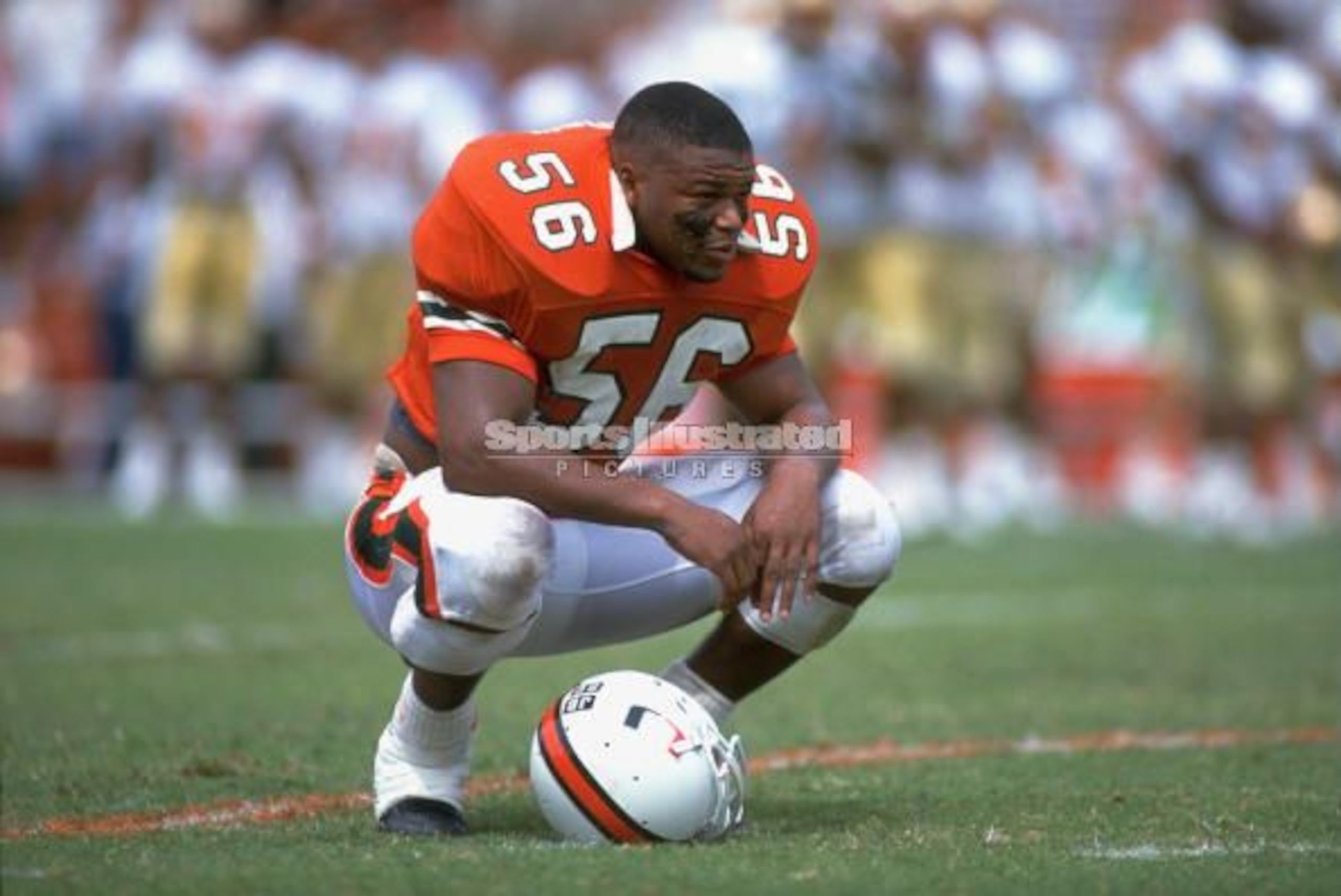
No. 26 Darrin Smith
Linebacker Darrin Smith, a Miami area native, made the most of his time at the University of the Miami on and off the football field.
Smith, Mr. Two for Two, is the only football player to hold two College Football National Championship rings (1989 and 1991) and two Super Bowl rings (Super Bowl XXVIII, XXX with the Dallas Cowboys).
During his days at the U in the late 80s and early 90s, Smith was known for being one of the fastest linebackers in college football and a tenacious tackler.
Smith along with fellow Hurricanes linebackers Michael Barrow and Jesse Armstead formed one of the greatest linebacking corps in college football history called The Bermuda Triangle.
The Bermuda Triangle, playing together from 1990 to1992, were an integral part of Hurricanes teams that had a 29-game winning streak and were named the 1991 National Champions (12-0) by the AP. The 1991 Hurricanes were a dominating defense that led major college football in average points allowed per game with an amazing mark of 9.1 ppg including a 22-0 shutout of Nebraska in the 1992 Orange Bowl. The 1991 University of Miami National Championship team was a highly decorated group and it was Smith who was one of their biggest leaders on the field, in the classroom, and in the lockerroom.
On the field, Smith was known for his quiet confident play revolving around his great speed which allowed him to always be around the football. Smith, the 4th leading tackler in Hurricanes history, was a highly decorated player during his four playing years at Miami being named two-time first team All-American as a Junior and Senior (1991 - UPI, Football News and 1992- UPI), 2nd team All-American (1991- AP), 1st team All-BIG East (1992), BIG EAST co-Defensive Player of the Year in 1992, and a two-time Butkus Award semi-finalist. Most Canes fans will probably tell that Smith's greatest collegiate game occurred in Miamis memorable 17-16 win over Florida State in Tallahassee, FL on November 16, 1991 which will forever be known as Wide Right I.
In the Hurricanes' huge win that propelled them to the 1991 National Championship, Smith had an amazing 18 tackles (ten solo).
Academically, Smith stayed five years at the University of Miami (red shirted first year) so he could maximize his educational opportunities at the school. He earned his undergraduate degree in business management in just three and half years then completed his masters degree in marketing in his final year of eligibility.
In recognition of his hard work within the classroom, Smith was named the National Football Foundation and College Hall of Fame Scholar-Athlete recipient for 1992. Smith, a former Little Brother from the Big Brothers organization, also took the lessons he learned from former Hurricanes like linebacker Bernard Clark to mentor several Hurricanes teammates too.
Smith and his 1992 Hurricane teammates also played a big part in helping to lift the spirits of the South Florida community after 1992s devastating Hurricane Andrew.
After his illustrious career at the University of Miami, Smith was selected by the Dallas Cowboys in the 2nd round of the 1993 NFL Draft joining several former Hurricanes including head coach Jimmy Johnson, receiver Michael Irvin, defensive tackle Russell Maryland and others on the Cowboys team. Smith made an immediate impact, starting as a rookie at the weakside linebacker position on the Cowboys Super Bowl XXVIII winning squad. The hard-hitting tackler went on to play four years for the Cowboys with highlights including winning another Super Bowl ring (SB XXX) and reaching 100 tackles or more twice.
Smith went on to play a total of 12 years in the NFL, playing for the Cowboys, Philadelphia Eagles, Seattle Seahawks, and New Orleans Saints while finishing with career stats 788 tackles, 24 sacks, and 11 INTs. After his professional football playing career was completed after the 2004 NFL season, Smith returned to the Miami area, where he still resides today.
He completed his second Masters Degree (Real Estate Development) at Nova University and is now operates a real estate investment/development company. Smith, when not busy with his burgeoning family and business, is active in several community related activities including the Fellowship of Christian Athletes organization. Smith also has recently taken on the additional challenge of tackling literacy in the South Florida area with his Project 59 program, which specializes in encouraging young people to read.
No. 25 Bryant McKinnie
After prep football at Woodbury High School in Woodbury, NJ, McKinnie played for two years at Lackawanna Junior College in Scranton, Pennsylvania. There, he gained 70 pounds and converted from his high school position as defensive lineman to offensive tackle. After junior college, he received a scholarship with the University of Miami Hurricanes.
After red shirting in 1999, McKinnie started his junior and senior years at left tackle for UM. During his career he was an extraordinary blocking tackle, not allowing a sack on a quarterback his entire collegiate career. He even managed to prevent future NFL star Dwight Freeney from recording a sack for Syracuse. McKinnie was however penalized for holding Freeney on one play, a rare blemish on his memorable season. McKinnie was named as an All-American in 2000 and 2001. Also in 2001, McKinnie was the winner of the Outland Trophy, finished 8th overall in voting for the 2001 Heisman Trophy, was the CNN Sports Illustrated "Player of the Year" and a key part of the Hurricanes' 2001 National Championship. Also at UM, he was a roommate with current NFL tight end Jeremy Shockey.
In the September 2006 issue of FHM magazine, McKinnie was one of five University of Miami alumni prominently featured in an article titled: "University of Miami Hit Squad: The Hurricanes are Taking Over the NFL. Deal with it." In the article, McKinnie said: "If you put together a team made up of guys playing in the NFL who come from the University of Miami, we'd be playing in the Super Bowl this season. And I think we'd win."
McKinnie majored in marine biology at the University of Miami, and graduated Suma Cum-Laude.
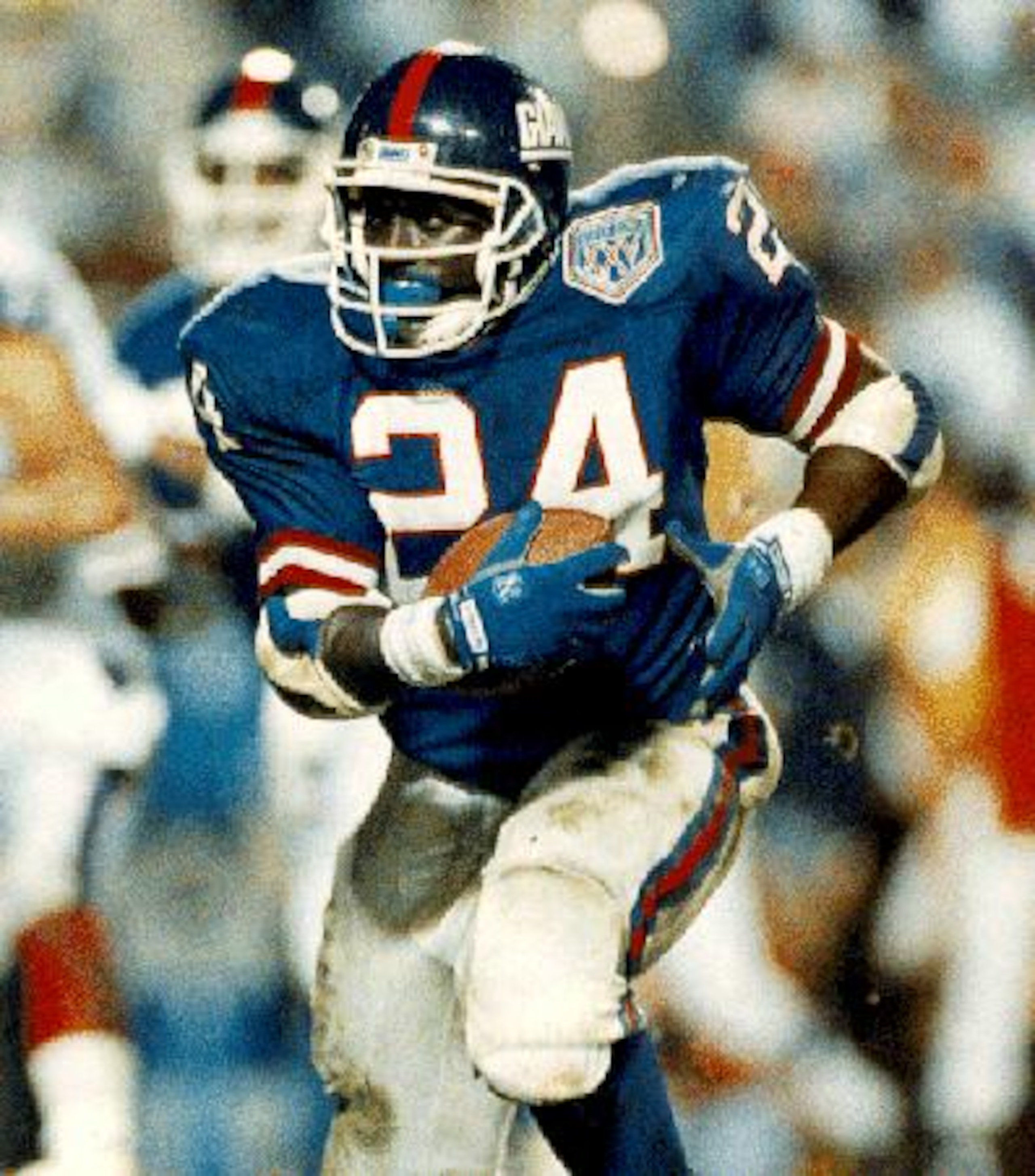
No. 24 Gino Torretta
Gino Torretta capped an illustrious collegiate career by bringing the prestigious Heisman Trophy award back to the Coral Gables campus in 1992. Entering the 2002 season, Gino was still ranked as Miami's all-time leader with 7,690 passing yards, 555 completions and 7,722 yards in total offense. He also had 123 consecutive pass attempts without an interception.
The 1992 season was to be Gino Torretta's coronation as the Heisman favorite. But the season started amidst disaster as Hurricane Andrew ripped through South Florida just 12 days before the season opener at Iowa.
Dealing with the emotional aftermath, Gino led the Hurricanes to a 24-7 win over the Hawkeyes on national television by passing for 433 yards and two touchdowns. If there was a game that typified his career it was the win against Florida State. Miami trailed 16-10 with 9:05 left in the fourth period when Gino led the Hurricanes on a 58-yard scoring drive to take the lead.
In his final year, Gino dominated the Heisman voting, outdistancing San Diego State's Marshall Faulk and Georgia's Garrison Hearst.
The Heisman capped an unparalleled season as Gino became the most decorated football player in Miami history. Torretta took every award available to him in '92: the Maxwell Award (best overall player), Davey O'Brien Award (top quarterback), Unitas Award (top senior quarterback), consensus All-American, and every Player of the Year Award.
No. 23 Melvin Bratton
Melvin Bratton had a standout career at the University of Miami during his five seasons in Coral Gables. As a runningback and fullback, Bratton ran his way into the UM record books as well as leading the team to the 1987 national championship over Oklahoma in the 1988 Orange Bowl Classic. Melvin's accomplishments can still be found in the football record book with his 32 career touchdowns tying for third all-time, and his 26 rushing touchdowns fourth-most.
When he completed his career in 1987, he was listed among several record holders including points scored (third, 192), touchdown receptions (sixth) all-purpose yardage (eighth, 2,455), rushing (ninth, 1,371) and receptions (ninth, 86). After getting injured in the 1988 Orange Bowl against Oklahoma, his final collegiate game, the sure-fire first round pick was forced to rehabilitate and wound up a sixth-round selection of the Miami Dolphins.
Melvin Bratton declined to play in his first season out of college prepping his knee for the next season when the Denver Broncos selected him. Melvin played with the Broncos from 1988-91, and later became an NFL scout with the Washington Redskins.
No. 22 Michael Irvin
The 15th of 17 siblings, Irvin was born in Fort Lauderdale, Florida. He first attended Piper High School then went on to become a football star at St. Thomas Aquinas High School and was heavily recruited by the University of Miami, one of the top collegiate football programs in the nation.
With the University of Miami, under coach Jimmy Johnson, Irvin set school records for career receptions (143), receiving yards (2,423 - later broken by Santana Moss) and touchdown receptions (26). He was part of Miami's 1987 National Championship team, and made one of the most legendary plays in school history that year, scoring on a 73-yard fourth quarter touchdown pass from Steve Walsh that provided the margin of victory in Miami's triumph over arch rival Florida State, which propelled them into the National Championship Game against the top ranked Oklahoma Sooners in the Orange Bowl.
Even at the time, Irvin was known for his exuberance, best displayed by his routine practice of pointing to the sky with both hands after scoring touchdowns.
Critics referred to the move as hot-dogging, though Irvin responded that the gesture was a tribute to his late father. Before a game, his mother would tell him "Say a little prayer, and ask God to be with you...Then go get 'em." Irvin retired the celebration after forgoing his final year of eligibility to declare for the 1988 NFL Draft.
Since leaving the University of Miami, Irvin has remained a staunch supporter of the Hurricanes' football program, often seen on the Miami sideline during big games and giving tutorials to receivers. He has also acted as a mentor off the field to younger Hurricane players over the years.
Irvin was interviewed about his time at Miami for the documentary The U, which premiered December 12th, 2009 on ESPN.
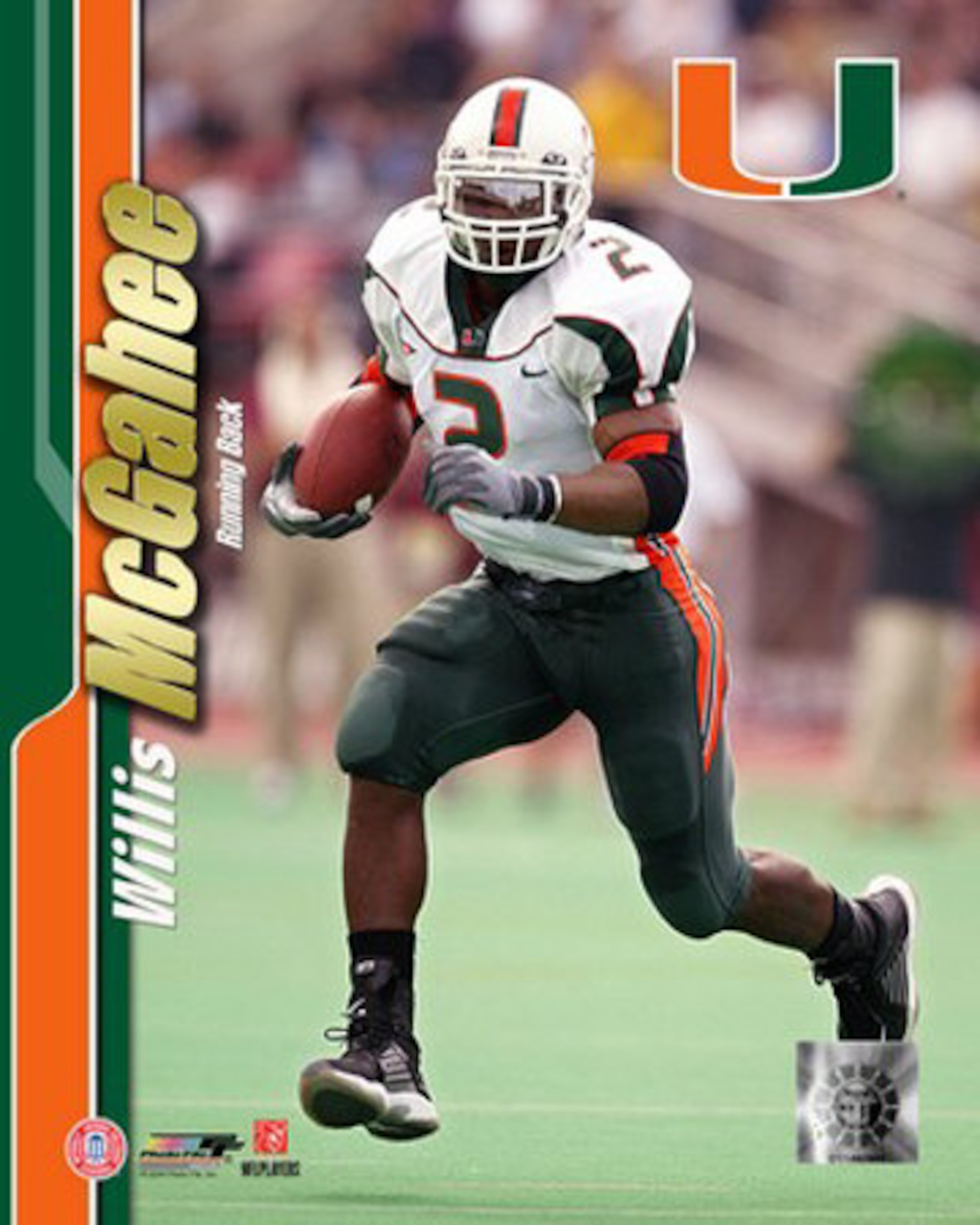
No. 21 Willis McGahee
In college, McGahee broke several records in the 2002 season. He shattered school season records, carrying the ball 282 times for 1,753 yards (6.2 avg.) and 28 touchdowns. Only UCF's Kevin Smith (29 in 2007), Nebraska's Mike Rozier (29 in 1983) and Oklahoma State's Barry Sanders (37 in 1988) ran for more touchdowns in an NCAA Division I-A season.
McGahee's ten 100-yard performances broke the Hurricanes' season record of eight, set by Ottis Anderson in 1978; he added 350 yards on 24 receptions (14.6 avg.) that season. He gained 2,108 all-purpose yards, breaking selection.
McGahee was a member of the 2001 University of Miami team, which won the Division I national championship in that year (the fifth such national championship for the University of Miami since 1983, the most of any university in the past 25 years).
In 2002, McGahee, along with Ken Dorsey, Andre Johnson, Kellen Winslow II, and others led Miami to an undefeated regular season and a #1 ranking, which included a trip to the National Championship game against second ranked Ohio State. Ohio State won the game in double overtime. That year, he rushed for 1,753 yards and 28 touchdowns. He was also a finalist for the Heisman Trophy, given to the nation's top player, finishing fourth in the voting (660 votes). Teammate Ken Dorsey finshed 5th behind McGahee with 643 votes.
In the early part of the fourth quarter during the 2003 Fiesta Bowl National Championship Game, McGahee suffered an injury after catching a screen pass from Dorsey. He was immediately hit by Buckeye safety Will Allen, bending his left knee backwards and causing tears of the ACL, PCL, and MCL. Prior to getting hurt, he had rushed for 67 yards and a touchdown, as Miami would lose the game in double-overtime, 31–24. This injury required several surgeries and extensive rehabilitation before he would be able to play again. At the season's end, McGahee announced he would not collect on a $2.5 million insurance policy he had taken out before the Championship game, and therefore would enter the 2003 NFL Draft.
At the conclusion of his collegiate career (2001–2002), he rushed for 2,080 yards and 31 touchdowns. He majored in criminology.
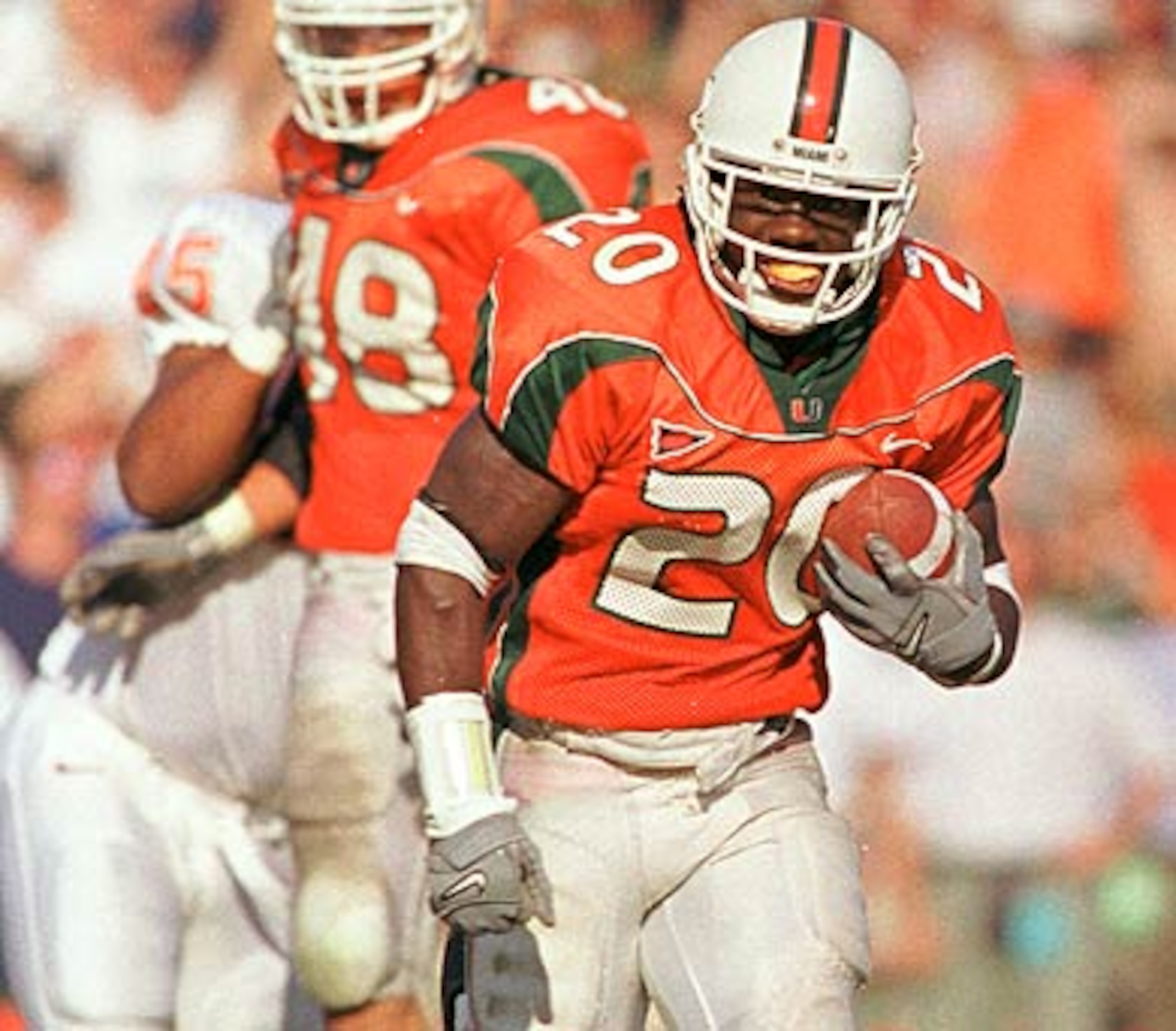
No. 20 Andre Johnson
Johnson enrolled at the University of Miami, where he was a standout wide receiver on the Hurricanes' successful football team.
He was MVP of the 2002 Rose Bowl, where quarterback Ken Dorsey connected with Johnson for two touchdowns and 199 yards. Johnson finished his University of Miami career catching 92 passes for 1,831 yards (19.9 avg.) and 20 touchdowns. His 1,831 receiving yards is ranked fifth on the University of Miami's all-time career list.
While at Miami, Johnson also ran for UM's track and field team. In 2002, he won the Big East 60 meter dash (6.83 seconds) at the Big East Indoor Championship and followed that up by winning the 100 meter dash (10.59 seconds) at the Big East Outdoor Championships.
He is currently one of the best receivers in the NFL and playing for the Houston Texans.
No. 19 Bernie Kosar
Bernie Kosar was instrumental in the University of Miami becoming known as "Quarterback U."
Kosar threw for 5,971 yards and 40 touchdowns as quarterback in 1983 and 1984. He is best remembered for leading Miami to its first national championship as a redshirt freshman in 1983.
Kosar was named MVP for his 300-yard passing performance in the Hurricanes 31-30 victory over the Nebraska Cornhuskers in the 1984 Orange Bowl Classic.
Although Kosar only played two seasons, he left UM holding school records for career passes completed, passing yards, total offense and touchdown passes thrown, all since eclipsed, but still holds the record for career passing completion percentage.
In 1984, he was a first team Academic All-American. Kosar was a first-round NFL supplemental draft pick of the Cleveland Browns, a team he spent nine seasons with. He finished his NFL career with 23,301 yards and 124 touchdowns. In 1993, he was a member of the Super Bowl XXVIII champion Dallas Cowboys, and ended his career with the Miami Dolphins.
In 1994, he was named the University of Miami Alumnus of Distinction. He was inducted into the UM Sports Hall of Fame in 1995, and in 1998, he joined the GTE/CoSIDA Academic All-America Hall of Fame. Bernie was inducted into the UM Football Ring of Honor in 1999.
No. 18 Eddie Brown
Brown was part of the 1983 Miami Hurricanes football team that upset the University of Nebraska in the 1984 Orange Bowl to earn Miami's first National Championship. The following year, Brown was named as a consensus first-team All-American and was the first WR in UM history to amass over 1,000 yards receiving, with 220 of those yards (on 10 catches) coming in the famous "Hail Flutie" shootout with Boston College. Brown would leave Miami setting school career records for receptions, receiving yards and receiving TDs.
Brown was the 13th pick in the first round of the 1985 NFL Draft, he was drafted by the Cincinnati Bengals and played from them from 1985 - 1992.
No. 17 Daniel Stubbs
Dan Stubbs was a consensus All-American defensive end in his senior year of 1987 when the Canes won their second national championship. He was one of three finalists for the Outland Trophy and one of 12 finalists for the Lombardi Trophy.
UM's sack leader for both single season (17 in 1986) and career (39.5), he also had 25 tackles for loss and 267 total tackles and holds the school record for his position with 139 assists. He was selected to play in the 1988 Japan Bowl in Tokyo.
A second round NFL draft pick of the San Francisco 49ers, he also played for the Dallas Cowboys and the Miami Dolphins.
Dan was inducted into the UM Sports Hall of Fame in 1999.
No. 16 Clinton Portis
Portis starred at the University of Miami. He considered going to the University of Florida but a fight that he had at Gainesville High School had his scholarship taken away. He became just the second true freshman to start at running back since the 1975 season. Portis set a school freshman record with five 100-yard performances, and led the team with 838 yards and eight touchdowns on 143 carries (5.9 avg.) in 10 games. He also caught four passes for 44 yards (11.0 avg.) and 2 touchdowns.
Portis' sophomore season was not as successful as he lost his job to James Jackson and rushed for 485 yards and two touchdowns on 77 carries (6.3 avg.) in eight games. He also added 103 yards on five receptions (20.6 avg.).
However, Portis bounced back in 2001 as the Hurricanes won the National Championship and Portis had his best season rushing for 1200 yards and 10 touchdowns on 220 carries (5.5 avg.). He also added 125 receiving yards on 12 receptions. In the Rose Bowl against Nebraska, Portis ran for 104 yards on 20 carries including a 38-yard touchdown.
Portis compiled 2,523 yards through three seasons to rank fourth on the Miami career rushing yards list. He also tied the Miami career record for 100-yard rushing performances with a total of 14, matching the total accumulated by Edgerrin James.
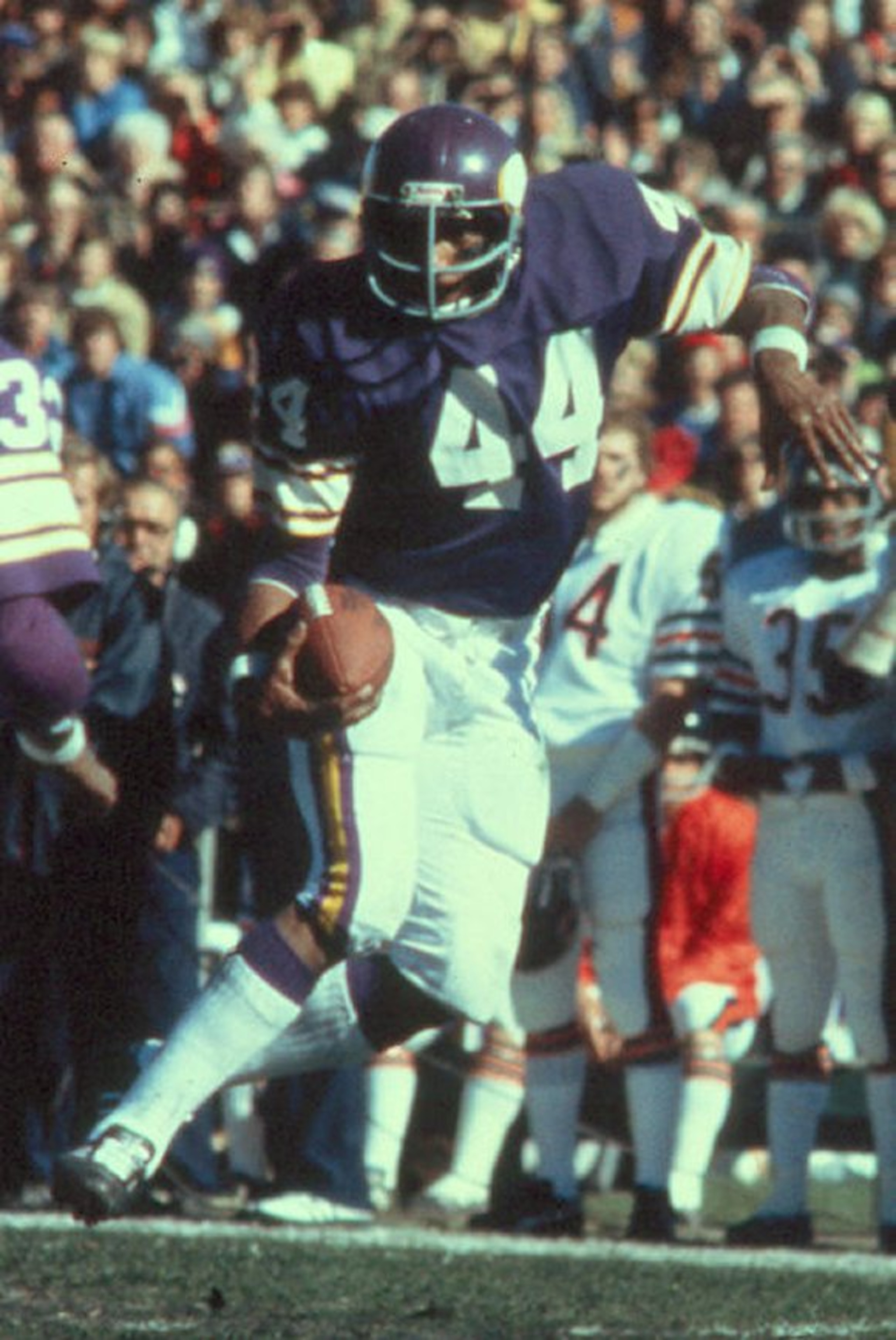
No. 15 Chuck Foreman
"Chuck Forman has that extra move to don't teach, you have to be born with it".
Those were the words of former Hurricane head coach Fran Curci describing the God-given talents which made Chuck Forman sush a vital part of the Hurricane offense during the 1970-1972 seasons. A profilic weapon as a pass receiver, a blocker, a punt returner and more importantly a running back.
Foreman's name is still listed in the Hurricane record books. Season records for net yards gained, kickoff return yards, touchdowns and total points still rack in the top ten. Chuck Foreman was one of the greatest running backs to ever wear the orange, green and white for the University of Miami.
Foreman began showcasing his athletic talents at Fredeick High in Frederick, Maryland where he was a two-way player in football and also lettered in basketball and track. Among his talents as well were playing trumpet and singing, things he continued while at UM.
Following his brilliant career in the warmth of Miami, Foreman headed North to the cold of Minnesota, where he set the Vikings, and the NFL on fire. "Scorpio", as he was known from his college days, twice earned All-Pro honors. He participated in 3 Super Bowls and rolled up 5,879 yards rushing during his 8 year career with the Vikings.
No. 14 Cortez Kennedy
Cortez Kennedy hails from Wilson, Arkansas where he helped lead his Rivercrest team to the 3-A State Championship in 1985. In 1988, Cortez transferred to the University of Miami from North Mississippi Junior College, where his coaches declared him to be the best defensive lineman in our league in 10 years.
As a senior defensive tackle in 1989, he emerged as a dominant force on what many considered to be the nation's top defensive line unit. Cortez, started all 12 games at right tackle.
Cortez tenacious defense helped lead UM to a 11-1 season, a victory in the Sugar Bowl over Alabama and the 1989 National Championship in College Football. He earned second team AP All-American honors and was drafted by the Seattle Seahawks as the 3rd player taken in the 1st round of the 1990 draft.
Seattle converted Cortez to a nose tackle/defensive tackle, and he was named to the Pro Bowl in 1991. After 12 seasons in the NFL, Cortez retired after the 2000 season. In 167 games with Seattle, he recorded 668 tackles, 58 sacks, and made 3 interceptions.
Kennedy was voted NFL defensive player of the year in 1992, despite playing on a 2-14 team. He also was named to the league's team of the decade for the 1990s, voted to eight Pro Bowls, selected All-Pro three times and inducted into the Seahawks Ring of Honor in 2006.
He was inducted into the University of Miami Football Ring of Honor in 2008. Cortez Kennedy was inducted into the Unversity of Miami Sports Hall of Fame in 2004!
No. 13 Vinny Testaverde
Vinny Testaverde came to the Hurricanes by way of Elmont, New York in the fall of 1982. Vinny was the first player in U.M. history to win the Heisman Trophy, 1986. Vinny is one of only a handful of Hurricane football players to have his number retired (14).
On the career lists Vinny ranked, at the time, second in passing yardage, (6,058), tied with Steve Walsh for first in touchdown passes (48) and forth in pass completions (413). In addition to winning the Heisman Trophy, he also won the Davey O'Brien Award, the Walter Camp Player of the Year Award, the Maxwell Award and was voted a consensus first-team All-American. As a starter, Vinny led the Hurricanes to a 21-1 regular season mark over two years.
Vinny was the U.M. leader in career passing efficiency (152.80) and the single-season pass completion percentage (63.4%) in 1986, completed 21 of 28 passes for 261 yards and four touchdowns in Miami's 28-16 win over No. 1 ranked Oklahoma at the Orange Bowl during the 1986 season. He also led Miami to back-to-back New Year's Day bowl games, the 1986 Sugar Bowl and the 1987 Fiesta Bowl. Vinny was also voted the Jack Harding team MVP award in both his junior and senior season.
Testaverde was selected the first pick in the 1987 NFL draft by the Tampa Bay Buccaneers and played on several other NFL teams during his long, and successful, career.
He was inducted into the UM Sports Hall of Fame in 1998.
No. 12 Jessie Armstead
Jessie came to the University of Miami in 1989 from Carter High School in Dallas, Texas, having been selected Superpro Magazine's Player of the Year and said by many to be the number one collegiate prospect at any position. Jessie had an immediate impact as a freshman, playing in all 11 regular season games and helping the University of Miami win its third National Championship in 1989.
He started fast as a sophomore, starting the first four games as weak side linebacker before a season ending knee injury. As a junior he started all 12 games at linebacker, after overcoming reconstructive knee surgery, and finished third on the team with 99 tackles. His strong defense helped lead the University of Miami to its undefeated season, a 22-0 win over Nebraska in the Orange Bowl and its fourth National Championship.
In his senior year he was 1/3 of the lethal linebacking crew of Armstead, Darrin Smith and Micheal Barrow, leading the 1992 team (despite a severe setback resulting from Hurricane Andrew) to a consensus number 3 final ranking and Miamis 51st consecutive victory in the Orange Bowl.
Jessie was taken in the 8th round of the 1993 draft by the NFL's New York Giants and played 9 years with the Giants, 2 years with the Washington Redskins and is currently playing for the Carolina Panthers. Jessie was selected to play in five Pro-Bowls and is an eleven year veteran of the NFL.
No. 11 Reggie Wayne
The most prolific and consistent receiver in the storied history of Miami football. Owns the UM career receptions mark and is a close second on UM's receiving yards list.
Perhaps the finest pure receiver in Miami history. Ranks first on UM's career receptions with 173 catches and second with 2,510 yards. Made 43 career starts, which places first by receivers since the 1983 season.
As a four-year starter at the University Of Miami playing with Ed Reed, Santana Moss, Andre Johnson, Wayne set a school record 173 career catches (including 36 consecutive games with a reception) and is only one of three wide receivers in school history to post 20 or more touchdowns in his career joining Michael Irvin, Lamar Thomas. His 48 receptions as a freshman were a school record.
Wayne graduated with a degree in liberal arts. He was also roommate to Baltimore Ravens safety Ed Reed.
No. 10 Ottis Anderson
In the four years that Ottis Anderson spent at the University of Miami he not only broke eight long standing rushing records, he also established himself as the best runner in the history of the school.
Anderson, a West Palm Beach native, became the first player in the school's history to rush for over 1000 yards in a single season, with 1266 in 1978, still the third highest total in school history.
His career achievements include breaking records in the following categories: career rushing yards with 3331; all-purpose yards with 4265; most 100 yard games with 13; and for longest kickoff return with two 100 yard returns.
Anderson's single season records are equally impressive. In 1978 he set university records for 100 yard rushing games with 8 in 11 games, consecutive 100 yard games with four, and carries in a single game with 39. That season he earned acclaim by being named first team All-American by both The Sporting News and the Football Coaches Association.
Anderson was a first round pick in the 1979 NFL draft by the St. Louis Cardinals , and was named NFL Rookie of the Year in 1979. In 1986, Anderson was traded to the New York Giants. He spent 14 years in the NFL, recording 10,273 career rushing yards and 86 touchdowns. He was a Pro Bowl selection in 1979 and 1980.
No. 9 Ken Dorsey
While at the University of Miami, Dorsey was known as a consummate winner, leading the Hurricanes to the 2001 national championship and posting a record of 38-2 as the team's starting quarterback.
Dorsey also effectively rewrote the school record book, setting career records for total offense (9,486 yards), passing yards (9,565), passing touchdowns (86), pass completions (668), pass attempts (1,153), victories as a starting quarterback (38), winning percentage by a starting quarterback (.974), 200-yard passing performances (31), consecutive passes without an interception (193), consecutive games with a touchdown pass (31), and touchdown passes in a game (5).
In addition, was named the co-MVP of the 2002 Rose Bowl (in which Miami defeated the University of Nebraska to win its fifth national championship), Offensive Player of the Year twice (2001, 2002), and First-team All-Big East three times (2000, 2001, 2002). Dorsey was also a finalist for the Heisman Trophy in both 2001 and 2002 and the winner of the 2001 Maxwell Award, which is given to the national collegiate player of the year.
In 2002, he led Miami to an undefeated regular season and a National Championship berth, where Miami would fall to eventual champion Ohio State in what is remembered as one of the all-time best bowl games in the history of college football. In double-overtime Dorsey and the Hurricanes were upset in their bid to win a second straight national championship. He passed for 296 yards, two TD's, and two picks. Miami finished the season 12-1, ranking second behind the Buckeyes. Dorsey finished the season with 3,369 passing yards, 28 touchdowns and 12 interceptions. He was once again a finalist for the Heisman Trophy.
He earned a degree in business management.
No. 8 Alonzo Highsmith
Alonzo Highsmith was an explosive fullback and an offensive leader for the University of Miami from 1983 to 1986. As one of the top running backs ever at Miami, Highsmith was a complete player who ran, blocked and caught passes with equal skill and determination.
Highsmith finished his UM career with 1,914 yards, ranking third in school history and 2,935 all-purpose yards, the fifth highest total for a Hurricane. He also scored 25 career touchdowns, tied for fourth place all-time at UM.
Originally from Miami, the former Columbus High School standout recorded five 100-yard rushing games, tying for the second highest total in 'Canes history, and rushed for a team high 50 yards and one touchdown in the 1984 Orange Bowl Classic as Miami captured its first national championship.
Highsmith was selected in the first round, third pick overall, in the 1987 NFL draft and went on to a five-year professional career with the Houston Oilers and Dallas Cowboys. He was inducted into the UM Sports Hall of Fame in 1997.
No. 7 Russell Maryland
One of the most intimidating and dominating defensive linemen of his era of college football, Russell Maryland left a legacy of excellence that few will ever match.
The first Miami player to win the coveted Outland Trophy (nation's top interior lineman) in 1990, Maryland captured virtually every award in his grasp during his outstanding senior season. A consensus All-American in 1990, Maryland was a first-team All-America selection by Associated Press, United Press International, Kodak, the Walter Camp Football Foundation, The Football News, and The Sporting News. He also was the UPI's selection as 1990 College Football Lineman of the Year.
Maryland, who finished his UM career with 279 tackles, 25 tackles for losses and 20.5 quarterback sacks, was UM's Jack Harding Most Valuable Player Award winner in 1990. Maryland, also an excellent student, was inducted into UM's elite Iron Arrow fraternity before his graduation and was the first player chosen in the 1991 NFL Draft (by the Dallas Cowboys).
A native of Chicago, Illinois, Maryland remains an active pro player for the Green Bay Packers. He also played for Dallas (1991-95) and Oakland (1996-99), winning three Super Bowls with the Cowboys.
No. 6 Edgerrin James
Edgerrin is one of the most prolific and exciting running backs in UM history! He came to Miami out of Immokallee (FL.) High School where he also played linebacker and handled kickoff and field goal duties and was named a Parade All-American.
He is the only Hurricane running back to post consecutive 1000+ rushing seasons and ranks 2nd in school history with 2,960 yards, despite starting only 17 games. His 35 total touchdowns is tied for the school record with Stephen McGuire, while his 32 rushing touchdowns is 2nd. He is tied for the school record with fourteen 100+ yard rushing games and had 12 multi-touchdown games in his career.
He is also third in rushing attempts (474), and 3rd in all-purpose yards (3,590). His 1,416 yards rushing in 1998 was the most to that time of any Miami back (now 2nd) and set a Big East record, and his 17 touchdowns that year shattered Eddie Dunn's 60-year old school record of 14 touchdowns in 1938! He also holds the freshman rushing record (446 yds).
"Edge", as he is known to teammates and fans, saved his best for the big stage, and nothing points that out better than his school record 299 yards in 39 carries performance in the Canes 49-42 upset victory over No. 2 UCLA in the Orange Bowl in December of 1998.
He was named first team AP All-Big East, Football News All-Big East, and Football News honorable mention All-American.
James was drafted in the first round (fourth overall) of the 1999 NFL draft by the Indianapolis Colts and was named the 1999 AP Offensive Rookie of the Year. As of the 2008 season, he was the NFL's active rushing leader with more than 12,000 yards.
He established the Edgerrin James Foundation and his annual Charity Basketball Classic benefits the foundation and his old high school.
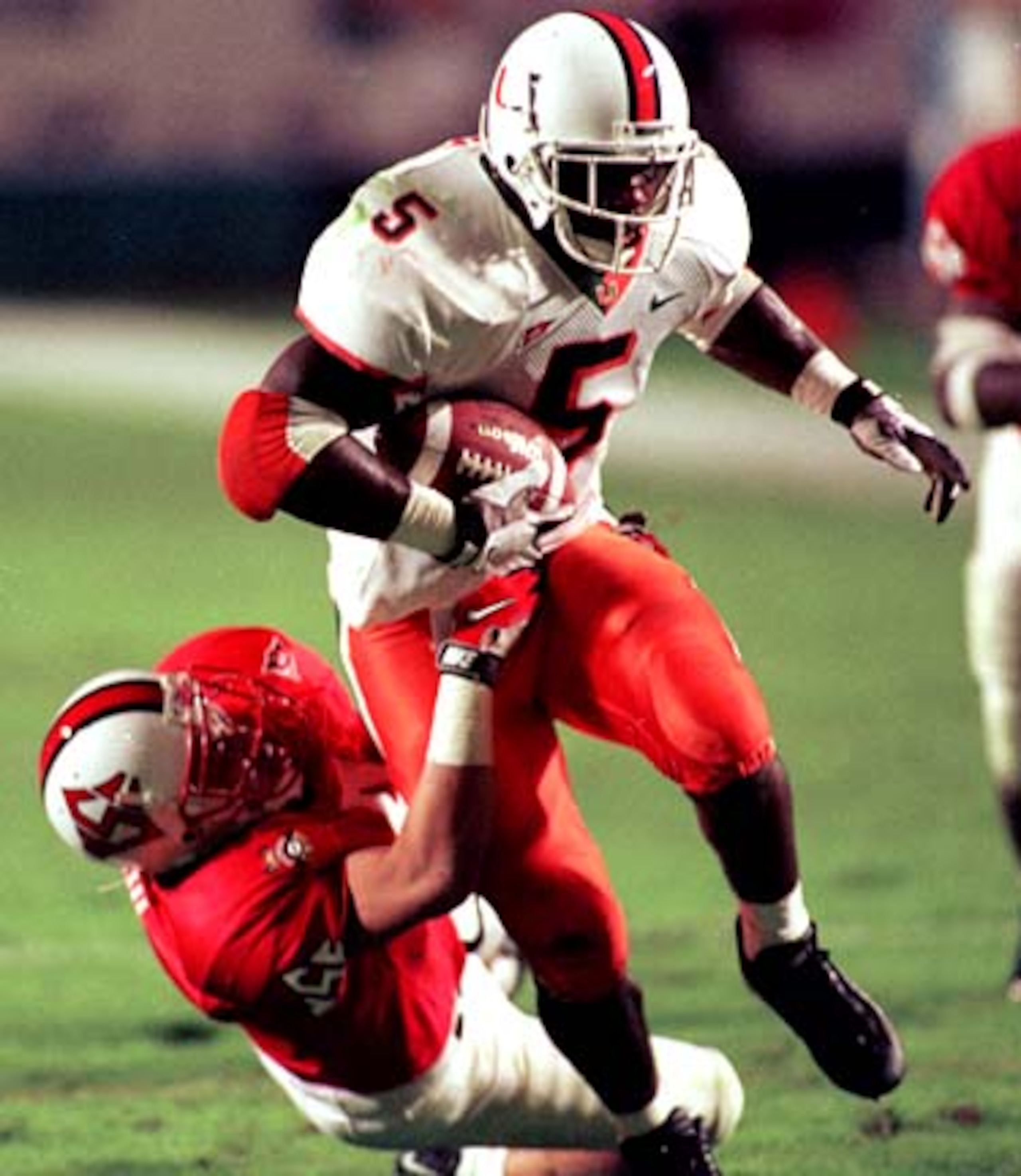
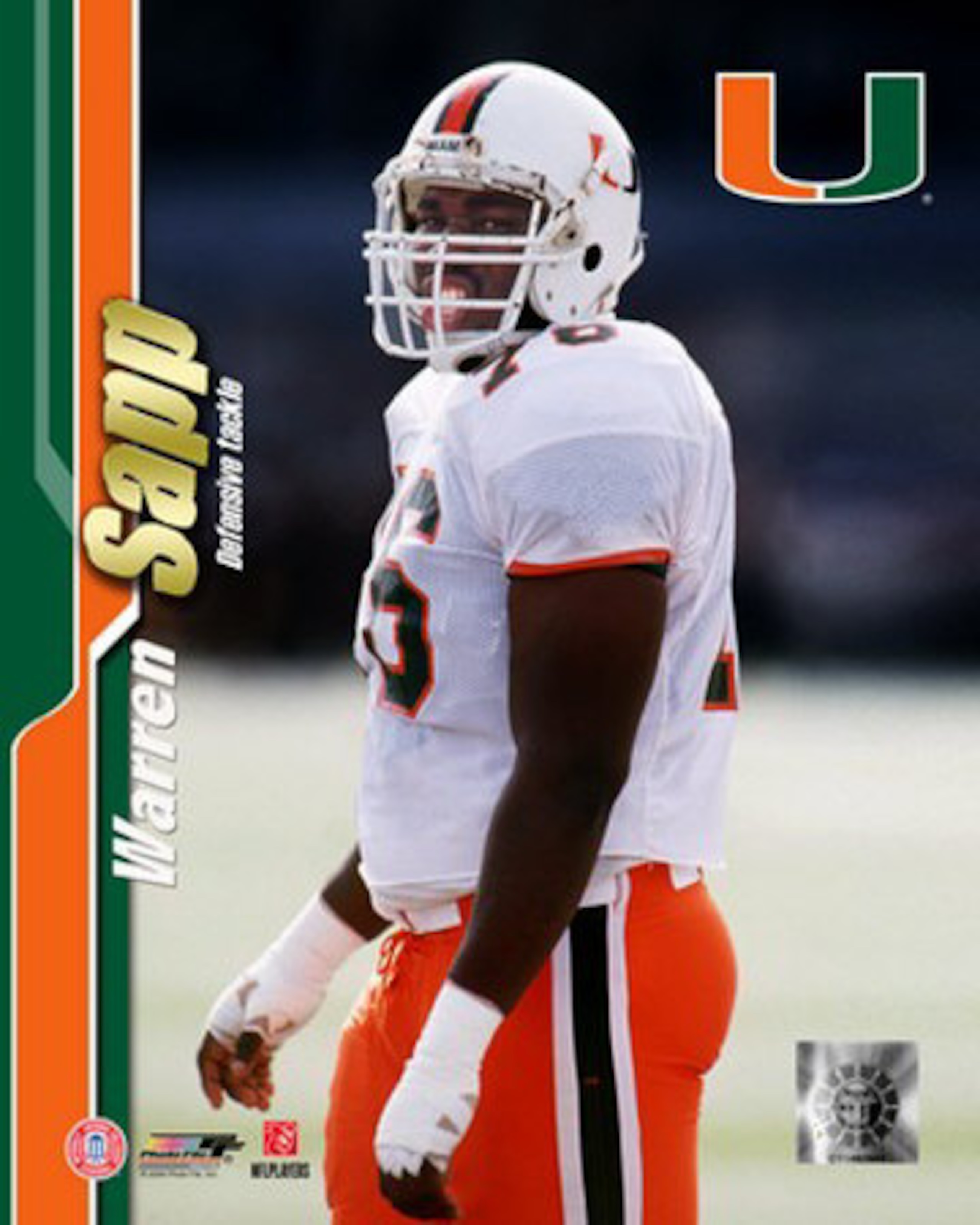
No. 5 Warren Sapp
A consensus All-American and the first Hurricane to win the prestigious Lombardi Trophy, Warren Sapp was a man among men as he annihilated opposing quarterbacks in the early 1990s.
Sapp was so dominant on the defensive line that he made the short list for the Heisman Trophy during his junior year, as opponents tried to formulate offensive schemes with futile hopes of containing No. 76. Known for his effervescent smile and larger-than-life personality, neither trait endeared him to Hurricane foes in 1994, when Sapp recorded 10.5 sacks and made forcing fumbles look easy.
Along with All-America honors, Sapp was a unanimous Big East Defensive Player of the Year winner and earned Hurricane football's highest team honor, the Jack Harding MVP award. A first-round draft pick of the Tampa Bay Buccaneers in 1995, Sapp is one of the select few players to earn both an NCAA Championship football ring and a Super Bowl ring.
Selected to seven NFL Pro Bowls and awarded the 1999 NFL Defensive Player of the Year award, Sapp has more than fulfilled the promise shown as a young big man from Plymouth, Florida when he arrived on the Coral Gables campus in 1991. Sapp finished his UM career with 176 tackles, 19.5 sacks, and many forced fumbles and pass deflections. Upcoming Hurricane opponents were not sorry to see Sapp leave early for the NFL.
He is now an analyst on the NFL Network.
No. 4 Ed Reed
Reed attended the University of Miami where he was a standout defensive player. Reed played for the University of Miami team that won the 2001 National Championship.
At the University of Miami, Reed was a two-time consensus All-American selection in 2000 and 2001. In 2001, he led the nation with 9 interceptions for 209 yards (a school record) and 3 touchdowns.
Reed helped seal a memorable win over Boston College in 2001 when he grabbed the ball out of teammate Matt Walters' hands, who had just intercepted it, and raced 80 yards for a touchdown. Reed earned the league's Co-Defensive Player of the Year Award in 2001 and was named National Defensive Player of the Year by Football News. He was one of three finalists for the Jim Thorpe Award and was one of 12 semifinalists for the Bronko Nagurski Trophy.
Reed set several records during his time at Miami. He holds the record for career interceptions with 21, career interception return yards with 389 and interceptions returned for touchdowns with 5. He also blocked four punts during his four year career. In addition, Reed was a member of the track and field team during his years at Miami and was a Big East Champion in the javelin.
He graduated in 2001 with a degree in liberal arts.
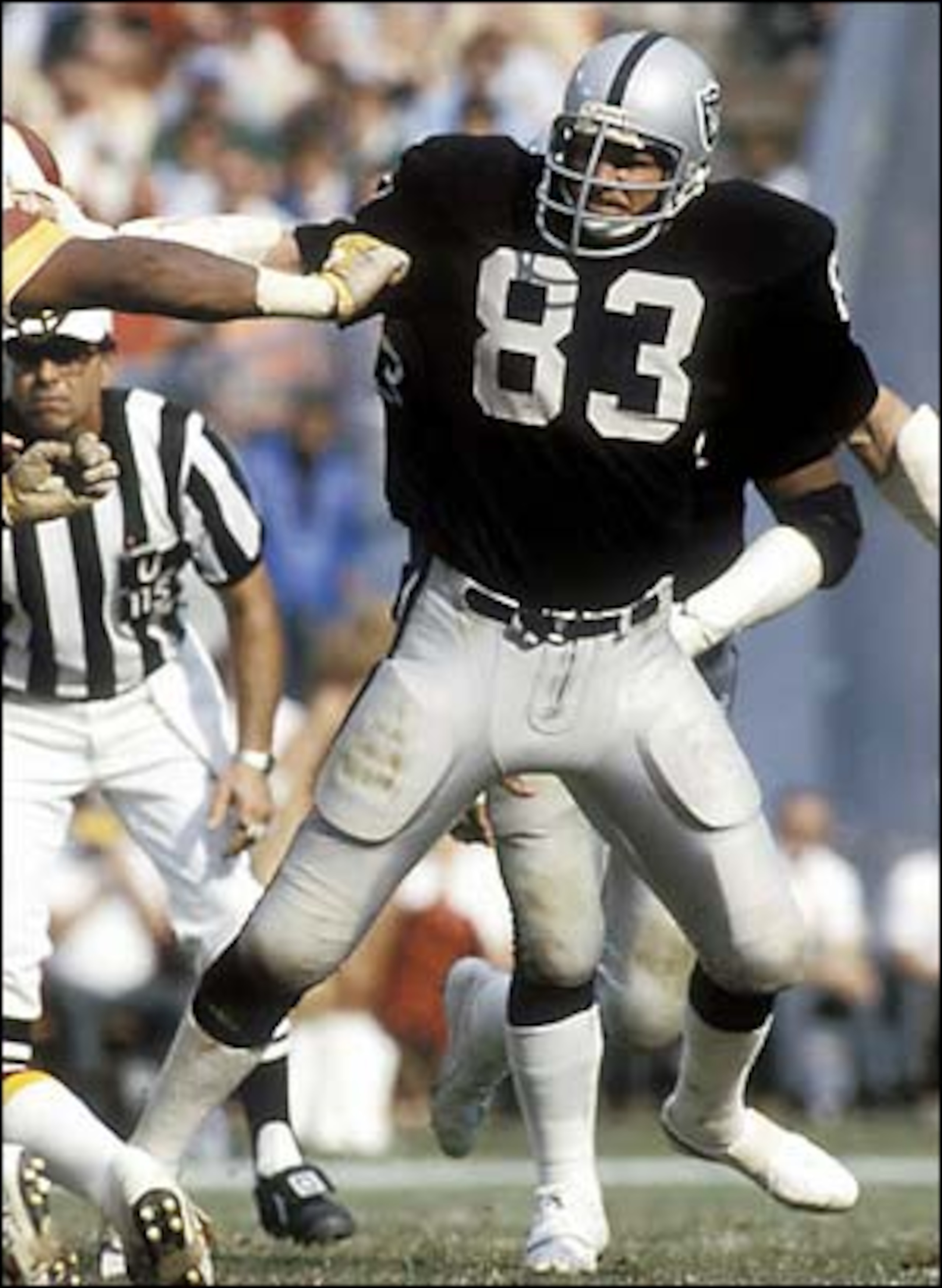
No. 3 Ted Hendricks
Hendricks played his college football at the University of Miami. He played stand-up defensive end for the University of Miami during the 1966 through 1968 seasons. The 6’7”, 220 pound Hendricks was one of the greatest defensive players in the history of college football.
He was a two-time All-American (1967 and 1968) and finished fifth in the 1968 Heisman Trophy voting. He was also a Second-team All-America selection in 1966.He also joined Kappa Sigma men's fraternity.
While playing for UM, Hendricks made 327 total tackles (the most ever by a UM defensive lineman). He also led UM with the most solo tackles by a defensive lineman with 139. Hendricks also recovered 12 fumbles during his UM playing career.
He recorded a career-high of 4 quarterback sacks against the University of Florida in 1968. In his junior year of 1967 he caused nine turnovers, by fumble recovery, stolen ball, pass interception or blocked kick.
It was at UM that the tall, thin Hendricks gained the nickname “The Mad Stork.” It was a nickname that would follow him through his professional football career. Hendricks' UM jersey was retired in 1997. He also was elected to the College Football Hall of Fame in honor of his college football career.
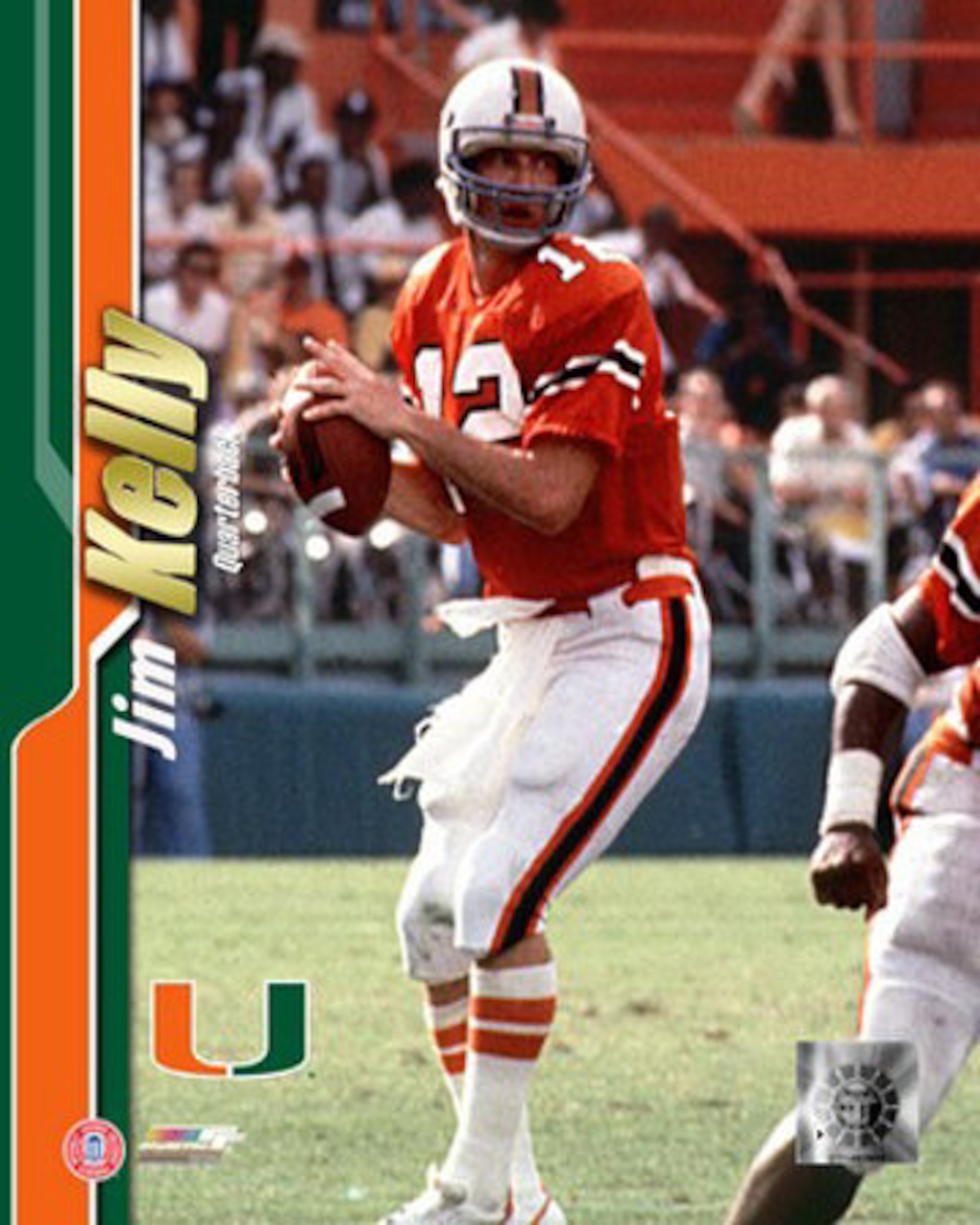
No. 2 Jim Kelly
Jim Kelly began the quarterback tradition at Miami that led the school to be known as "Quarterback U." The names are almost as one: Kelly-Kosar-Testaverde-Walsh-Erickson-Torretta. He also was at the helm for perhaps two of the biggest games in UM history, beginning a turnaround that made Miami the most successful team in college football during the 1980's.
As a 19-year-old freshman, Jim returned to his home state and made his first college start, leading Miami to a 26-10 upset at Penn State. Two years later, the same Nittany Lions came to the Orange Bowl ranked Number One and Kelly led the Hurricanes to a stunning 17-14 upset victory. That season Kelly earned MVP honors in Miami's first bowl appearance in 14 years, the Peach Bowl. Despite an injury plagued career, Kelly rewrote the Miami record books during his time at UM.
Jim went on to star with the Houston Gamblers of the USFL, throwing for more than 5,000 yards in 1984, while earning league MVP honors.
He moved to the Buffalo Bills in 1986 and rewrote their record books, leading the team to four consecutive Super Bowl appearances.
He was named to the NFL Pro Bowl 5 times. Kelly was inducted into the UM Sports Hall of Fame in 1992. He was inducted into the UM Football Ring of Honor in 2008.
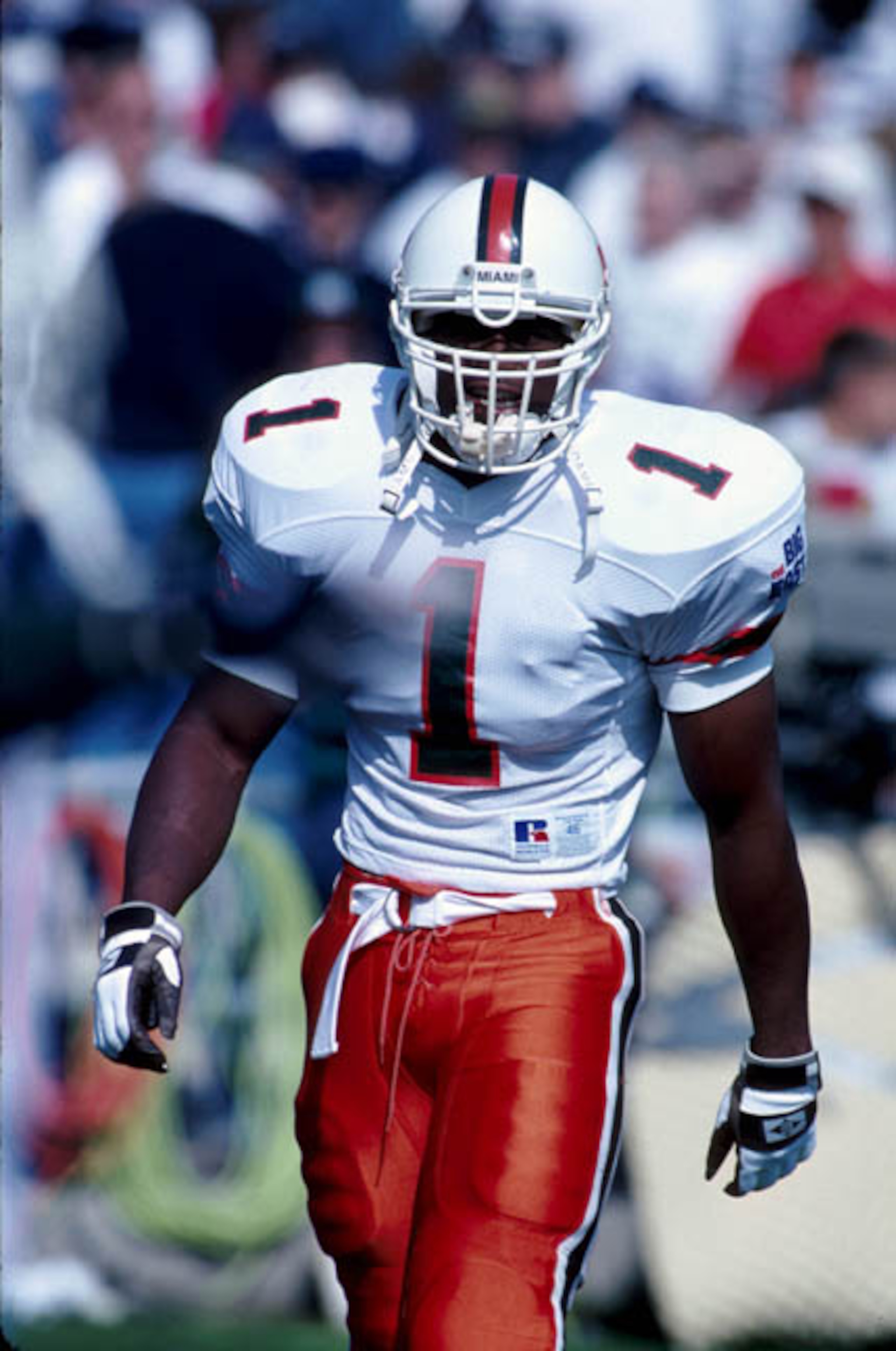
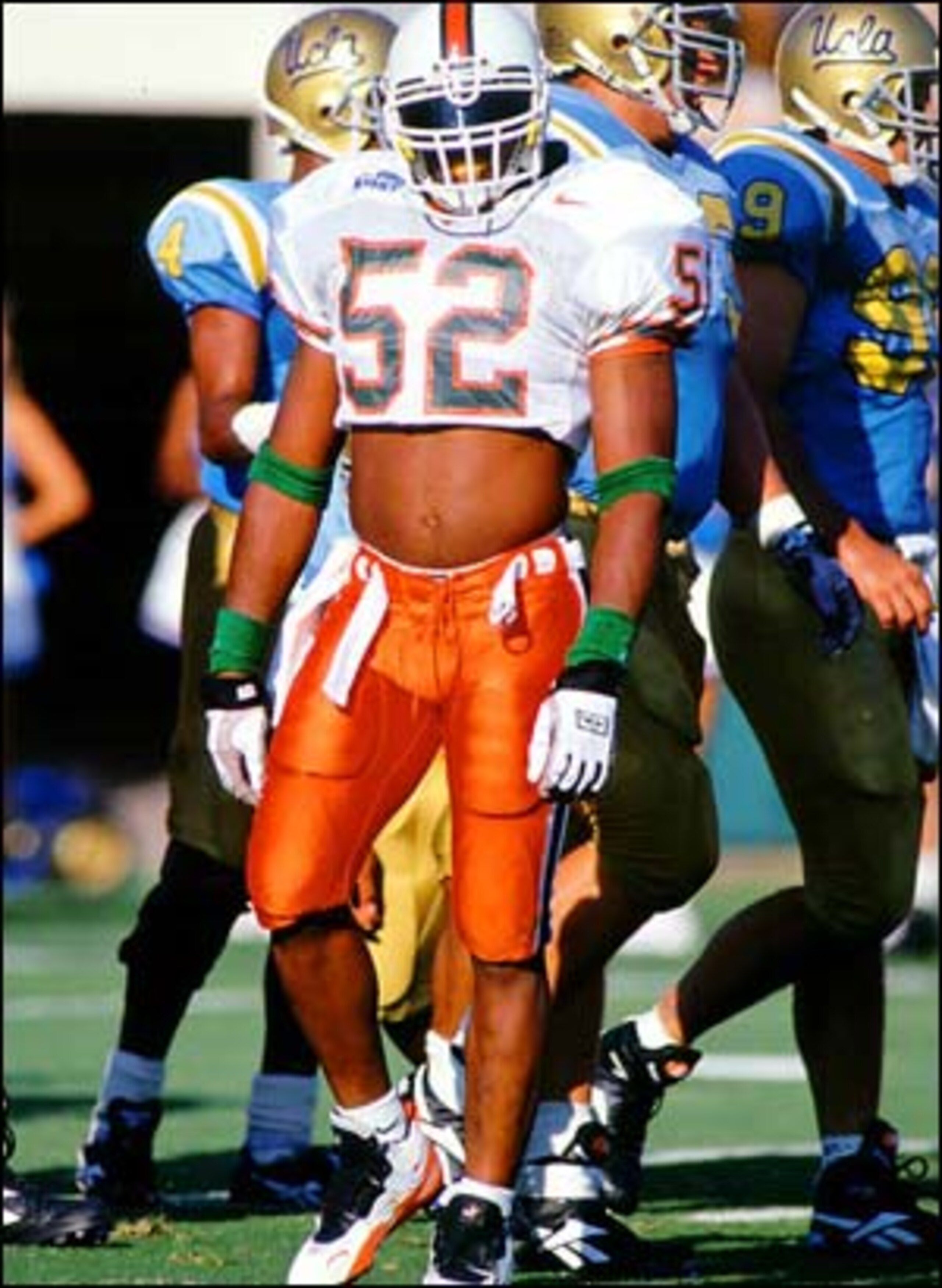
No. 1 Ray Lewis
One of the most intimidating Hurricanes ever, Ray Lewis' dominating field presence changed the way teams prepared to play the 'Canes.
His punishing abilities as linebacker made opposing coaches draw up special plays to try and contain him, while their teams' QB and running backs were always nervously looking for #52. Starting as a true freshman, the Bartow native racked up awe-inspiring numbers and a bevy of honors in his three-year Miami career.
Lewis holds the UM individual season record for tackles by a MLB with 95, and incredibly is tied for second in career total tackles and assists with 160. He was named All BIG-EAST in 1994 and 1995 as well. Not bad for someone who only played three years and was the recipient of the very last scholarship available in 1993.
Voted the Jack Harding MVP of the team after the 1995 season, Lewis opted for the NFL draft and became a first-round pick of the Baltimore Ravens. Now preparing for his 11th NFL season with Baltimore, Lewis has racked up over 1000 solo tackles, 258 assists, 23 sacks, 71 pass deflections, and 21 interceptions. Lewis was also the NFL's defensive player of the year in 2000 and was named MVP of Super Bowl XXXV, leading the Ravens to their first-ever world championship.
Lewis remains beloved both in Baltimore and Florida for his commitment not only to being a great football player but his deep involvement in community enrichment. He regularly donates of his time and money to a variety of worthy causes, among them "Ray's Summer Days", which raises money for his non-profit foundation.
After earning his degree Lewis put it to work, starting several successful business ventures, including a nutrition product line and a popular barbecue restaurant in Baltimore. A man who feels 'completely blessed' to be part of the Hurricanes rich football history, Lewis will go down as one of the best to ever play for the 'U'.
What is the duplicate article?
Why is this article offensive?
Where is this article plagiarized from?
Why is this article poorly edited?
Flag This Article


66 Comments
Loading comments...
This comment and all replies have been deleted This comment has been deleted Undo delete