Hitting for Power Would Take Francisco Lindor into the Stratosphere
Francisco Lindor didn't need a big stick to loom large in the 2016 American League MVP race. He finished ninth in the voting despite being the only position player in the top 10 to hit fewer than 24 home runs.
This is the part where one would say, "Just imagine what Lindor could do with more power." But right now, there's no imagination required for that.
The Cleveland Indians' star shortstop hit another homer on Sunday. That gives him five dingers through 18 games.
TOP NEWS
Papelbon Honors Fan Bet 😂
.jpg?w=2560)
Kevin Gausman, Shota Imanaga's Top Suitors 🛬
Latest Free Agent Rumors👂
A major development by league-wide standards? Not really. Lindor entered Monday as one of 28 players with at least five homers on the season. He's certainly no Eric Thames.
But a major development by Lindor's standards?
Oh, just a bit.
Lindor didn't get to five homers last season until his 53rd game, and ultimately finished with only 15. He's already a third of the way there with only 11 percent of the 2017 season in the bag.
There's a limit on how much excitement is warranted by Lindor's power surge. April is when fluky things tend to happen, and Lindor did have 10 homer-less games in between his fourth and fifth home runs.
Plus, the man himself insists he's not a slugger.
"I'm not a power hitter," Lindor said, according to Zack Meisel of Cleveland.com. "I'm not going to be a power hitter. It's not going to happen."
The notion that Lindor, 23, isn't actually a power hitter is easy enough to confirm. He hit only 27 home runs in his first 257 major league games and only 21 homers in 416 minor league games.
"Power is the one tool that won't be Lindor's forte," wrote Jim Shonerd for Baseball America in 2014.
Lindor was still considered an elite prospect, however, because he did everything else well. He could hit for average. He could run the bases. And above all, he was a phenomenal defender.
It's because of these same abilities that Lindor hasn't needed power to be a superstar major leaguer. He had a solid .356 on-base percentage and 31 stolen bases on one side of the ball in 2015 and 2016, and 27 defensive runs saved on the other. He led all shortstops in wins above replacement.
And yet, the question is too intriguing not to ask: Maybe Lindor's power outburst is more real than all of the above would indicate?
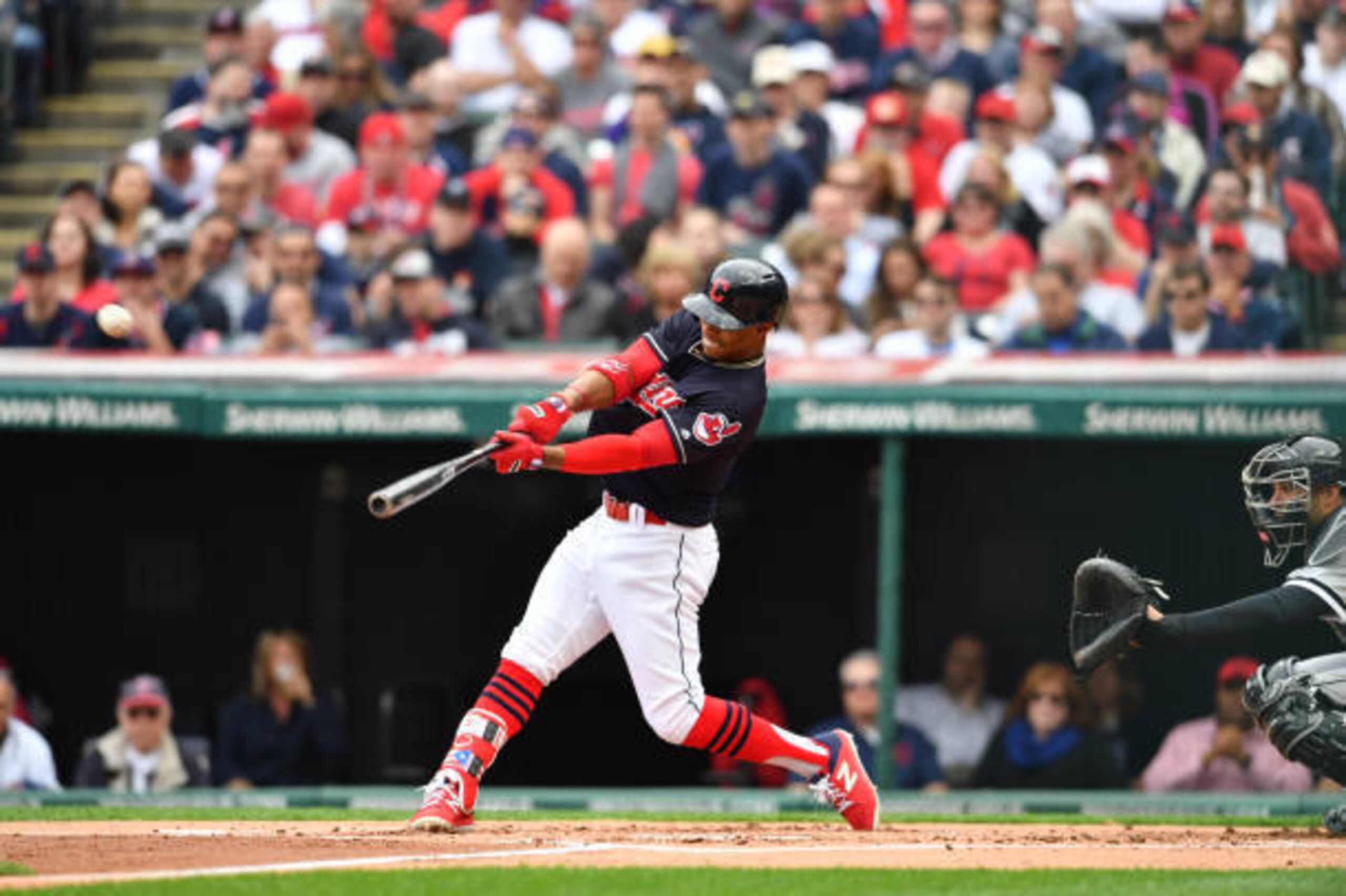
Consider how drastically Lindor has changed his batted-ball profile this season.
He was a ground-ball hitter in his first two seasons, hitting 49.8 percent of his batted balls on the ground. Out of the blue, he's now hitting only 29.5 percent of his batted balls on the ground in 2017. He has joined baseball's fly-ball revolution.
Lindor isn't just hitting balls in the air in greater volume. He's also hitting them than ever. Per Baseball Savant, his average exit velocity on fly balls and line drives has progressed like so:
- 2015: 94.4 mph
- 2016: 92.9 mph
- 2017: 95.4 mph
This is no joke. Lindor has been hitting his fly balls and line drives about as hard as Kyle Schwarber, and harder than guys like Mike Trout, Mark Trumbo and Brian Dozier and many others.
Put simply: The dude's crushing the ball all of a sudden.
Lindor insisted he's not trying to elevate the ball on purpose, telling Meisel: "If I hit the ball up in the air, the chances of them catching it are a lot higher."
However, he also said:
"Am I surprised? I don't want to say I'm surprised. I work very hard to help my team win and to stay in shape. I want to drive the ball. I don't want to be a punching bag. I want to drive the ball. I want to hit it hard. Am I swinging as hard as I can? No, I won't do that. I can't repeat my swing when I swing as hard as I can.
"
This clearly isn't a case of a hitter who's just trying to slap base hits and somehow ending up with home runs. Lindor wants to do damage.
And for him, the key to doing so isn't taking fly-ball swings. It's simply taking good swings.
"If you swing at pitches out of the zone, you are not going to drive the ball out," he told Travis Sawchik of The Athletic (h/t Chris Towers of CBSSports.com). "For me to drive the ball out, it has to be a good pitch, on the barrel."

So far this season, Lindor has practiced what he's preaching.
He chased pitches outside the strike zone 31.8 percent of the time as a rookie in 2015. He improved to 30.3 percent in 2016, and even more to 26.3 percent in 2017. With an in-zone swing rate of 72.4 percent, he's roughly three times more likely to swing at good pitches than bad ones.
This is having the desired effect. A greater percentage of Lindor's in-zone swings are resulting in fly balls and line drives, and these balls are being hit at higher speeds:
| 2015 | 14.8% | 95.4 mph |
| 2016 | 16.2% | 93.6 mph |
| 2017 | 33.0% | 96.6 mph |
There's no guarantee that these numbers will stay high, but they're evidence that there's a method behind Lindor's sudden power madness. Maybe he won't stay on a 45-homer pace, but something like 25 home runs seems reasonable.
And if he gets there, his 2017 season will go into the books as a true rarity.
Go looking for shortstops who have clubbed over 25 homers in a season with Lindor-like efficiency in other departments—an OBP north of .350 and easily above-average baserunning and defensive value—and what shows up is a list that includes Ernie Banks, Cal Ripken Jr., Alex Rodriguez and Troy Tulowitzki at the height of their powers.
In other words: Lindor is transforming from a player on the fringes of the MVP conversation to a player worthy of an MVP award, period.
Data courtesy of Baseball-Reference.com, FanGraphs and Baseball Savant.

.jpg?w=2560 "Cubs Offseason Guide")
.jpg?w=2560 "Porter Blasts Steelers 😳")



.jpg?w=2560 "Rodgers' 75 Hand Signals 🤯")