What Can MLB Pitchers Do to Stop the Return of the Home Run Era?
Major League Baseball pitchers don't have it too bad. Strikeouts are at an all-time high and, not so coincidentally, scoring is well below the heights it reached in the 1990s and 2000s.
The elephant in the room, however, is liable to show itself whenever there's a crack of the bat.
Baseball revolves around the dinger again. Home runs seemed gone for good when there were only 0.86 per game in 2014. They then made a roaring comeback in the second half of 2015, and the revolution continued in 2016. At 1.16 per game, home runs were hit at a near-historic rate.
TOP NEWS

Brewers Stun Padres in Game 2 😧
Braves' Opener Shines vs. LA 💪
Aaron Boone Calls Out Yankees Catcher 🗣️
This is good for baseball. Given the degree to which runs had dried up, anything that puts more offense into games is welcome.
Not by pitchers, though. Their job is to keep runs off the board. Keeping the ball in the park sure helps with that. As far as they're concerned, the return of the home run must be thwarted.
But how?

There's no obvious answer because there's no obvious explanation for why home runs have returned. There are only theories to put to the test.
One of them is a conspiracy theory: MLB has juiced the ball. The idea is so intriguing and so plausible, in fact, that Ben Lindbergh and Rob Arthur of FiveThirtyEight looked into it in June and got results that, while not conclusive, were at least "suggestive."
Pitchers themselves aren't so sure, however.
"The balls have felt the same to me for the last 11 years," San Diego Padres starter Jered Weaver told B/R's Scott Miller during spring training.
That echoed what the Washington Nationals' Max Scherzer, now a two-time Cy Young Award winner, told Jerry Crasnick and David Schoenfield of ESPN.com in July: "Even if they did make a change, I wouldn't be able to feel anything different."
Besides, it's not as if pitchers could wave a magic wand and de-juice the ball if it is indeed juiced. All they can do is try to suppress its influence by changing things they have the power to change.
Which brings us to another theory: Velocity is to blame for all the home runs.

There's no question pitchers are throwing harder. Per FanGraphs, the average fastball skyrocketed from 89.0 mph in 2002 to 92.3 mph in 2016.
The logic holds that the harder the pitch, the harder batters can hit it—in layman's terms: Speedy thing goes in, speedy thing comes out. What's more, perhaps extra velocity makes pitchers sloppy.
"I think there are harder throwers, and when you throw harder, you make more mistakes," Weaver said. "Everybody's geared up for heaters and hard stuff."
But in the year 2017, this can be checked at Baseball Savant. Here's a look at what percentage of fastballs at certain velocities have been hit for home runs over the years:
Have hitters gotten better at hitting high-velocity fastballs over the fence? Yes.
They've also, however, gotten better at sending lower-velocity heaters over the fence. That continues the pattern that low-velocity heaters have a smaller margin for error.
(Side note: Yeah, Weaver's a guy who should know this all too well.)
So, perhaps it's not the baseball or pitchers driving the home run revolution. Maybe—just maybe—it's the guys hitting the home runs.
It's easy to lob the dreaded S-word out there, but that's a reach. The decline in power hitting started with the introduction of performance-enhancing drug testing in the mid-2000s. We also know from experience what juiced-up players look like. Not many in today's game match the description.
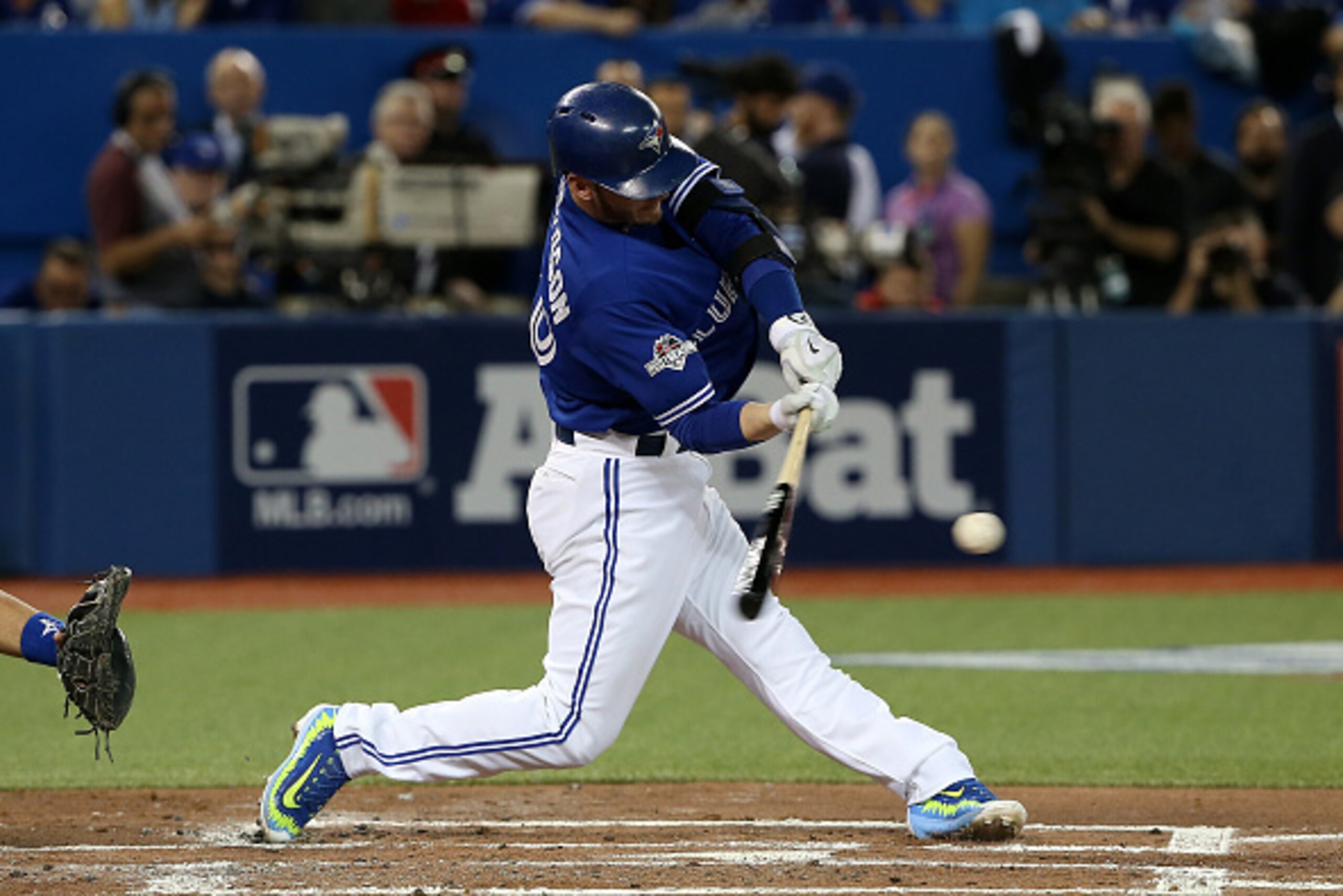
Rather, the difference may be how hitters are swinging the bat.
"I think guys are paying more attention to putting balls in the air," Oakland A's third baseman Trevor Plouffe told Miller.
Or, as Toronto Blue Jays slugger Josh Donaldson put it on Twitter:
Quite a few other players—MLB.com's Mike Petriello and USA Today's Steve Gardner have quote-filled pieces worth checking out —have voiced similar sentiments. And they may not just be speaking for themselves.
A term that's become all the rage in the last two years is "launch angle," which tracks the angle of the ball off the bat. The greater the angle, the more hitters are getting under the ball. And if the last two seasons are broken into halves, the majors' average launch angle looks like this:
| 2015 | 1st | 10.2 |
| 2015 | 2nd | 10.8 |
| 2016 | 1st | 11.3 |
| 2016 | 2nd | 11.8 |
Wouldn't ya know: Hitters have indeed increased their launch angles.
For some of them, this could be a simple matter of taking a decades-old tip from Ted Williams, who wrote in The Science of Hitting:
Coming from the greatest hitter who ever lived, this is solid advice for any era. But it's especially good advice in this era.
Beyond the drastic spike in velocity, there are two other reasons why scoring had been on a downward trajectory. As Jon Roegele of the Hardball Times covered in 2014, the bottom of the strike zone was becoming more inviting. Meanwhile, infield shifts went mainstream.
Swinging up at the ball and getting it in the air is a good way to bypass the latter. It's also proving to be a good way to combat the former. Hitters slugged just .335 against pitches at and below the bottom of the zone in 2014. That number rose to .350 in 2015 and to .370 in 2016.
What's the best way for pitchers to adjust to this adjustment?
Well, one idea that's gaining traction is to throw more high fastballs. It's been gaining buzz in the analytics community, and the Tampa Bay Rays are one team putting it into practice.
"[It] makes sense also because of the way hitters train for the most part. Hitters are ... down there," Rays pitching coach Jim Hickey told Travis Sawchik of FanGraphs in March.
Tampa Bay is in the minority, as the percentage of fastballs at and above the top of the zone has declined while the percentage of fastballs at and below the bottom of the zone has risen sharply.
But the Rays could be ahead of the curve. Just take a look at how home run rates are progressing for high fastballs and low fastballs:
Low fastballs aren't yet more of a home run risk than high fastballs, which fits with the conventional wisdom that hitters like the ball up.
But given the way things have been trending, 2017 could be the year when low fastballs start getting hit over the fence at a higher rate than high fastballs. Pitchers might be able to preempt that by weening themselves off low fastballs and falling back in love with high fastballs.
It's either that, or they can exclusively throw off-speed pitches. Those have been, still are and always will be more advantageous than fastballs in the game of home run suppression. Failing that, pitchers could just start throwing every fastball at least 96 mph.
But since neither of these solutions is practical, pitchers should throw more high fastballs.
There's no guarantee it will work. But in an environment as rich with home runs as this one, it's worth a shot.
Quotes courtesy of B/R's Scott Miller unless otherwise noted.
Special thanks to Baseball Savant for making the advanced number-crunching possible. Other data courtesy of Baseball-Reference.com and FanGraphs.


.jpg?w=2560 "NFL investigating 2 referees for separate viral exchanges")

.jpg?w=2560 "Report: Chiefs Contact Hill's Agent")
.jpg?w=2560 "OBJ Calls Out Giants 😳")
.jpg?w=2560 "Tyreek makes another cryptic post amid Chiefs rumors")