Reviewing AC Milan's Tactical Improvements Since Vincenzo Montella Took Charge
Having taken charge in June, Vincenzo Montella has now had six months to instigate tactical change at AC Milan.
The head coach, who previously had spells with Sampdoria, Fiorentina, Catania and AS Roma, has brought with him a clear style of play, albeit one that perhaps doesn’t quite correlate entirely with initial expectations.
This is primarily due to what he inherited.
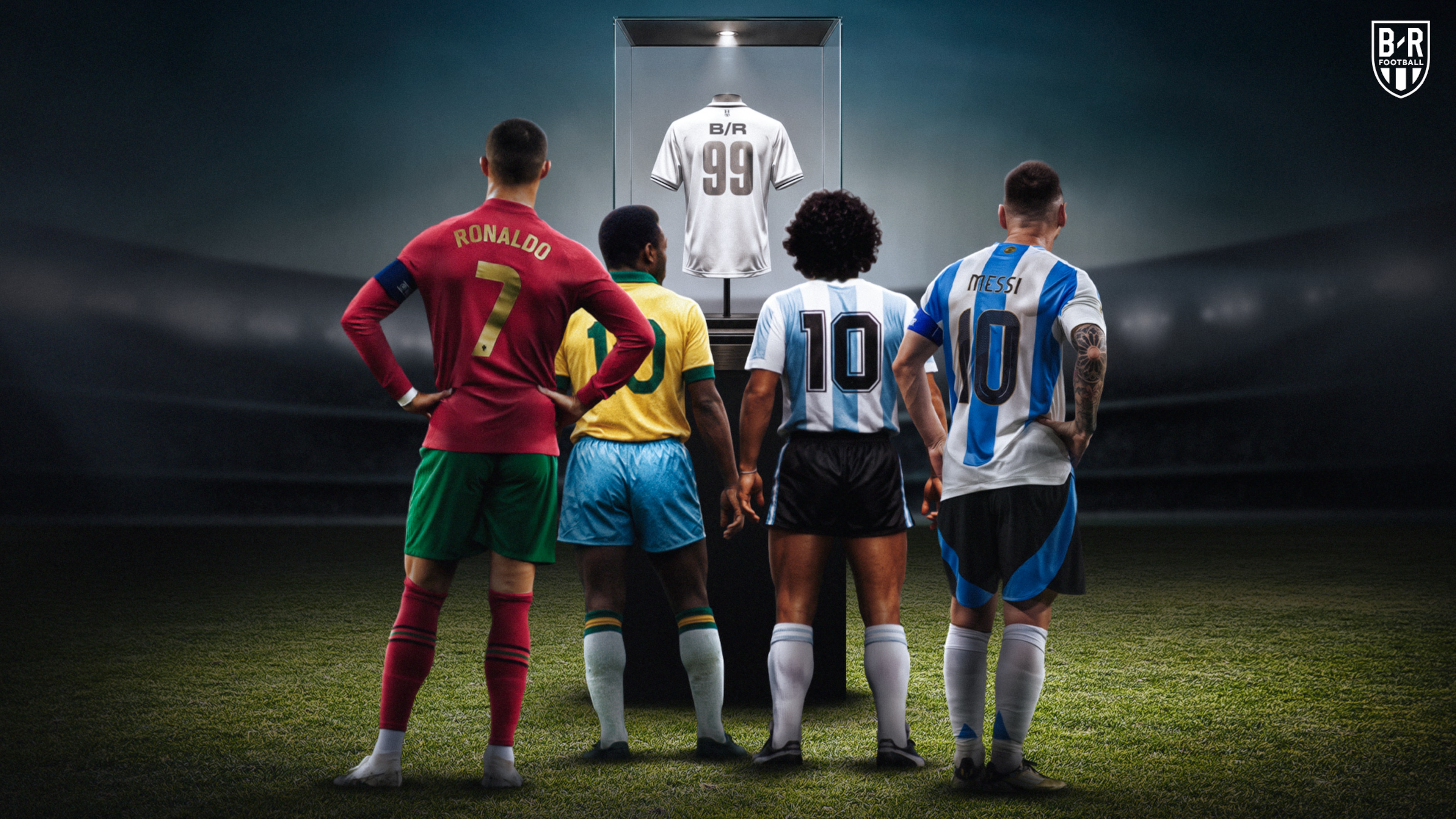


Montella took over a team that previously, under the auspices of Sinisa Mihajlovic and then Cristian Brocchi, had little cohesion in its attacking phase—often having default possession but being unable to utilise this effectively when up against defensive-minded opposition.
There was also a general lack of structure to Milan in 2015-16, something that was perhaps not helped by the constant changing of formations. They started off last term in a basic 4-3-1-2, which was quickly abandoned in favour of a 4-3-3. They then had greater success within a 4-4-2 before reverting once again to a diamond midfield.
On top of that, their passing was inconsistent and often took on an inefficient U-shape, as the ball was passed horizontally from one flank to the other without threatening the opposition.
Defensively, Milan were functional under Mihajlovic—only six teams in Serie A conceded fewer goals last season. However, the problems seen in the attacking phase remained relevant when the Rossoneri didn’t have the ball; the structure was frequently poor with occasional open spaces between the lines.
Montella may not yet have fully implemented his philosophy, but he has improved the team in all of these areas, even if only slightly.
Certainly in terms of overall cohesion, his Milan are a different animal—compared to this stage last season, they have lost less, and won and scored more. This time last year they were seventh on 25 points; currently they sit third on 32.
Here we look at the tactical changes underpinning the progress.
Defensive Phase
In the defensive phase, Montella’s Milan generally operate in a medium block. This is a compromise between a low block that wouldn’t suit the coach’s attacking preferences and a high block that would only emphasise the vulnerabilities of a defensive line without real pace.
The rough shape is a 4-1-4-1 with 18-year-old Manuel Locatelli, who took over the deep-lying midfield role following an injury to club captain Riccardo Montolivo in October, taking up a central position close to the defensive line. The back four remains horizontally compact, although when the opposition have the ball on one flank, the relevant Rossoneri full-back will move out to press the opponent in possession.

However, there have also been occasions when Milan take up a rough 4-4-1-1 shape in the defensive phase, with the left-sided central midfielder—usually Giacomo Bonaventura—pushing up to apply pressure to the opposition’s deep-lying playmaker. Andrea Bertolacci supported the press in this manner in the recent defeat to Roma, as discussed in this post.
Since his appointment, it has been clear that Montella instructs his side to use a fairly low-intensity middle press with man-orientations. This involves allowing the opposition to pass out from the back before engaging them in the midfield area, man to man, the aim being to contain and force the opposition back or wide into less dangerous areas of the pitch.
An example of this is shown in the below image, where Suso looks to press his opposite man.

It is in this particular aspect of the team’s play that Juraj Kucka thrives. The Slovakian wasn’t seen as the typical Montella player due to his technical limitations, but thus far he has been able to contribute effectively to the team defensively thanks to his combativeness, relentless energy and physicality.
Milan’s medium block combined with a midfield press ensures that the space between their own defensive and midfield lines is relatively small. This vertical compactness has the effect of reducing the space and freedom available to the opposition when attempting to play in and around the final third.
Attacking Phase
In the attacking phase, Milan’s basic shape morphs to become a rough 2-3-4-1. Their full-backs—Ignazio Abate on the right and Mattia De Sciglio on the left—push high down their respective wings, while the outside central midfielders—usually Kucka and Bonaventura—will fall back on to the first receiver line alongside Locatelli.
There are a few different objectives underlying these movements, though one is simply to enhance the quality of the team’s buildup.
Compared to the full-backs, the midfielders are more comfortable on the ball and are better able to receive passes from the centre-backs in the channels with their backs to goal and while under direct pressure from an opponent—Bonaventura is highly resistant to pressing thanks to his impeccable touch; Kucka through his sheer strength.
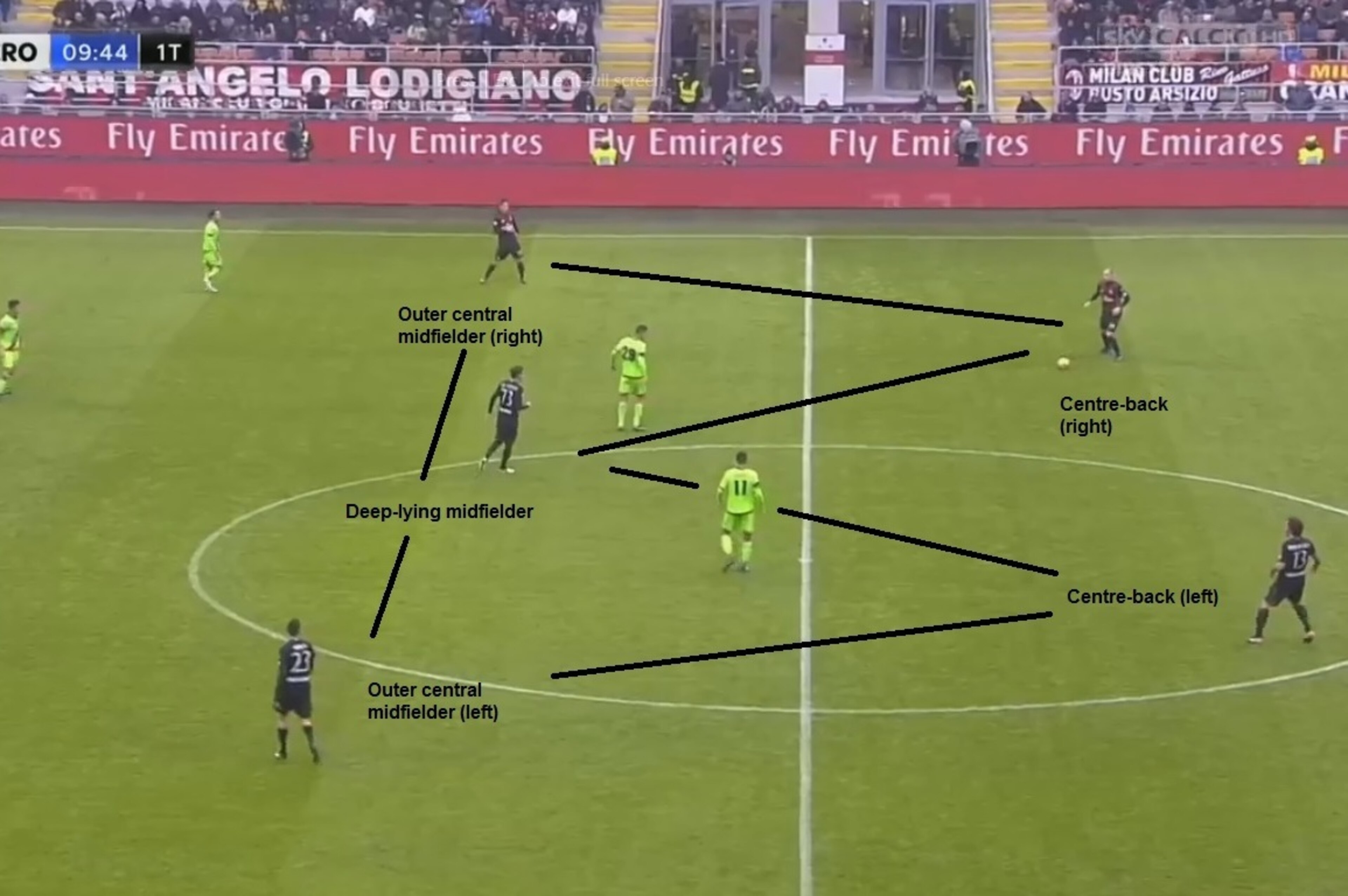
It is in this area of the team setup that Milan differ drastically from Mihajlovic’s short reign. Where previously the team’s passing out from the back was disorganised and without true direction, there is now genuine clarity as to their structure in the early stages of their possession. Under Montella, they make deliberate and consistent use of specific passing patterns.
The buildup revolves around short and patient circulation between the two centre-backs and the midfield three in front of them. This is done not only to allow the Rossoneri time to find their attacking structure, but also to shift the opposition’s defensive shape from side to side and create gaps that could be exploited.
While they are improved in this respect, it's worth noting that Montella’s side remain susceptible to a high press. In the 2-2 derby draw, Inter Milan deployed Joao Mario to support lone striker Mauro Icardi in aggressively pressing Locatelli and his central-defensive team-mates. This provoked a series of misplaced passes and turnovers from Milan as they initially struggled to break out of their own half.
The value of Alessio Romagnoli in this particular sub-phase cannot be understated. The 21-year-old centre-back was missing for the derby and it showed; his left foot is capable of penetrative passes that his colleagues simply can’t emulate. And, on occasion, the youngster—thanks to the dropping deep of Locatelli for cover—will drive forward with the ball at feet and attack the opposition to draw pressure and create space further up the pitch.
As discussed earlier, the high and wide positioning of Milan’s full-backs serves multiple purposes, one of which regards aiding the team’s progression of the ball through the thirds.
As Abate and De Sciglio push on, the nominal wingers—M’Baye Niang and Suso—are permitted to drift infield into the channels and between the lines. From here, they can make themselves available to receive a pass behind the opposition’s midfield, thus allowing the Rossoneri to play through rather than around the opposition’s defensive block.
In this area, Suso thrives. The 23-year-old has enjoyed a breakout season on the right-hand side, cutting in on to his favoured left foot to wreak havoc with his exceptional close control and dribbling skill. Only three players in Serie A have completed more dribbles this term, per WhoScored.com's statistics.
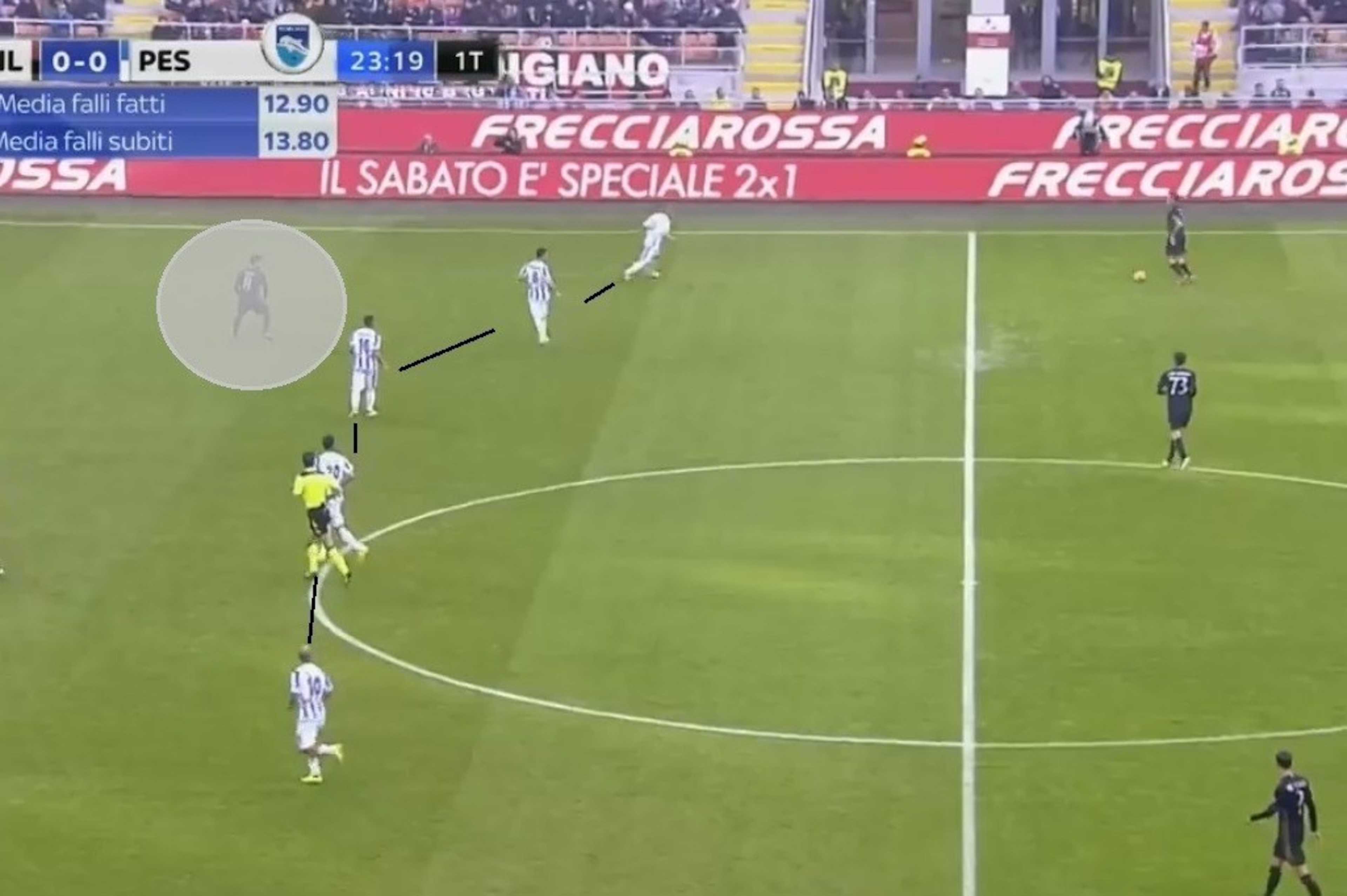
Operating almost as a trequartista, the Spaniard also offers layers in the final third that cause problems for the opposition defensive line, who must decide whether to concentrate on retaining their shape or to move up and pressure Suso, potentially leaving space behind for Milan’s lone striker—either Carlos Bacca or Gianluca Lapadula—to take advantage of.
Transitions
During pre-season, Milan occasionally utilised counter-pressing high up the pitch in their defensive transitions, though this has not become a prevalent part of their play since the 2016-17 campaign officially kicked off. Instead they focus on quickly moving back into their established defensive shape.
With regard to attacking transitions, one criticism of Montella that could be made is that there has often been a serious disconnect within the team when trying to counter-attack, especially late on in games. The team’s defensive block has at times become too deep, leading to the isolation of the striker and a failure to counter effectively upon winning the ball.
Room for Improvement
It could be argued that, for a side that tends to enjoy a qualitative advantage over many of the teams they meet in Serie A, Milan do not press intensively enough. It would also be reasonable to suggest that, as alluded to earlier, their buildup could be better when placed under pressure.
In addition, there is occasionally a lack of dynamism and variation in the final third that makes it easier for opponents to mark and stifle the Rossoneri’s possession. More positional rotations between the front three could help here, as perhaps could positioning Niang wider on the left so as to isolate him one-on-one against his marker.
Still, in all of these aspects the team are already much improved on last term. Montella has not simply ground out results since he arrived as Milan coach, he has instilled a coherent tactical vision that appears to be taking greater shape with each passing week.


.png?w=3840 "Ranking the Best Shooters of All Time 🎯")



.jpg?w=3840 "AEW Redemption Was Stacked 🍿")