Barcelona Return to Anoeta Graveyard: How Do Such Hoodoos Prolong Themselves?
Luis Enrique had warned them, and yet maybe that was part of the problem. "This is an incredibly tough away trip," the Barcelona boss had told the press ahead of a pivotal weekend. A weekend in which the heavyweights would play one after another, the stakes rising each time and the difficulty, too. "It's the toughest away game of the season."
Barcelona were headed for Anoeta to take on Real Sociedad in April. They hate it there—despise it. Luis Enrique's stressing of the point reflected his and the club's awareness, but one sensed he was also looking for something, something he couldn't quite explain. "We need to think about why we haven't been able to win there," he said. And they haven't.


.jpg?w=2560 "Election 2024 Julie Pace Column")
As the Asturian spoke, a glance back at Barcelona's record at Anoeta illustrated the point. The Catalans hadn't triumphed there in almost a decade. The supreme vintage of 2010-11 had lost 2-1; those of 2012-13 and 2013-14 had gone down 3-2 and 3-1. Luis Enrique had experienced the phenomenon, too.
Lucho's first trip to San Sebastian had been wet and cold. An early error put his team behind almost immediately. They then never got going. Geronimo Rulli was on hand to stop them in the few moments they did. 0-1.
So the coach gave his warning. April's trip mattered, and surely this time it would be different. But the game always has other ideas: It was wet and cold. An early error put his team behind almost immediately. They then never got going. Geronimo Rulli was on hand to stop them in the few moments they did. 0-1.
"The game began in the worst way possible," Luis Enrique said in a press conference, trying to forget Harold Ramis' film. "Real Sociedad are always a stone in our shoe."
They are, but why? How? What is it about Anoeta? What does that stadium have? Barcelona have beaten Real Sociedad 19 straight times at the Camp Nou but fall to bits with a simple switch of venue. Anoeta stops Barcelona from being Barcelona. It makes no sense, but then football often doesn't.

Football is a simple game, but there's something about it that lends itself to the weird. Barcelona's record at Anoeta, where they travel to on Sunday, defies explanation, but it's not the only of its kind. Hoodoos or hexes are nonsense as a concept, and yet we perceive evidence of them anyway. Superstitions run strong in a game that can reject statistical probability.
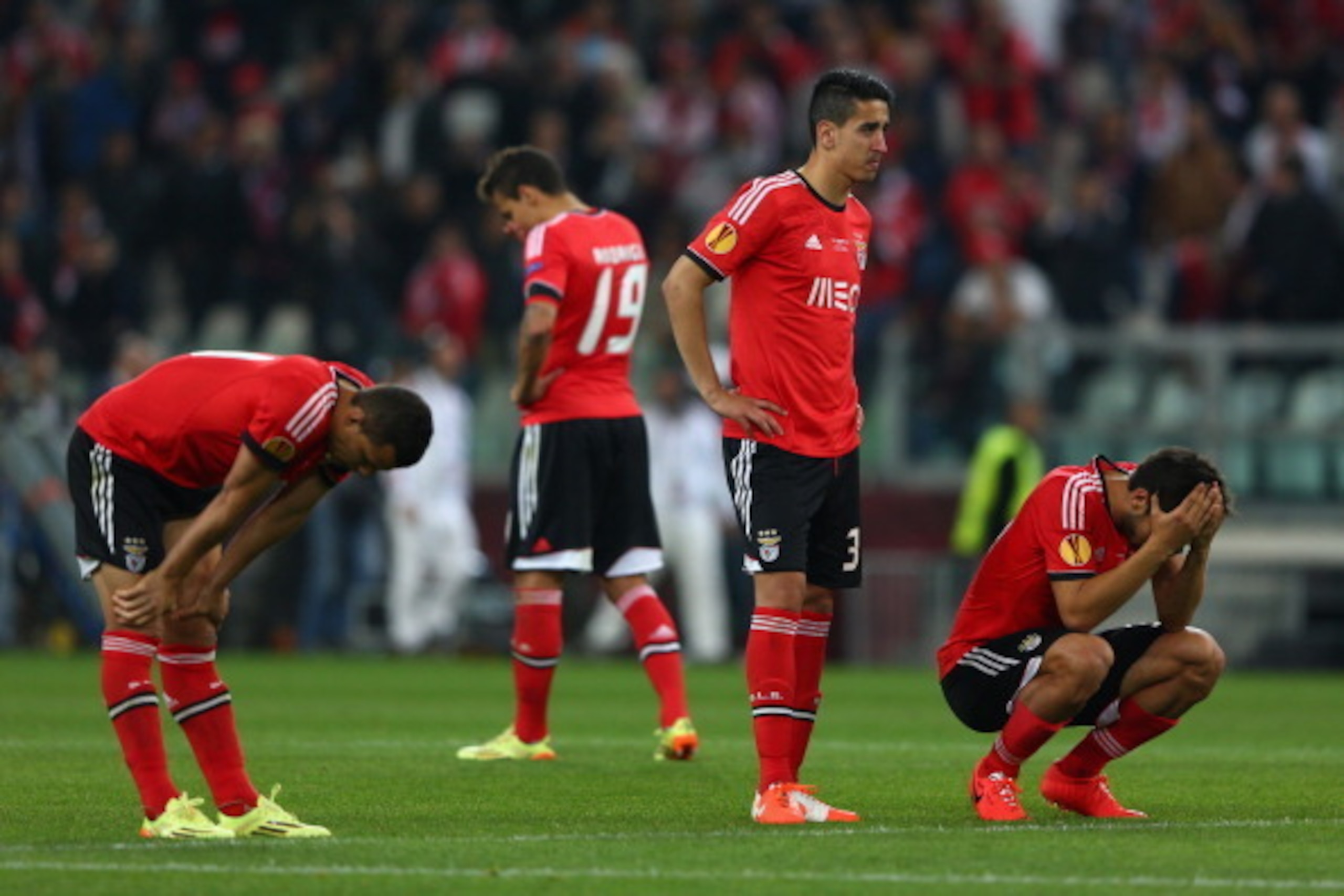
It was the famous Hungarian manager Bela Guttmann who, as the story goes, cursed Benfica after leading the club to a second straight European Cup in 1962, departing after a pay dispute with the club's directors. Its accuracy is questioned, but legend has it that Guttmann said Benfica would not be European champions for 100 years. In the 54 years since, they haven't.
Benfica have lost eight European finals in that time, five in the European Cup/Champions League and three in the UEFA Cup/Europa League. When the club lost to Chelsea in the final minute in the seventh of those in the 2013 Europa League final, goalkeeper Artur hinted that he bought into the mystical. "I can't explain it," he said, per FIFA.com. "How can we explain it?"
A year later, Benfica's players rejected the idea of Guttmann's curse ahead of another final against Sevilla. They then lost the game on penalties. "Once again, in a final, the ball just didn't go in," captain Luisao said afterward, according to the Associated Press (via Yahoo)—his use of "again" feeling significant.
Even the flowers laid at Guttmann's grave—and that happens—haven't changed anything. The wait goes on, while Benfica ask the only question they can: How?
In his wonderful book God Is Round, Mexican writer Juan Villoro delves into the spiritual while pondering such a question.
"Another thing that doesn't make sense," he writes, "is the debt teams owe to past players. A team can be on fire and then lose at a stadium because their club has failed to win there for 24 years. How do such hoodoos function? Players who weren't born at the time of that first, fateful defeat play as though they were, and still are, there."
Villoro proposes something paranormal. "The Brazilian writer Nelson Rodrigues had the answer: death is no obstacle, he tells us, to people's responsibilities to their club. The matchday XI and the people in the stands are a minority compared to the ghosts. Every person who has ever played for and shouted on their team is present; a team is as great as its spectres."
The logical among us would see such a plunge into supernatural thought a result of substance abuse. But there is something about the weight of history, the way it exerts an influence that's difficult to rationalise.
Just last week, Arsene Wenger had rejected the notion that his team had some sort of hang-up with Old Trafford. At a news conference ahead of Arsenal's clash with Manchester United on Saturday, he called the 3-2 loss there in February—the game that seemed to say it all—an "exception."
But by Saturday's post-match television interview following the 1-1 draw, he was more receptive, pondering very suggestion himself.
At Old Trafford, Arsenal had looked nothing like Arsenal. Or perhaps they'd looked exactly like Arsenal at this particular venue. Wenger's side had been timid, disjointed and devoid of all life, their winless run in the league at United's home extending itself into a 10th season, or to 3,716 days.
So Wenger was asked again. "Could it be a mental block here?" Considered, candid, a mere twenty-four hours or 94 bizarre minutes had changed him. "It's funny you tell me that because I wondered during the game about that," he responded. Again, history had shaped the present.
Arsenal know all about that (Old Trafford, Didier Drogba, November, the round of 16) but so, too, do Atletico Madrid.
Between 1999 and 2013, Atleti didn't manage a single victory over neighbours Real Madrid in the capital's derby. Twenty-five meetings passed in that time, and on each occasion, it grew more ridiculous.
Atleti's penchant for the absurd was unrivalled. Seeing those white shirts in front of them did something to them, something profound. Atleti would concede within seconds, would gift penalties, would commit comical acts and would find every conceivable way to avoid victory. The curse of "El Pupas" was all-consuming.
Before one derby at the Santiago Bernabeu, a colossal banner showing an array of horror characters surrounding a frightened child in an Atletico shirt read: "Every derby night: your worst nightmare."
It was. Last week, ahead of the latest Madrid derby at the Vicente Calderon, Atletico captain Gabi spoke to Marca about those years and those nightmares. Things have changed now, but they haven't forgotten.
"Before [Diego Simeone], we didn't know how to beat Real and we didn't know why," he said. "I don't know if we put too much pressure on ourselves because neither the coach nor the players could understand it."
There was something to Gabi's line that seemed to fit into the theme of Benfica and Guttmann; of Arsenal and Old Trafford; of Barcelona and Anoeta. For Atleti, the game had ceased making sense. It was as though something deeper was going on, something on another level. The hoodoo was nonsense, but somehow it was real to them.
On Sunday, Barcelona return to the site of their own hoodoo. After their last visit, Mundo Deportivo's cover declared: "The curse of Anoeta continues." And no one knows how or why.




.png?w=2560 "Madden 99 Club Revealed")
.jpg?w=2560 "Bills Reveal New Unis")

.jpg?w=2560 "Aiyuk: I'm Commanders' 'Final Piece'")
.jpg?w=2560 "Evaluating Every NFL Roster 📝")
.jpg?w=2560 "Fans' NBA Community GOATs 🐐")