

Brutal Injury Derails Mika Zibanejad's Breakthrough Season with New York Rangers
The trade which brought Mika Zibanejad to the New York Rangers was one of the sharpest made by any team over the summer. The 23-year-old centre responded to the move immediately, starting 2016-17 at a pace which would have made it the best season of his career.
Unfortunately for player and team alike, that's on hold now. Rangers head coach Alain Vigneault had the unpleasant task of announcing that the pivot would be out six to eight weeks after breaking his leg during Monday night's game against the Florida Panthers.
TOP NEWS
Trades That Could Happen Before Training Camp
Bold Trade Predictions 🔮
Crosby in Extension Talks
"Every team's got injuries; we don’t expect to be any different than anybody else," Vigneault said. "This is...like every coach says in these moments, it's an opportunity for somebody else."
He's right that every team deals with injuries, and that line about opportunity rings a little truer for the Rangers than it does for many other teams. Vigneault has been able to run a four-line attack all year, and he will have options as he recalibrates his lines in the wake of the injury.
Even so, there's no disputing that this is a loss of real magnitude.
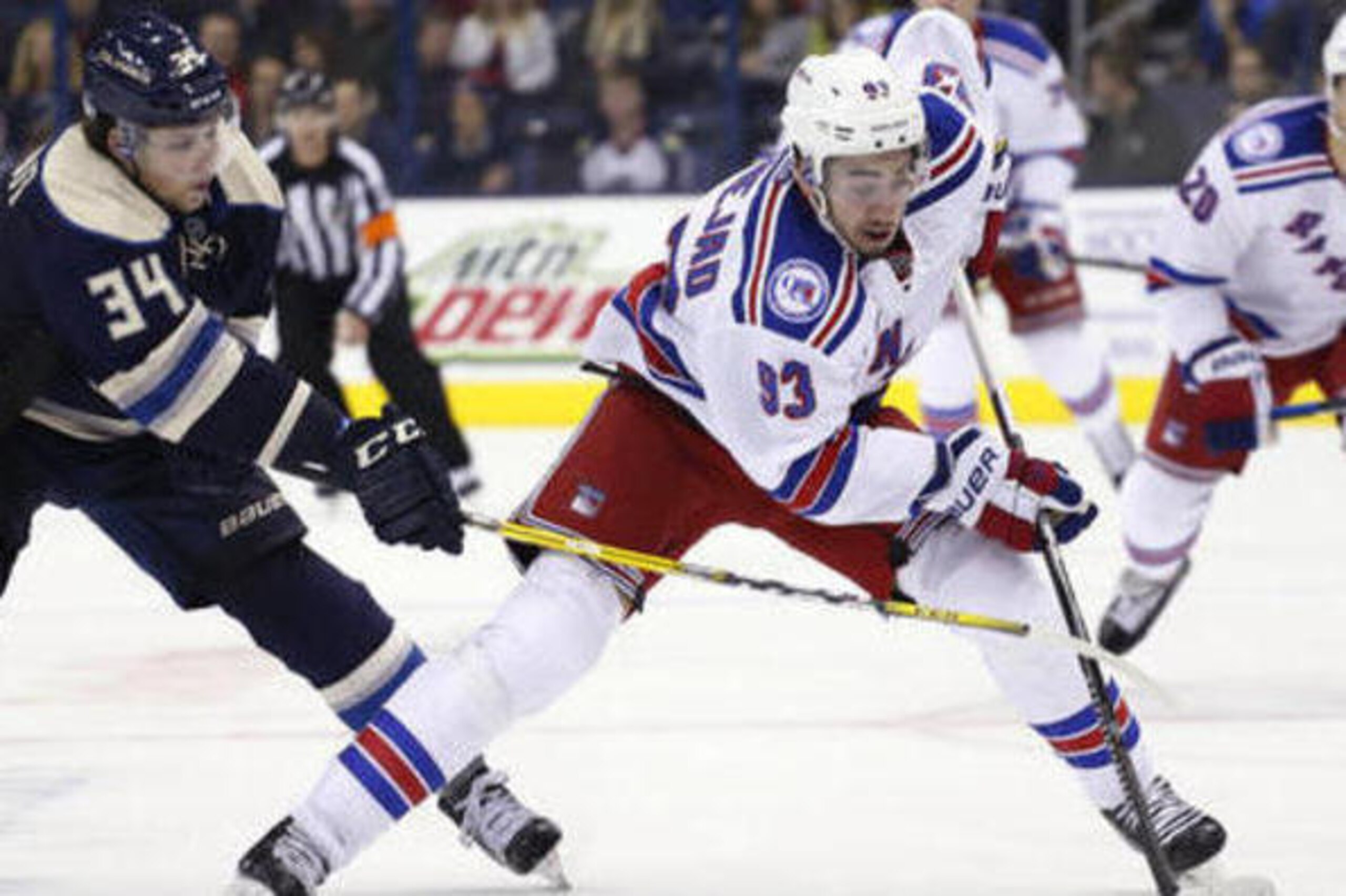
At even strength, Zibanejad has been averaging 13 minutes, 32 seconds of ice time per game, two seconds off the lead among Rangers centres. He has 10 even-strength points this season, which is an excellent number. For context, that ties him for fifth among New York forwards, but it also ties him for 29th among NHL forwards overall—it’s the same number of even-strength points as Sidney Crosby, Vladimir Tarasenko and Evgeni Malkin.
Put another way, 29th place in that stat means that the average NHL team has just a single forward currently scoring at that rate.
That isn’t even the most important thing Zibanejad does at even strength. New York has a lot of players running insane shooting percentages right now—percentages which will inevitably fall as the season progresses. What makes Zibanejad different is that his line has been able to consistently drive offence by outshooting the opposition.
Zibanejad leads all Rangers forwards in quality of competition (as measured by his opponents’ time on ice). When playing with Mats Zuccarello on a line that starts a lot of shifts in the defensive zone, Zibanejad’s forward unit has taken 51 percent of all shot attempts. When playing without Zuccarello in somewhat easier minutes, Zibanejad’s line has taken 59 percent of all shot attempts.
When Zibanejad is on the ice, it is tilted in the Rangers' favour, with the team spending far more time in the opposition's end of the rink in a way that just isn’t true of other lines. With him out there in five-on-five situations, New York takes 60 shot attempts per hour to the opposition’s 54; when he’s on the bench, those numbers plummet to 47 and 59, respectively.
Zibanejad is also valuable on the power play.
In special teams analysis, one sees handedness mentioned, and there’s a reason for that. Consider, for example, this recent power play in a game between the Rangers and Vancouver Canucks:

Zuccarello, a left-handed shot, is tasked with running the power play. He can charge the net, where his fellow lefty, J.T. Miller, is providing a screen. He can pass to the point, where yet another lefty, Ryan McDonagh, is in a decent position to one-time the puck. He can go to another left-handed shot, Brandon Pirri, who could hope to redirect the puck on net.
His other alternative is Zibanejad, a right-handed shot in great position to one-time the puck.
New York kept the puck in Vancouver’s end for 34 seconds before scoring. Pirri missed with a couple of shots before the power play got set up. McDonagh got a shot through from the point, which created some chaos. The goal, though, came about because of a rebound off a Zibanejad one-timer which was only possible because he was a right-handed shot taking a pass from a lefty.
Zibanejad is averaging 31 shot attempts per hour in five-on-four situations, the highest total of any Rangers regular. His 6.18 points per hour is the second-highest scoring rate of any Rangers regular, and his five power-play points lead the team.
Zibanejad also plays a supporting role on the penalty kill, which is a big reduction for him after being a staple on that unit with the Ottawa Senators. Presumably, he’ll take on a larger role while short-handed, but it’s one area where the Rangers aren’t going to be seriously hurt by his injury.
Losing Zibanejad will hurt everywhere else, though. He plays critical roles at even strength and on the power play, and this is the kind of long-term injury which could substantially slow down a streaking New York team.
Nevertheless, this could be worse. Zibanejad’s play this year is a tremendous positive for the Rangers, who own the rights of the 23-year-old for the long term. He’s established himself as a foundation piece, and he should be around not just for the back half of this season, but potentially for the next decade as well.
Statistical information courtesy of Corsica Hockey, Stats.HockeyAnalysis.com and Hockey-Reference.com.
Jonathan Willis covers the NHL for Bleacher Report. Follow him on Twitter for more of his work.
.jpg?w=2560 "NFL head coaching legend has a Minecraft hobby just as impressive")
.jpg?w=2560 "Week 1 Waiver Wire Targets")
.jpg?w=2560 "Week 1 Start 'Em, Sit 'Em Plays")
.jpg?w=2560 "Baker, Bucs Agree to Deal 💰")