

With Ugly Civil Trial Over, Derrick Rose Looks to Save a Career in Decline
NEW YORK — He spent 14 days wearing a suit and tie instead of a blue and orange practice uniform. He spent half of October sitting in a Los Angeles courtroom while the rest of his team got to know one another 3,000 miles away. The details of his sex life were exposed to the public.
His absence forced his bosses to answer questions they didn’t want to field.
This, it’s safe to say, was not how Derrick Rose or the Knicks envisioned preseason playing out, certainly not when just four months earlier Rose was “thanking” the Chicago Bulls for granting him “another start” by trading him to the New York Knicks, and certainly not when in late September Knicks president Phil Jackson was blowing off questions about him and saying he didn’t “anticipate” Rose missing any part of training camp or preseason games.
TOP NEWS

LeBron's Special Helicopter Deal

MJ Makes Record-Setting Donation 🙌
Shams: KAT, Hart Could Be Trade Names
Then the particulars of the civil suit filed by Jane Doe against Rose, alleging that Rose and two friends raped her, began to trickle out.
On Sept. 1 we learned, courtesy of Think Progress, that Rose had disclosed, under testimony, that the woman had never consented to having sex in text messages between the two. More sordid revelations followed. The judge overseeing the suit reprimanded Rose's law team for “shaming” rape victims. Soon after, the LAPD confirmed it was investigating the case.
The suit went to trial, and eventually, after two weeks of testimony, Rose was found not liable. It’s now “extremely unlikely,” according to Sports Illustrated legal expert Michael McCann, that any criminal charges are leveled against him.
And so Rose returned to New York on Thursday eager and interested in moving past the civil suit.
“Oh man, it felt like heaven to be out there, man,” he said while talking to reporters for the first time since leaving for L.A. “I got through my little situation, but I’m happy to be focusing on nothing but basketball right now.”
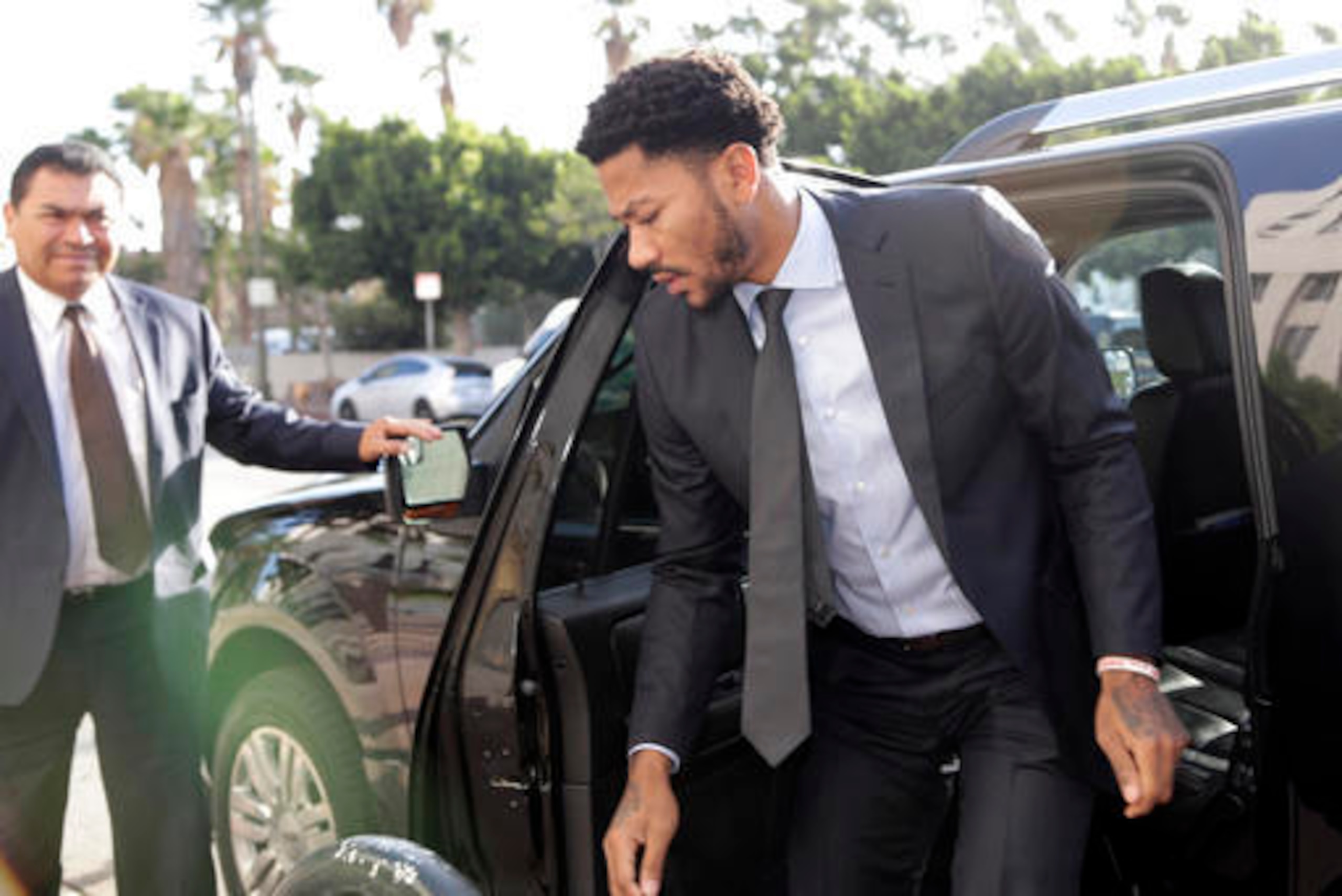
Rose did answer questions about the case. He acknowledged that the accusation made against him was “serious.” He admitted he made a mistake by putting himself in “this situation and I had to get myself out of.” He said he was “praying” for Jane Doe but later added, “the only thing that really hurt me was missing my son's birthday party.”
To date no charges have been filed against Rose. The police haven’t questioned him. Also, a jury has decided Rose’s account of the night in question is more believable than Jane Doe’s.
You might not like it. You might be repulsed by some of Rose’s more unsavory actions and comments. But as things stand now, Rose, technically, has done nothing wrong. Whether fans or the media feel the same way is irrelevant. Such is life in the world of professional sports, where a man suspended for allegedly choking his wife can be responsible for getting the final out of a baseball game and bring tears of joy to the eyes of millions.
The Knicks aren’t making it to the NBA Finals this season, but if Rose comes close to replicating his MVP-level outputs, Knicks fans will have no qualms about showering him with applause.
Any breakdown of his game has to start with his health. So it goes for a player who’s seen both legs operated on and has played just 100 regular-season games between 2011 and 2015, even if he is only 28.
The good news is Rose is coming off his healthiest campaign since his 2010-11 MVP season. He missed just 16 games last year, and those were due to an orbital fracture he suffered in the preseason. For the first time in four years, his lower body held up.
This is where an optimistic case for a comeback season begins. Sure, his basic numbers last year (16.4 ppg, 4.7 apg, 42.7 FG%, 29.3 3PT%) were average, and yes, the advanced stats paint an alarming picture (ESPN’s Real Plus-Minus ranked him as the 69th-best point guard in the league).
Ask Rose, though, and he’ll tell you there’s a simple explanation for these woes.
“I was seeing two baskets,” he said to Bleacher Report during training camp. “And I’m running top speed along the way. Just think about that with depth perception, you know what I mean?”
The orbital fracture left Rose seeing double in his left eye and blurry images when he looked down.
“But, if anything, it made me a lot better, because it made me pick and choose whether to take my shots,” Rose said. “I couldn’t come down and force shots the way I wanted to, so it made me be more patient.”
So which of the two baskets would he aim for?
“Man, whichever one is closer,” he said. “You know what I mean? For real, I can’t think of any better way to explain it.”
Rose said the double vision ceased being an issue around mid-February (though he conceded that he still occasionally gets blurry vision when looking down), and his shooting numbers back up this claim: He connected on 25.5 percent of his triples in 45 games before the All Star break and 37.5 percent through 21 games afterward. He also upped his field-goal percentage from 40.8 to 46.8. His catch-and-shoot and pull-up jumper numbers saw similar spikes, per NBA.com.
Rose is no longer an explosive dynamo (his average speed on the court has dropped a bit over the past three seasons, according to NBA.com’s player tracking data). He now struggles finishing in the lane (a career-low 51 percent at the rim last season, according Basketball Reference). And his focus on avoiding contact at the basket has undermined his ability to get to the foul line.
But he’s improved his shot selection (he cut his three-point attempts in half) and still brings an elite skill, one the Knicks sorely lacked last season: Rose averaged 8.9 drives per game last year, according to NBA.com’s data, the 17th-best number in the league. He also was more effective in the pick-and-roll (0.84 points per possessions, according to NBA.com) than any Knick.

The mere threat of him attacking the paint, along with his ability to beat his defender, should unlock all sorts of possibilities for the Knicks offense. He also likes to push the ball, which jells with the amped-up attack head coach Jeff Hornacek wants to run.
There’s no doubt Rose will help trigger some fast breaks, but how he fits into a crowded half-court offense is a different question. And it’s still unclear how frequently the Knicks plan on running the triangle—Rose himself seems a bit confused.
“We're running an uptempo type of game,” Rose said Saturday. “On out-of-bounds plays, that's when we're throwing in the triangle. On just dead balls, so it's very simple.”
Hornacek was asked Sunday whether Rose’s description was correct.
“Yeah, no, not totally,” he said. “We can call it at any time, we’re just trying to give him a basic thing that might happen just so he can train into it, and so, yeah, there’s some of that, but it's not all the time.”
Some of this is understandable. The triangle is different and more complex than the offensive systems Rose has played in before. It involves less instinct and more thinking. Hornacek installed a lot of it during the nine practices and five preseason games Rose missed while in L.A. But its intricacies are tough to pick up on the fly.
Rose will also have to prove he’s comfortable playing off the ball and occasionally deferring to Carmelo Anthony and Kristaps Porzingis.
Then there’s his defense last year, where Rose morphed into a human turnstile. Players he guarded buried a blistering 59 percent of their shots last season, according to NBA.com. ESPN’s Real Plus-Minus had him pegged as the fourth-worst defensive point guard in the league.
He obviously has the physical tools to stay in front of opposing guards. He also spent five years playing for Tom Thibodeau, so defense is not a foreign concept. Rose may never be confused for George Hill, but there’s no reason he can’t be solid on that end, as long as the effort’s there.
For now, though, Rose has a long way to go. He's got an offense to learn. Teammates to meet. A broken-down body to keep healthy. And an image to rehabilitate.
Rose will be an unrestricted free agent this summer. This could be the start of a fruitful marriage with the Knicks, or a short-lived one. He has one season to prove himself, not only on the court but off it, too.
KNICKS INSIDER'S NOTEBOOK
The subtle brilliance of Joakim Noah
Noah looked great in the Knicks' preseason finale against the Nets. His numbers were solid (12 points, six rebounds, three assists), but more importantly, he flashed the other more subtle skills that, in his prime, made him such a valuable contributor.
One such area is his ability to spring teammates open with perfectly timed screens. Noah is especially adept at doing so after handoffs from the top of the key.
Take a look at Noah's assists to Rose in the past, and you'll see myriad examples of a dribble handoff between the two leading to points. He and Rose already have developed chemistry from their time in Chicago. But a handoff to Anthony could morph into an impossible play to defend, and a nice way for Hornacek and the Knicks to add a modern wrinkle to the triangle offense.
"Well I think it just comes out of our offense, sometimes he ends up with the ball in the pinch post area or on the high swing and he can just go into it," Hornacek said after the team's practice Sunday. "And you know if his man is going to play off of him, then if he can get it to a guy and get that quick screen, those guys are going to come off wide open. He does a very nice job of that."
Missions accomplished?
Hornacek has said, repeatedly, that he wants the Knicks to pick up the pace this year, and in the preseason they did. New York averaged 103.7 possessions per 48 minutes through six preseason games, a significant uptick from the 95.8 they averaged during last year's regular season.
One caveat: The Knicks weren't particularly successful at converting this new strategy into points. In the first half of games, when rotation players got the majority of their minutes, the team averaged just 4.8 fast-break points, according to NBA.com. Double that and you get a number that barely eclipses the league-low 8.4 they averaged last season.
Is that something that concerns Hornacek?
"No, it doesn’t have to be (a fast-break point), when we want to push the pace it doesn’t necessarily have to be a fast break and a layup," he said Sunday. "If we can get into the offense early and we’re swinging the ball and we’re moving, that creates open shots. That shot may not come for 10-12 seconds.
"There's a lot of times where you might have pushed it and a guy drove and kicked it out and two or three swing passes and a guy knocks a shot in and they don't count it as a fast break."
Still, the Knicks have finished last in fast-break points in each of the past four seasons. Getting early baskets might not be the primary goal, but getting a few more easy buckets would certainly elevate the team's offense.
Goodbye to Carmelo the power forward?
Almost every lineup Hornacek put on the floor this preseason featured two traditional big men. Not only, as touched on in this space last week, does that mean fewer minutes for Kristaps Porzingis as a floor-spacing, rim-protecting 5, but also no Carmelo Anthony at the 4, where he's most suited to thrive.
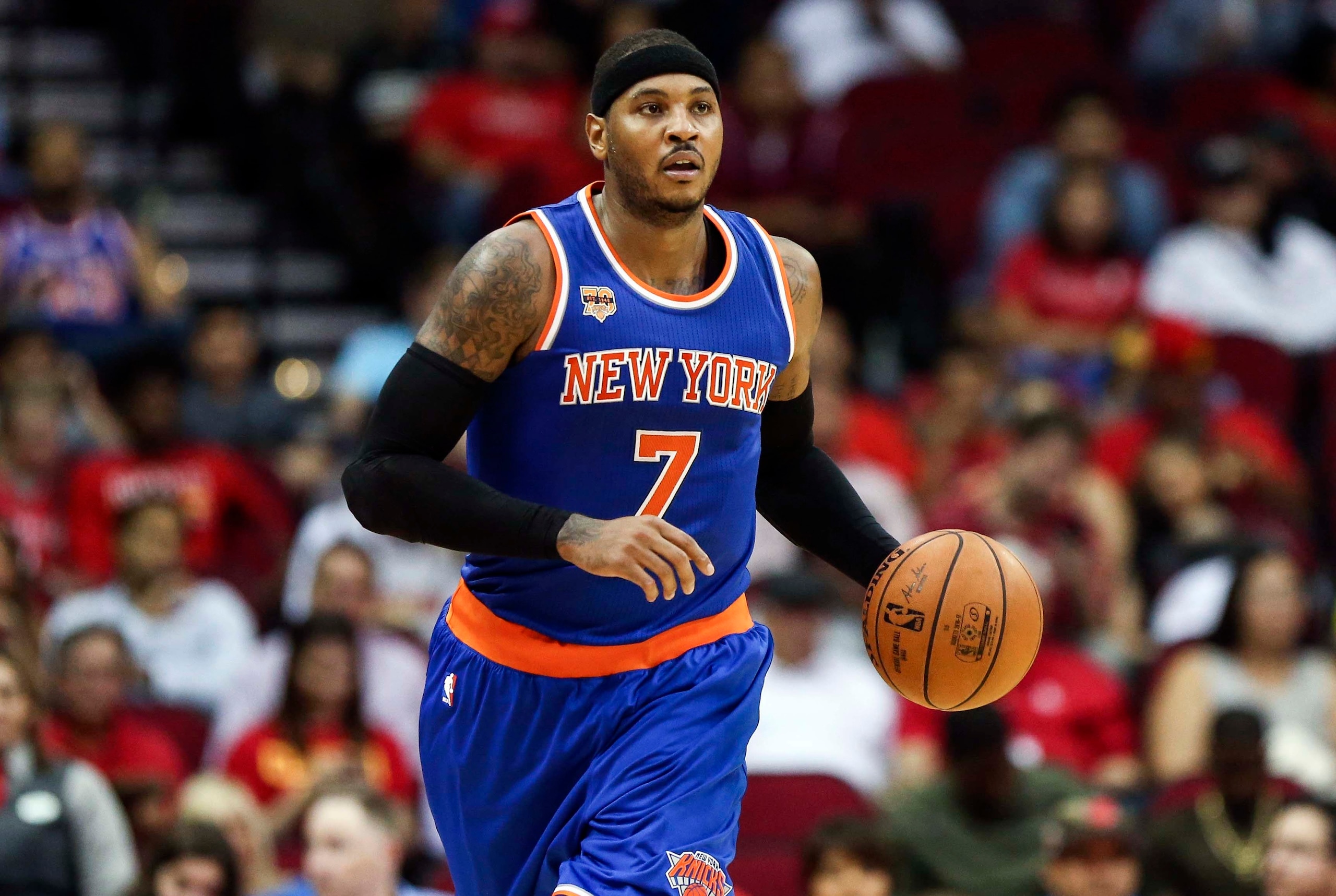
Anthony has always been more effective and efficient in that slot. He's quicker than most opposing power forwards and the removal of one big man from the court opens up more space on the floor. It's no coincidence his best season in New York came during 2012-13, when an early-season injury to Amar'e Stoudemire forced Anthony to move up a position.
A lineup with Porzingis and Anthony in the frontcourt could be devastating offensively. But it doesn't appear Hornacek has any plans on deploying it, at least not in the season's early stages, a tactic Anthony is not upset about.
"I’ve been playing 3 all my life, I’ve only played 4 the last couple years," Anthony said to Bleacher Report during training camp. "I’m back at the 3 now, which is feeling pretty good, (it) feels natural, comes natural to me. I’m pretty sure through the course of the season they'll be some games that I’ll slide over to the 4, we’ll go small, but for now I'm at the 3."
Roster breakdown
The Knicks said goodbye to Lou Amundson and guard J.P. Tokoto last week. Neither move came as much of a surprise. The team also waived guard Chasson Randle, who looked good in the preseason but will miss the next month due to an orbital injury.
"Our hope is if he doesn’t go to another team, he stays with our organization," Hornacek said of Randle last week, according to Marc Berman of the New York Post. "We really like what he did for us."
The three bubble players who made the roster were guard Ron Baker, center Marshall Plumlee and forward Maurice Ndour.
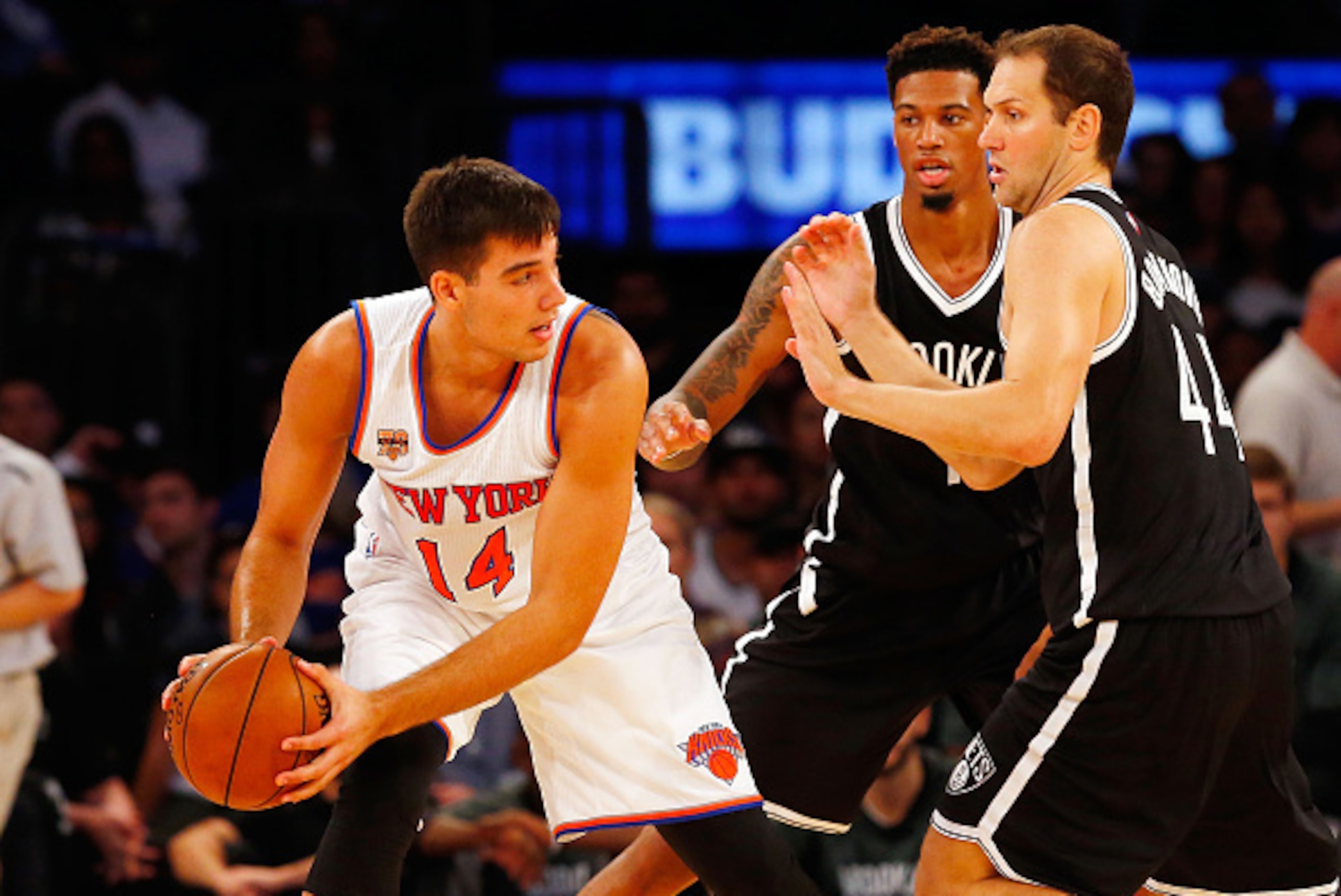
Also worth noting: Reserve big man Willy Hernangomez played just six minutes in the Knicks' final preseason game against the Nets, while Kyle O'Quinn was the first big off the bench and got 16 minutes of playing time. Hernangomez looked better than O'Quinn in training camp and during the preseason, but he's just 22 and in his first year in the NBA. It's not a shock to see Hornacek go with the veteran instead.
The bet here, though, is that Hernangomez overtakes O'Quinn in the rotation, and sooner rather than later.
All quotes obtained firsthand unless otherwise noted.
Yaron Weitzman covers the Knicks, and other things, for Bleacher Report. Follow him on Twitter @YaronWeitzman.

.jpg?w=2560 "Grading WWE Raw 🔠")

.jpg?w=2560 "Viral Rams Coach Vid 🖕")

.jpg?w=2560 "Injury-stricken Seahawks signing veteran RB")