

UFC 202's Conor McGregor Has a Brand-New Camp. Will It Be Enough to Stop Diaz?
In one of the most highly anticipated rematches in UFC history, reigning featherweight champion Conor McGregor gets a shot at redemption when he faces Nate Diaz at UFC 202 on Saturday.
The first time they met, Diaz came in on short notice, with no camp, and handed McGregor his first loss in the UFC. Diaz broke McGregor's stunning 15-fight win streak with a spectacular rear-naked choke in Round 2.
McGregor and his camp were thrown for an unsurprisingly lengthy loop and have listed the numerous changes in his approach to the rematch. Kevin Seccia, a screenwriter, occasional combat sports writer and author of a manual on how to beat up anything, joins me to review what, exactly, McGregor and coach John Kavanagh say they're doing differently this time.
The differences, they say, will provide us a McGregor unlike any we thought we knew. McGregor is an adept trash-talker, given to bold claims he often backs up without issue. All aboard the hype train?
Maybe.
McGregor's Brazilian Jiu-Jitsu
1 of 7What McGregor has said during a media call:
- "I'm confident in my jiu-jitsu. Nate is very skilled on the mat. I don't think the difference between us in that fight was the jiu-jitsu."
- "I am confident on the mat with Nate. After that, I've brought in heavier people, more experienced jiu-jitsu people to come and push me daily, so I'll be experienced for the jiu-jitsu and the later rounds also."
What he's doing differently this time: He brought in Dillon Danis and Chris Haueter, although I don't know why, since BJJ was apparently not the difference in the first fight.
Sydnie:
McGregor really hasn't said much about the Brazilian jiu-jitsu during their first meeting, and his assertion it wasn't the difference between them isn't totally off base. It was Diaz's boxing that rocked McGregor and made him think a takedown was a good idea, and it was all over from there.
The Irishman did score a sweep on Diaz in the first, but the cage aided his subsequent guard pass significantly. Diaz, up against it with nowhere to go and folded in half, didn't suffer a failure of BJJ; he suffered the reality of physics. As I wrote before the fight, McGregor's BJJ had, at the time, evident and considerable shortcomings for an MMA fighter at his level. Namely, he was passive and spent time waiting in certain positions, rather than engaging or actively trying to improve his own.
From the scant footage available of his grappling now, I don't see anything that indicates his has risen to the level of Diaz's. Diaz was never remotely threatened on the ground; even during the sweep, he took it as an opportunity to slap McGregor a few times as McGregor rolled him onto his back. When McGregor's guard pass succeeded, he was in control for a matter of seconds before Diaz regained the dominant position.
What we've seen since is McGregor in almost exclusively top or advantageous positions, with the exception of some armbar escapes in the video above—including from an armbar attempt to omoplata that he, almost like magic, escapes and turns into a triangle. He's also training with opponents who are clearly not emulating Diaz's intensity. Generally, that's good for training, as even in a non-striking martial art like Brazilian jiu-jitsu, going 100 percent is a great way to get hurt.
While it's certainly possible McGregor is intentionally keeping some of his training out of sight, it's also possible none of his coaches or partners can convincingly mimic Diaz's game, which has been honed for MMA over more than 40 fights (including his exhibition bouts).
McGregor overestimating his own game, especially when Diaz tapped him out just 21 seconds after his takedown attempt, is the type of bluster and reckless complacency that cultured his overconfidence in their first fight. He claims to have reflected at length on how he fell short, but if McGregor believes BJJ wasn't part of the problem, he's deluding himself.
Kevin:
We don't know much about Conor's skills on the mat since we haven't seen him there often, and I'm going to assume there's a huge reason for that. And I'm confident saying that reason is unlikely to be one that favors McGregor. In the same way what we don't know about Donald Trump's taxes is unlikely to favor Trump. Although, I've heard rumors about Trump's ground game, and guys, people are saying he's the best!
To be honest, part of me likes the idea of a young Conor secretly getting amazing at jiu-jitsu, then becoming a world champion and internationally famous megastar because of his precision striking, only to finally reveal his insane mat prowess at the last possible second—saving the day and the fight—like the Dread Pirate Roberts suddenly revealing his left-handedness in The Princess Bride...but it does not seem likely.
I hope he's kidding when he says he's confident in his jiu-jitsu. I hope he's kidding when he says he's
"...confident on the mat with Nate," because that sounds a lot like me saying, "I am confident in the water with that shark." Weirdly, the shark-defense move experts advise you to attempt—"punch them in the nose"—is the same one experts recommend for dealing with Diaz's jiu-jitsu.
If Conor wants to preserve this possibly fictional confidence he mentions, he should stay as far away from the ground as possible. Like ideally, don't even stand on the ground. Treat the ground like that game you played as a kid when you pretended the floor was lava. Barring that, he should concentrate on what's worked in 19-and-a-third other fights, striking from a distance.
I don't think there's any doubting Conor's "bluster," as you put it, but for his sake let's hope the "reckless" part is in check. I don't think he truly believes he can hang jiu-jitsu-wise, and I think he's smart enough to try to keep it standing.
Sydnie:
I agree with you; the fantasy world where McGregor doesn't touch the ground is his best chance of beating Diaz's Brazilian jiu-jitsu. But if he wants to claim he's confident on the mat with the black belt, I want to see it. McGregor says he doesn't trash talk, it's all truth talk. OK. Get down there and prove the last time was a fluke.
I find his hot air...deflating. I swear, I'm as fatigued by Conor right now as Conor was in Round 2. The buy-in potential for this posturing—get it? Posturing? I know you grapplers do!—gets a 4/10 rating.
Kevin:
If Conor's choke defense had the tenacity of you trying to force some awkward wordplay, he'd be in good shape. I really do think he's just saying what he thinks needs to be said, with no intention of taking it to the ground. So as meaningless bravado, I give it 8/10.
Other recent McGregor BJJ videos:
McGregor's Numbers
2 of 7What coach John Kavanagh has written on the42.ie:
- "There are certain fitness tests that we have numbers on, and the improvements from when Conor began to where he is now have been dramatic."
- "Sometimes your feelings can trick you, but when things are being measured, like they are now, then it's different."
What they're doing differently this time: Measurements? Fitness tests?
Sydnie:
Well, I'm sold. Did you see, Kevin, that they have numbers now? Numbers from measurements? This quantifiable if vague metric is a strong argument for the differences we're about to see in McGregor's performance. And if the improvements, whatever they are, have been dramatic, I just don't see how he could lose.
Admittedly, it is a little difficult to analyze how these numbers will translate into his showing at 202, especially since Kavanagh didn't elaborate on what they are or provide a single example. Better numbers on the Olympic rings? Faster sprints? Five hundred consecutive kipping pull-ups? Nevertheless, if anything is going to convince me McGregor is ready for Diaz this time, it's his numbers.
Joking mostly aside, I'm not sure improving in whatever areas he did will ipso facto help him significantly in the cage. Putting stock into Conor's Numbers has literally no foundation. They've never measured his fitness before this, apparently, nor its progress, and thus have never seen McGregor fight at a "measured" fitness level. This will be the first time, and while it seems accurate enough to say better physical condition—at least as far as signifiers during fights suggest—is only a boon to the athlete, there is nothing definitive about what that means in this instance.
The total lack of any actual data, not even what exercises they were testing, renders this claim meaningless. In fact, the addition of information may not make it any less so; the fitness necessary to, say, run a four-minute mile might not have much practical application in the cage or might be eclipsed by the myriad factors at play in a fight. Are you convinced?
Kevin:
Hmm, well, here's what I know about numbers. From what I've heard, "the number don't lie"? I assume this is what they were talking about? Maybe? OK, yeah I'm not following.
I understand the "feelings can trick you" part. That's relatable, and it happens to me constantly. No clarification needed there. But otherwise I'm having trouble following this numbers business. Like you pointed out, why even bring up these rising, incredibly improved numbers if you're not to going to specify what they mean and/or what they're measuring? Are these numbers lucky? Are they prime numbers? Will we, at some point, be expected to "do the math"? Man, I hope not...
I'm almost in awe of Kavanagh's levels of vagueness here. Like, it's actually impressive. Looking at what he wrote, I don't think it's even humanly possible to be more vague while still committing that same number of words to a page. He's pared this thing down to a whisper of an echo of an idea...that somehow tells him his guy will win.
Sydnie:
That seems to be a common thread between McGregor's consciousness and everybody else on his team, that some as-yet-undetermined shortcoming in his previous camp is responsible for his loss, and whatever it was, they've almost certainly got it covered this time. They've chalked his loss up to so many different things, I can barely keep track. My buy-in rate on this is 1/10.
Kevin:
Hey look, you've managed to use a set of numbers to somehow rate the effectiveness of other, far less convincing numbers! Is that irony? Just confusing? Either way, I guess numbers aren't all bad. Uh, 2 out of 10?
McGregor's Cardio/Endurance/Lactate/Efficiency
3 of 7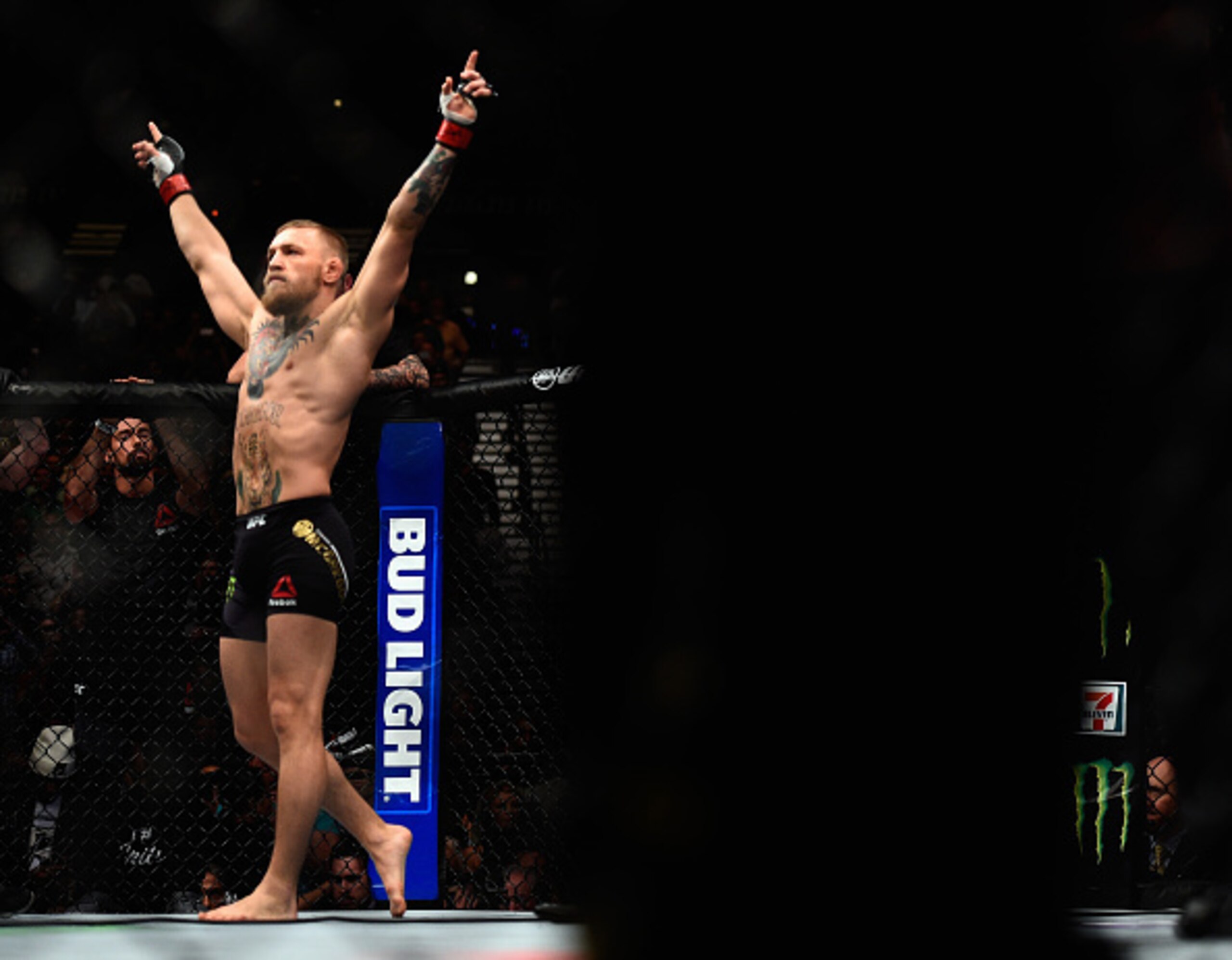
What coach John Kavanagh and Conor McGregor have said:
- Kavanagh: "But perhaps in our own eagerness to finish the fight, we were lured into areas where Diaz was more efficient."
- Kavanagh, to MMA Hour's Ariel Helwani: "Dana [White] helped him make a machine, and that's what we've spent the last 17, 18 weeks doing, is upgrading Conor's engine. Now it’s a super-charged, 800 horsepower, five-liter American muscle car type engine."
- McGregor, in a press conference: "I feel I was simply inefficient with my energy."
- McGregor, in a press conference: "I'm still going to bust him but there's going to be a lot more in the tank and I'm going to be a lot more prepared for a man that can stay in there with me."
- McGregor, in the UFC 202 extended preview (via the Daily Star): "I'm going to play the exact same game. I'm going to press forward and butcher him on the feet. Only I'm going to have a lot more in the tank this time."
- McGregor: "I was simply fatigued. My lactate was through the roof. And I couldn't flush it out and I was drowning in there."
- McGregor, in a Q and A: "Eight minutes of the fight, I was toying with him. That fadeaway left hand that he caught me with, my senses were still there. It was almost like a fatigue thing that my balance was gone."
What they're doing differently this time: Filling up that tank.
Kevin:
Hmm, a muscle car sounds good, but weren't they known for looking good but having really bad gas mileage? Weren't they super heavy, which is why we make then with plastic now, not wrought iron or whatever?
I actually think this assessment makes a lot of sense, and their ability to correct these issues is one of the biggest factors heading into the rematch. Conor definitely gassed; I don't think anyone would argue that.
You could say McGregor hit Nate clean with big shots—the kind that usually get the job done—and when he realized it wasn't happening, instead of pacing himself, he continued to push for the knockout and then got tired. Or, you could say Nate took Conor's best shots while applying constant pressure that forced Conor to keep punching at a high rate, and then he got tired.
Either way, more cardio and better pacing and awareness would help him here. So yes, sounds good on paper. But there's also the fact Nate was coming in on short notice and hadn't done much MMA training, so his cardio was probably less than ideal, too. And we all know Diaz is an endurance athlete who runs marathons and triathlons and maybe the one where they shoot a bow? Probably there are swimming portions? He definitely does the thing where you eat those little futuristic gel pack things. This time he'd have all of that and MMA training.
And so I guess I'm a little wary of Conor's chances in a cardio arms race against Nate Diaz.
Sydnie:
I agree McGregor's cardio played a part in the first fight, but I don't think it's as big as he (and apparently you, Kevin, McGregor's No. 1 apologist) thinks it is. While McGregor seemed to be heading toward possibly punching himself out, I don't think he was there yet. It was Diaz's left that sent him into what he calls a "fatigue."
But let's review: McGregor says his senses where there. Except his balance was gone and he suddenly found himself fatigued. So no, his senses were not all there. An inability to focus or a mental fog isn't exhaustion; it's a result of taking a particularly hard blow to the head. Diaz didn't hit McGregor's secret fatigue switch. That's not a thing. McGregor had no balance and apparently a disconnect between what he was perceiving and what he was telling his body to do.
In fact, in the first minute of Round 2, commentator Mike Goldberg says, "Fatigue should not be a factor for either fighter." If McGregor was feeling it, he gave little outward indication. Up until that left, which came with 2:22 left in the second round, his movement was crisp, measured and precise. And directly afterward, it was muddled, slow and inaccurate.
Of course, throwing strikes for eight minutes, even when they do connect, is indeed tiring. I trust McGregor was in fact feeling the effects of fighting for two-and-a-half rounds. I'm just not convinced it was enough of a stumbling block before that it will make a considerable difference this time. Maybe the sum is greater than its parts? I don't know, I'm getting a "the lady doth protest too much" vibe here.
Kevin:
Wait, we're basing things on what Mike Goldberg says now? Sure, he can yell really loud when someone falls down, but stringing a series of words together to convey a thought or idea isn't exactly his strong suit. Hell, he doesn't even own that suit. This is the fight where he calls Conor a southpaw until Joe Rogan corrects him by saying Conor mostly switches between stances. He also said, "One year...eight months...younger than big brother Nick." Oh, so Nick's the "big brother," glad that was specified.
The only thing that took a bigger beating than Conor that night was the English language, compliments of your pal Goldy. And a secret fatigue switch is a real thing. Mine's flipped every time I have to listen to Goldberg wade through a sea of words and phrases that are slowly drowning him.
Conor did get hit, yes, but I'd argue that fatigue made him a more stationary target than he would've been with a full tank. With more gas, he could've slipped that hard blow to the head. Maybe. But, yes, maybe not. Also, when you're in shape you can take a punch better than you can when you're not. If he'd cut some corners in training, it's not that unlikely the punches would get to him more.
9/10, or as Goldberg would put it, 9 of the 10 possible, Joe, are the numbers.
Sydnie:
Dang, Kevin, you're going mad hard on someone you think lacks the faculties to vocalize coherently. Ice, you are as cold as. You at least have to admit his inventive syntax makes for an interesting listening experience.
OK, I agree, if McGregor's cardio was suffering, he could ostensibly slow in both movement and output. But he did say it was that strike in particular that made him go into his fatigue fugue state. Maybe during the fight, he didn't realize how gassed out he was, and that left amplified it.
Whatever the reality is, McGregor with improved cardio is only good. I'll be generous and give this tack a 7/10.


Training for Diaz
4 of 7What McGregor and Kavanagh have said:
- Kavanagh: "We were always regarded as the last-minute gym—the guys who would be ready to step in at short notice. Our mentality reflected that so all you can do in those circumstances is try to get your skillset to such a high level that the opponent doesn't matter."
- Kavanagh: ...the amount of analysis we have conducted on his opponent and the strategy and gameplan we have designed, it's new territory for me."
- Kavanagh: "I'd describe it as doing an exam after seeing the questions on the teacher's test sheet. I feel like we're almost cheating going into this fight because we know what questions we're going to face in the test."
- Kavanagh: "I really feel like I can describe—technique by technique, round by round—what's going to happen."
- Kavanagh: "We know what routine to follow now. ... Routine was the missing link. We have it now and I'm very excited about moving forward with it."
- McGregor, in a media call: "But this time, I've been preparing for that. I've been preparing to face a durable experienced fighter who has the reach, the height and the length. And that's it."
- McGregor, to MMAjunkie: "We know we're going to be facing a tall, lanky southpaw with a decent lead hand. Now I've brought in tall, lanky southpaws with a solid lead hand and other guys with strong jiu-jitsu credentials..."
What they're doing differently this time: Training specifically for Nate Diaz.
Sydnie:
Gone are the halcyon days of a half-asleep McGregor cracking one eye open long enough to say "they're all the same" when informed his opponent changed. Now, they're tailoring the training around Diaz and his game. There are several different mindsets about this; some fighters focus on their opponent, as McGregor is doing now, some coaches structure their training around the opponent's style without explicitly telling the fighter, and then, of course, is the "they're all the same" approach. They all have their merits, perhaps some more than others.
While some of Kavanagh's statements sound almost naive—"I feel like we're almost cheating going into this fight because we know what questions we’re going to face in the test"?!—this will assuredly be helpful. I suppose there's a chance it could lull McGregor into a false sense of security, but since he believes he underestimated Diaz the first time, I'm inclined to think it won't.
Instead, McGregor will be more accustomed to fighting people built like Diaz, whose long limbs present particular challenges in grappling for nearly anyone, never mind his excellent boxing and height advantage. Familiarity begets comfort, and McGregor feeling less like a fish trying to swim upstream in strange waters can only help.
At least on the ground, I'm not sure four or five months of training with Diaz proxies is enough to get McGregor's grappling on par. McGregor seems fairly accustomed to grappling from top or dominant positions. Unless your game as a small guy is highly developed, you rarely end up on top when you go up against someone built like a praying mantis. There's not even a hint of a whisper in McGregor's grappling he's got one of those games—a fast, extremely agile one that makes him hard to catch.
Nate boxing clones, I would wager, will be profoundly helpful in keeping McGregor's zeal in check. And in keeping him from punching himself out. But will it be enough for the fight to go McGregor's way? Training with Nate-alikes and actually fighting Nate are two very different things, and if McGregor wants to win, he should bear that in mind.
Kevin:
This is getting into astounding territory. If even half of what they're saying is true, I expect Conor to be improved by about 200 percent come fight time. They never trained for opponents?! Obviously the first Diaz fight was short notice, so OK, maybe you get a pass there (but would it have killed you to run at least a few slap block drills?), but not for any of his other big fights? That's like running outside into a rainstorm and by the door there's a ladle, a wooden spoon and an umbrella, and you're like, "Hey, it doesn't matter what's going on outside, I'll grab the best thing for me—Oh check out this awesome ladle!"
It's good to hear they're game-planning for their opponent, and win or lose, I hope they keep it up.
As for this fight, I agree with you; grappling with longer-limbed opponents will help Conor, but it's unlikely to close the gap enough to make that a viable path to victory.
And you're right, sparring a Diaz clone isn't like boxing the real thing, but I'd argue that's also the case with Nate. The guys he's working with won't have Conor's exact mix of speed, power and technique mixed with trash-talking ability and the occasional "spinning s--t," but it's better than sparring random people.
All of this sounds like they're moving (cue pool noodles touching a butt in the park) in the right direction.
Sydnie:
It's impossible to replicate a fighter's game in training, but trying is a good idea—especially if you've already lost to said fighter once. Diaz is indeed a unique opponent, both in game, technique and body, so I give this a not-begrudging-at-all 8/10.
Kevin:
Hmm, I wonder what it would have taken for you to have grimly opened up that sack of numbers you're always lugging around and stingily plucked out that last two points. Alas, we shall never know. As for me, 10/10.
McGregor's Technique
5 of 7What John Kavanagh has written:
- "We've been working on only a handful of techniques. That includes some new techniques I've been working on with Conor which he hasn't done before, so you can expect to see a thing or two that you haven't before. I'm confident that this will change the landscape."
- "Technically there has been a massive jump in the right direction."
- "Technically speaking we were already quite sound (for the first fight)."
What they're doing differently this time: Massive jumps in "the right direction," despite being "quite sound" already.
Kevin:
What techniques, though? That would be my question. This is still all very vague, like a politician unwilling to commit to anything specific while also hoping to assure you, "It will all be fine! How will I do it? I just will, silly!" In fairness to them, I get that you don't want to reveal the specific details of what your game plan is. They're obviously not going to mention a specific opening they intend to exploit or new weapon they hope to deploy. They can't say much, but they have to say something, which makes this pre-fight chatter all the more fun but also mostly meaningless.
The "Technically speaking we were already quite sound" part doesn't sound...encouraging? So if the technique was fine, then why even worry about it? How about just worrying about the many not-fine areas instead? Areas so complex and tricky to master that you'd have a hard time improving them in a year's time. Focus on that stuff.
Still, the presence of technique, any technique, is better than the opposite. Which would be, uh, wild caveman-esque swings?
Sydnie:
Once again, you raise a surprisingly salient point: If, technically speaking, they were faring pretty well, why the explicit focus? Maybe they're trying to outpace Diaz and get McGregor's "technique" leaps and bounds ahead of his.
Is this a new tactic? They don't really say, but since Kavanagh does claim there's been "a massive jump in the right direction," that makes me think they're at least focusing on technique in a different way than previous camps. Maybe McGregor will roll into the Octagon and prove himself to be a true wunderkind, putting on a spectacular display of dominance in all the techniques.
But wasn't that part of McGregor's game already, that his technique is impeccable and when paired with his timing, also unstoppable? I'm imagining in this fight, he punches Diaz, who then pinwheels into the atmosphere like some poor sap you bump off in Mario Kart.
I feel like that's probably a claim not too far removed from those McGregor is comfortable making. With everything they've talked about, I wonder if they're trying a "throw everything against the wall and see what sticks" plan of attack. It sounds like they're pretty sure they know what went wrong the first time around, which was, apparently, everything. Despite what they've said. It strikes me as somewhat scattershot.
Kevin:
Well now anything short of that incredible video game maneuver will seem like a disappointment. Did that game have mushroom power-ups, like the regular Mario games? Maybe they can get the fistic equivalent of whatever that is. Oh right, that'd be drugs. OK, never mind.
A "throw everything against the wall and see what sticks" plan of attack doesn't seem that insane. I don't envy these guys; this is a huge task with a lot of moving parts and variables and X-factors...wait, is an X-factor the same thing as a variable? I feel like it is. Yeah, OK, so that's one less thing they have to worry about! Hmm, maybe they can do it.
Sydnie:
It's true, if they have several hypotheses about what went wrong in the first fight, an all-encompassing strategy seems as reasonable a choice as any. Generally speaking, I think it's a good idea to sweat the technique, despite what you may have heard. I guess I'm going to take them at face value when they say it's greatly improved, and bestow a magnanimous 5/10 on this one, surprising even myself.
McGregor's Routine
6 of 7
What McGregor and Kavanagh have said:
- Kavanagh: "We basically did the same thing every day since we arrived in Vegas: Leave the house to go to the gym for a skill session at 1pm, before working on cardio in the evenings."
- Kavanagh: "We've been following that pattern now for what feels like a long time — about 19 weeks in total come fight night."
- Kavanagh: Following a schedule "has been like nothing we've done before and it's going to be a massive help for his next number of fights, not just this one."
- McGregor, at a UFC press conference: "This time, we incorporated structure into the game. I feel structure is the true key to success...You've got to live a life of structure and you can't stray from that and that's what we've done. We've set training times, we've set schedules, and we've stuck to it, and I've responded really well. (Previously) we'd just train until it was fight time. This time, we had our set days, and we had our rest days, so I knew what days my rest were, and the days prior to that, I would work hard in anticipation for this rest day...and I would not have this anxiety feeling where I must train again, because that's what happens to a lot of people."
- McGregor: "Everything was structured, I take my rest, I work when I work. The session starts and ends. That's another thing we drifted off; the session never really started or ended. Sometimes I'd be in the gym for eight to 10 hours a day. Just rolling through, not really anything specific, and for the fight game that's not the correct approach."
What they're doing differently this time: Incorporating a routine.
Sydnie:
This actually sounds like a claim with potential, but I'm not sure how much is the placebo effect—or how much that would even matter. When McGregor lost the first time, he listed multiple reasons why: He underestimated Diaz. He gassed out. He was "inefficient." He was overtrained and overfed.
Now, McGregor and Kavanagh are implementing several new strategies for his training. They didn't say why they thought trying out a routine would be beneficial, but it certainly could be. Some people thrive on schedules and routine, and it sounds like McGregor is one of them. But this reminds me of his numbers: We have no idea and no reference for what this will actually do for McGregor in a fight.
The physical benefits of having a set training schedule have apparently already manifested in said numbers. He also says now, unlike previous camps, he's not just waiting for it to end, sick of training and beat up. As of August 12, he describes his condition as "absolutely perfect" and "full of energy, full of vitality," which he attributes partly to routine.
That sounds like a definite improvement. But McGregor's confidence going into his prior fights—all with his old style of training camp, remember—was unwavering. Sure, part of that may just be good public policy, because what fighter is going to go into a fight saying they're not feeling so hot, but McGregor has also never given us any reason to doubt he believes everything he says about himself. So that confidence also doesn't necessarily indicate anything.
Then there's the psychological aspect of doing something you feel is edifying. That can boost morale and motivation and reduce anxiety, as McGregor testified above. The simple reality of having and following a plan feels like progress, which can end up a self-fulfilling prophecy.
In this camp, they're incorporating ideas that are not new, that gyms and coaches and fighters have used for decades. It's as though the loss to Diaz made everyone at SBG wake from their McGregor-gravy-train hangover, rub their eyes and say, "We need to get ourselves together." And the result is they're now actually thinking about their training camp, rather than going in and aimlessly training eight hours a day for months on end.
A good strategy, but also in its infancy, for this camp. Nonetheless, I think it has merit.
Kevin:
It feels like we're getting into even vaguer territory here. OK, not quite "numbers" vague, but we're again dealing with a lot of amorphous, phantom-like ideas just floating in the ether, tied to nothing in particular.
This one feels odd because of how basic and important structure is to most fighters. You train when you're supposed to, not when you feel like it or want to settle your nerves. And the coaches dictate when and how and why. It's the part that's in every fighting movie. An alarm clock rings, and the pissed-off fighter rises to do what must be done. On a schedule.
So I'm glad that's in place now, but what concerns me is what else was skipped. They're drinking water in camp, right? Water is very important to a fighter/human, and it's crucial they're ingesting it. In fact, it's right up there with oxygen—Oh god, Sydnie, tell me they've been taking in oxygen, as much as several breaths a minutes, because it is a game changer! It will really help Conor in this fight and "his next number of fights."
I think structure is important, and I'm glad they're finally implementing it. I know that movement coach guy took a lot of heat a few months ago, but I always had a somewhat open mind; maybe it works. I have no idea. Conor and his camp know what they're doing. But when you find out movement coach came before something as tried and true as fight-camp structure, it gives me pause.
Sydnie:
I don't know if McGregor's prior dominance was because of his unconventional camps or in spite of them. You're right that having as novel a factor as a movement coach months (years?) before something as basic as a schedule is pretty bizarre. Maybe they got caught up in doing what worked, because why not?
While I'm not totally convinced it was the fight camp that's most responsible for his loss, I do think this will prove beneficial, to some degree. So I'll be generous and give this an only mildly begrudging 7/10 on the believability scale.
Kevin:
Yeah, I'm optimistic here. Let's hope Conor gets himself an old-fashioned alarm clock and a nice wall calendar and see how he does with a little structure. And pray he doesn't run into a guy who promises to teach him the state-of-the-art technique of, let's say...punch-whispering or shadow grappling, or some other ill-advised endeavor, on the way to the clock store. 7/10
McGregor's Weight
7 of 7
What McGregor and Kavanagh have said:
- Kavanagh, from his autobiography (via the42.ie): "Not having to cut weight for the fight against Diaz was supposedly helpful, but in hindsight it was undoubtedly a hindrance. Cutting weight may not be much fun, but it does serve as a reminder that you're preparing for a fight. It focuses the mind and has been an enormous part of what we've been doing. ... If a person is starving, they're in survival mode. It focuses the mind and taps into the reptilian part of the brain. When Conor is cutting weight, he views his opponent as an obstacle in the way of his next meal. It's a primal thing. ... Being stuffed isn't conducive to maintaining a competitive mindset.
- Kavanagh: "Even for his next welterweight fight, Conor's diet will be strict. We've accepted now that it's an important element of his preparation, so you can expect him to come in on weigh‐in day at around 165lb. No cheesecakes this time! It will be nutrition geared specifically towards performance."
- McGregor, per MMA Fighting: "My body almost went into shock and I was stuffing my face and eating everything" (after agreeing to fight Diaz the first time at 170)
- McGregor: "I was almost like, I don't have to make weight, I can train all day long. So we were doing 6-to-8-hour sessions on fight week, swinging on gymnastic rings. Looking back, it wasn't the best idea and it came back and bit me in the ass. ... I was a little bit heavy in the midsection, I was overtrained, my diet wasn't great and it came back and bit me in the ass. ... I'm staying on my nutrition."
What they're doing differently this time: Neither cutting weight nor consuming cheesecake with abandon.
Kevin:
This all rings true to me. It makes sense, and more importantly, it's not just more frustratingly vague pontificating. Nary a number in sight, aside from the one on the scale!
Attempting something entirely new at the last possible moment, with no indication of how it might affect your performance, is a huge risk and one that clearly did not pay off. I can see how in the moment it may have seemed like a safe bet: Don't cut weight, feel healthier, possibly be stronger...but it's a bet they lost.
I don't know what they could've done differently short of hiring a nutritionist last minute. They didn't know how it would play out, and now they do. And they're correcting things. Seems solid to me. To be clear, I know less than nothing about dieting and weight cuts. I am vaguely aware there are people in this world who don't treat their bodies like a repository for third-rate deli sandwiches and actually pay attention to what they eat. Hey, live and let live, I guess.
This seems like this is a smart approach to an area they can definitely improve on.
Sydnie:
Man, you're such a sucker for McGregor.
Some of what Kavanagh says sounds reasonable; a fighter on a strict weight cut is probably pretty grouchy about it, and that could add some fire to a performance. But also, weight cutting can and often does deplete a fighter because it's so extreme. People in survival mode may show extraordinary resourcefulness in order to survive, but extraordinary physical feats, such as a supremely dominant showing in a fight? Non sequitur. The mind is incredibly powerful, but it's not powerful enough to compensate for the physical effects of weight-cutting.
Since McGregor doesn't have to cut to a wraithlike 145, he won't have to contend with those effects. However, it beggars belief that McGregor's diet went so far in the other direction for their first meeting he began suffering from it.
I absolutely believe overtraining is a tried and true way to get hurt or hinder one's performance. But unless McGregor was mainlining Mountain Dew and huffing Cheetos dust, how much of a difference did it actually make? Was it actually the food, or was it the departure in routine from all the other camps he'd had up to that point that threw him?
Maybe a period of weight-cutting followed by a dietary free-for-all does have an effect on the body—actually, I'd be surprised if it didn't—but did McGregor not notice it during all those hours he was in the gym? Did he not once think to himself, "Hmm, my performance in training is suffering, I wonder why?"
Kevin:
All your talk about people in survival mode and the amazing resourcefulness they use to make it out alive really makes me wish I'd seen that movie The Revenant last year. I can't imagine all the great jokes and references I'm just leaving there, on the floor, just waiting for a...a bear attack? I have no idea! See! Is that even relevant? I don't know...man I really blew it. Looks like Conor's not the only one with changes to implement.
As far as "did McGregor not notice it during all those hours he was in the gym" goes, my guess is he may not have had enough time to notice it. He had two weeks. For the most part, fighters do very little sparring that last week. And even the week before, he's getting ready to peak and probably winding down various other elements; maybe he attributed it to other factors? I have no idea. Even if he noticed after, let's say, a few days, now he has even less time to do anything about it. I'm guessing at that point he just plows forward.
Sydnie:
True, maybe he took it easy in the week prior to the fight, although from how he's phrasing it, it's hard to tell.
Kavanagh calls weight-cutting an "important element" in McGregor's preparation. This is advocating for what was, apparently, an unintentional routine, and I can see how diverging from that could trip someone up. I believe such a drastic change in diet can truly make you feel differently. And if McGregor believes that how he feels in this regard impacts his performance, I believe him, too, even if the logic doesn't quite make sense to me. 8/10.



.jpg?w=2560 "Weather Channel Trolls Texans-Titans 💀")

.jpg?w=2560 "Grading WWE Raw 🔠")