

Promising Signs for Vincenzo Montella's AC Milan in Friendly Win over Bordeaux
AC Milan kicked off their pre-season schedule with a 2-1 win away to French side Bordeaux at the Stade Armandie in Agen on Saturday night.
The teams last met over two decades ago in the quarter-finals of the UEFA Cup. The Rossoneri lost 3-2 on aggregate then after blowing a two-goal lead from the first leg, but the result went their way this time around courtesy of a pair of goals from Suso.




The Spanish winger opened the scoring in the 28th minute with a fine right-footed strike, before adding another 10 minutes later. Bordeaux came back into the game in the second half and pulled one back 75 minutes in through Brazilian winger Malcom but couldn’t find an equaliser.
Milan held out in the dying moments to ensure they won Vincenzo Montella’s first match in charge, and the new head coach was pleased with a number of aspects of his team’s performance.
He told Sky Sport Italia (h/t Football Italia):
"I am certainly happy, as the lads showed their willingness to put the principles we worked on into practice. Fortunately, we can get a lot better.
The lads interpreted the game well in terms of attitude too. We worked a lot with the ball in training, as the secret is in the quality and the predisposition of the players.
It was our first match, we have to raise the tempo and especially the passing when we construct moves. But we are only at the start and there are some positive signs.
"
Some of those signs were immediately evident, as Milan dominated possession in the early going, attempting to build moves patiently from the back. These features in particular have been recurring themes throughout Montella’s coaching career.

The Rossoneri did, however, have some difficulty progressing the play through to the final third effectively. While they had control of the ball, they had minimal room to manoeuvre, as Bordeaux dropped deep in their own half and congested space between the lines well.
Milan’s new approach to building and maintaining possession is something that has been worked on specifically in training since Montella took charge, as left-back Luca Antonelli made clear when talking to Milan TV per the club’s official website.
“The coach’s creed is clear,” he said. “Play construction must start from the goalkeeper and defenders. We are following his directions to better prepare the next season.”
While there was a visible attempt to put these concepts into practice against Bordeaux, perhaps the most impressive aspect of Milan’s play in their opening friendly of the summer was in their defensive work, where there was a greater emphasis than before on winning the ball back higher up the pitch.
In transitions after losing possession, Montella’s men often defended at a high tempo and put good collective pressure on the opposition ball-player, something that had a direct hand in creating the opening goal.
Suso’s finish, while nicely executed, would not have been possible had it not been for he and three team-mates haranguing Bordeaux midfielder Valentin Vada and forcing an error which led to the Milan wide man receiving the ball on the outside of the French side’s penalty area.
And, before and after that goal, the Rossoneri applied effective man-orientated pressure on their opposition, generally restricting access through the centre and forcing play to go into less dangerous wide areas.
Another noticeable modification brought about by Montella was the sheer fluidity of Milan’s formation. The team’s setup changed depending on the phase of the game. When building possession from the back, it took on the appearance of a 3-6-1; when moving the ball through midfield it looked more like a 4-3-3, and when defending it often resembled a 4-4-1-1 shape.
This flexibility was discussed by the coach in an interview with La Gazzetta dello Sport’s Alessio da Ronch (h/t Gazzetta World), where he said: “I don’t believe in formations, instead I look at strategies, and those can change.”
Several individuals shone for Milan in an impressive first-half display, as they showed an understanding of their positions within the new-look team.
Right-sided central defender Gabriel Paletta, who spent last season on loan at Atalanta, showed good reading of the game to win several tackles and make an important interception. Jeremy Menez worked hard on the left wing, impressing with his attitude in the defensive phase.
Giacomo Bonaventura showed some nice touches and set up the second goal, while Suso’s finishing and overall performance suggested he can play a more important role under Montella.
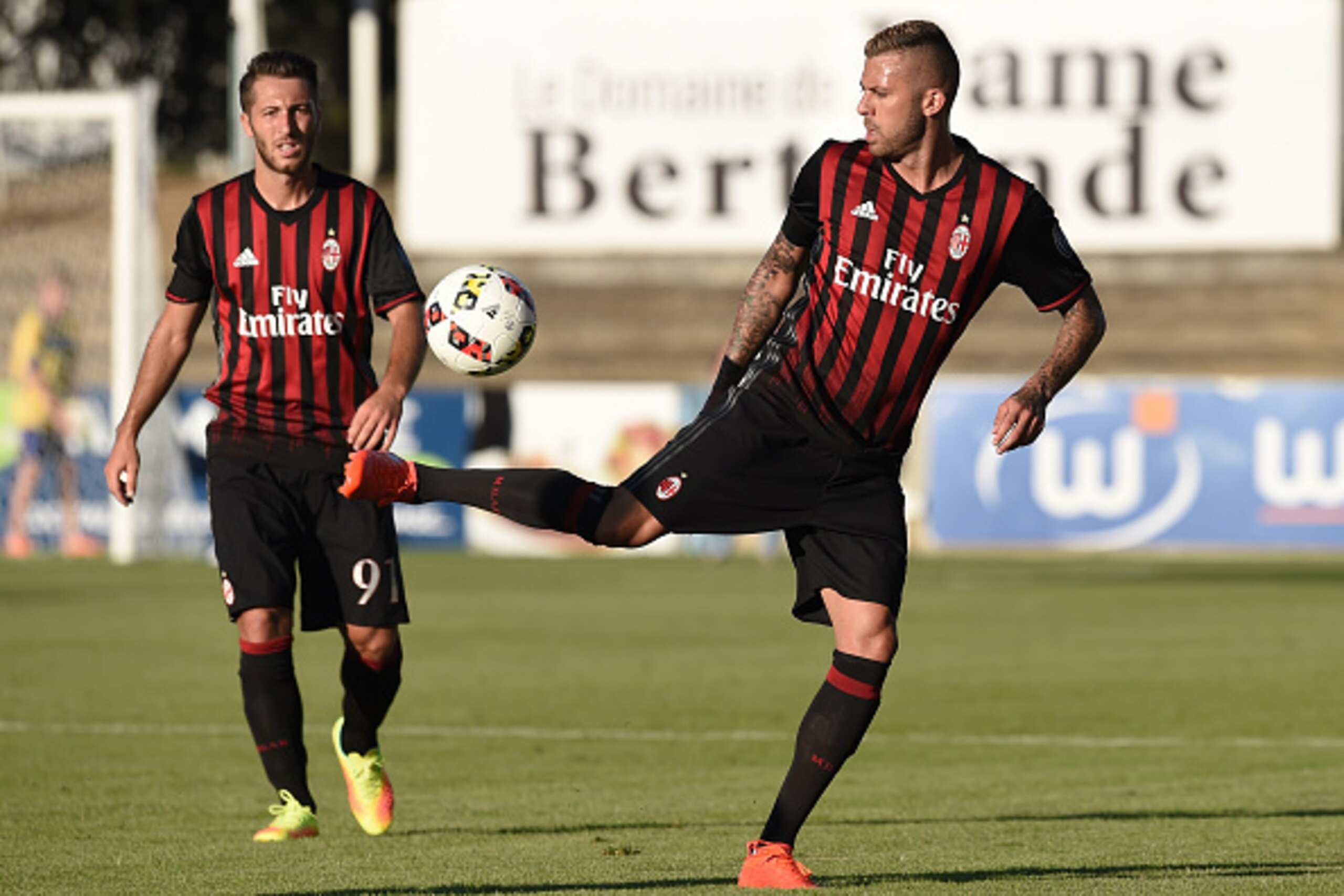
However, Andrea Bertolacci was the player who stood out the most. This was not necessarily because of the quality of his performance, but for his willingness to take on the task of dropping deep between the two centre-backs—Paletta and Alessio Romagnoli—in the buildup stage.
The Italian central midfielder struggled in his debut campaign with Milan last season, seemingly unable to fit into whatever system was chosen. Against Bordeaux, though, he adapted well to the new demands asked of him. It was his duty to fall back centrally and aid circulation of the ball, something he did remarkably well considering he has not done this for the team before.
The Rossoneri seemed to wilt in the second half, as Bordeaux had more of the ball and began to threaten more consistently, though this was mainly to do with the quantity of substitutions made by Montella.
At half-time, he made five substitutions, taking off the likes of Bertolacci, Suso and Bonaventura. The coach then made a further three changes on 58 minutes and two more on 67 minutes before bringing off the last remaining starter, Andrea Poli, on 72 minutes.
These constant changes meant Milan lost cohesion in possession and subsequently had to accept being on the back foot for the remainder of the game. However, there was one positive in that they gave Montella a chance to see several Primavera graduates in action.
Three 18-year-olds, Niccolo Zanellato, Giovanni Crociata and Mattia El Hilali, came on in midfield, with the former impressing in bursts after taking Bonaventura’s place, while two 19-year-olds in Ivan De Santis and Luca Vido also made appearances. The good news for all five youngsters is that none of them looked out of place among first-team players.

While the burgeoning influence of a new tactical vision was on show, youth-team members were given an outing and the match ended in a win, there are still improvements to be made.
Montella has done well to begin implementing his ideas in such a quick time frame, though Milan are a long way off where he will want them to be. The pace of the team’s possession is still quite slow and occasionally lacking in penetration, while some individuals such as M’Baye Niang and Jose Mauri simply did not look up to speed.
Later this month, the Rossoneri will fly out to the United States to take part in the International Champions Cup, where they will play friendlies against some of Europe’s biggest teams. They will begin by taking on German champions Bayern Munich before playing English giants Chelsea and Liverpool.
Each of those fixtures will be a serious test of Montella’s Milan, but the promising early evidence offered during the win over Bordeaux suggests they will have what it takes to compete.
.jpg?w=2560)






.jpg?w=2560 "Nabers' Recent IG Post 👀")
.jpg?w=2560 "Landon Dickerson Placed on IR")