

5 Tactical Changes Vincenzo Montella Will Make at AC Milan
After a third successive season of underwhelming football, it was absolutely vital that AC Milan brought in a quality head coach ahead of the 2016-17 campaign.
On Wednesday morning, the club took a positive step in this regard, announcing the appointment of Vincenzo Montella, per Reuters (h/t the Guardian).
The former Roma striker has earned plaudits as a coach, particularly with Fiorentina, whom he led to fourth place in Serie A for three consecutive seasons.
Montella spent much of the 2015-16 campaign with Sampdoria and is excited to have the opportunity to turn around Milan’s fortunes. Speaking to Mediaset (h/t ESPN FC), he said:
"Our objective is to return to the top in Italy and in Europe. There's a lot of work to do and I'm aware of what to expect. To bridge the gap to Juventus, it is going to be up to the players. We'll start to work seriously during the week. Milan need to have the ambitions to get back to being on the highest level in Europe, as well as in Italy. It's going to be an arduous task, but I know full well what I have to do.
"
An astute tactician, the 42-year-old will have to draw upon all of his coaching acumen to reinvigorate an ailing giant of Italian football.
What follows is a look at five possible tactical changes Montella may make to rejuvenate Milan.
Formation Flexibility
1 of 5
Last season, under the tutelage of Sinisa Mihajlovic and Cristian Brocchi, Milan made use of three basic shapes. Starting and ending in a 4-3-1-2 formation, they had mixed fortunes with the 4-4-2 and 4-3-3 in the middle portion of the campaign.
This may initially seem like a lot of variety, but it pales when compared to Montella’s experimentation in recent years.
With Fiorentina he opted for a 3-5-2 before utilising 3-4-3 and 4-3-3 formations. And in his brief time in charge of Sampdoria last season he switched from a 4-3-1-2 to a 3-4-2-1 as the term went on.
Montella’s willingness to rotate between shapes comes from his view of their importance, or lack thereof. Indeed, in an interview with La Gazzetta dello Sport’s Alessio da Ronch (h/t Gazzetta World) he stated:
"I don’t believe in formations, instead I look at strategies, and those can change. I believe in a philosophy as it is key to have one. You pick one and move forward with it, or else you will just create confusion. ... Continuity, in the long run, has its advantages."
Montella is more interested in implementing an overarching style of play that suits his vision than with specific shapes. As such, expect him to trial a multitude of different systems with Milan.
Three-Man Defence
2 of 5
While Milan’s formation was altered at times last season, one thing remained certain: They would play with a back four. The simple reason behind this consistently conventional approach was the personnel available.
Apart from Alessio Romagnoli, the Rossoneri’s centre-back options, including Alex, Rodrigo Ely, Philippe Mexes and Cristian Zapata, lacked the technical and athletic qualities necessary to perform as part of a defensive trident.
Milan will have to freshen up in this particular area of their squad over the summer. And, if they do begin that process, they would be well advised to take note of Montella’s proclivity for a three-man back line, something he often deployed during his spells in charge of both Fiorentina and Sampdoria.
There are several reasons for this preference. One is that a three-man back line, when utilised correctly, offers good opportunities for building possession from the back. Another is that it allows for numerical superiority in the centre when defending.
According to La Nazione (h/t Calciomercato), Fiorentina’s Nenad Tomovic is on Milan’s list of potential defensive reinforcements. Signing the Serb, who has worked with Montella previously and can operate on the right of a back three, would indicate a move to a defensive trident.
Two Trequartisti
3 of 5
In January, Montella’s Sampdoria were forced into a tactical change. Having enjoyed some success with a 4-3-3 shape, the Blucerchiati were left without their first-choice wide men. One, Eder, moved to Inter Milan while the other, Carlos Carbonero, was ruled out for the rest of the season with a knee injury.
Assessing the squad and improvising in difficult circumstances, the coach decided to bring in a 3-4-2-1 shape that would make full use of his attacking-midfield talent. The switch allowed him to play without wingers, of which he had a shortage, and instead play with two trequartisti.
With attacking-midfield options including Ricardo Alvarez, Joaquin Correa and Roberto Soriano, Montella’s move was a clever one. In making this change, he took a leaf out of the book of Paulo Sousa, his successor at Fiorentina, who used a 3-4-2-1 with Josip Ilicic and Borja Valero behind a lone striker for much of last season.
And, with players such as Giacomo Bonaventura, Keisuke Honda and Suso available, this is something that may be explored at Milan next season.



More Possession
4 of 5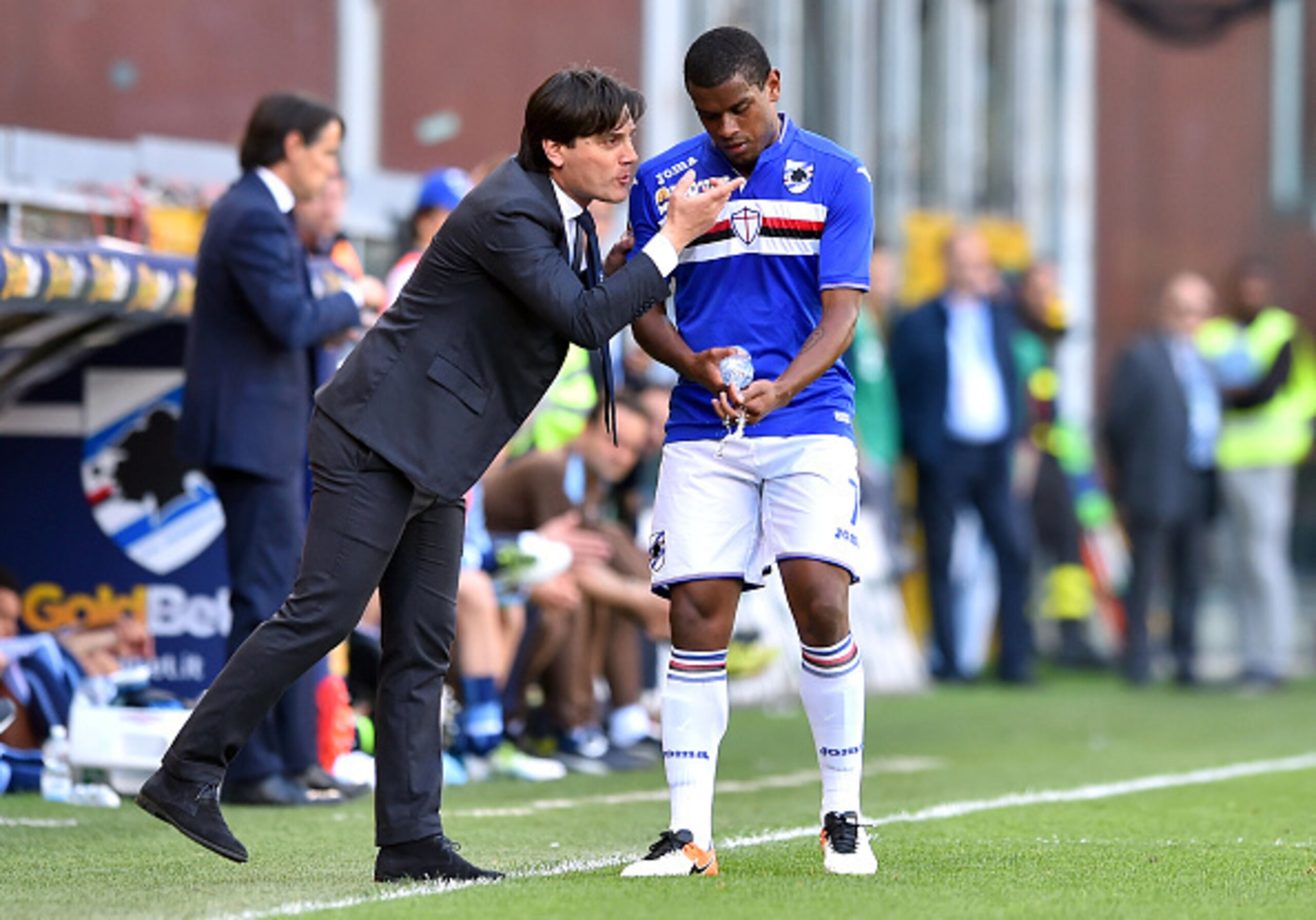
Last season, Milan had the eighth-highest average possession in Serie A. This can quite reasonably be expected to change under Montella’s guidance.
Prior to his time in charge of Catania, the Elefanti averaged 46.6 and 46.9 per cent possession in 2009-10 and 2010-11, respectively. But, in his solitary season with the Sicilian club, they achieved 48.3 per cent.
In 2010-11 and 2011-12, Fiorentina averaged 49.3 and 48.9 per cent possession. However, under Montella’s leadership they obtained 55 per cent in 2012-13, 56.5 per cent in 2013-14 and 55.9 per cent in 2014-15.
This is central to the coach’s football philosophy; he tends to build his teams in order to control the match through having, and using, the ball.
Milan have some quality technicians within their ranks who could prove useful in this respect. Romagnoli can build play from the back, while in midfield Riccardo Montolivo, Andrea Bertolacci, Manuel Locatelli and Giacomo Bonaventura are adept in possession.
Expect Montella to pack his lineup with flair and creativity, as well as players who can control the ball in tight spaces, as he looks to increase both the quantity and quality of the Rossoneri’s possession game.
Greater Innovation
5 of 5
On January 5, Sampdoria defeated city rivals Genoa 3-2 in the Derby della Lanterna. The win had a lot to do with Montella’s tactical innovation. That evening he played diminutive 33-year-old forward Antonio Cassano in a false nine role atop a 4-3-3 formation. The player had a hand in all three goals, assisting directly for two of them.
Milan’s new coach has always had an acute understanding for how to use his players. And, when appropriate, he has been unafraid to try something completely different.
With Fiorentina, Montella occasionally used Josip Ilicic as a false nine in an attempt to negate the Slovenian attacking midfielder’s defensive weaknesses. He also played Joaquin as a wing-back to give the Spanish winger additional space to exploit with his dribbling skill. And, in addition to pre-planned positional innovations, he has always been willing to alter his plans in the midst of a game.
Viola Nation’s Chloe Beresford told Bleacher Report about this particular aspect of the coach’s arsenal, saying: “He’s great at uniting the squad and is tactically flexible, often changing the formation midway through the match.”
Last season, Milan often stuck by the system they started fixtures with and generally opted not to test players in new positions. Under Montella’s leadership, however, the Rossoneri will likely showcase a more innovative and improvisational tactical approach.
All statistics provided by WhoScored.com unless otherwise stated.
.jpg?w=2560 "Chiefs Camp Football")

.jpg?w=2560 "Report: NFL Edge Not Going to LSU")
.jpg?w=2560 "Cowboys Cut QB Joe Milton")
.jpg?w=2560 "Eagles, Ertz Reunion Possible")


.jpg?w=2560 "Oldest, Youngest NFL Teams Revealed")