

Marcus Mariota Q&A: Titans QB on Hawaiian Roots and Learning a New Offense
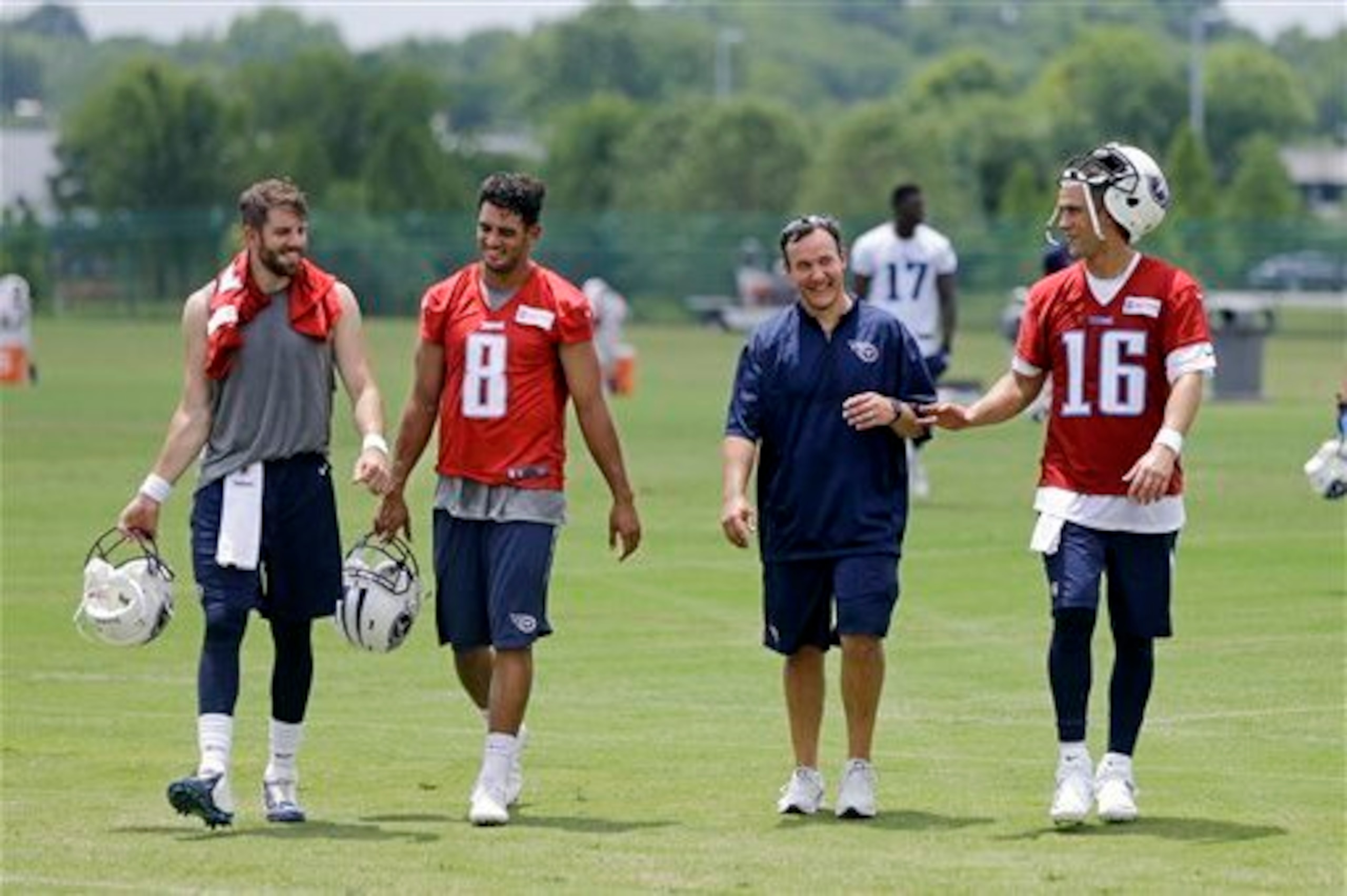
NASHVILLE, Tenn. — Tennessee Titans quarterback Marcus Mariota is going through an interesting transition this season. For the first time in his career, he will be in a pure power-based offense, getting away from the run-and-shoot and spread offenses he played primarily in college.
Mariota's transition to a pro-style attack began last year under head coaches Ken Whisenhunt and Mike Mularkey. But the addition of running backs DeMarco Murray and Derrick Henry make it clear what Mularkey's intentions will be this season: a power-based, run-heavy offense in an effort to keep Mariota and Co. out of high-leverage situations.
Mariota talked about that and more during a recent interview with Bleacher Report:
TOP NEWS
Peyton Manning's son sidelined with injury
Each Team’s 53-Man Roster📋
.jpg?w=2560 "Falcons Buccaneers Football")
Bijan Accepts Godfather Offer ✅
Bleacher Report: In college you played in a system that put a lot of emphasis on speed and stressing the defense over big spaces. You are now getting into an offense that puts an incredible emphasis on power. DeMarco Murray and Derrick Henry are one-cut runners, and this is a big offensive line. Philosophically, do you have to think differently as a quarterback between those two styles? Do you have to be more patient?
Marcus Mariota: Not necessarily. I think the biggest difference is you're playing in tighter spaces, so there's a lot more defenders in the box, things that I wasn't accustomed to seeing at Oregon in terms of spreading people out. Decisions have got to be a little bit quicker, but it's still football, and a lot of times it's just learning how to play within a tighter space. There's a lot more bodies moving around rather than schematically different things.
B/R: Which one do you like more?
MM: I'm not biased. I like both of them. I think they both have their strengths, and I think there's ways to be efficient in both systems.
B/R: When you played in high school, was it more power football? Classic Hawaiian football is more of the power game, from what I understand.
MM: It was a mixture; it was more run-and-shoot. I ran a lot of quick-strike concepts in high school just because from the University of Hawaii, a lot of guys that were in my high school coached that way.
B/R: They do the June Jones (former Hawaii head coach from 1999-2007) thing?
MM: The June Jones, run-and-shoot, different concepts like that.
B/R: The north side of the island doesn't play that way, right?
MM: The north side of the island plays power football. They run the ball 40 times a game and have counter, triple-option type of stuff.
B/R: The big farm kids?
MM: Yeah, the Kahuku kids. It's just kind of how it's always been. The north shore, those types of teams run heavy offenses, big-style defenses. In town, you have kids where it's more spread it out—use your quickness, use your speed. I was with townie kids, so that's what we ended up doing.
B/R: I'm surprised that there isn't more mixture of the two kinds of systems. It's not like Hawaii is the most gigantic place, but it seems very distinct.
MM: Yes, for sure. I think that's just based purely on the fact that a lot of times the teams up on the north shore, it's generation after generation that are playing on the same high school teams. The same coaches are coaching, their grandfathers, their fathers and their sons. It's just kind of always kept that way.
B/R: It must make for a pretty cool playoff game.
MM: Of course, that's what's really cool about playing in Hawaii. My high school was in the private school league, and we played all our games at the college stadium. It wasn't like we filled it, but we got a good crowd. When playoffs came around, that's one of the biggest things in the island. When everybody is out there enjoying the game and it's a great mixture.
B/R: And the clash of styles must be pretty cool, because you get the big kids from the north shore. How much trash talk is there?
MM: In Hawaii, after somebody introduces themselves, the next question is, "What high school did you go to?" From there, it's either "Oh, OK, it's cool, I know some family," or it's trash-talking to the max, like "my school is better than your school." This is how it kind of is back there.
B/R: Because it's so parochial basically. It sounds like a cool way to grow up.
MM: Yeah, and a lot of people are always talking about the state of Texas being where football is a religion. I would definitely argue that Hawaii has got that same mentality. Growing up, you care more about playing for your high school than even thinking about going to college. It's crazy, but it's kind of always been that way. Now that I'm seeing even my younger brother go through it and my cousins, it's the same way as when I was there, and it will probably be that way for the rest of eternity.
B/R: Was that why you chose to do your draft party there and not in Chicago?
MM: Yeah, that for me it was more important to spend that with family and friends because I wouldn't have gotten to where I was without their help. I just wanted to make sure that they could share in that moment with me because that was such a huge, pivotal moment in my life. It was more of a thank you than anything else.
B/R: How much did you study the June Jones stuff growing up?
MM: I was in it since I was in eighth grade, so I had been a part of that system all the way up until high school, so a lot of the run-and-shoot concepts were things that I had learned at a young age.
B/R: So you're not going to miss some of that?
MM: It's funny because I was kind of talking to my pops about this. I played in three distinct offensive systems. When I was in Oahu, I was playing in the run-and-shoot. At Oregon, I played more in the zone-read-spread offense, and here I'm playing more of a power-style I formation. It's fun to see all the different dimensions of each offense. To me, each one is very unique, and each one has their own strength. It's fun to play each.
B/R: Do you guys do the pregame Haka dance? Is there anything that pumps up a crowd more than that? It looks awesome.
MM: If you ever have a chance to go watch a rugby game when the All Blacks team does it, that's where it stems from. If you ever get a chance to do that, it's something special and it's very unique. It's hard to describe because it's so powerful. The entire community and entire stadium gets into it. It's hard to rival that with anything else.
B/R: You feel it more than you can describe seeing it?
MM: No doubt.
B/R: Is the entire team on the field and everybody in the stadium?
MM: It's the entire team on the field that does it. The tradition behind it is that it was meant for Polynesian warriors who are going out to battle, and it was just to unify them so they were ready to go to war. The All Blacks team does it as a way to pay respects to their culture. A lot of high schools are doing the same.
B/R: I notice you were working on your cadence earlier, trying to draw the defense offsides? Was that the get-out drill, just trying to get out a couple of first downs?
MM: Yeah, especially in that situation, you want to achieve five to six yards just to get the ball away from the goal line, try to give yourself a little bit of room.
B/R: I don't know if in previous systems when you're playing in gun most of the time, is that easier to do, or is that easier to do the cadence stuff when you're up on the line?
MM: I think the best in the league can do it from both under center and gun. For me, I think it's a little easier to do it from gun, but at the same time, it's kind of an art, which is cool about it. If you develop that part of your game, that pre-snap, it not only helps you, but it helps the guys around you because they can see different tells and what the defense might do.
B/R: So did you watch Aaron Rodgers, because he's really good at that?
MM: Oh yeah, a bunch of those guys are really good. Peyton [Manning] was probably one of the best at it. Guys like Jay Cutler; they've got a savvy to it. It's an art form. If you can develop that—I'm working on my art form, but if I get better it's going to help us out as well.
B/R: Is it the hesitation? Is it how you speak things? Is it replicating how you did it the previous time?
MM: Yeah, you gotta be able to [change up], because if you get repetitive, then guys are able to catch on to it, and they jump you. But if you do something different in terms of changing the count, you can get guys who jump offsides and maybe get a free play.
B/R: I know your agents represent Ben Roethlisberger and some other quarterbacks. Are there guys who you sought guidance from, either before your rookie year or even after your rookie year?

MM: Yeah, when I got here, Charlie Whitehurst was here. He was a guy that had been across the league for a number of teams. He had gone through a lot of different things. So he was somebody when I got here that really helped me out. Before the combine, before the draft, I was working out with Philip Rivers. He was somebody that helped me out through watching film and taking snaps under center and different things like that. So those two guys definitely were huge helps in my game.
B/R: Was that a little strange, because there were a lot of rumors revolving around you and Philip?
MM: It is what it is. A lot of times, people just like to throw things out there. I think Philip's very happy where he is.
B/R: Your receivers, obviously Dorial Green-Beckham has got a whole lot of potential, but he's been banged up. How do you get on the same page? How to get that out of him when he's struggling?
MM: You just got to continue to do your best, whether it's spending a little bit of extra time just talking to him. As we continue forward, if he continues to learn on the field, he has amazing potential.
B/R: Have you ever worked with a guy with that kind of size and speed?
MM: No. He is physically very unique, somebody that has all the talent in the world. If he can get up the wall, he's going to really help us out.
B/R: Mularkey was telling me that you're very polite, and everybody has pointed that out over the years. But he said that last year, there were times you got in the huddle and you could get a little salty, that you know how to do it when the time is right.
MM: Yeah, it just comes out. I'm going to do whatever it takes to help our team win. I'm going to get on guys at certain times and talk to them the way I think they'll hear it.
B/R: Were they surprised?
MM: Not necessarily. I think we're talking about guys who will appreciate the fact that if I say something, hopefully it means something to them.
B/R: I went to college with John Elway, and he would act calm and cool all the time. Then he'd get in the middle of one of those fourth-quarter comeback drives, and his teammates told me that his eyes would get big, and he'd start talking really fast and furious. Do you get sort of taken over by the moment like that?
MM: I think you get into a zone, and you become something. You fall into a place where all you think about is trying to make a play and win the game.
B/R: Last question: What has been the biggest transition from living in Hawaii or on the West Coast to living here in the South? I imagine it's harder to get the kind of food you like?
MM: Not necessarily. I think the biggest thing is just being landlocked. I've been close to the ocean my entire life. It's a little different not being able to be next to the ocean. I've been in the water my entire life, and it's something that's a little new to me.
B/R: The Cumberland River will have to do.
MM: We'll see (laughing).

.jpg?w=2560 "Jets RB Taken To Hospital")
.jpg?w=2560 "Grading Every Team's Season 🔠")