

Max Verstappen Living Up to Ayrton Senna Comparisons with Spanish Grand Prix Win
In the 1990s, there were 10 first-time Formula One grand prix winners. In the 2000s, there were 14. This decade, at least until Sunday, there had only been three: Nico Rosberg, Pastor Maldonado and Daniel Ricciardo.
Red Bull and Mercedes (and, more specifically, Sebastian Vettel and Lewis Hamilton) have largely dominated the 2010s, leaving precious little room for newcomers to break into the exclusive club of grand prix winners, which numbers only 106 over the the 66-year history of F1.
But at the Spanish Grand Prix on Sunday, 18-year-old Max Verstappen did just that, also setting the record as the youngest race winner in the sport's history.
TOP NEWS
_0.png?w=3840)
Summer League Takeaways ✍️
LeBron's decision is impacting NBA's plans
Riley Teases Another Heat Move
Yes, it took a double-retirement from the championship-leading Mercedes team to set up Verstappen's victory, but forget that for a moment. What we witnessed on a mild spring afternoon in the hills outside Barcelona was a masterful drive by a crafty veteran...not a teenager in his first race with a new team.
In a sport growing weary of win after win from the Silver Arrows, Verstappen's triumph provides a reminder of what F1 is at its best: tense, unpredictable and brilliant.
Back in 2014, after Verstappen had just signed with Toro Rosso for the following season, Red Bull adviser Helmut Marko compared him to Ayrton Senna, per the official F1 website.
That comment, and Red Bull's decision to sign such an inexperienced driver to their sister team, were met with skepticism and derision in some quarters.
Now, Marko looks like a soothsayer.

Promoted to the main Red Bull team just 10 days before the Barcelona race, Verstappen adapted to the increased pressure and exposure immediately, as he has throughout his brief career.
No previous car racing experience? No problem—he finished third in his first (and only) season of Formula Three. Too young for F1? No problem—he scored points in his second race, had two fourth-place finishes and ended his rookie year 12th in the championship. Undeserving of a drive with four-time champions Red Bull? Think again—fourth in qualifying and a race win (the team's first in nearly two years) the first time he sat in the car.
Senna won the 1983 British F3 championship before making the jump to F1. After a season with Toleman, he jumped to the more competitive Lotus team, winning the second race of the year, in Portugal.
Verstappen may not end up a three-time world champion, but so far Marko's comparison looks valid.
After qualifying in Spain, Red Bull team principal Christian Horner compared Verstappen to another multiple world champion on Sky Sports' television coverage. "His mannerisms remind me an awful lot of a young German we had a couple of years ago—his demeanour, his calmness in the car," he said, referring to Vettel.
Through the first two corners of Sunday's race, everything was following a familiar script from the last three seasons, with the two Silver Arrows clear of the pack and ready to sprint off into the distance.
But Rosberg unexpectedly slowed at the exit of Turn 3 and moved to his right at the exact moment Hamilton dove for the same gap. Hamilton was forced onto the grass and then spun into the back of Rosberg's car, taking both Mercs out of the race.
At that point, for one of the few times in F1's hybrid V6 era, the grand prix was thrown wide open. At least four different drivers (none of them in a Mercedes) had a legitimate chance to win.
Verstappen had lost a place to Vettel in Turn 1 but stayed calm and retook it on the outside of Turn 3, seconds before the Hamilton-Rosberg crash. That manoeuvre proved crucial, as it left Verstappen second at the restart, behind his team-mate, Ricciardo.
The two Red Bulls continued to lead the Ferraris of Vettel and Kimi Raikkonen until the second round of pit stops. At that point, both teams put their lead drivers on three-stop strategies, while Verstappen and Raikkonen looked to be stopping twice.
Verstappen first led the race for the six laps between his and Ricciardo's second stops. When Ricciardo stopped for the third time on Lap 43, the Dutch teenager took the lead again and never relinquished it.
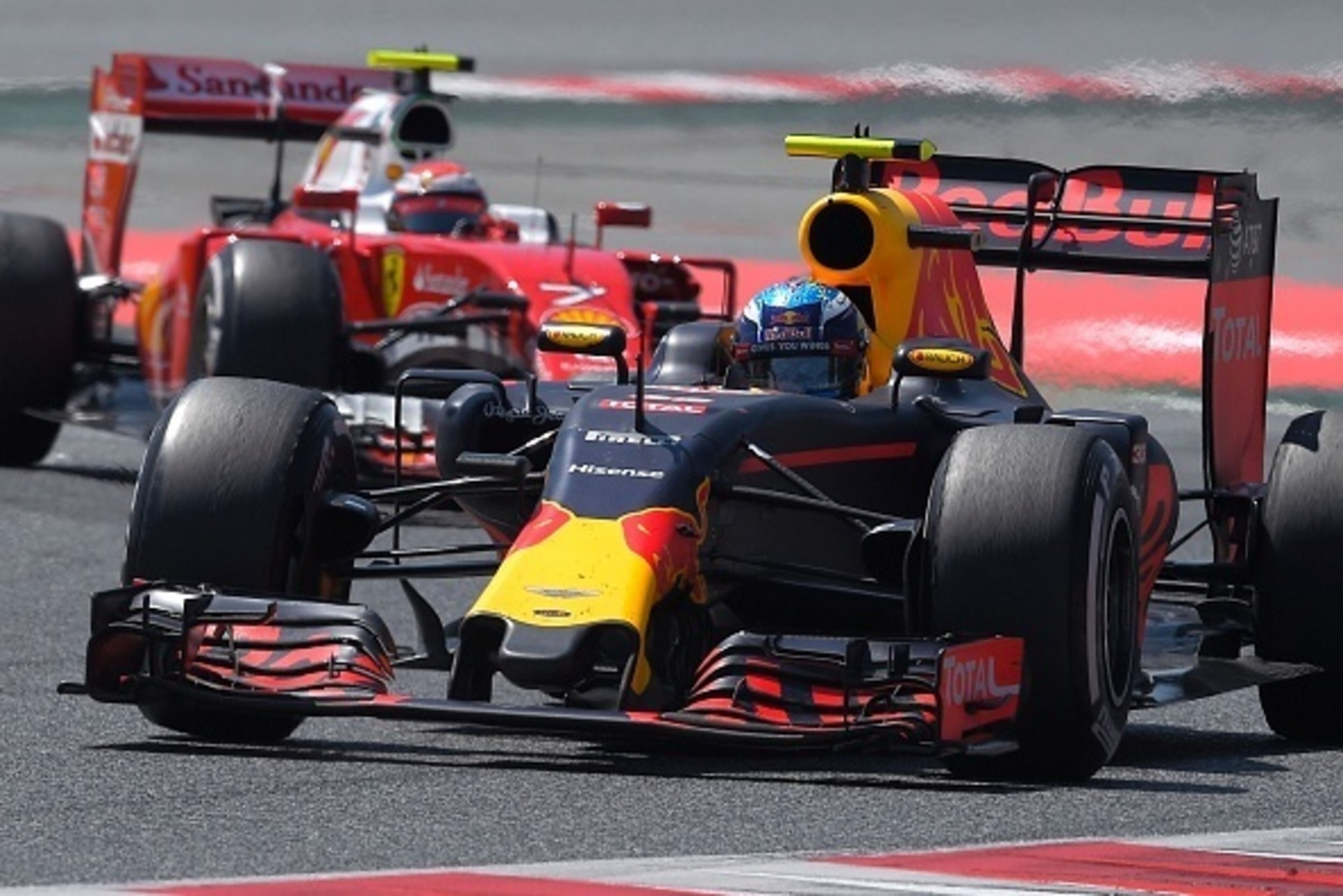
This final stint, under near-constant pressure from Raikkonen, was the most impressive part of Verstappen's race. He needed to be perfect, and he was.
In the post-race press conference, Verstappen spoke of the challenge he faced making his tyres last for the final 32 laps of the race. "Of course you are not pushing hard on them, you are just controlling it, and I have to tell you, the last 10 laps, you are driving on ice," he explained. "It's like driving on ice. Sliding a lot but it's all about managing the last sector and get a good exit."
A few times, it looked like Raikkonen might be close enough to attempt a pass at Turn 1, following the kilometre-long pit straight, but he never did.
From the outside, Verstappen looked cool and calm inside the cockpit, but he admitted that he was getting emotional near the end of the race.
"I think on the last lap, I got a bit of cramp," he said in the press conference. "I was getting very excited. I couldn't believe it. I was looking up to the big boards, I saw my name, first, with 10 laps to go. ... I was just thinking to myself, don't look at it any more and focus on the tyres and bring it home, and that's what we did."

The Merc crash and Verstappen's win will not necessarily have a huge impact on the championship. Mercedes and Rosberg still have healthy leads in the constructors' and drivers' standings, respectively, and the Mercedes cars are still the class of the field.
In Spain, though, Verstappen silenced any doubters who might have remained and announced himself as a serious contender going forward—perhaps not for the drivers' title this year but certainly for race wins here and there, at tracks that suit the Red Bull RB12 or if the Mercs slip up again.
The young Dutchman has a formidable team-mate in the ever-smiling Ricciardo, but he has already shown that competing against the best drivers in the world does not fluster him. Meanwhile, Red Bull are expecting a Renault engine upgrade in time for the Canadian Grand Prix in June that could push them even closer to the Mercs and Ferraris, per Autosport's Lawrence Barretto.
"Too much celebrating already, @Max33Verstappen? #F1 #SpanishGP https://t.co/3ddnZEvVBJ
— Formula 1 (@F1) May 15, 2016"
The Monaco Grand Prix is next, on May 29. With the tight and twisty circuit placing a premium on downforce rather than engine power, we may not have to wait long for an encore from Verstappen. Another victory would likely require more help from the Silver Arrows (not outside the realm of possibility—it's a minor miracle it took this long for Rosberg and Hamilton to take each other out), but the Bulls should be competing for a podium.
For many drivers, winning a grand prix is the highlight of their career. Of those 106 race winners, 33 of them won only once. For Verstappen, you know it won't be enough. For fans looking for a break from the Mercedes monotony, though, Verstappen's brilliance in Barcelona is just enough—a taste of the magic that sometimes seems lost in modern F1.
Follow me on Twitter for updates when I publish new columns and for other (mostly) F1-related news and banter:
.jpg?w=3840 "Pro Bowl Football")
.png?w=3840 "Offseason Moves Sure To Backfire 💥")

.png?w=3840 "Every City's 2000s Mt. Rushmore 🤩")