

Alabama's Secondary Could Go from Its Biggest Weakness to Its Biggest Strength
TUSCALOOSA, Ala. — As far as the University of Alabama football team is concerned, the window has closed.
Not the one that some people talk about regarding national championships. That’s so open it’s the equivalent of a car with a convertible top down going from destination to destination, with head coach Nick Saban driving and his trophy collection in the back seat.
This is regarding the window of opportunity for other teams going after the Crimson Tide’s secondary. For the past few years, the prevailing thought has been that if Alabama were especially vulnerable anywhere, it was in the secondary, especially at cornerback.

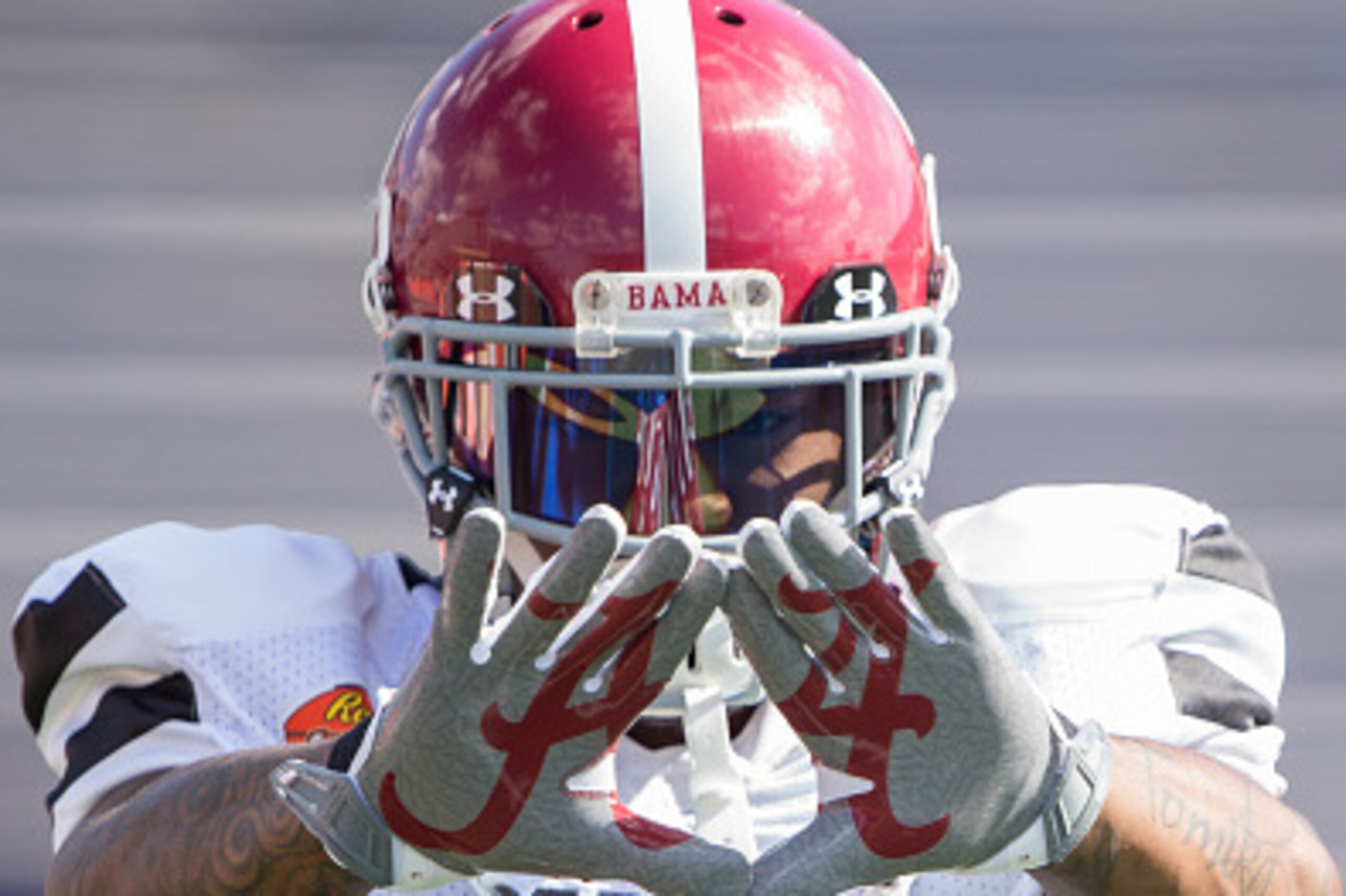
It’s something that the players have heard and taken to use as motivation. You think you can throw on us? Good luck.
“It really gives us a big chip on our shoulder,” safety Eddie Jackson said.
To backtrack a little, when Saban arrived at Alabama in 2007, one of his biggest recruiting priorities was in secondary, where the Crimson Tide had enjoyed some success (including Roman Harper, who’s still playing in the NFL with the Carolina Panthers) but needed an upgrade.
It began with cornerback Kareem Jackson, a late addition to Saban’s first recruiting class out of Fork Union Military Academy in Virginia. Coaches plugged him into the starting lineup for the opener against Western Carolina, and couple of years later, he was 20th overall selection in the 2010 NFL draft.
From 2007-12, Alabama added a defensive back who would be a future first- or second-round draft pick each year, although seeing them leave school early also became commonplace:
- 2007: Kareem Jackson
- 2008: Mark Barron
- 2009: Dre Kirkpatrick
- 2010: Dee Milliner
- 2011: Ha-Ha Clinton Dix
- 2012: Landon Collins
Just as problematic was that even though top prospects were still coming in, they were primarily safeties, as the string of shutdown cornerbacks came to an end.
In short, there was a gap that corresponded to the 2013 and 2014 teams, the ones that didn’t win the national championship—and the unintentional window. Saban started to slam it shut with his recruiting class of 2014, which according to the 247Sports composite rankings included 5-star cornerbacks Marlon Humphrey and Tony Brown and high 4-star safety Laurence "Hootie" Jones.
The question was how long they and the players to follow would need to develop.
Meanwhile, Eddie Jackson was part of Alabama’s signing class of 2013, which was highlighted by Reuben Foster, Derrick Henry, Jonathan Allen, O.J. Howard and A’Shawn Robinson.
Jackson was rated a 3-star prospect out of Boyd Anderson in Fort Lauderdale, Florida, but with the potential to play different positions. With Alabama’s need at cornerback so glaring that at one point it tried three wide receivers at cornerback including Cyrus Jones, he was quickly thrown into the mix.
Jackson started four games at cornerback as a true freshman and despite tearing his ACL during the spring, came back to make 10 starts in 2014.
So going into last season, the only starter in the secondary with experience at his position, including the dime and nickel defensive backs, was Jones.

Jackson tried his hand at strong safety, which was even more difficult considering he was replacing All-American Collins.
“It was difficult at first,” he said.
Geno Matias-Smith slid over from free safety, giving Alabama two former cornerbacks at the safety spots—a real concern due to the size it gave up.
"[It] makes us a little more athletic, with a little more speed and a little more range on the field,” Saban said.
Redshirt freshman Humphrey ended up starting at cornerback, and true freshmen Minkah Fitzpatrick and Ronnie Harrison ended up being the extra defensive backs when necessary. So when Alabama was in a dime defense with six players in the secondary, three of them were first-year players.
| Name | Year | Stars | Rank |
| Tony Brown | 2014 | 5 | 9 |
| Marlon Humphrey | 2014 | 5 | 12 |
| Kendall Sheffield | 2015 | 5 | 20 |
| Minkah Fitzpatrick | 2015 | 5 | 30 |
| Deionte Thompson | 2015 | 4 | 44 |
| Hootie Jones | 2014 | 4 | 50 |
| Nigel Knott | 2016 | 4 | 62 |
| Shyheim Carter | 2016 | 4 | 71 |
| Maurice Smith | 2013 | 4 | 84 |
| Jared Mayden | 2016 | 4 | 147 |
| Shawn Burgess-Becker | 2015 | 4 | 166 |
| Ronnie Harrison | 2015 | 4 | 197 |
| Anthony Averett | 2013 | 4 | 275 |
| Eddie Jackson | 2013 | 3 | 351 |
| Aaron Robinson | 2016 | 3 | 646 |
"We have a lot of young guys that are starting to feel their oats, in terms of their confidence and understanding how to do things and why," Saban said at midseason.
Jones was the clear leader of the unit, and due to being 5’9”, which was what he measured at the Senior Bowl, it was pretty easy to see where the unit’s collective chip came from.
During Alabama’s second game of the 2013 season, he came off the bench and then swapped spots with Deion Belue to try to slow down Johnny Manziel and Mike Evans. Alabama won, 49-42, but gave up a program-record 628 total yards, while Manziel and Evans set Texas A&M records with 464 passing yards and 279 receiving.
“I grew up a lot that day; let's just put it that way,” Jones said.
Fast-forward to the start of the 2014 season, and this time the wide receiver torching the secondary was West Virginia’s Kevin White. He had seven receptions for 133 yards when Alabama’s coaches switched Jones on him even though he had primarily been playing the other cornerback position during training camp.
“I knew what they were going to do,” said Jones, who broke up the up the next attempt to the tall receiver and finally nullified the threat. From that point on, White only had two receptions for 10 yards, with Jones making the tackle both times.
He ended up with 46 tackles, three interceptions, a team-high 13 pass breakups, two forced fumbles and a fumble recovery while establishing himself as Alabama’s most consistent cornerback and was named second-team All-SEC. Now here’s the really impressive part: Jones played the entire 2014 season with a torn hip labrum.
"Right when I made the transition my sophomore year I was trying to feel my way around, like I was playing unconfident, still not sure what I was supposed to be doing as far as the defense goes," Jones said. "It definitely hindered me as far as being able to just go out there and play fast and with confidence.
"If you don't have confidence playing corner, you just can't do it. It's impossible.”
Getting everyone else up to a similar point has been the challenge. And even though Clemson passed for 405 yards in the national championship game, 175 when Alabama was trying to pull away in the fourth quarter, the Crimson Tide made some big plays.
They included Harrison knocking a pass away in the end zone, Humphrey catching the onside kick and Jackson making a veteran play on his interception.
“It was huge,” he said. “Our front seven, they gave a great push, and man Geno, they did a little pick route, so I saw that happen, and I just tried to run to the man when he did the wheel and I was able to make a play.”
Aided by that outstanding front seven, Alabama made 19 interceptions and returned four for touchdowns in 2015. Now, even though Jones and Matias-Smith are moving to the NFL, the unit is expected to a real strength.
“You can definitely see they’re growing up, and they’re just more confident every time they step out there,” Jones said. “I knew it would come with time just like it did for me. I just think they’re progressing gradually.”
Similar to how Alabama’s defensive line could attack in waves this past season, the secondary might be able to do likewise in 2016 and give opposing offenses a multitude of looks. The talent is there again, with some experience mixed in that will only improve over the spring and summer.
“We've got really good, smart guys in the secondary,” Jackson said.
Quotes were obtained firsthand unless otherwise noted.
Christopher Walsh is a lead SEC college football writer. Follow Christopher on Twitter @WritingWalsh.
.png?w=2560 "CFB Top 25")
.jpg?w=2560 "Jameis Benched by Giants")
.jpg?w=2560 "Travis Hunter Makes Rare History")
.jpg?w=2560 "Skattebo Has 0 Touch Game 😬")
.jpg?w=2560 "NFL Addresses Paris Concerns")
.jpg?w=2560 "Titans Win 1st Game 🙌")
.jpg?w=2560 "McCarthy Injured During Game")
.jpg?w=2560 "Browns' Late FG Stuns Ravens")