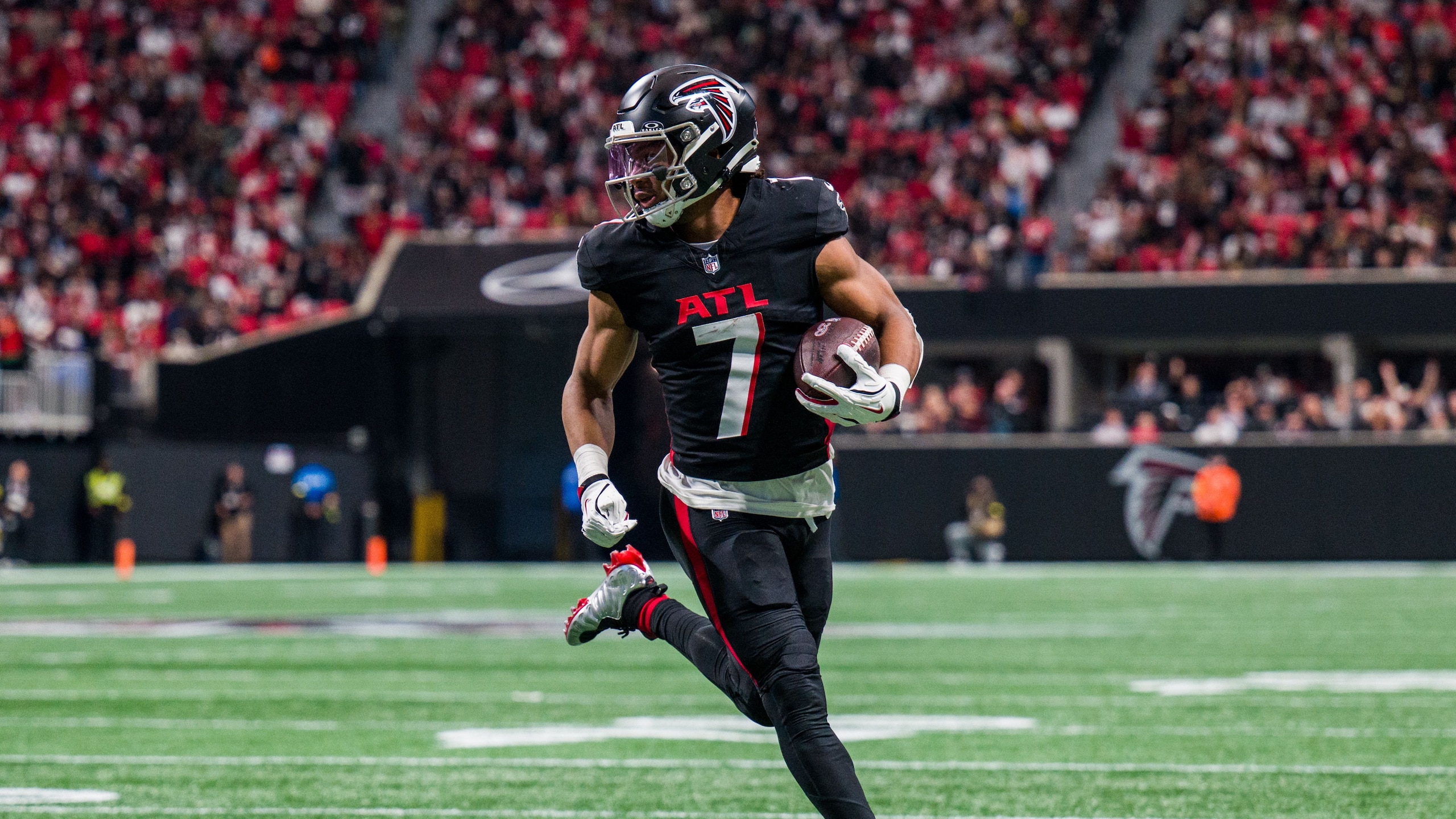
The Secret to the Boston Bruins' Power-Play Success
The NHL’s power-play leaderboard looks a lot like one might expect. Alex Ovechkin and the Washington Capitals, Patrick Kane and the Chicago Blackhawks, and the Dallas Stars with their magical duo of Jamie Benn and Tyler Seguin are all near the top of the list.
Not at the top, though. Those teams take up three of the four top spots in the league in terms of power-play efficiency, but they all trail the Boston Bruins.
TOP NEWS

Best Free Agents Still Available 💰
1 Word for Every NHL Team's Offseason 🗣️

Larkin, DeBrincat on Trade Targets Big Board 🎯
Boston is not a team with a long reputation of power-play brilliance. It’s the club that won the Stanley Cup in 2011 with an 11.4 percent success rate in the postseason, the same team which was sub-average last season.
That reputation can be exaggerated. Excluding this season, Boston has had an 18.4 percent success rate over head coach Claude Julien’s tenure. That’s the 11th-best mark in the league over that span. Still, it’s nothing compared to the 28.4 percent efficiency the club has enjoyed this year.
What has made the Bruins so good on the man advantage? As one might expect, it’s a combination of talent and good fortune.
On the talent side, Boston ranks second in the league in terms of shots per hour on the power play (behind Washington) and third in shot attempts per hour (behind the Capitals and, surprisingly, Toronto).
The Bruins did reasonably well in these categories a year ago, but on the good-fortune side of the equation, their power-play shooting percentage has climbed from 11 percent to 18 percent, going from 26th in the NHL a year ago to first in the league this season.
That’s a simple answer, and while there’s a good deal of truth in it, much of the nuance of the Bruins’ success is lost. We turn to video to answer the rest.
The first obvious thing about Boston’s power play is its puck movement. There’s a delicate balance to be struck between making quick passes which create opportunities and knowing when to shoot rather than over-passing, and the Bruins seem to have found the temperate zone between those two extremes.
This goal, which takes all of eight seconds to generate and features one touch by every member of Boston’s first unit, is a great example:
Nashville, a well-coached team, just has no time to react. Loui Eriksson gets the puck off a scrambled faceoff and moves it to the point before Shea Weber can reach him. Patrice Bergeron, the real key to the play, moves the puck so quickly after it cycles through the point men that Weber barely has time to decide to engage before the puck is gone again.
That decision leaves Eriksson all alone at the net, and when Ryan Spooner gets him the puck, it’s all over.
This is what quick puck movement to open up holes in a penalty kill looks like. Weber knows his business in the defensive zone and engages quickly, twice, against Boston. The Bruins' puck movement is so fast that Weber’s aggression pulls him out of position rather than creating an opportunity to win the puck back from the Bruins.
Of course, quick passing isn’t the only kind of puck movement that Boston’s power play uses.
This is a great sequence of plays. It kicks off with a David Krejci point shot which isn’t a booming blast but simply low and accurate. The beauty of this shot is that it has a screen, making a rebound more likely, and immediately creates a three-on-two battle in front of the net for said rebound.
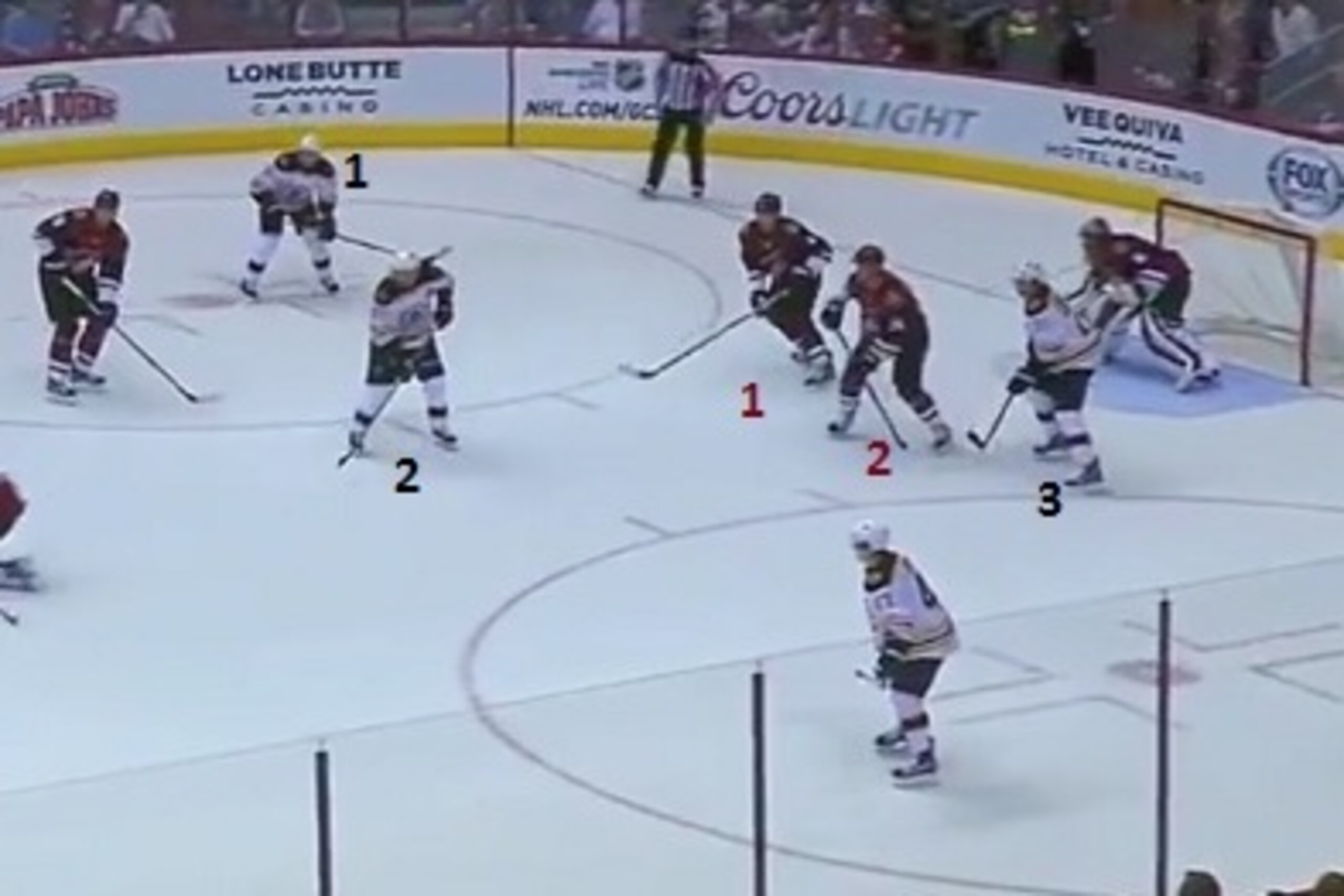
Spooner wins the three-on-two and gets a great opportunity which is turned aside.
Torey Krug gets much the same opportunity a moment later. He opts for a blistering slap shot which finds its way through traffic to the net.
It’s not redirected en route, and Eriksson can’t immediately find a rebound, but Arizona’s respect for Krug’s shot means that Bergeron has a jump on his man in the middle of the ice and creates another immediate three-on-two battle.
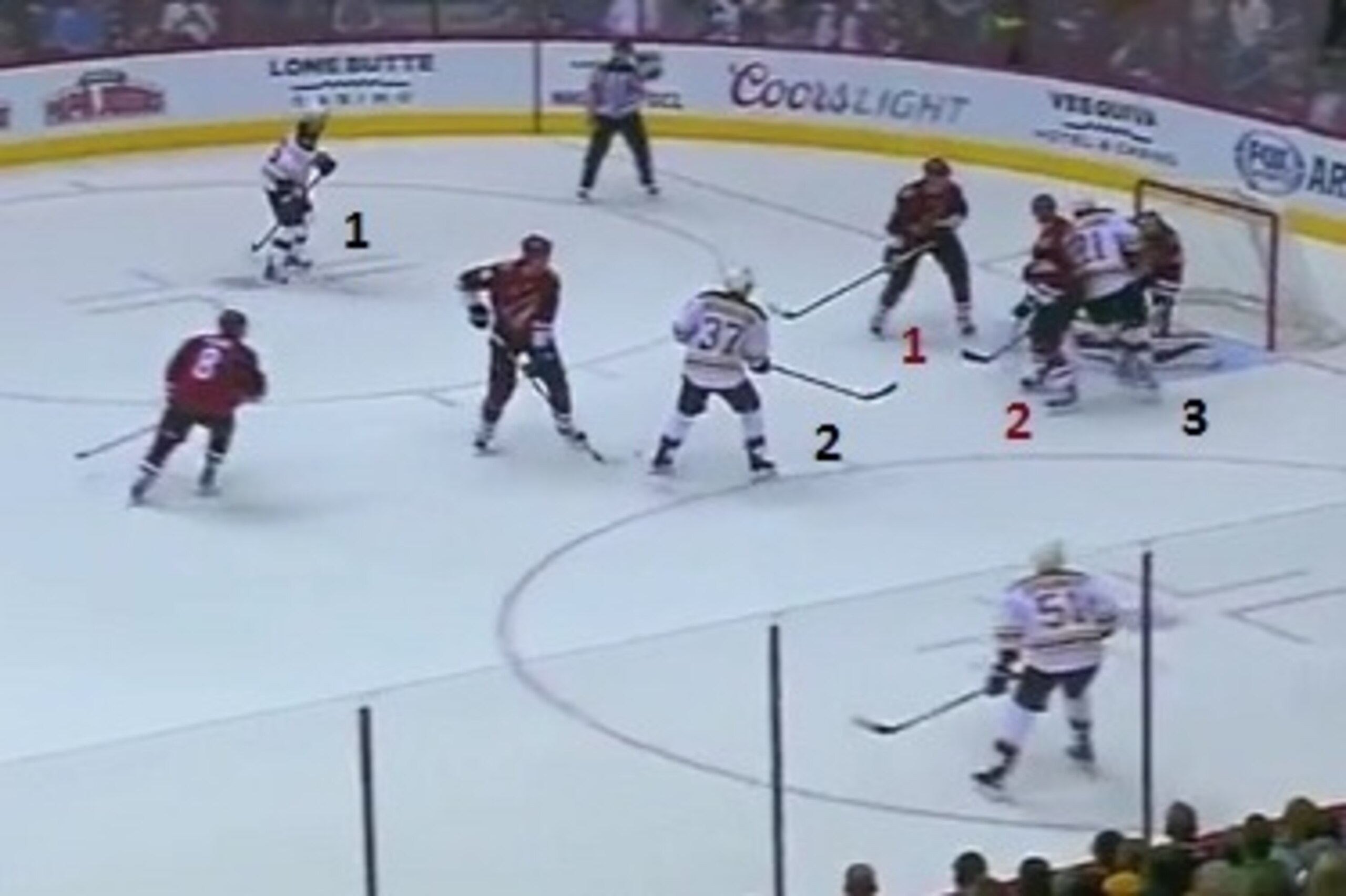
Boston doesn’t get an additional scoring chance out of winning this battle, but it does retain puck possession, leading to the goal-scoring play.
Krejci doesn’t have the same advantages of traffic and a big edge in manpower in front of the net, but he hammers the puck and is aided by a clearly frazzled Mike Smith. Arizona’s goalie barely has time to grab his stick and reset before Krejci one-times the puck, and as a result, he lets the shot through.
The Bruins’ power play thrives on chaos. Only six of the team’s 33 power-play goals have come off clean shots, and three of those either involved a five-on-three advantage or an empty net.
It’s not about passing the puck into the net. It’s about moving the puck quickly, creating odd-man situations in front of the net and then firing. Boston doesn’t look for a perfect play. It simply looks to set up a situation where there’s a manpower edge in front of the net so that battles will be won far more often than not.
The team’s first unit is a fantastic combination of talents.
Krug and Krejci are both excellent point men, with the right-shooting Krejci shuffling down to the half-wall when the team switches to a 1-3-1 formation.
Spooner gives the team a playmaker on the opposite side, and Eriksson is a more talented option in the net-front role than most teams have at their disposal.
The real key, though, is Bergeron.
Bergeron being a right shot sets him up wonderfully to work with Krug and Spooner (both left shots). His ability to shoot, pass or crash the net makes him unpredictable and allows him to alter his approach as the situation dictates. And, naturally, his faceoff skill helps Boston get possession in the first place.
This is a well-coached, well-staffed unit that strikes the fine balance between passing and shooting and excels at keeping control of the puck in the offensive zone.
The team’s shooting percentage probably won’t stay quite as high as it is right now, but this unit is so efficient at shot generation that it should keep scoring plenty of goals.
Statistics courtesy of NHL.com and Stats.HockeyAnalysis.com.
Jonathan Willis covers the NHL for Bleacher Report. Follow him on Twitter for more of his work.


.jpg?w=2560 "Buzz: Donald Eyeing Media Future")
.jpg?w=2560 "🔴 Live: WWE NXT 👊")