

2015 Is Nick Saban's Greatest Season Ever
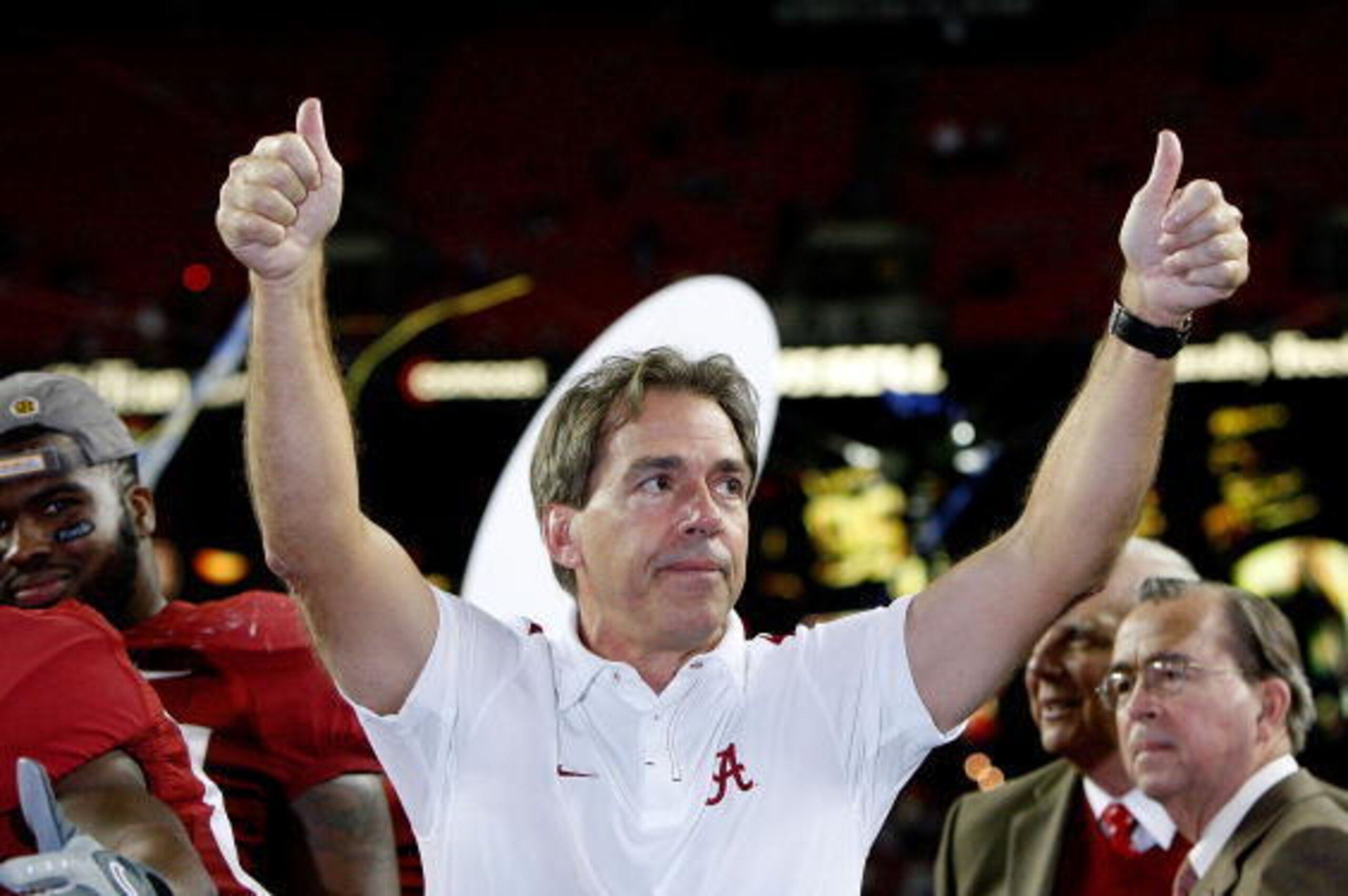
It was a moment of vulnerability, the latest in a long line of necessary and successful modifications to the process. Standing atop the confetti-drenched turf at AT&T Stadium, after tearing himself down and building himself back up, Nick Saban showed a much different side. He let us in.
After his team flattened Michigan State like some sort of stray traffic cone in the Cotton Bowl, a rare smile commandeered the coach's face. It hung around longer than anticipated, captured by the scoreboard's 30 million light bulbs high above for the world to see.
He even danced—if you want to call it that—looking like a tentative T-Rex enjoying his first karaoke night. But he didn't care. To cap it all off, Saban served his nightcap just as New Year's Eve was giving way to New Year's Day. His final statement before stepping off the podium was unprompted, unanticipated acknowledgements of the media he has often sparred against.
TOP NEWS

Updated CFP Bracket Projections 🔮

Week 5 AP Top 25 Poll 🔢
Top Overreactions after Week 5 of CFB Season 😧
"Even though you think I don't like you," Saban said, gesturing toward the room, "I really do appreciate what you do and I do like you. So thank you."
From start to finish, this season has been different. This lighter, looser side was not the first modification. This was a showcase for his adaptability and willingness to evolve.
In the long line of overpowering Saban creations, this latest installment will not be his ultimate masterpiece. No matter how dominant Alabama looks in its final 60 minutes against Clemson in the national championship, this will not be the team shown first in the Saban retirement montage. It likely won't be the second team mentioned either.
Alabama's 2009 team was one of the greatest of all time: an unblemished year headlined by a roster laden with NFL talent. The 2011 team wasn't quite as good, although Alabama allowed a ridiculous 8.2 points per game and overcame an early, ugly loss to win it all once again.
The 2015 squad has traits similar to both teams. It has weapons on both sides of the ball, although it's not as gifted as his team was in '09. And the current defense, while unrelenting, is not as collectively talented as it was in 2011. It's close, though.
And yet, despite these relative shortcomings, no team exemplifies Saban's brilliance and flexibility more than the one still playing. This is the greatest coaching job of Saban's career.
While we assume these previous champions shaped this Alabama team, it is quite the opposite. The losses and failures over time—as limited as they might be—have shaped and fueled the future.
"I think they call it quality control," Saban said the day before the Cotton Bowl. "You sort of assess the things that you did well, the things that you need to improve, some area that may give you difficulty. And then you go into research mode to try to figure out how can we innovate, to use your term, something that will help us do these things better."
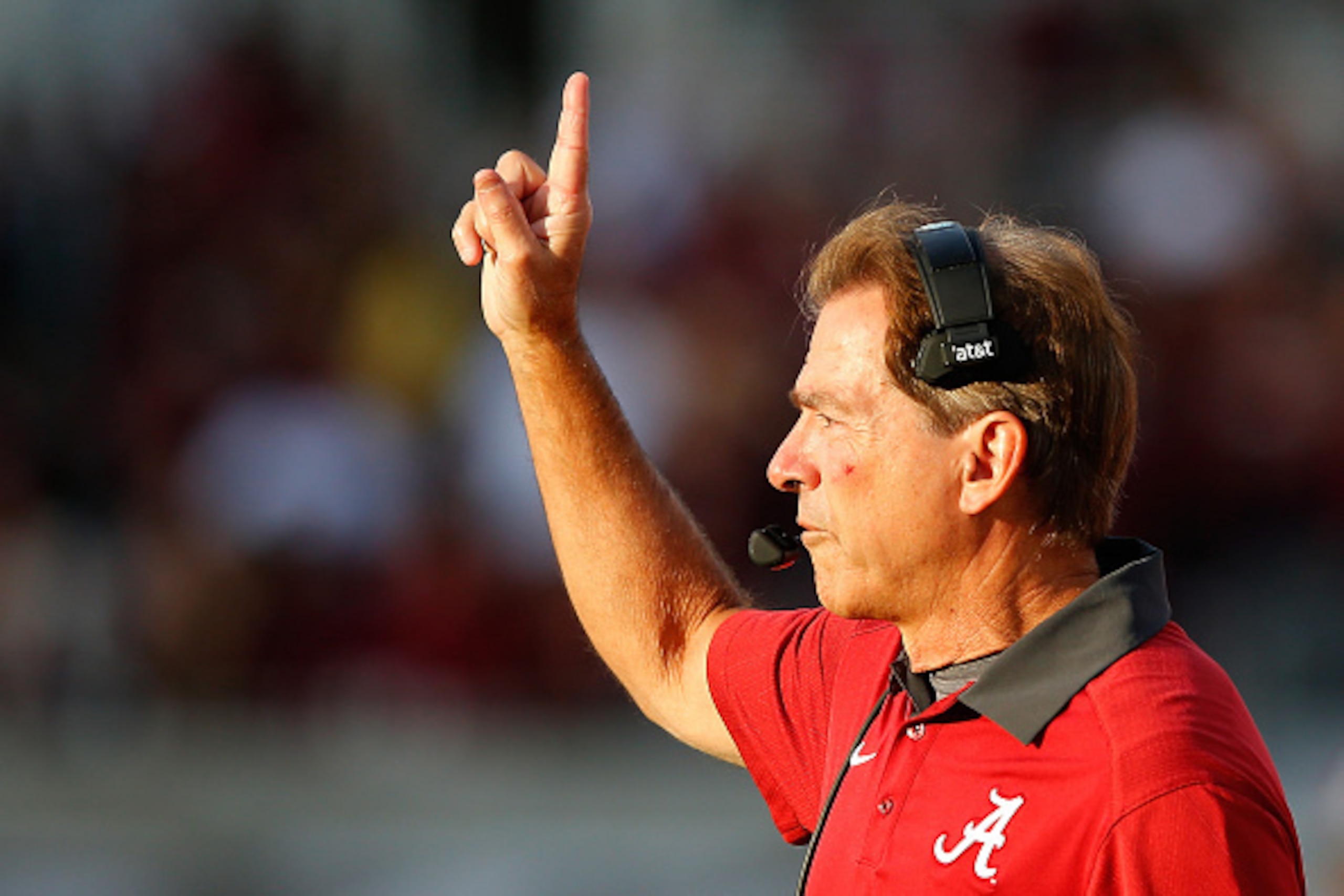
This is a yearly ritual for Alabama. As players and assistants come and go, Saban analyzes what his staff and roster will look like come spring. At the same time, he puts himself under the microscope. He dissects his own performance.
Like a raw freshman linebacker still learning the playbook, he breaks himself down. While he comes off as demanding of his players and staff, he's even harder on himself.
"Every year he does a quality control of himself to see what he can do better to keep this thing going," former Alabama assistant coach Sal Sunseri told Bleacher Report. "Most people become satisfied, and he just doesn't do that. There is a burning desire to challenge himself and his staff. That's just the way he is."
In recent years, Alabama has been plagued—at least by absurd Alabama standards—in a few areas.
The offensive revolution was actually two years in the making. In need of a spark and fully mindful of his shortcomings on this side of the ball, Saban went out and hired the most polarizing head coach the sport had to offer.
Since Lane Kiffin touched down in Tuscaloosa, he has been nothing short of brilliant. Alabama's offensive coordinator has developed two unproven quarterbacks—first Blake Sims and now Jake Coker—all while giving Alabama's more deliberate style an edge.
Saban recognized a need to stray from what won him many games. He needed someone willing to take him to task. And although the run-first mentality is still the team's identity—look no further than Derrick Henry's Heisman—Kiffin has provided a dramatic philosophical change.
"We were hopeful that he [Kiffin] would be able to add a new dimension from an energy and enthusiasm standpoint," Saban said. "And we knew that a year ago we were going to have a different kind of quarterback, and we were going to have to adapt some things. We felt like he was the kind of guy that could be able to adapt our offensive team to the players that we had."

Defensively, having watched his secondary picked to pieces at times, Saban went to the NFL and hired Mel Tucker to coach his defensive backs. Like Kiffin, Tucker rapidly helped shore up the program's Achilles' heel.
Alabama soared from the nation's No. 59 passing defense in 2014 to No. 18 in 2015. The Crimson Tide intercepted seven more passes from the previous year and returned four of those interceptions for touchdowns. Only two teams returned more.
The secondary's woes were partly a product of a lack of pressure. So, instead of sticking to the course, Saban and defensive coordinator Kirby Smart tweaked this part of the defense. More specifically, they found snaps for Ryan Anderson and Tim Williams—two change-of-pace linebackers with a gift for getting to the quarterbacks.
Other defensive players garner more systematic praise and NFL intrigue, but Anderson and Williams combined to sack quarterbacks 16.5 times this season in non-starting roles. They were the lightning to the thunder.
After finishing 40th or worse in sacks over the past two years, Alabama led the nation in 2015.
Beyond the schematics, Saban was able to take the actual failures—not the reason for these defeats, but the accompanying disappointment with rare losses—and use them as fuel.
When Alabama fell to Ole Miss last year, the dynasty was losing its appeal. When Alabama lost to Ohio State in last year's playoff, the dynasty was lost. And when Ole Miss beat Alabama for a second time in 2015, we buried it even deeper.

Turns out the dynasty is definitely not done. It's just evolved. And the change has actually worked in the Crimson Tide's favor. It's made the biggest favorite in college football hungrier.
"Last year we were just happy to participate," Saban said following the Cotton Bowl. "This year we wanted to make a statement."
There is no shortage of talent at his disposal. Having collected and developed his roster into the deepest in the nation, this is not Alabama's great underdog tale. This is not a team that suddenly emerged out of thin air through the guidance of its coach.
But talent does not equate to guarantees, something Saban knows firsthand. His willingness to accept his deficiencies and make the appropriate philosophical changes to a glorious assembly line is what pushed this season over the edge.
Having seen exactly what was necessary to win at an unprecedented level, Saban altered the formula. He gave up on something proven with the hopes of something more.
Sure, he's overseen better teams and deeper rosters. Perhaps the best is still to come.
But in 2015 we learned that Saban can win in more ways than one, and that's a scary thought.
Unless noted, all quotes obtained firsthand. All stats via CFBstats.com.
_0.png?w=2560)



.jpg?w=2560 "Viral Rams Coach Vid 🖕")
.jpg?w=2560 "Injury-stricken Seahawks signing veteran RB")
.jpg?w=2560 "2 NFL Officials Suspended")


.jpg?w=2560 "Mahomes' Wife Trolls Kubiak 💀")

.jpg?w=2560 "Grading WWE Raw 🔠")