Florida State's Everett Golson Proves Graduate Transfer QBs Are Hit or Miss
Graduate transfer quarterbacks are like Everett Golson passes: wildly hit or miss.
Golson proved the latter at Florida State this season and will not have a chance to redeem himself in the Peach Bowl.
According to Tom D'Angelo of the Palm Beach Post, Golson did not travel with the team to Atlanta and will miss the final game of his career:

Head coach Jimbo Fisher failed to elaborate on the circumstances, saying only that it's a "personal issue," per D'Angelo.
Bruce Feldman of Fox Sports reported further, saying Golson is dealing with the death of a close family member:
Still, Golson missing the bowl game could also be cited as a "personnel issue," as he never meshed with the Seminoles and lost his job to Sean Maguire late in the season.
Even with sophomore running back Dalvin Cook, the best big-play threat in the country, sharing the backfield, Golson failed to take advantage of overloaded run defenses. He fixed his biggest issue from his time at Notre Dame—turnovers—but never stretched the field the way his arm suggested was capable.
For the season, Golson averaged fewer than 200 passing yards per game, down from 265 last season with the Irish. Jameis Winston, the 2013 Heisman Trophy winner who preceded Golson, averaged 300.5 passing yards per game last year for the 'Noles.
Even with the loss of personnel from that team, which reached the national semifinals, Golson should have done better.
He just never found his footing in Tallahassee.
Those struggles, however, say more about the graduate-transfer-quarterback complex than they do about Golson's abilities.
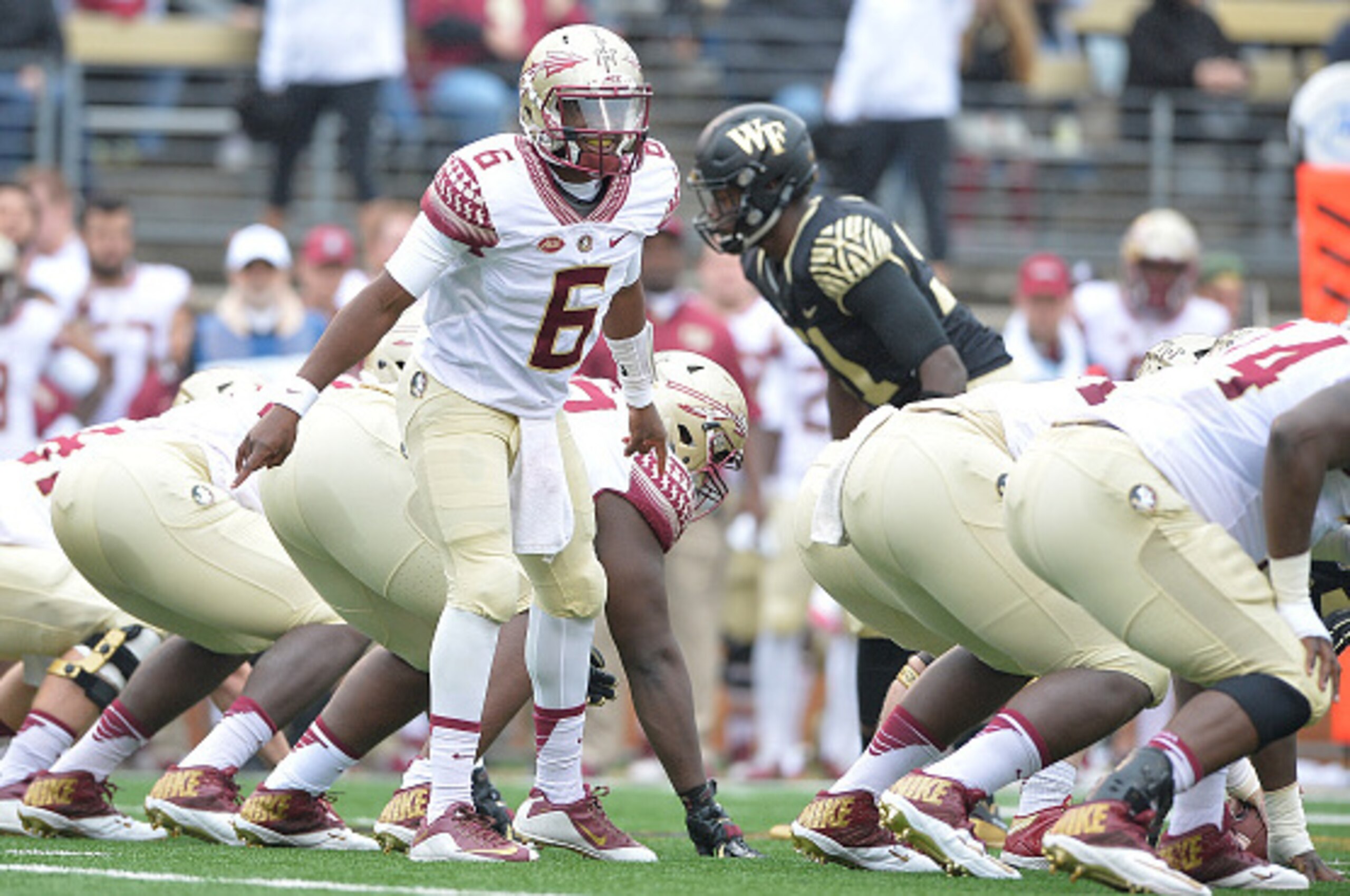
Golson is loaded with tools and potential. He's undersized (6'0", 199 pounds) but mobile and has a cannon for an arm.
As a redshirt freshman, he led Notre Dame to a 12-0 regular season and a spot in the BCS National Championship Game. Some say "led" is the wrong word and that the defense carried the Irish to the title game, but numbers suggest otherwise. According to Football Outsiders' FEI ratings, Golson's offense ranked 12th in the country. Manti Te'o's defense ranked 16th.
No one "carried" Golson to success.
So why, then, did he struggle at Florida State? Because he didn't have ample time to learn the system. Fisher's offense is notoriously complex; even Winston took a redshirt year before assuming the starting job. Golson was asked to start after one spell of fall practice.
Even with lowered expectations, Florida State fans still thought, in the back and sometimes the front of their minds, that Golson would put things together and lead the 'Noles to the playoff. All he had to do was be better than Maguire, but it never became clear that he was.
Dan Wolken of USA Today called it a "bad marriage from the start":
Replacing departed quarterbacks with graduate transfers is a trend that won't go away. After success stories elsewhere—Vernon Adams Jr. and Jeff Driskel in 2015; Russell Wilson in the way-back machine—that's a good thing. With the right scheme and players around them, transfer quarterbacks can succeed immediately.
They just shouldn't be recruited desperately or hailed as saviors. With the wrong scheme and players around them, they can fail to meet previous levels of success. Fit is as important as talent, and sometimes part of fitting is having time to learn the system.
Graduate transfers do not have that luxury.
.png?w=2560)
.jpg?w=2560 "WWE Raw Live Grades 🔠")
.jpg?w=2560 "Chiefs, Steelers Eye WR Trades")

.jpg?w=2560 "Cowboys Handle Eagles on MNF 🤠")

.jpg?w=2560 "🚨Jay-Z Headlining Super Bowl")