Despite the Paradoxical Path, Atletico Madrid Getting to Where They Want to Be
It was a single move that brought them back; them being Atletico Madrid. The old version. The real one.
For 19 minutes against Granada at Los Carmenes, Atletico had continued the theme of their previous 1,260 in the league by being secure but curiously uneventful. Not bad by any stretch, of course, but different, almost unfamiliar. Until it happened.
Atletico had won a corner, and Koke took it. In characteristic fashion, his whipped ball was one of venomous pace and found the well-worn head of Diego Godin. Thump. Netting. Goal. In every way, it was so totally Atletico, a move we'd seen so many times before it was almost as though it had become a perpetually looping Vine ingrained in our eyes.
TOP NEWS

Soccer Stock Check 📈📉

New NFL contenders starting to emerge after Week 4
.jpg?w=2560 "Cardinals Giants Football")
NFL investigating 2 referees for separate viral exchanges
And yet somehow this one felt more significant than most; it struck you that we hadn't recently seen a lot of it.
Little over an hour later, Atletico had secured a 2-0 victory, their fourth straight in the league and sixth straight in all competitions. In those six, Diego Simeone's men had conceded just the solitary goal, and it had been more than a month since they'd last conceded in the league. What's more, they had 32 points—two more than Real Madrid and, by the end of that night, just two fewer than Barcelona.
They were where they wanted to be, but had they gotten there the way they'd wanted to? And were they in the title race?
"We have our own way of fighting for championships," said Simeone when asked about the latter afterward, with the sort of response that is essentially Simeone code for we don't talk about that. But the Argentinian was prepared to engage with the stylistic subject. "It was a very complete game," he said. "Continuing our recent level: Security in our pressing and with the intention to break quickly."
What the manager was describing, of course, was the very Simeone Atletico. The old one, the suggestion being that's who they were and that's who they'd always been. But that wasn't strictly true.
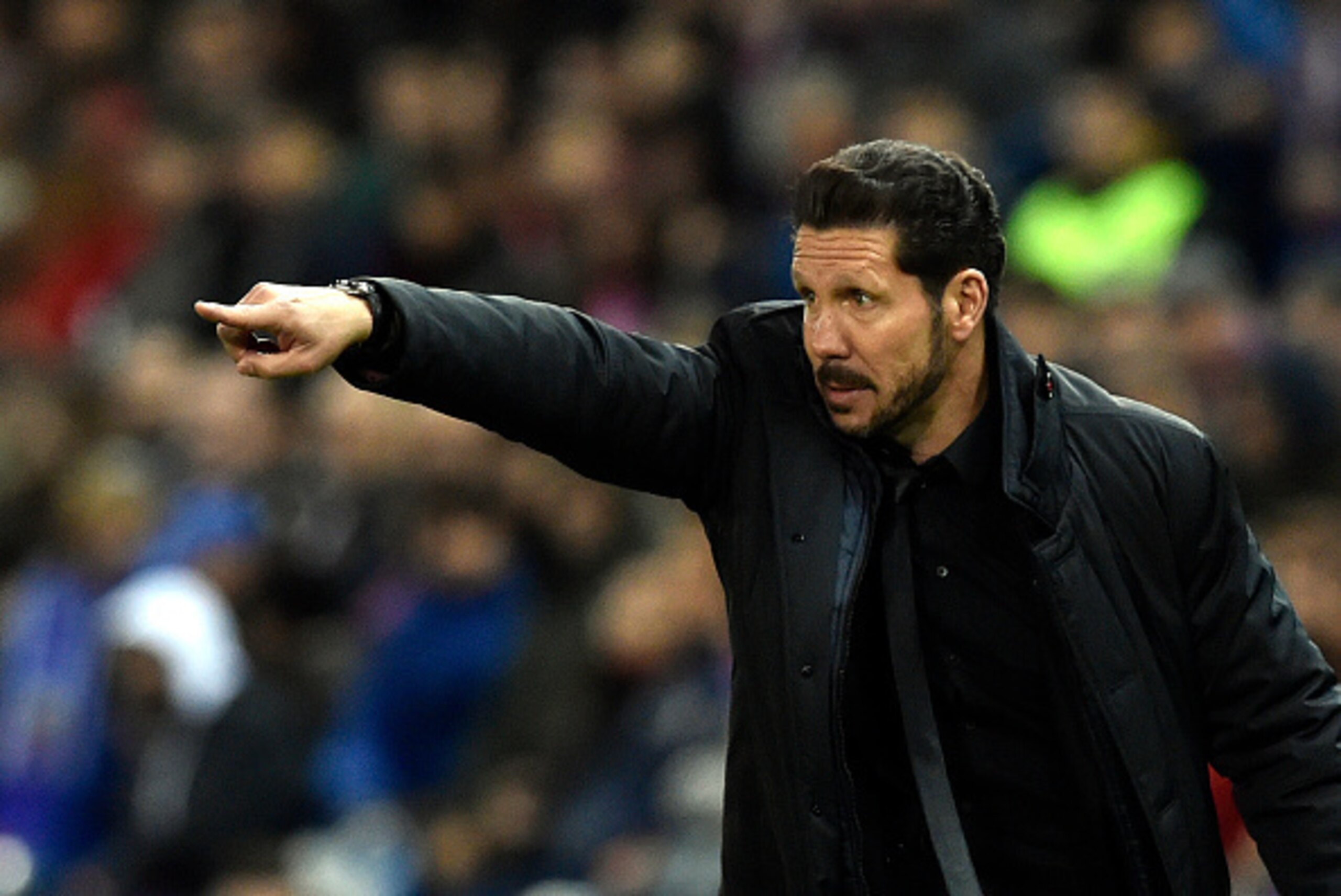
A month earlier, Simeone's men had drawn 1-1 with Deportivo La Coruna at Riazor before trudging through a scoreless stalemate with Astana. At the conclusion of the latter, Atletico had won only three of their previous eight in all competitions, and for the first time in a long time, there was criticism coming their way over style, over goals and over the discrepancy between talent and end product.
The framing of that criticism was essentially: Atletico aren't as good as they should be.
In response, Simeone turned to the concept of identity. "For those who do not know what Atletico have been about throughout history, I remind you that it is working, pressure, counter-attack and strong defence," he said with words that were almost a carbon copy of those he used when he took the position four years earlier. "Those who want to change that go against the history of what Atletico are."
In short, he was saying that the world was wrong to want them to change. But what he'd neglected to acknowledge was that he'd wanted them to change, too.
Back in the summer, Simeone had spoken of changing the team's dynamics and altering their method. They would play faster, in space and with a 4-3-3; Koke would go into the middle and more creative talent would be used. A "new stimulus," said Simeone to AS (h/t Football Espana). An "internal movement."
The squad looked ready for it, too.
In the transfer window, Jackson Martinez headlined an arrivals list that also included Luciano Vietto and Yannick Carrasco. Oliver Torres was also returning from a loan spell at Porto, while the exciting Angel Correa was ready to play after heart surgery. Those retained were just as important, too: Antoine Griezmann, Diego Godin, Jose Gimenez, Jan Oblak and Koke.
Atletico had assembled perhaps the best squad in their history and had spent more than €100 million to do so. Consequently, the expectation, heightened by the manager's words, was that they'd blend their existing characteristics—aggression, physicality, robustness, defensive excellence—with something else. Something more.
The idea was that, between their old selves and glorious football, they'd be some kind of sumptuous halfway point. And so far, a halfway point is what they've been—just not in the way that was expected, and theirs is a path that's paradoxical in a number of ways.

Among the new faces, Martinez has made little impact, and Vietto has scarcely played. Carrasco had fared considerably better but has only added two goals. Ditto for Correa. Ditto for Fernando Torres. Thus, it's the old firm doing the heavy lifting.
As such, despite the vast attacking cast, Atletico have just 20 goals in 14 league games to date. Elsewhere in the division, the more limited Deportivo and Athletic Bilbao each have one more, and Celta Vigo have five more. Perhaps more significantly, though, last season's theoretically inferior version of Atletico had seven more at the same stage. The supposedly ugly, title-winning version of a season earlier had an additional 18.
Indeed, in the opening 14 games of the 2013-14 season, Simeone's Atletico recorded scorelines of 7-0, 5-0, 5-0, 4-2 and 3-1. So far this term, they've gone past two goals in a league game only once.
But why?
In the hunt for creativity and dynamism, it appears that Atletico have found themselves caught not at that sumptuous halfway point but at one further back along the spectrum—an uncomfortable one between their starting point and the one they'd envisaged as their destination. Some of their essence has been missing. Their point of difference hasn't been what it was.
In the summer, the club lost Arda Turan and also sold Mario Mandzukic, Miranda, Raul Garcia and Mario Suarez. The summer before that, they lost Diego Costa.
That's a whole lot of nastiness to say goodbye to—a bucket load of boot-throwing, saliva-spitting, elbow-raising, hard-tackling, dark-arts nastiness, you might affectionately say. As such, have Atletico become nicer? Not nice, no, but nicer? A little less horrible to play against?
It seems that way.
So far this season, Simeone's team are different across the board in a less hostile kind a way. In terms of possession and pass completion, according to WhoScored.com, they're currently at their highest levels since the Argentinian took over. Conversely, they've never committed fewer fouls under Simeone than they are now, while their card count is down on last term as well.
Certainly, such changes will be considered positive by some, evidence that this team is building toward a more expansive method defined by football and not other things. Yet, it's inescapable that, amid the shift, this team are at their lowest point for shots on target in four years.
And then there are the set pieces.

Last season, Atletico's proficiency in dead-ball scenarios bordered on ridiculous. Like, absurd. So often they would land early blows through them, leaving their opponents punch-drunk and susceptible to being physically disintegrated thereafter.
In them, the otherwise awkward-fitting Mandzukic was a focal point, Garcia was a pest and Miranda was surprisingly effective; throw in Godin, Gimenez and Tiago's near-post flicks, and you had a recipe for a very particular type of destruction. Regular destruction, too.
In total, Atletico scored 30 times via set pieces in the league alone last season, Valencia being the only other side to crack 20. But this term, the men from the Vicente Calderon have scored three goals in such a way, less than a third of last season's pace. Eight teams have more, reinforcing the feeling of Atleti being just nice enough to deal with—something that's been apparent since day one.
On the season's opening weekend, Atletico needed a wicked deflection from a free-kick to edge out Las Palmas 1-0. More recently against Sporting Gijon, a last-minute winner was needed to reach the same scoreline; against Real Betis, a lone early goal from Koke delivered it, too.
Three newly promoted clubs, three one-nils: That's Atletico right now. They haven't beaten anyone in the top six, either.
And yet, that's why all of this is so paradoxical: Atletico are second in the table, anyway. Two points off top, they're firmly in a title race that, both statistically and financially, they probably have no right to be in.

Somehow, this is a team that so far this season has developed a contradictory existence and thrived anyway.
Despite wanting to become dynamic, they've grown increasingly dependable. Despite wanting to add explosiveness, they've become more secure. Despite making a clear attempt to become more talented and creative with the ball, they've actually gone to another level without it.
In La Liga, Simeone's men have conceded just six goals—no team in any of Europe's major leagues has conceded fewer—and in all competitions, Oblak has been beaten only once in a month and a half.
In a way, that's difficult to comprehend—the team's indicators in comparison to the original designs are the wrong way around.
As such, Atletico have become different in a peculiar way. They're not quite the old Atletico and they're not quite the new, new Atletico we'd anticipated. They're somewhere in between, which is often an awkward place to be.
But not here, not in this case. They're making it work.
Despite taking the most paradoxical of paths, Atletico Madrid are getting to exactly where they want to be.
They're in the hunt.

.jpg?w=2560 "Hill Injury Update Football")
.jpg?w=2560 "OBJ Calls Out Giants 😳")
.jpg?w=2560 "Tyreek makes another cryptic post amid Chiefs rumors")