Will the Indianapolis Colts Run Game Improve Down the Stretch?
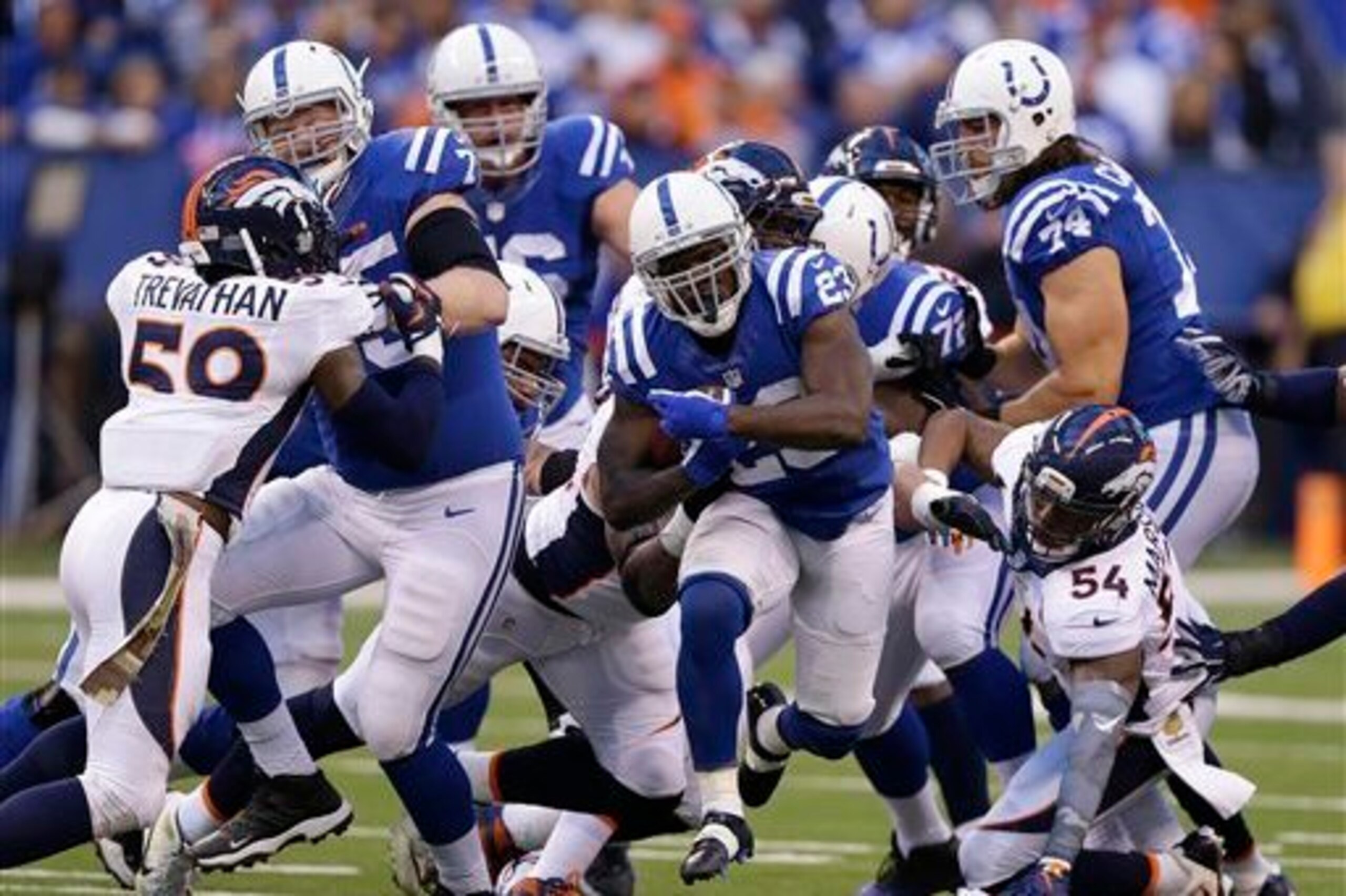
The Indianapolis Colts run game has not been a pretty sight over the last three weeks to say the least.
The news that veteran running back Ahmad Bradshaw had been placed on the injured reserve list, announced on the team's official site on Monday, doesn't bode particularly well either. Bradshaw, the younger of the Colts' two main running backs, lasted just six games before injuries took him down yet again.
Even with Bradshaw, the run game has been putrid over the last few weeks, although the Colts have managed a 3-0 record over that time. The Colts have rushed for a total of 182 yards over the last three weeks but on 80 carries.
.jpg?w=2560 "Raiders Camp Football")
.png?w=2560 "Commanders Camp Football")
No matter how you look at the numbers, it's been pitiful.
| Week 9 | 34 | 86 | 2.53 | 1 | 10 | 29.4% | -18.50% |
| Week 11 | 23 | 66 | 2.87 | 0 | 7 | 30.4% | -54.20% |
| Week 12 | 23 | 30 | 1.30 | 0 | 4 | 17.4% | -60.30% |
| Total | 80 | 182 | 2.28 | 1 | 21 | 26.3% | - |
With such a depressing look in the last three outings, it's hard to find optimism regarding the team's run game. But, when looking closely, we can see specific reasons as to why the run game has struggled so much and why it may pick back up as the season progresses.
It all starts with the opponent.
The biggest factor in the how the Colts' running game, and specifically lead back Frank Gore, has performed has been the opponent.
The Colts have faced seven teams with defenses in the top 10 in yards per carry allowed, including the Jacksonville Jaguars (first), Denver Broncos (second), Tampa Bay Buccaneers (third), New York Jets (fifth), Atlanta Falcons (sixth), Carolina Panthers (eighth) and Tennessee Titans (10th). They've faced just two teams in the bottom 10, including the Houston Texans (23rd) and New Orleans Saints (31st).
Against the teams in the top 10 in YPC allowed, Gore has averaged 3.16 yards per carry but run for 4.8 yards per carry against the other four teams Indianapolis has faced (New Orleans, New England Patriots, Buffalo Bills and Houston).
Looking at the last few opponents, you can see why the Colts have struggled. Carolina, Denver, Atlanta and Tampa Bay have all been able to keep opponents limited in the run game this year. Denver and Carolina are the top two overall defenses in Football Outsiders' DVOA (defense-adjusted value over average) metric, and Tampa Bay is second in rush defense DVOA.
Looking further into the DVOA metric, we can notice a few things.
Against those seven teams inside the top 10 in YPC allowed, the Colts averaged negative-31.2 percent rushing DVOA but averaged 2.0 percent DVOA against the other four teams, per Football Outsiders.
DVOA adjusts for opponent, so this tells us the Colts vastly underperform against good run defenses. While some have tried to paint the recent struggles as offensive coordinator Rob Chudzinski's fault, the truth is the team has been underperforming against good run defenses all season.
The lone exception is the game against Tennessee in Week 4, when Frank Gore ran for 86 yards on over six yards per carry and the Colts earned 56.6 percent DVOA in the run game. But Tennessee is ranked 24th in run DVOA, so perhaps its run defense isn't as stout as the yards-per-carry mark might suggest.
The point here is the Colts offensive line, while decent in pass protection, is very limited in the run game. Good defensive lines can push them around, and the team's lack of ability in space means linebackers often have easy shots into the backfield. The team's scheme and threat in the passing game often gets Gore space against average or poor defenses, but against team's with a stout front seven, the team is playing at a disadvantage.
The other big factor in the team's recent run struggles is Matt Hasselbeck. With Andrew Luck out, opposing defenses haven't respected the pass, particularly the deep pass, nearly as much as they normally would.
It's no coincidence the three worst run performances by Indianapolis this season, by DVOA, came with Hasselbeck at the helm—namely Week 3 against Jacksonville (negative-70.5 percent), Week 11 at Atlanta (negative-54.2 percent) and Week 12 at Tampa Bay (negative-60.3 percent).
Even Week 5 at Houston earned a negative DVOA (negative-10.2 percent). So with Hasselbeck at the helm, the Colts had a negative run DVOA in every game but had a positive run DVOA in four of Andrew Luck's seven games.
This is not a coincidence.
So what can we expect going forward?
The answer is twofold and includes both some positive and negative indications.
To start, the Colts' schedule doesn't ease up, at least not in the run defense department. On Sunday, the team faces the Pittsburgh Steelers, who rank ninth in yards per carry allowed as well as in DVOA. The following week, the team will face Jacksonville (first and fourth respectively). That's followed by a home game against Houston, which has had four consecutive negative DVOA performances (negative is better for defensive DVOA) in both run-defense and overall defensive DVOA.
The team will face the Miami Dolphins in Week 16, 21st in YPC allowed and 25th in run-defense DVOA, before facing an inconsistent Tennessee team in Week 17.
The second part that will affect the run defense is Hasselbeck. The Colts will get Luck back, presumably, in a few weeks but will have to ride with Hasselbeck until then. If defenses continue to play the Colts the way they have, it's unlikely Gore will find any more room to run.
But Hasselbeck had a stellar second half last time out, consistently picking Tampa Bay apart with play-action passes. If he can continue to punish defenses that play downhill, defenses will adjust and Gore might be able to find room to run.
Chudzinski will certainly stick with the run game, even if it's not particularly efficient—the question is whether the results will change.
The Colts view the run game as a larger piece of the puzzle; it's not the main tool to pick up yards and scores but a cog in the machine that greases the wheels.
Just ask Chudzinski, via Stephen Holder of the Indy Star:
"That's the thing. You run the ball for a lot of reasons. One of them is it complements what you do. And certainly, our play action was very effective in the last game. Also, it brings together the drives and helps take time off the clock, keeps the defense off the field, which is important in winning games. Hopefully the effectiveness and production will increase, and I expect that it will.
But we're going to continue to run the ball. We need to run the ball. This is the time of year you have to have an effective run game. … Whether it's the pass game in some games or the run game in other games, being a balanced team and being able to win games in different ways is critical.
"
There is some truth to Chudzinski's words. The run game was certainly a part of Hasselbeck's success in play action over the last two weeks.
But there also needs to be more efficient running going forward. You can't waste 23 downs for just 27 yards and expect to win many games. It happened to work out in Week 12, but it's not a formula that will work often for Indianapolis, particularly with Hasselbeck at quarterback.
Unfortunately, with the upcoming schedule, it doesn't look like efficiency will return unless Hasselbeck is able to keep up his level of play and force defenses to give more-than-adequate respect to the passing game.
For more information on DVOA, check out Football Outsiders' Methods page.
.jpg?w=2560 "Titans Jaguars Football")
.jpg?w=2560 "Vikings Camp Football")

.jpg?w=2560 "Harden Gun Charge Dismissed")