Regardless of Starting QB, Browns Must Center Offense on Duke Johnson
The Cleveland Browns offense has, for the most part, been the only consistently positive aspect of the 2015 iteration of this team. Granted, it's not the most adept at scoring points as evidenced by the 10 they managed (and zero in the second half) in Cleveland's Week 9 loss to the Cincinnati Bengals. But, compared to the defense, the Browns offense seems on a better track.
There have been head-scratching moves made throughout the past nine weeks. One has been the use—or lack thereof—of rookie running back Duke Johnson, the versatile rushing and receiving weapon the Browns drafted in Round 3 back in May.
TOP NEWS
B/R's Expert Week 4 2026 NFL Picks 🔮
The Biggest Disappointments of NFL Season So Far ☹️
.jpg?w=2560 "Falcons Steelers Football")
Rodgers' 75 Hand Signals 🤯
Partially to blame is the Browns' seemingly unfocused use of their running backs. The disappointing Robert Turbin didn't get a single carry on Thursday night, with Isaiah Crowell doing the bulk of the Browns' running, with 10 carries for 38 yards. But nine of those carries came in the first half and only one in the second.
The same went for Johnson on Thursday, with three first-half carries and one in the second. It's much like what happened in Week 8, when Johnson's contributions—one three-yard carry and two catches for 68 yards—were limited to the first half.
The thing is, the Browns seem not to know what they have in Johnson, though his pedigree as the Miami Hurricanes' all-time leading rusher—and prodigious receiver—was well known to all heading into the draft. But, if the Browns can finally focus, and evaluate Johnson for what he is, they have a star on their hands—a star who can be the centerpiece of the offense, regardless of whether Johnny Manziel or Josh McCown is the team's quarterback.
Johnson's usefulness to Cleveland's offense was clear on Thursday night—at least in the first half, until he disappeared again. On his four targets and two catches for 38 yards and a score, he was constantly getting behind Cincinnati's defensive front, leaving only space in which to roam relatively free.
| 59 | 179 | 3.0 | 0 | 42 | 35 | 369 | 280 | 2 |
Johnson in space is dangerous. He leads the Browns with 280 yards after the catch, though he has just 35 receptions for 369 yards and two scores on the year. Manziel didn't necessarily see every instance of Johnson being open against the Bengals, but given his ability to do so, he should be a bigger part of the Browns offense than he currently is.
If Browns running backs coach Wilbert Montgomery really sees Johnson as being capable of having a Thurman Thomas-type career, as he said during the summer, then the Browns need him more involved with the offense. Right now, Johnson has only played 48.2 percent of Cleveland's offensive snaps, according to Pro Football Focus—way too few given his skill set.
Sure, blocking isn't likely to be his strongest suit right now, but that's no excuse for Johnson constantly being pulled from the field for no discernible reason. Pettine explained Johnson's low usage on Friday, and it makes no clear sense:
"When you're not in a rhythm and you're going three and out and if [Johnson's] not getting the ball in those first three plays he's not going to have a lot of production. When you only have seven yards through the third quarter, then halfway through the fourth, I think you could say that about all of our offensive skill guys that there was no production in the second half.
"
Granted, Pettine is not wrong—there was no production in the second half, given that their group of "offensive skill guys" only had seven combined yards of offense into the fourth quarter. But, it was his decision for Johnson to not get the ball on those first three plays that kept resulting in three-and-outs—and it's possible that a few quick throws to Johnson would have prevented at least one or two of those punts, or at the very least extended drives.
Essentially, the Browns chose not to run with or throw to Johnson just because. There's no believable explanation except a poor game plan. But, with Johnson more involved, the Browns offense has a better chance to be a multidimensional one.
Think of Johnson sort of like the Pittsburgh Steelers' Le'Veon Bell. When Bell is on the field, no matter where he's lined up, he can be thrown to, quickly pitched to or handed off to. Defenses need to keep an eye on him. The same can be the case for Johnson— even when he's not the target of the pass or getting the handoff, accounting for him can occupy defenders who could otherwise be deeper on the field in coverage.
This can open up all kinds of passing lanes for other Browns' receivers. Even when he's not making the play, he's helping the Browns make plays.
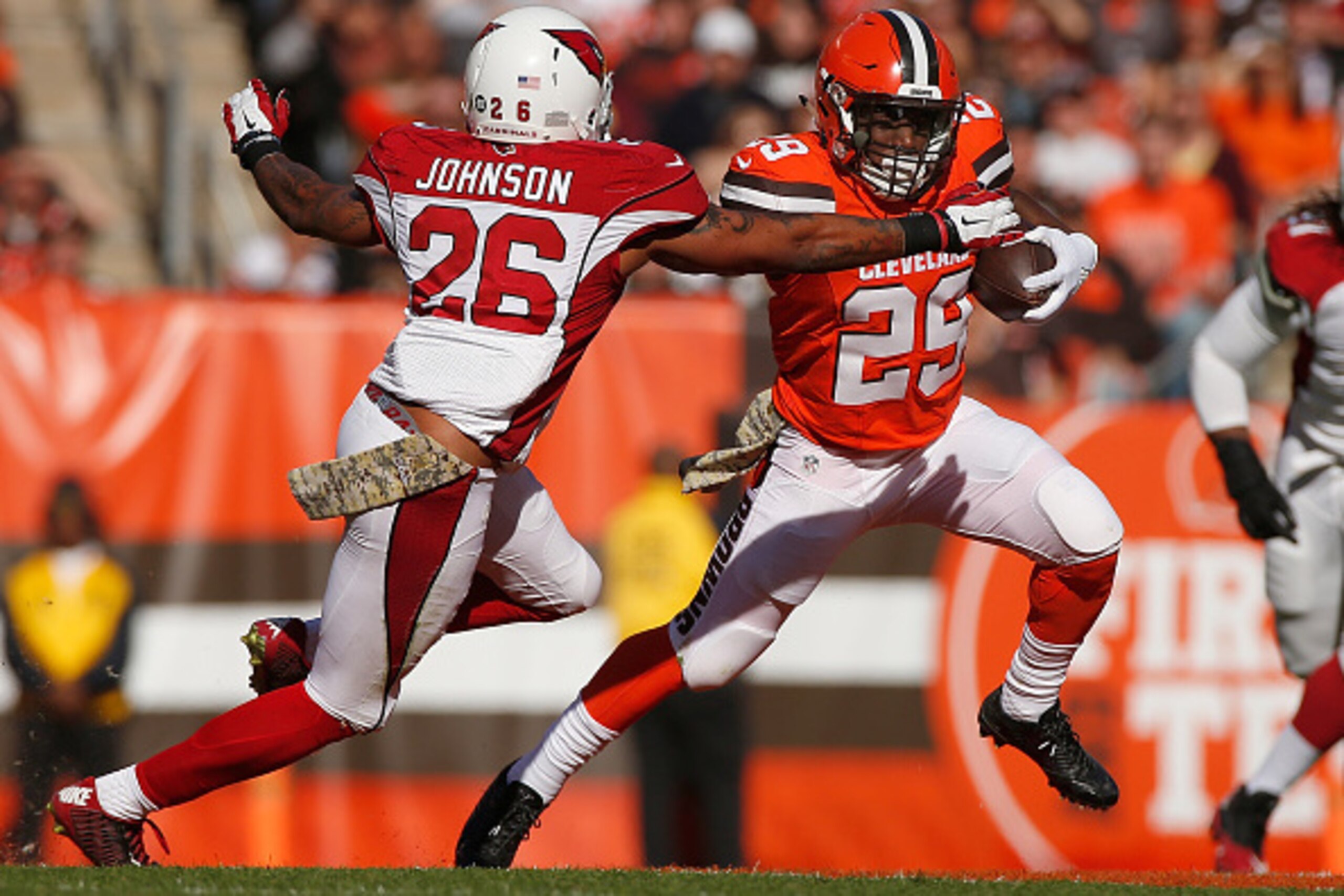
But he's not helping anyone by being on the bench for unknown reasons related to the whims of a coaching staff that just doesn't know what to do with him. In fact, it hurts the Browns to remove Johnson from the game plan when the going gets tough. He should be the one they turn to in these situations.
Johnson can be a valuable weapon to any quarterback the Browns trot out, as compared to players like Gary Barnidge and Travis Benjamin, whose production is often dependent upon which quarterback is on the field. The Browns just have to come to that conclusion themselves.
And with just one game to play in the next 25 days, their upcoming player evaluations that Pettine said are ahead should unearth one important thing: Johnson is a playmaker, and he needs the football in his hands more often.

.jpg?w=2560 "Buccaneers Jets Football")