Isco's Pre-Season Form Giving Rafa Benitez a Conundrum over the BBC
In Madrid debate is growing stronger, questions regarding systems, lineups and pecking orders at the Santiago Bernabeu steadily increasing. At the centre of it lie Isco and Rafa Benitez: The former's performances are stirring the debate, while the latter is charged with the responsibility of settling it.
"The BBC in the shadow of Isco," declared AS during Real Madrid's visit of Melbourne for the International Champions Cup. From the Madrid-based daily, it's just one of a large number of Isco-centric headlines this summer.
"Isco provides the inspiration for a much-improved Madrid," AS wrote after Real's victory over Manchester City. When the team moved on to China, the theme continued: "In-form Isco gets the fans' vote to be Madrid's playmaker," it remarked, its strong tone going on to add, "Benitez's big problem: Bale, Benzema or Isco."
TOP NEWS

New NFL Power Rankings 📊
.jpg?w=2560 "Texans-Mixon Released Football")
Injury-stricken Seahawks signing veteran RB

Coco Calls Out Racist Messages
On other occasions, though, the message has been simpler, more direct: "No Isco, no disco."
The undercurrent to such vocal support is almost as notable as the support itself. AS has been extremely critical of Real Madrid president Florentino Perez, regularly disgruntled not only by Perez's Galactico model but also by the perceived political pressure that is exerted upon the club's managers to prioritise the needs of the marquee signings over all else.
Thus, Isco—a Spaniard, a Bernabeu darling—is viewed as a star needlessly relegated to the status of 12th man or super-sub because of a polarising president. Concurrently, the Galacticos are depicted more as opponents to Isco than team-mates, with AS rarely missing the chance to find fault in Perez's project.
"(Isco's) position is the same as Bale's and that is where he will surely end up if Benitez doesn't bow to politicking," the outlet wrote in its match report of the 4-1 victory over City, commenting on the Welshman's new central role that's been evident in the ongoing pre-season. "(Isco) can also play on the right, but James (€80 million last summer) is ahead on paper," it added, not-so-subtly suggesting that price tags influence pecking orders, the dig aimed more at the broader situation than the outstanding Rodriguez.
The debate has been hotting up at Marca, too. "Isco takes charge," the influential Madrid-based daily said of the 23-year-old last month, more recently adding that "Isco stakes his claim" and that decision time is looming: "Isco vs. James: let the battle recommence."
The playing element to this debate has been the Andalusian's form in Real's summer campaign. Having started four of the club's six games in Australia, China and Germany, Isco's influence in the early stages of Benitez's tenure has been immense.
Against Manchester City, the former Malaga star was probably the best man on the field. Against Tottenham, his work to set up Rodriguez was sublime; against Roma and AC Milan, Madrid significantly improved after his introduction.
Though pre-season games can deceive—unconventional lineups, experimental tactics and heavy rotation benefiting some and hindering others—Isco's case has been compelling.
Simultaneously, Cristiano Ronaldo, Karim Benzema and Rodriguez have missed time at various stages, and Gareth Bale hasn't entirely convinced. In a meritocracy, Isco's name, right now, would be among the first on the team sheet.
Benitez, therefore, is facing a conundrum: How to satisfy the Spaniard while also satisfying the BBC, the Galacticos, Perez?

In theory, the manager's characteristic 4-2-3-1 should better suit Isco than Carlo Ancelotti's 4-3-3. Ahead of a defined six from defence to midfield, Benitez's front four will be a fluid, interchanging quartet, their roles broad and diverse rather than narrowly defined—"the forward players have the freedom to move around and switch positions," Benitez told a news conference after Tuesday's victory over Tottenham.
In such a system, Isco can play anywhere across the "three" and should benefit from being part of a protected, four-man attack that promotes his aggressive instincts, whereas his positioning in a more central trio under Ancelotti heightened his two-way demands.
But squeezing Isco in means pushing others out, the others being Ronaldo, Benzema, Bale and Rodriguez.
The alpha dog, Ronaldo isn't going anywhere. After a majestic first season at the Bernabeu, Rodriguez isn't either. Thus, Isco's competitors, sort of indirectly, are most likely Bale and Benzema, with Benitez's major decision now being how he deploys the vaunted "BBC" while also using his two chief playmakers.
Certainly, Benitez has countless options.
Like Isco, Rodriguez can play anywhere across the "three," and Bale can play on either wing if the central role doesn't work out. Additionally, Ronaldo can interchange between the left and up front, while Benzema's diverse talents give him the capacity to lead the attack as well as to play behind the striker. And Benitez, a known advocate of player rotation, will want to indulge in such interchanges.
Yet—and this is the crucial part—the Bernabeu isn't anything like the Madrilenian's previous stops.
Indeed, Benitez's current bunch represent the biggest names he's ever worked with, the most talented group he's ever had at his disposal. It's a positive for the manager, but also a challenge: Stars like Ronaldo want to be stars, not rotating components.
What's more, their stature sees them exert an implied influence over a coach, which means that rotating them to accommodate Isco won't be easy. And Benitez needs only to look at Luis Enrique's predicament at Barcelona in January for evidence that the rotation of stars at this level is fraught with peril.

So here we are: a Portuguese, a Welshman, a Frenchman, a Colombian and a Spaniard—five attacking stars competing for four spots; three of them in the "untouchable" BBC; one outside that trio a Galactico. And then Isco. The much-adored Isco.
This is where the other element to this debate lies. In 2013, the signings of Isco, Daniel Carvajal and Asier Illarramendi were supposed to represent a renewed commitment to Spanish talent from Real, the club so long defined by its expensive imports. Just two years on, though, the team's Spanish identity is waning.
In goal, Iker Casillas has departed, with Costa Rican Keylor Navas currently his successor. At right-back, Carvajal's place is under threat due to the sheer sum of money handed over for Brazilian Danilo, while Illarramendi feels like an afterthought in midfield. Without Isco, Real Madrid's starting XI might feature just a single Spaniard, Sergio Ramos.
To some, citing such a situation as an issue may sound xenophobic, and in a portion of the fanbase a prejudice will undoubtedly exist, just as it does elsewhere. But for most it won't be that.
Real Madrid fans, like those of any other side, want to feel a connection to their club, a sense that its identity is representative of its community—that Real Madrid's identity lies in Madrid and Spain. Remember that at a Copa del Rey clash last year, the sight of the homegrown Jese warming up on the sideline drew a bigger applause than the team's goals that evening.
It's this which is central to the Bernabeu's appreciation of Isco. Young, Spanish, full of hunger, his commitment unquestioned, the often dazzling technician evokes something in fans (and local media) many of his team-mates can't, his name so regularly heard ringing around the famous footballing address in a universal chant: "Isco, Isco, Isco."
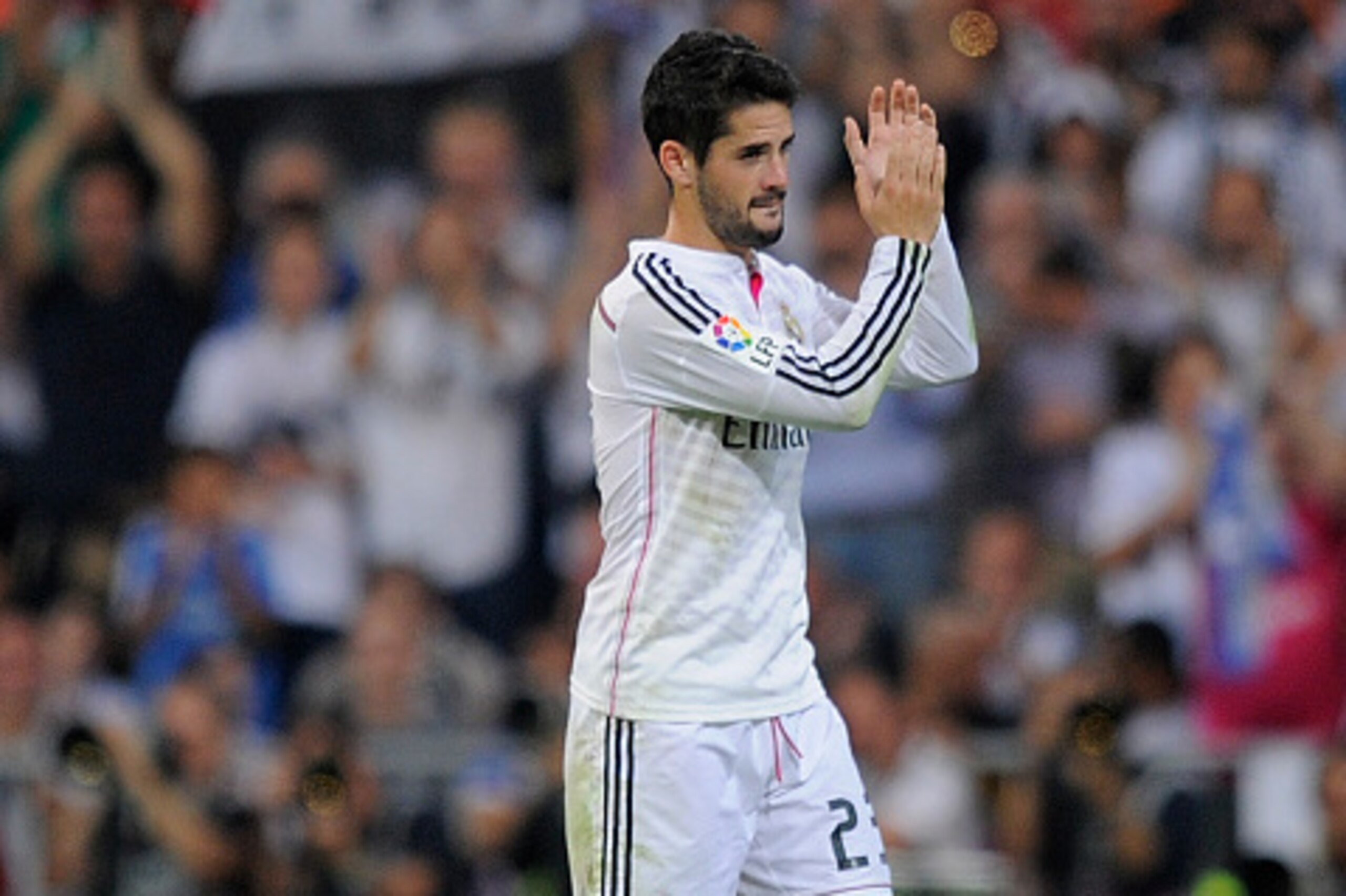
In a sense, it's a situation that's positive for Benitez. Having players on the periphery of the XI knocking down the door for a starting place promotes healthy internal competition. But at Real Madrid, such circumstances can be problematic; the demands are different than they are elsewhere.
Right now, Isco's form demands his own inclusion in the XI. Additionally, the Bernabeu demands Isco. The Madrid press demands Isco. But Benitez, mindful of his own job security, will know he can't afford to satisfy the demands at the expense of the BBC, the Galacticos.
So it's five stars and four spots: A conundrum Benitez is likely to face all season, with Isco's current form only serving to make the manager's choice significantly more difficult.
.jpg?w=2560 "Rams Eagles Football")
.jpg?w=2560 "Commanders Eagles Football")


.jpg?w=2560 "Mahomes' Wife Trolls Kubiak 💀")