Premier League Tactics: What to Watch at Manchester City This Season
The Premier League season is, amazingly, upon us. On August 8, fans will gather for their well-rehearsed rituals ahead of the weekend's ultimate treat: competitive football's return.
Manchester City finished 2014-15 with six straight wins, but that run simply papered over the obvious cracks that grew ominously across the campaign. Ultimately, many are surprised Manuel Pellegrini kept his job, and the pressure is on for him to rekindle the fire in his players' bellies.
Two major signings have set the club back just shy of £60 million, but all other transfer moves have involved shedding deadweight off the bill and acquiring youngsters with potential to mould. It's largely the same squad that dropped out of the title race alarmingly early last term plus two additions who, in global terms, are not yet world-class performers.


In 2013, the Manchester City board told Pellegrini to "win five trophies in five years," per the Guardian. He bagged two in his first season, earning himself some breathing room, but the pressure's back on as he enters year three in search of the third.
Here, B/R analyses City's summer preparation so far and straddles the big questions: How will they line up, what's changed, how will the new signings be incorporated and where are the areas for concern?
1. 4-3-3 to Reignite the Midfield?
With Edin Dzeko seemingly off to Roma, per Sky Sports, and Stevan Jovetic already confirmed as an Internazionale player by his new club, a changing of the guard (of sorts) has occurred up front. Manuel Pellegrini has slimmed down his strike force while bolstering his midfield, therefore changing his side's basic formation.
The 4-3-3 has been out in force during pre-season—at least to start games, anyway—and it seems as though that's the shape City will carry into the new Premier League campaign. Under Manuel Pellegrini, we've seen 4-4-2 and 4-2-3-1 prioritised, but rarely have we seen 4-3-3 given a proper run.
That changes here.
The back four will operate as normal, though City fans will be praying Vincent Kompany refinds form and that £40 million man Eliaquim Mangala sorts himself out. If City go through another season with Martin Demichelis as their best and most reliable centre-back, they're not winning that title.
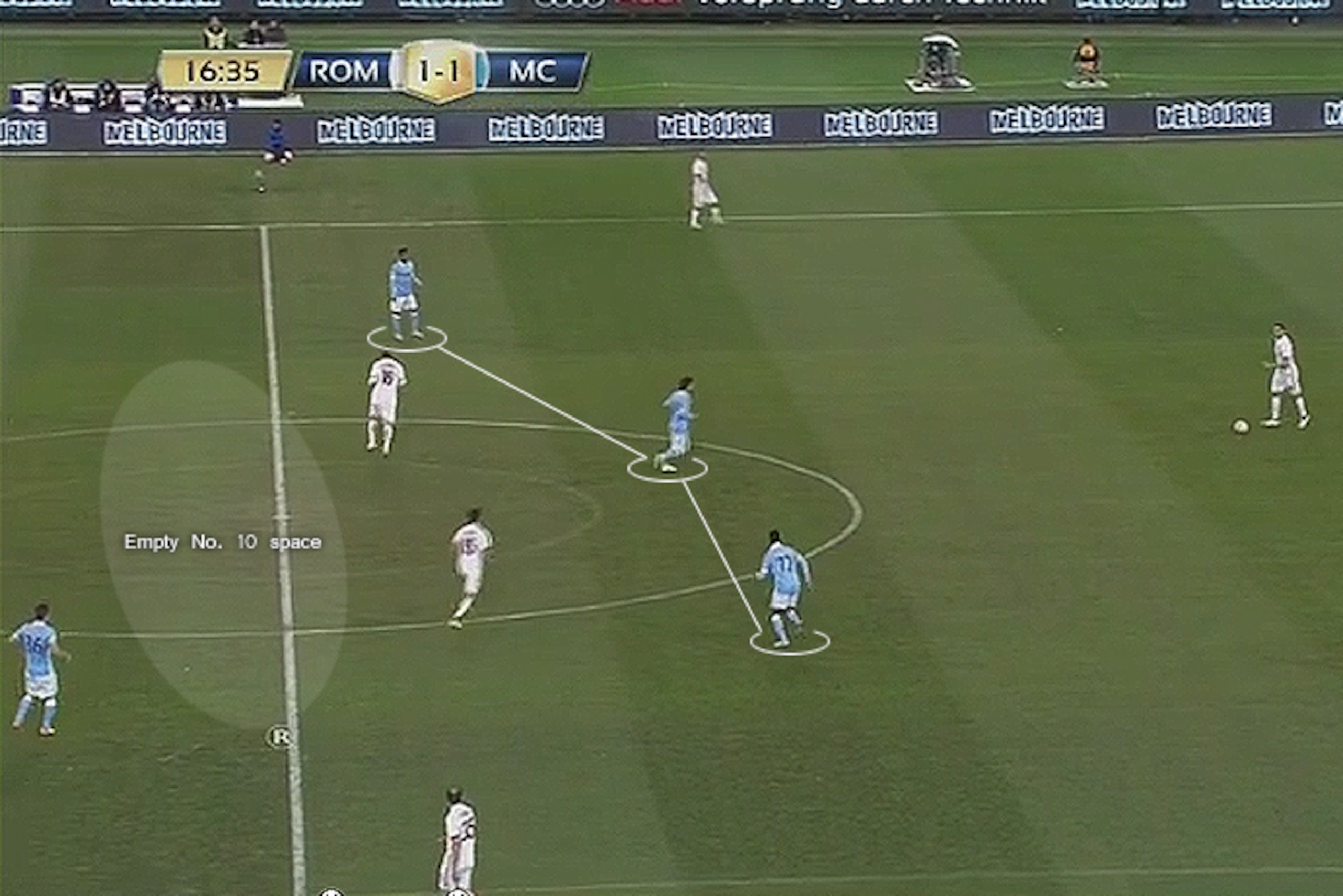
Fernando has been shown preference as the anchor in pre-season, though that may be partly down to Fernandinho's involvement in the Copa America, forcing a late return. He's the best dedicated holder at the club, and while an inconsistent 2014-15 has perhaps created a false perception of his abilities, should he rediscover his FC Porto level, he'll be suffocating playmakers weekly.
Fabian Delph is a perfect fit for the left-centre-midfield role in the 4-3-3, utilising burst and box-to-box energy in order to impact at both ends. He can share with Fernandinho as they vie for the spot alongside the team's talisman: Yaya Toure.
Free from international concerns, many associated with City hope their Ivorian star can bounce back from a disappointing 2014-15 campaign. With talk of birthday cakes firmly shelved, perhaps the 32-year-old can get back to his barnstorming, destructive self.
Perhaps it's a coincidence, but it feels like Pellegrini has opted for a 4-3-3 in order to boost his midfield and coax it back to form. He's got four senior players who suit the system down to the ground, and Delph will add intensity to the group and perhaps spark something we didn't see last term.
Samir Nasri has made appearances in that flatter midfield role during pre-season, too, indicating he's being considered in a deeper role as well as a rotational option on the flank.
2. 4-2-3-1 as the Fail-Safe
Of course, the 4-2-3-1 is never far away when it comes Pellegrini and City, and even in pre-season, despite the telegraphed lust to move to 4-3-3, mid-game switches have seen the 4-2-3-1 restored.
It's been a go-to play for many a City manager in recent history, as moving back to that shape places two of the club's best players into what is arguably an even more dangerous position. David Silva and Yaya Toure, slated to start wide and deep respectively in the 4-3-3, can be pushed into a more prominent role if there's a pressing need for it.
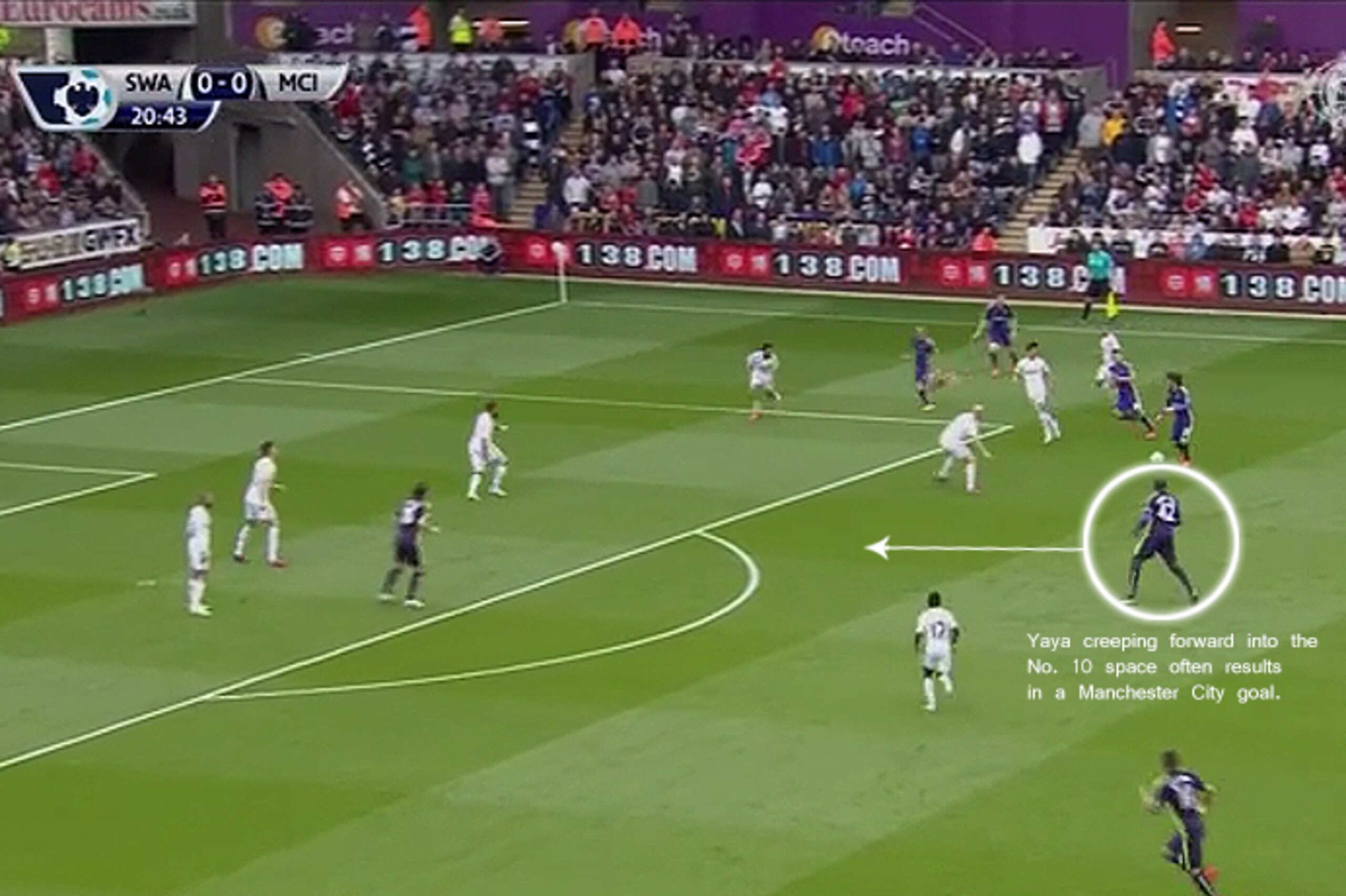
Yaya pushing forward has its obvious effects: get him closer to goal and that muscular physique does more damage and those rapier-like long shots become more accurate. Fans will recall a certain watershed moment at St. James' Park back in 2012, when Roberto Mancini pushed him into the No. 10 role and was rewarded with two goals that all but sealed the title.
Sliding Silva inside increases his effectiveness—though he comes in off the flank anyway, so it does only change his starting position—and he represents a more delicate option when City are chasing the game. His absurd reverse passes and tricky qualities rise to the fore nine times out of 10 here.
It's still a one-striker formation, but it ramps up the pressure on the opposition by flooding the spaces between the lines and gives the spare opposing centre-back a runner to worry about. There's also the option of going 4-4-2—something Pellegrini is perfectly happy to do—but pushing Yaya up can have just as much of an effect as bringing Wilfried Bony on.
3. The Three Musketeers
As discussed, Dzeko is going and Jovetic is gone. The forward corps currently stands at Sergio Aguero, Bony and Kelechi Iheanacho, and Pellegrini looks quietly very pleased with that trio.
Aguero is arguably the best player in the Premier League, and when you boast that luxury in a forward position, you're going to be a serious threat in every game. The Argentinian is the undisputed No. 1 striker in City blue—not even £25 million man Bony would contest that notion.
Bony joined in January and barely got started. He endured a frustrating Africa Cup of Nations campaign on a personal level despite the Elephants winning the competition (finally), and came back tired like Toure. It left him on the outside looking in as others received more minutes. With a pre-season under his belt and time to settle, however, he stands to make a much bigger impact as a rotational player in 2015-16.

Iheanacho is the new name, and those who don't concern themselves with youth football (or hail from Nigeria) may be unfamiliar with him. Per the Manchester Evening News, Pellegrini indicated late last season that he planned to incorporate the youngster in the senior side for 2015-16, and true to his word, he's given him plenty of time to impress in pre-season.
B/R's Hidden Gems piece took a closer look at his talents, and so far it seems as though he's taken everything on board while training with the seniors; he's always been an instinctive No. 9 who makes good runs, finishes emphatically and uses his physique well, but now he's dropping in and linking play like Bony, too.
These three options for Pellegrini are perfectly balanced from a stylistic perspective—he's got the agility and nous of Aguero, the bulk and reliability of Bony and the well-rounded promises of Iheanacho to call upon.
Moving Dzeko and Jovetic on and trusting the Nigerian with the third striker slot is a bit of a gamble given they're one injury from playing him quite a lot, but Pellegrini knows a good striker when he sees one, so Iheanacho must be capable and ready.
4. Incorporating Raheem Sterling
Manchester City have made just two first-team signings so far this summer, dropping £8 million (a pittance) on Delph and £49 million (a lot) on Sterling. It's the latter who will attract the most scrutiny in terms of footballing ability, as the fee paid creates demand for return.
We feel extremely safe in predicting Sterling waltzes into this starting lineup, likely lining up from the right side in the 4-3-3's front three. He could play from the left, too, but Pellegrini loves his natural width—hence the repeated attempts to spark Jesus Navas back into a footballer—and should love what Sterling brings.
A front three of Silva-Aguero-Sterling is spine-chilling for defences; how on earth do you even begin to contemplate stopping that? Game-planning against City used to be so easy under Mancini and his three No. 10s clogging the central zones, but now, with an appropriate measure of guile, pace and hawk-eyed finishing, they're a menace.

Sterling's pace and quickness could transform the manner in which the Citizens attack, which has become steadily more laboured as the side have aged year on year. His directness and the threat he offers in behind gives the club's slick ball-players a run to aim for, and Sterling's decision-making is already at a pretty high level. Those who suggest we don't yet know if he's Arjen Robben or Aaron Lennon clearly haven't been watching properly.
He'll need to improve on his finishing—a tangible weakness in his game—as that deft one-on-one conversion three minutes into his (pre-season) debut was the exception to the rule.
At Liverpool, whichever position he played, he consistently buckled in front of goal. He missed three clear-cut chances in a 3-0 loss at Old Trafford in December 2014 and once dribbled around five players before passing the ball harmlessly into the goalkeeper's arms from about six yards out.
5. Full-Back Concern
At the beginning of the 2014-15 season, City had the best stall of full-backs in the league. On the left, Gael Clichy and Aleksandar Kolarov; on the right, Pablo Zabaleta and newly signed Bacary Sagna.
But fast-forward 12 months and there are concerns to raise over all four: Clichy's slowly regressing, Kolarov's struggling defensively, Zabaleta faces another fitness hangover due to international football and Sagna struggled to spark in his debut campaign. They're all 29 years of age or older, with Sagna at 32 and unlikely to improve.
Clichy has carved out a career at the top level but has largely benefited from being a "pretty good" outlet in a position exceptionally difficult to fill. Blessed with recovery pace, Pellegrini often prefers him in the big games because he can mop up and match wingers yard for yard.

Kolarov will have targeted pre-season as a chance to prove himself capable of a full-time role, but he struggled even in his attacking duties at times. Sagna could perhaps stake a claim as a steadier option on the right, but Pellegrini never gives him the run of games required, consistently reintroducing Zabaleta, hoping he'll kick into form.
A real feature of the modern, successful Manchester City has been attacking full-back play; the sight of Zabaleta powering forward has become as synonymous with goals as Toure's piercing runs and Aguero's neat finishes.
Is this the season that element falls away?
Projection
Manchester City are well in with a chance of winning the title this season provided they avoid the mental and physical collapse of last term. Their African contingent won't have to worry about midseason commitments to international football, and the XI is stronger for the introduction of Sterling.
In him and Delph, Pellegrini has added the key ingredient City were crying out for this summer: pace. As the squad has aged, the intensity has dropped; any directness and quickness has evaporated from the team's approach.
Familiar and well-worn platitudes over Aguero staying fit will be recycled again this coming week, but they ring just as true as ever. Last season's top goalscorer in the Premier League can lead the Citizens to glory if he avoids strains, tears and tweaks.


.jpg?w=2560 "Report: Darnold Could Miss 3-6 Weeks")
.jpg?w=2560 "Week 2 Start 'Em, Sit 'Em Decisions")