

Enes Kanter's Max Offer Sheet a Head-Scratching Move for Portland Trail Blazers
On a scale of "puzzling" to "totally confusing," the Portland Trail Blazers' handing Enes Kanter a max offer sheet ranks as wholly and inexplicably baffling.
And yet, according to NBA.com's David Aldridge, the Blazers have handed Kanter a max offer sheet anyway:
TOP NEWS
Jokić Pops Out at CU Game 🦬
Watch: LeBron's 1st 76ers highlights

NBA Power Rankings Entering Preseason 🔢
Before we start ripping off expletives or typifying our bewildering dissatisfaction through emojis (trust me, that's a thing now), let's first entertain the possibility of Portland trying to mess with the Oklahoma City Thunder.
The Thunder have maintained all along that they will match any offer sheet Kanter receives, a stance general manager Sam Presti reinforced upon hearing of the big man's dalliance with the Blazers, per the Oklahoman's Anthony Slater:
If that is indeed how the Thunder feel, they're unlikely to be deterred by Portland's handsome gesture. After all, Vincent Goodwill of CSN Chicago already has them dangling a lucrative offer of their own:
As a fellow member of the Northwest Division, Portland might just want to ensure Oklahoma City pays as much as legally possible to retain Kanter. The Blazers have a ton of cap space after losing LaMarcus Aldridge and Wesley Matthews in free agency, and they don't have to worry about tying up that spending power for 72 hours as the Thunder decide whether to match. The pool of other available players is almost entirely drained.
It's a gutsy gamble for sure. But the potential payoff is huge if the Blazers are looking for the Thunder to sell off some of their spare parts in order to duck the luxury tax.
Grantland's Zach Lowe explains further:
In other words, the Blazers better hope the Thunder match, lest they be stuck with an unwanted and unneeded max contract on their ledger for the next four years.
Unless, of course, they really want Kanter—in which case they better still hope Oklahoma City matches.
Kanter isn't worth a max contract to any team, especially the Blazers. They cannot, in good conscience, justify spending $70 million on him, not even when the salary cap is set to hit $89 million for 2016-17 and $107 million for 2017-18.
Ed Davis, Chris Kaman, Meyers Leonard and Mason Plumlee are already on the roster. Signing Kanter would give the Blazers five towers, four of whom need to exclusively play center.
Leonard is the only one fit to play power forward. Kaman's baby jumper lets him soak up time at the 4 in a pinch, but he isn't a long-term solution.
Forcing any of those five to masquerade as a power forward only takes playing time from Noah Vonleh anyway. He will be just 20 years old when the season starts and has drawn comparisons to Chris Bosh. He isn't someone the Blazers should chain to the bench.
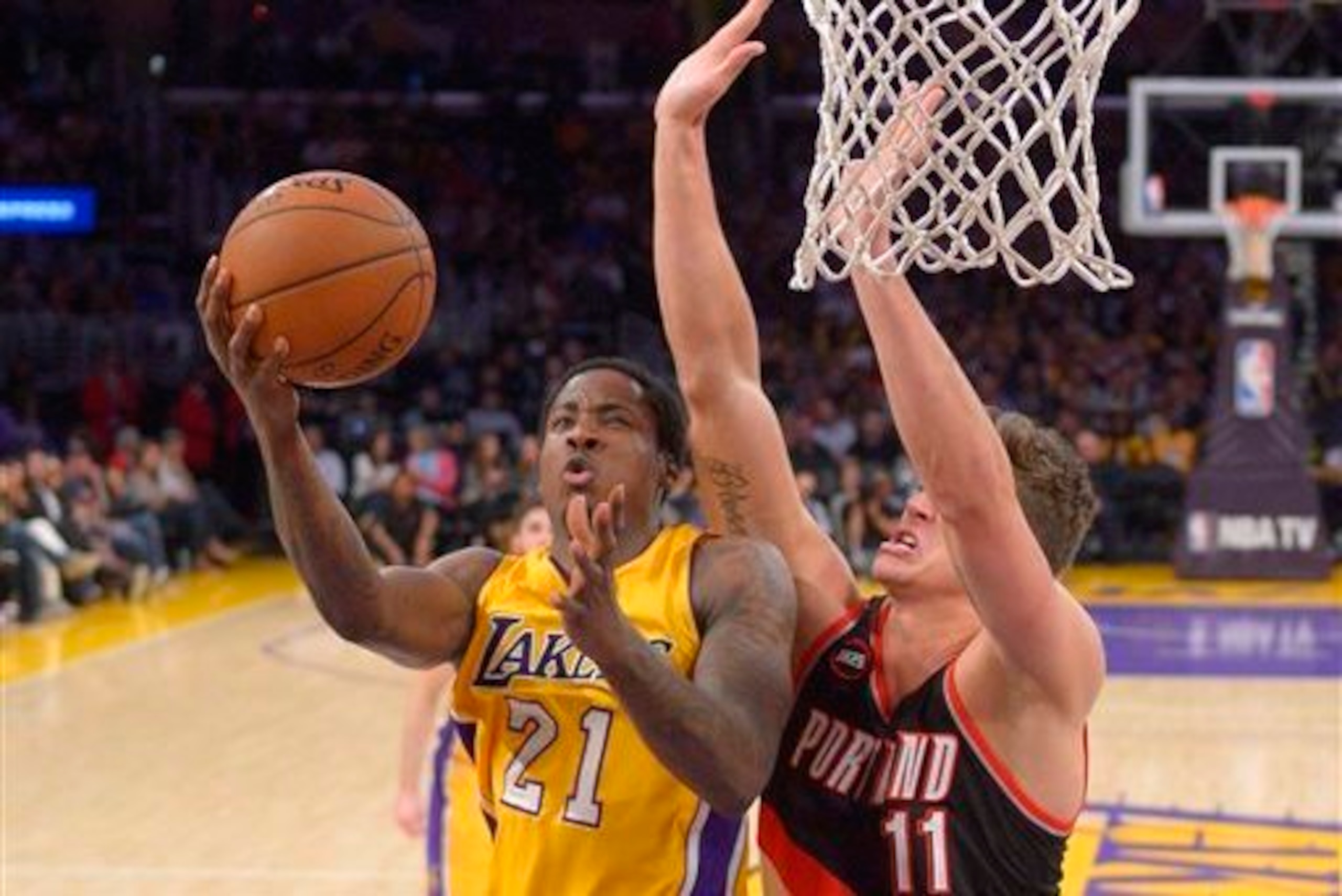
More than that, Kanter's on-court limitations make him a liability in any contemporary system, even if he's jumping center. The 18.7 points and 11 rebounds he averaged through 26 games in Oklahoma City are flashy, but there isn't much more to him than what we've already seen.
Utah Jazz head coach Quin Snyder tried turning Kanter into a stretch 4 before he was shipped out at the trade deadline, and the experiment failed. He only thrived in Oklahoma City because the Thunder had the roster flexibility—read: injury bugs—necessary to stick him in the paint without ever expecting him to leave.
Nearly 77 percent of his total shot attempts came inside 10 feet of the basket in Oklahoma City. That only flies when he's allowed to play center and is surrounded by shooters. And shooters aren't commodities the Blazers have in excess anymore (miss you, Wesley).
Indeed, the Thunder offense was a net plus with Kanter. But Oklahoma City was a net negative with him overall, and there's little point in tailoring an offense to meet the inflexible needs of a defensive sieve.
Opponents shot 56.9 percent at the rim when being defended by Kanter. That ranked in the bottom five among all players who contested at least five point-blank opportunities per game.
Of the Blazers' other bigs, Leonard is the only one who's similarly porous around the iron:
| Chris Kaman | 6.2 | 52.9% |
| Ed Davis | 5.3 | 53.9% |
| Mason Plumlee | 6.4 | 55.5% |
| Enes Kanter | 5.6 | 56.9% |
| Meyers Leonard | 1.2 | 62.7% |
This isn't just an around-the-rim thing either. Kanter is, unequivocally, a bad defensive player. He cannot guard ball-handlers off the dribble, and his verticals make for terrible block rates.
Through the first four seasons of his career, he has sent back 1.6 percent of all the shots he's faced. That gives Kanter one of the 20 worst block percentages in league history among all players, 6'11" or taller, to log at least 5,000 minutes through their initial four campaigns.
That both the Jazz and Thunder were much better defensively without him, then, is hardly surprising. It's par for his career's course, as the fine folks over at Basketball-Reference.com show:
So, um, why are the Blazers prepared to give Kanter $70 million?
It's not because of his offensive range, and it sure as anything isn't for his defense.
Could it be the possible pick-and-roll synergy between him and franchise point guard Damian Lillard?
Nope.
Kanter averaged a combined 0.97 points per pick-and-roll possession as the roll man while in Utah and Oklahoma City. That would barely rank in the 50th percentile of the entire league. He isn't going to come in and anchor a pre-eminent pick-and-roll-packed offense.
Perhaps, then, the Blazers are banking on a stark upswing in the coming years. Kanter is still only 23 and has averaged more than 16 minutes per game just twice. The player he is now isn't the one he's necessarily destined to remain.
But like Matt Moore of CBS Sports underscores, there's no guarantee he morphs into a modern-day-friendly behemoth either:
"Kanter can improve. Maybe he’ll become a solid defender and an elite post presence and be part of the Big 4.
— Hardwood Paroxysm (@HPbasketball) July 9, 2015"
"However, there’s also a good chance that none of that happens. You have to make the call based on what we know right now.
— Hardwood Paroxysm (@HPbasketball) July 9, 2015"
So, one more time: If you're the Blazers, why would you offer Kanter $70 million?
You wouldn't.
And that's the problem.
Stats courtesy of Basketball-Reference.com and NBA.com unless otherwise cited. Salary information via Basketball Insiders.
Dan Favale covers the NBA for Bleacher Report. Follow him on Twitter: @danfavale.

.jpg?w=2560 "Commanders May Change Logo 👀")

.jpg?w=2560 "Seahawks Have No Plans to Move")