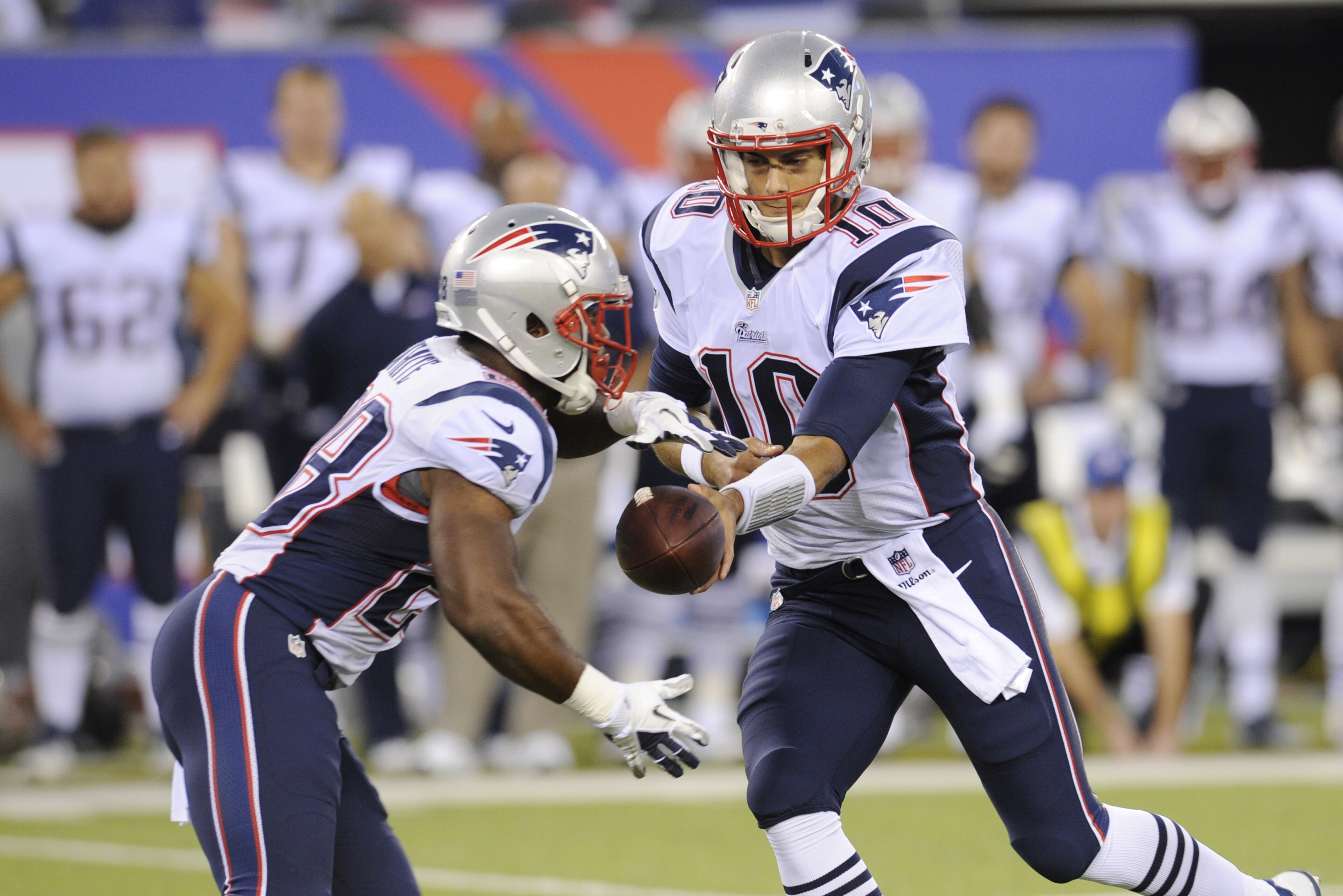

Who Are New England Patriots' Biggest Wild Cards Entering 2015 Season?
The most critical play of Super Bowl XLIX involved a 2014 undrafted rookie beating a 2011 undrafted rookie to a spot on the goal line. While the New England Patriots were on the winning end of that Malcolm Butler-Ricardo Lockette exchange, the play illustrates how it's impossible to determine who will play the leading role at a game's most critical juncture.
So although the likes of Tom Brady, Rob Gronkowski and Jamie Collins will hold the biggest stakes in the success of the 2015 Patriots, we also need to keep the high-variance wild cards in mind. Last year's champions were fortunate to see Bryan Stork, Brandon LaFell and midseason signing LeGarrette Blount thrive in unexpectedly large roles to keep the machine humming.
TOP NEWS
.jpg?w=3840 "Pro Bowl Football")
Watch: Jerry Rice Chases After Heckler
Most Improved NFL Defenses 📈
.jpg?w=3840 "SEMANA 10-PANORAMA")
Fantasy Football Busts You Need to Avoid
Offseason work has just gotten underway, so we can't really know which borderline players will be put in those roles this season. However, the following trio are among the most interesting potential starters, with the ability to become reliable cogs but also the combustibility to play their way onto the bench or even off the roster entirely.
James White
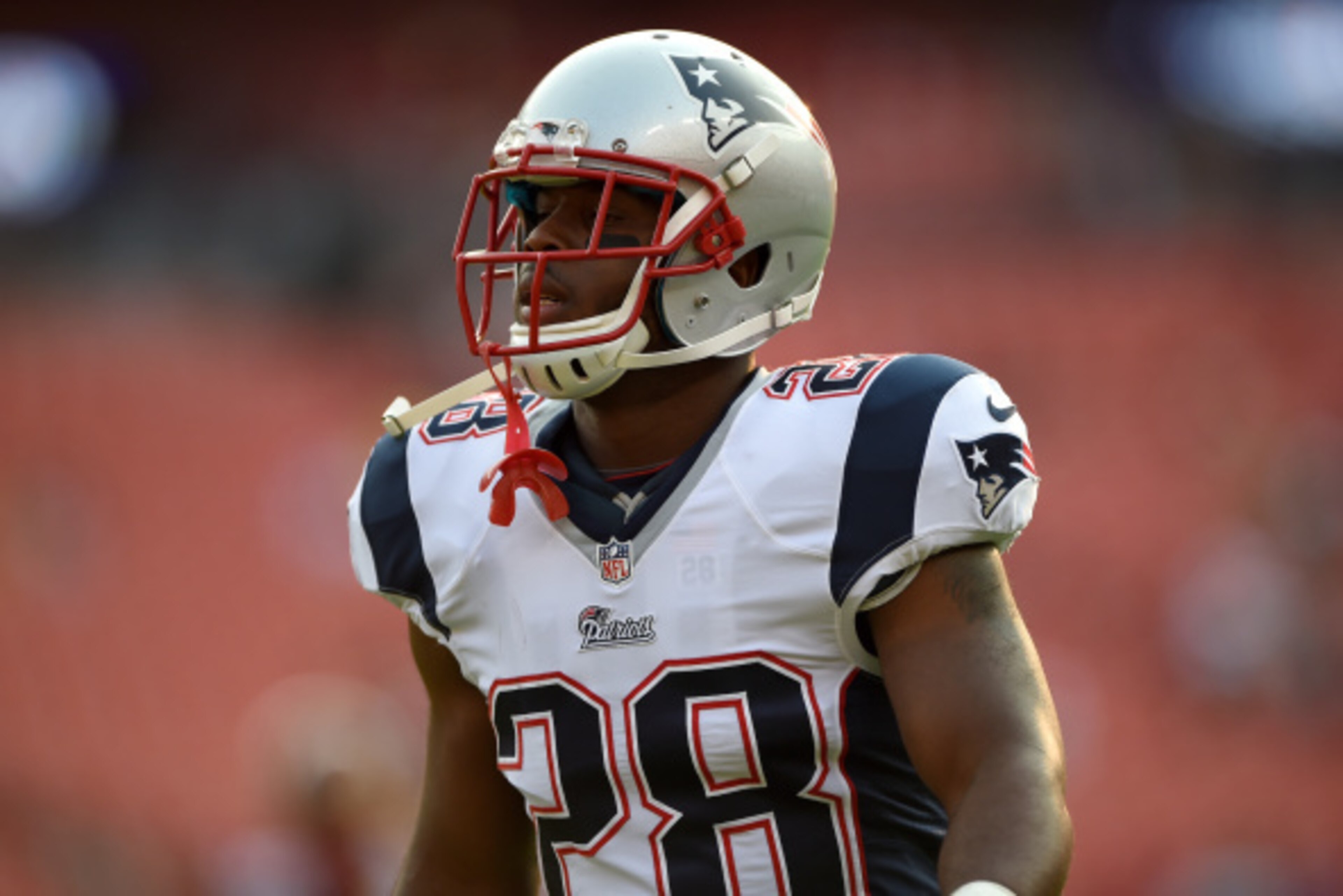
The Patriots showed a lot of faith in their mostly untested backfield this offseason, letting co-starters Stevan Ridley and Shane Vereen leave in free agency while also passing entirely on a deep running back draft class.
James White stands as arguably the biggest beneficiary from that organizational faith, as the 2014 fourth-rounder should see a huge uptick in involvement after compiling just 14 total touches over three games his rookie season.
Seen as a receiving back out of Wisconsin, White won't simply inherit Vereen's old role. Free-agent signee Travaris Cadet was rather impressive in limited touches last season for the New Orleans Saints, and I've actually penciled in the fourth-year veteran as the passing back in early roster projections. Of course, that's a tentative guess at this point, and White does have the advantage of a year in New England's system.
The Pats would surely love if White undertook the same career path as Vereen, who also played sparingly his rookie season (15 total rush attempts). In fact, based on their predraft combine measurables and times, White and Vereen were eerily similar prospects when they first arrived in Foxborough:
| Height | 5'10" | 5'9" |
| Weight | 210 lbs. | 204 lbs. |
| 40 Time | 4.55 sec. | 4.57 sec. |
| Vertical Jump | 34 inches | 32 inches |
| Broad Jump | 9'7" | 9'6" |
| Short Shuttle | 4.28 sec. | 4.20 sec. |
| Three-Cone Time | 6.95 sec. | 7.05 sec. |
Vereen made significant improvements in his pass protection to get on the field, and White needed a year to develop the strength necessary to pick up front-seven rushers. To refresh your memory (and mine as well) on White's game, I went back on the handy site Draft Breakdown to watch two of his senior-year games against Illinois and South Carolina.
Since we're thinking about him as a potential Vereen replacement, I watched for plays that might translate well to White's role in the passing game. The clearest plus for White is his open-field elusiveness. The lateral agility is a nice asset that should help him create leverage on routes and accelerate away from linebackers in coverage. Multiple times, White juked defenders out of their shoes en route to huge gains:
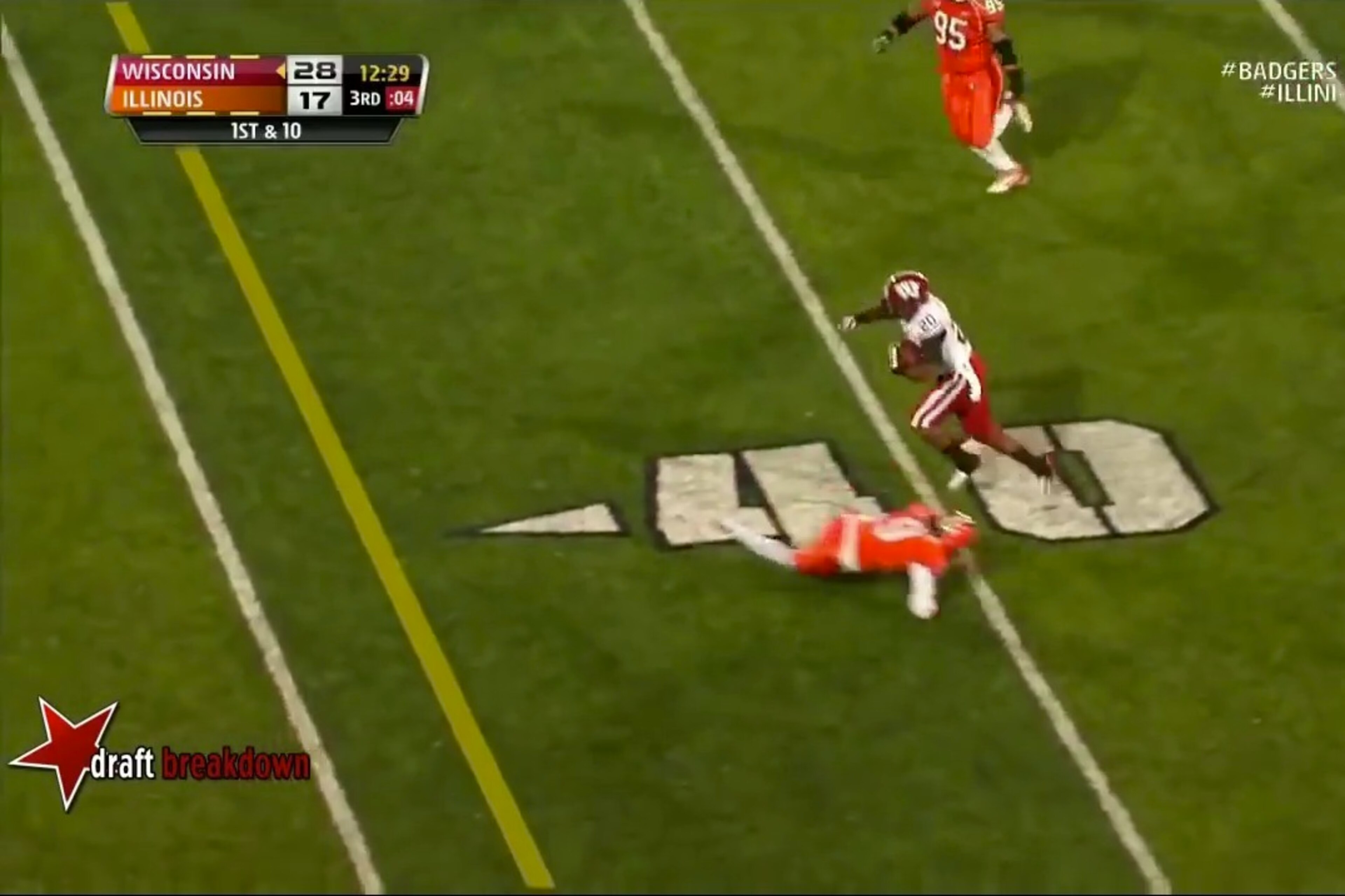

However, I also never saw him run any real routes apart from one swap boot concept against Illinois. Wisconsin treated White like a normal between-the-tackles rusher, and his contributions in the passing game were mostly limited to checkdown leaks out of the backfield.
The pass protection issues are also uglier than one might imagine, as White's blocks were usually awkward shoulder thrusts, like this one on Jadeveon Clowney:

In hindsight, perhaps it's less surprising that he played sparingly in 2014.
Quite simply, White needs to develop into a different kind of running back than the one he was at Wisconsin. Though he wiggled his way into extra yardage on occasion, White typically took whatever yardage the offensive line created for him. That's great for the Badgers, who always have an endless buffet of quality blockers on their roster, but it meant a larger learning curve for White.
And that's fine considering the season Vereen turned in last year. Vereen himself never matched the 39-catch season White posted in 2013, topping out at 27 catches during his time at Cal. And while Vereen became a chess piece who lined up all over formations to generate mismatches, his receiving game still relied on his quickness and ability to slither away from slower defenders.
White can win in similar ways, so Pats fans shouldn't necessarily sour on him after just a single season. But protecting the franchise quarterback is the top priority; when training camp and preseason roll around, look to see if White has bulked up and improved his blocking technique. If so, he'll have a legitimate chance to hold off the speedy Cadet for larger slices of playing time.
Bradley Fletcher

In fretting about New England's revamped cornerback corps, most fans have turned to youngsters Malcolm Butler and Logan Ryan as sources of potential hope. While Butler and Ryan might excite with their upside, the much-maligned Bradley Fletcher is actually the most important corner for the Patriots' short-term future.
By now, everyone knows about Fletcher's immense struggles in Philadelphia last season. The Eagles ended up benching their top corner, but not before he hemorrhaged bundles of yards on the perimeter.
According to Football Outsiders' internal charting numbers, Fletcher was targeted on 28.3 percent of his coverage snaps, tops in the league, and conceded 9.8 yards per pass attempt, 67th out of 77 corners who were targeted at least 50 times last season.
However, given Fletcher's productivity during his time in St. Louis, there's a school of thought that he might have simply been a poor system fit. The 6'0", 200-pound Fletcher possesses good size and the capability to play multiple schemes, but Philly's aggressive defense often left him on an island in its zone concepts:
"Bradley Fletcher was the worst CB in 2014, but he just wasn't a cover 3 guy and wasn't coached right. Definitely would blame Davis > him
— Fly Eagles (@FlyEaglesNation) June 1, 2015"
Cover 3 asks the outside corners to take anything deep and outside the numbers with just a single-high safety, and this is where Fletcher's problems came into play. Teams most often beat him with speed last year, using straight go routes down the sideline, where the single-high safety coverages couldn't help bail out Fletcher:
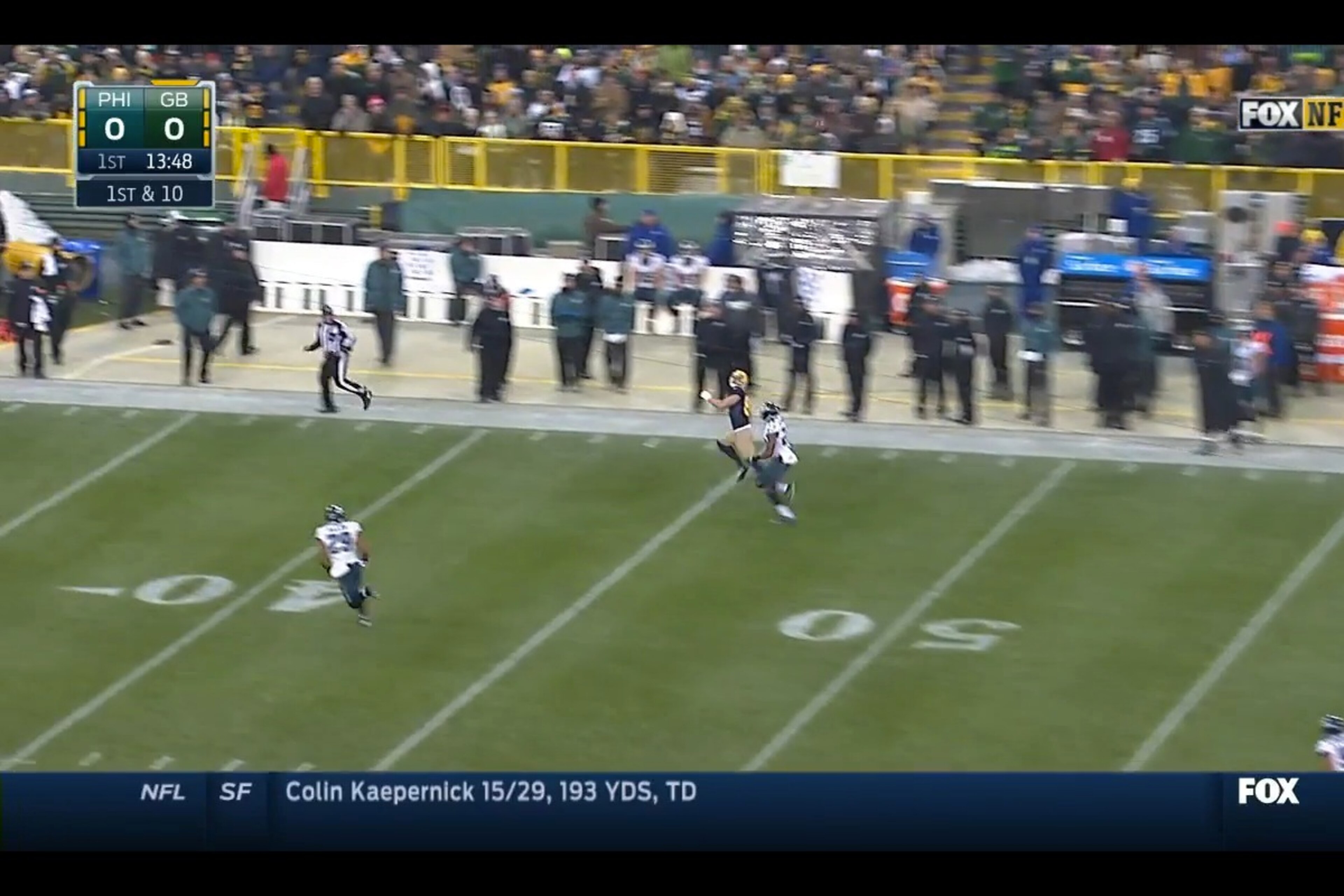

If Fletcher really is a starter for the Patriots (and it appears he has an early lead based on OTAs, per ESPN Boston's Mike Reiss), this might indicate more two-high safety coverages, which will allow Fletcher to be more physical while also facing less one-on-one responsibilities.
Moreover, despite the poor charting numbers, it would be an exaggeration to suggest that Fletcher was the worst starting corner in the league last season despite what the famously measured Eagles fanbase will tell you.
FO's numbers are a little kinder to Fletcher once you adjust for the fact that he played 1,047 snaps, 90.4 percent of Philly's defensive snaps. By adjusted success rate, Fletcher ranked a more reasonable 36th out of the 77 qualifying corners.
In fact, FO's Andrew Healy developed a cost-benefit analysis of all free-agent signings earlier this offseason, measuring the amount of approximate value each signing needed to generate to justify his salary while also adjusting for age. By age-adjusted value, Fletcher's one-year, $1.5 million deal was the most valuable contract of any free-agent cornerback signing, as he's projected to produce 1.24 more AV than his deal is worth.
In fairness, the methodology favors solid cornerbacks on smaller, short-term deals. The analysis is not to suggest that Fletcher is "better" in a vacuum than, say, Darrelle Revis, who ranks lower on the list because of his contract's exorbitant dollars and lengthiness. Still, Fletcher has roughly performed at the level of a No. 2 corner over the past three seasons since suffering a torn ACL that limited him to four games in 2011:
| 2014 | 51.0% | 36 out of 77 | 8.9 | 55 out of 77 |
| 2013 | 54.6% | 28 out of 71 | 6.2 | 28 out of 71 |
| 2012 | 52.7% | Did not qualify | 5.9 | Did not qualify |
That's obviously a far cry from what the Patriots enjoyed last season with Revis, but any corner New England inked wasn't going to fill No. 24's shoes. In Fletcher, the Pats at least have a veteran with a pedigree of success in Quarters coverage, the type of scheme New England figures to employ more often to protect its weaker cornerbacks.
Of course, teams will still test Fletcher on the deep ball until he proves that he's recovered from last season's traumatic struggles. Truthfully, the majority of those struggles were limited to the second half of last year, but it's still concerning that Fletcher was so helpless to adjust against the simplest route concept in the playbook.
For that reason, we shouldn't necessarily pencil in Fletcher as a surefire asset, especially considering that he'll again need to cover No. 1 receivers on the majority of snaps (assuming he starts at left corner). However, Fletcher is also the only cornerback on New England's roster with an extended track record of positive play, making him a potentially invaluable asset amid a young position group.
Jimmy Garoppolo
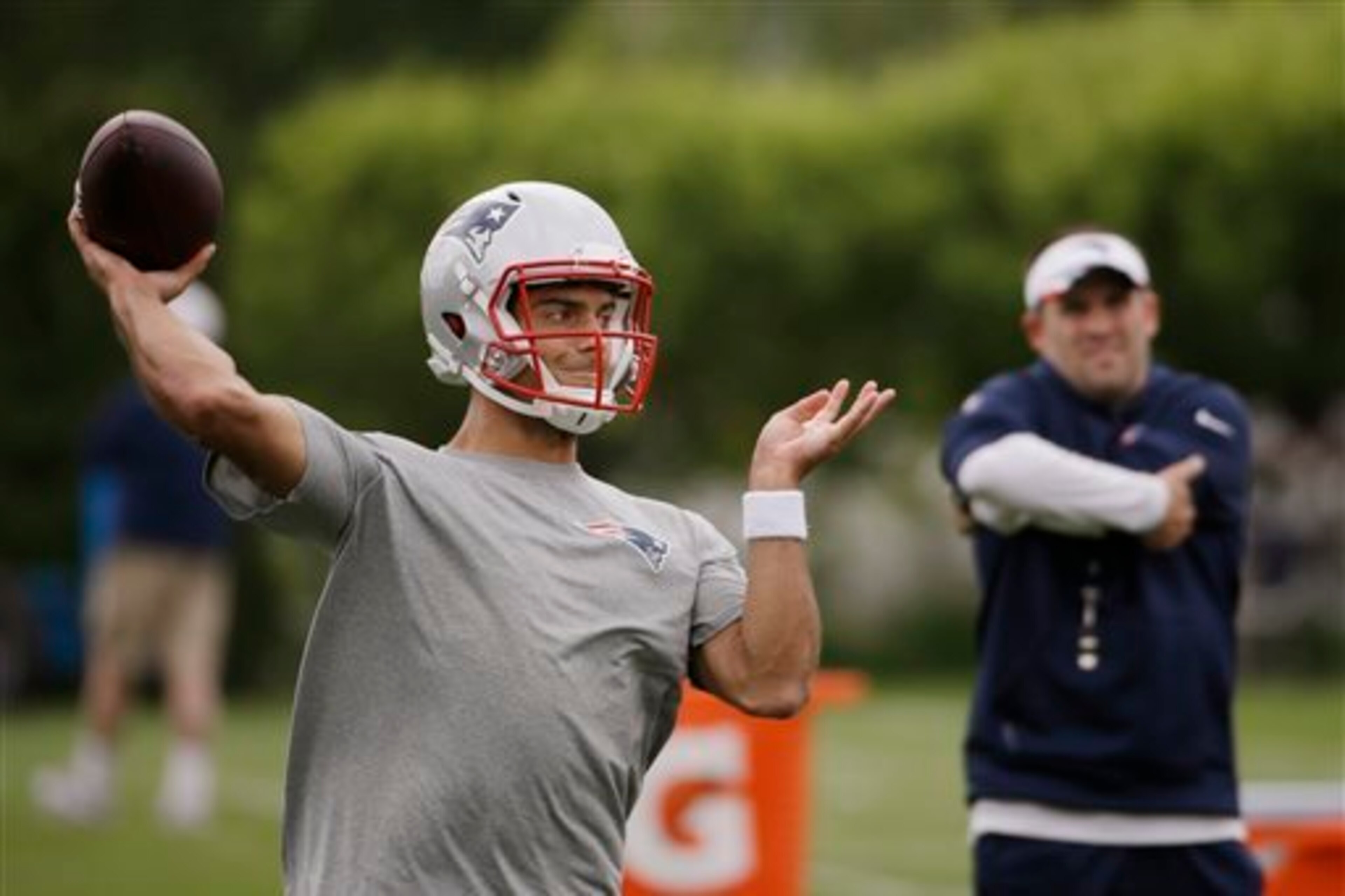
When you clicked on the article, this is probably the name you were expecting to see first. Jimmy Garoppolo is clearly the biggest unknown among projected Week 1 starters.
The Pats' season is unlikely to capsize even if Tom Brady serves his entire four-game suspension given the impeccable infrastructure in place. However, Garoppolo's performance can mean the difference between a division title and a Wild Card struggle, or between hosting Denver Broncos and/or Indianapolis Colts in the playoffs and traveling to those venues.
Although we'll certainly have more on Garoppolo's game as the season draws nearer, I won't bother with film breakdown yet.
He did see extended action in the preseason and last year's Week 17 tilt against the Buffalo Bills, but none of that is particularly instructive on how he'll fare on a normal week of preparation with a full game plan. Garoppolo didn't play with New England's top offensive line or receivers in any of those situations, so we have no game film of him in any situation with real stakes.
Instead, it might be more instructive to see if there are any historical precedents for Garoppolo's situation. New England finished fifth in passing DVOA, Football Outsiders' opponent-adjusted measure of success rate. Since 1989, here are the teams that finished with a top-five pass offense DVOA, only to have a different quarterback throw the majority of the team's passes the following season:
| 1992 Miami Dolphins | Dan Marino to Scott Mitchell | -4.7% | 5 |
| 1992 New Orleans Saints | Bobby Hebert to Wade Wilson | -50.4% | 27 |
| 1993 Miami Dolphins | Scott Mitchell to Dan Marino | +9.2% | 2 |
| 1995 Chicago Bears | Erik Kramer to Dave Krieg | -31.2% | 13 |
| 1997 Cincinnati Bengals | Jeff Blake to Neil O'Donnell | -28.2% | 20 |
| 1998 Denver Broncos | John Elway to Brian Griese | -41.0% | 16 |
| 1998 Minnesota Vikings | Randall Cunningham to Jeff George | -25.7% | 9 |
| 1998 San Francisco 49ers | Steve Young to Jeff Garcia | -50.8% | 24 |
| 1998 New York Jets | Vinny Testaverde to Ray Lucas | -35.9% | 15 |
| 2000 Kansas City Chiefs | Elvis Grbac to Trent Green | -24.1% | 17 |
| 2005 Kansas City Chiefs | Trent Green to Damon Huard | -22.0% | 10 |
| 2007 New England Patriots | Tom Brady to Matt Cassel | -58.3% | 15 |
| 2008 Miami Dolphins | Chad Pennington to Chad Henne | -22.5% | 18 |
| 2010 Indianapolis Colts | Peyton Manning to Curtis Painter | -46.0% | 27 |
To be clear, this is an overstatement of the situation the Patriots face. Barring a Brady injury, Garoppolo isn't going to throw the majority of the passes. So while New England's seasonal passing stats are likely to take a hit, it would be wrong to directly extrapolate from these numbers and apply them to the 2015 Pats.
Still, only the 1993 Miami Dolphins were truly successful in replacing their signal-caller, with Scott Mitchell sustaining Miami's top-five pass DVOA ranking when Dan Marino went down with a torn Achilles.
Excluding the Marino-to-Mitchell-to-Marino Dolphins, just two of the other 12 teams on this list managed a top-10 pass DVOA finish the following season with a new quarterback. And every one of those teams saw a significant dip in overall pass DVOA.
The Patriots will probably fall out of the top five in 2015 unless Garoppolo is above average for four games, but again, none of these teams are really like New England because we know Brady will return at some point. If we were to draw a comparison, the Patriots would appear most similar to the 1999 Broncos, who started unproven second-year quarterback Brian Griese to replace departing legend John Elway.
Ultimately, this illustrates that the Patriots should be happy to cobble together a roughly league-average passing game in Brady's absence, much like they did in 2008 with Matt Cassel. Expecting a Brady 2.0 succession was always a foolhardy expectation, but if Garoppolo can perform at a Scott Mitchell or Trent Green type of level, the Patriots can consider that a big win.
*Unless otherwise noted, all stats via Football Outsiders and the FO game charting project.
.jpg?w=3840 "Commanders Football")
.jpg?w=3840 "Giants Cowboys Football")
_0.png?w=3840 "Summer League Takeaways ✍️")
.png?w=3840 "Offseason Moves Sure To Backfire 💥")