Canadian Grand Prix 2015 Preview: Start Time, TV Times, Weather, Schedule, Odds
Formula One crosses the Atlantic Ocean for the first time in 2015 to visit the city of Montreal, host to the Canadian Grand Prix.
The race has been a much-loved part of the F1 calendar since 1967. The venue for that first race was Mosport Park, but the grand prix moved to its present home on the Ile Notre Dame in 1978 and never looked back.
Only twice since then—in 1987 and 2009—has it been missing from the schedule.
Lewis Hamilton is the only current driver to have won here on more than one occasion. The defending world champion will be hoping to bounce back from losing a certain victory in Monaco, but rival Nico Rosberg took pole here last year and is aiming to win three consecutive races for the first time in his career.
One-time winners Sebastian Vettel and Kimi Raikkonen may also have a say in the outcome of Sunday's race—and expect Williams to be closer too.
F1 needs a fun and exciting race after two relatively dull affairs, so here's hoping the Circuit Gilles Villeneuve can once again produce the goods.
Read on for a full preview of the weekend ahead including a circuit map and detailed guide, TV times, session times, tyre and DRS information, current standings, weather and odds.
Current Drivers' and Constructors' Standings
1 of 6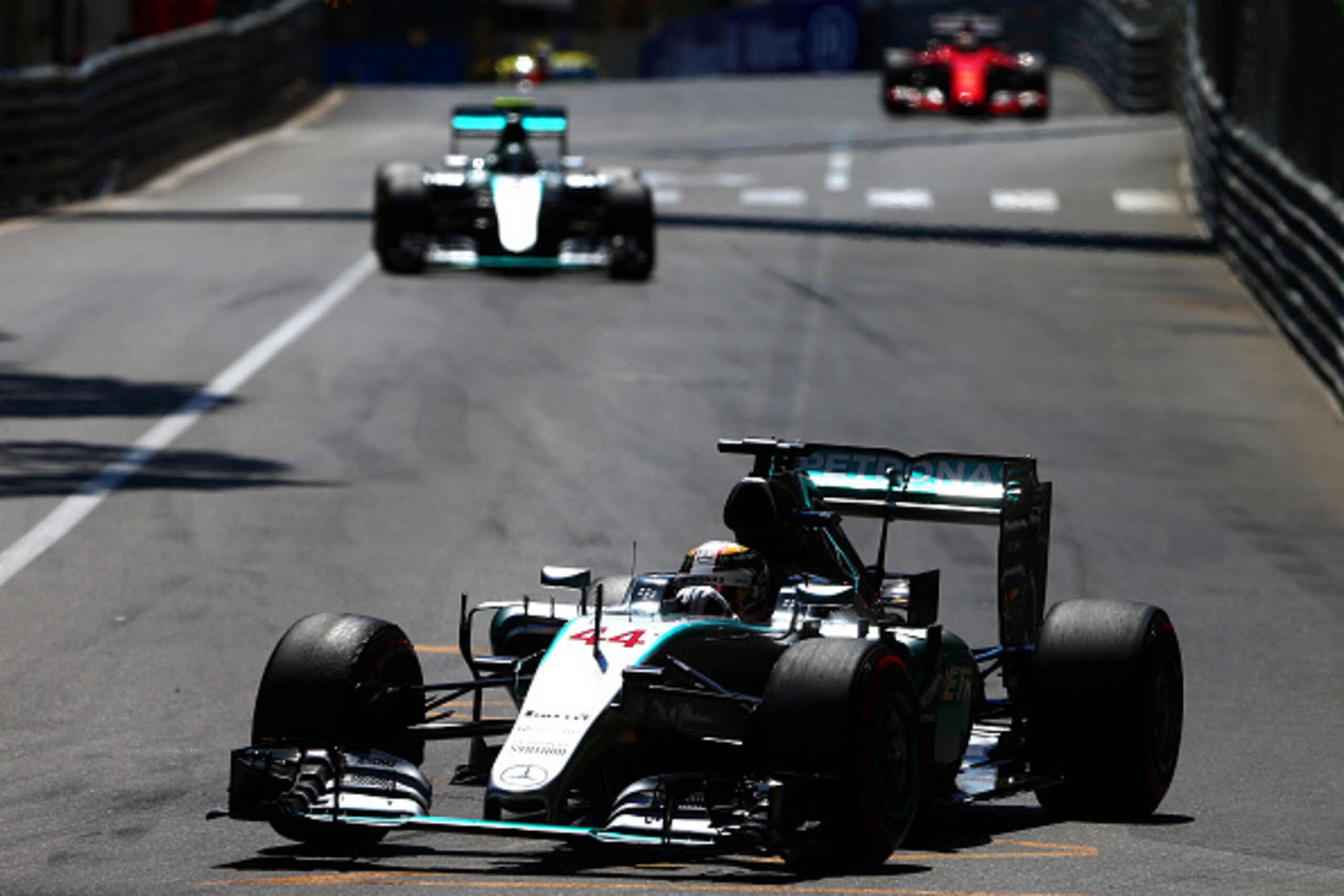
Nico Rosberg's victory in Monaco saw him cut the gap to championship leader Lewis Hamilton. Sebastian Vettel also reduced the deficit.
The current top 10 are:
| 1 | Lewis Hamilton | 126 |
| 2 | Nico Rosberg | 116 |
| 3 | Sebastian Vettel | 98 |
| 4 | Kimi Raikkonen | 60 |
| 5 | Valtteri Bottas | 42 |
| 6 | Felipe Massa | 39 |
| 7 | Daniel Ricciardo | 35 |
| 8 | Daniil Kvyat | 17 |
| 9 | Felipe Nasr | 16 |
| 10 | Romain Grosjean | 16 |
In the constructors' championship, Mercedes hold a substantial lead over second-placed Ferrari. With fourth and fifth in Monaco, Red Bull cut the gap to Williams by 22 points. Further back, Force India jumped ahead of Toro Rosso and Lotus into sixth.
But the biggest points-related news of the Monte Carlo weekend was Jenson Button finally putting some points on the board for McLaren.
The nine teams with at least one point are:
| 1 | Mercedes | 242 |
| 2 | Ferrari | 158 |
| 3 | Williams | 81 |
| 4 | Red Bull | 52 |
| 5 | Sauber | 21 |
| 6 | Force India | 17 |
| 7 | Lotus | 16 |
| 8 | Toro Rosso | 15 |
| 9 | McLaren | 4 |
Data sourced from the official F1 website.
Circuit Gilles Villeneuve
2 of 6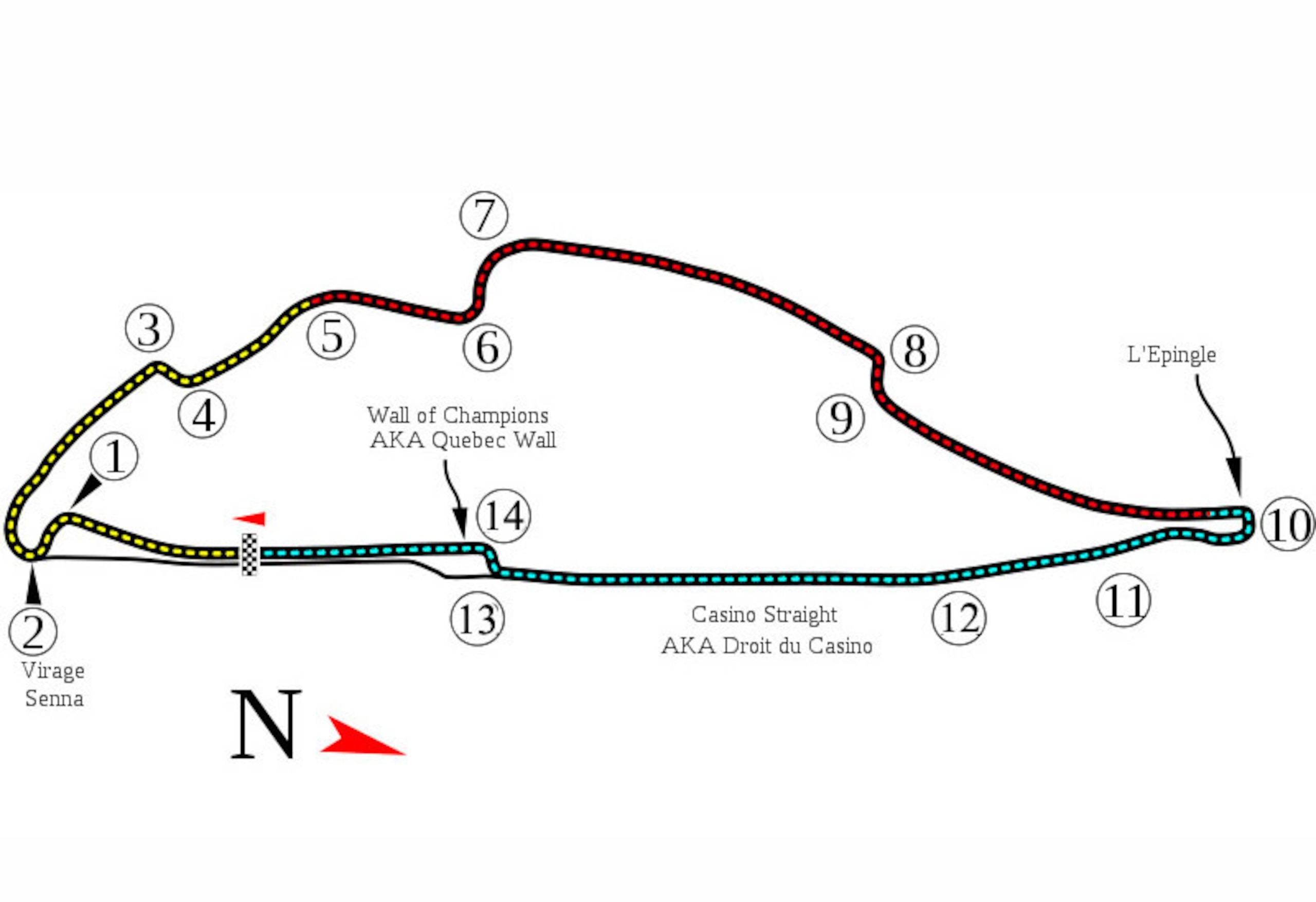
The Circuit Gilles Villeneuve bears the name of one of the most exciting and talented drivers to have ever graced a Formula One grid. Father of 1997 world champion Jacques, Gilles Villeneuve won six races in a career cut short by a fatal accident at Zolder in 1982.
It was renamed in his honour later that year.
The track lies on the man-made Ile Notre Dame, close to the centre of Montreal. Semi-permanent and little-used, it's a curious mixture of street circuit and road course; barriers line the 4.361 kilometre circuit, but the straights are long and corners are few.
Overtaking isn't quite as easy here as it used to be, but we should still see a marked increase in passing after the somewhat dreary races in Spain and Monaco.
Turns 1 and 2
A lap begins on the pit straight with the drivers immediately steering right through the flat-out kink that doesn't have a name. It does, however, have an impact on lines and overtaking opportunities into the slow left-hander of Turn 1.
Moves are possible here, but because the straight leading into the corner is short, a driver needs to be very close to his rival coming out of the final corner.
As soon as they've rounded Turn 1, the drivers swing back across to the left-hand side of the track for the slow, right-hand hairpin of Turn 2. If someone managed to hang on around the outside of the first corner, they could overtake with the inside line here.
Turns 3, 4 and 5
It's hard on the power at the exit and out onto a short straight between the walls. A few seconds after nailing the throttle, the drivers brake for the slow-to-medium speed right-left chicane of Turns 3 and 4.
A little bit of kerb is essential for a good run through the slower first part, before getting back on the throttle (though not at full power) for the right-hander. After the exit, the cars drift out toward the edge of the track and a very large, very hard wall—errors here, such as taking a bit too much kerb on the entry, tend to be heavily punished.
Providing the chicane is safely negotiated it's back on the power and flat-out through the left-hand kink and the longer, right-hand Turn 5.
Turns 6 and 7
As soon as Turn 5 is cleared, the drivers are braking for the second of the circuit's four chicanes.
This one, comprising Turns 6 and 7, starts off with a slow left-hander. The second part is much quicker and far more open, and after a second or two of feathering, the drivers are hard on the throttle at the exit.
It can be easy to lose the rear of the car here, and this can be a problem as it leads out onto a medium-length straight.
Turns 8 and 9
The cars reach speeds of around 300 kilometres an hour before hard braking in the shadow of the bridge for yet another chicane.
Turn 8 is the slow right-hander that leads into the quicker, open left of Turn 9. The best line at the exit requires the driver to almost brush the wall on the outside—as at the first chicane, there's zero room for error.
Back on the power and leaving the wall behind, the drivers head off on another straight.
Turns 10, 11 and 12
This one curves slightly to the left through an unnamed, flat-out corner. It was here that Robert Kubica had a terrifying crash in the 2007 Canadian Grand Prix.
As the drivers exit that kink, they hug the left-hand side of the track and brake hard from around 300 kilometres an hour down to just 60 or 70 for the slow, right-hand hairpin of Turn 10.
Not a tight, Tilke-style hairpin, the corner nonetheless presents an overtaking opportunity. However, some drivers may hang back and instead try for an easier pass on the long straight that follows.
Just after the exit, as the cars enter the longest straight in Montreal, are a pair of kinks—one left, one right. Exactly why they get numbers when the other kinks don't is unclear, but numbers they have—Turns 11 and 12.
Turns 13 and 14
Approaching the end of the lap and hitting the highest speeds attainable around this circuit, the drivers reach end of the straight and brake very hard for the final corners.
This slow, unassuming left-right chicane is famed around the F1 world for what lies at the exit. The chicane itself requires maximum commitment over the kerbs to get the best possible time, but even a small mistake could pitch the driver into arguably the most well-known, well-loved solid object in Canada—the Wall of Champions.
So-named after Damon Hill, Jacques Villeneuve and Michael Schumacher—all F1 champions—crashed here in 1999, it hasn't had a high-profile victim for years.
The most recent champion to have ended a session here is Sebastian Vettel. He dropped it during first practice back in 2011.
A driver succeeding in making it through emerges onto the pit straight. In qualifying, you'll see some drivers staying to the right of the circuit for the shortest route to the line; in a race, the usual racing line is to the left, preparing for the kink that starts the lap.
Pit Lane
The pit-lane entry is straight on at the final chicane, and the exit feeds back in at the outside of Turn 2.
Tyres and DRS
3 of 6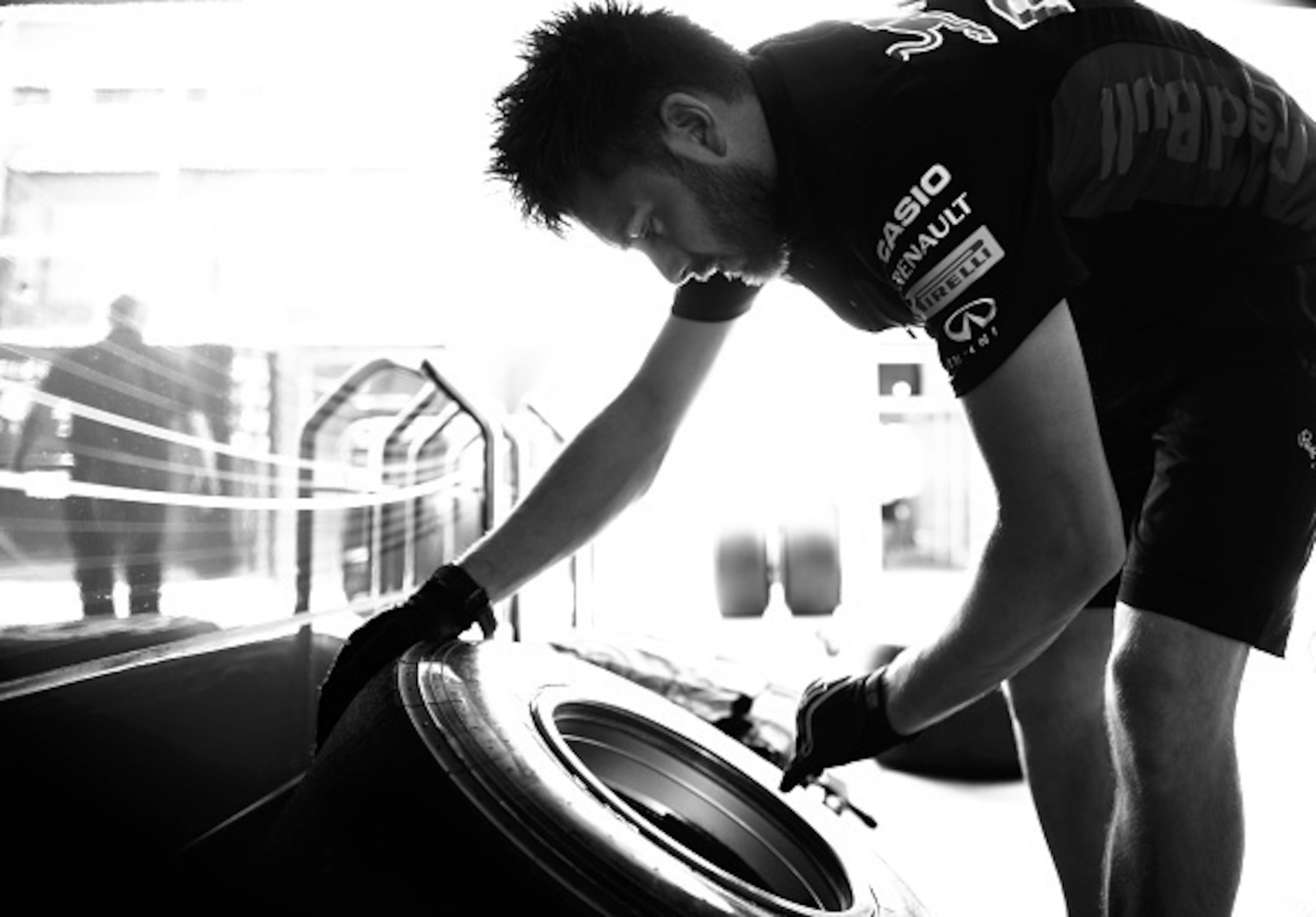
The Circuit Gilles Villeneuve is laid out around the edge of the Ile Notre Dame, a man-made island in the St. Lawrence River. Outside the grand prix weekend, it's open to the public and all the mess and grime they inadvertently bring with them; as a result, the surface gets very dirty and slippery from one year to the next.
To counter this lack of grip, Pirelli is bringing the red-marked super-soft and yellow-marked soft tyres to the Canadian Grand Prix. This choice is made possible by the lack of "tyre-killing" long, high-speed corners.
But the rubber doesn't get the weekend off entirely. The numerous acceleration zones from the slow corners and back-end sliding caused by the low-grip surface and low-downforce configurations gives the rear tyres a hard time.
This makes Montreal a rear-limited circuit—stint length and tyre life is determined by how quickly the rear tyres lose performance.
At least two stops are expected, but there could be some strategic variation from the likes of Force India.
DRS
After the single zone of Monaco it's back to two DRS zones for Canada.
Both are run from a single detection point shortly after the exit of Turn 9. Being in DRS range here can be more important than being ahead on track; hence the somewhat amusing sight in 2013 of Lewis Hamilton and Fernando Alonso both slowing because neither wanted to be ahead at the detection point.
The first zone's activation point comes just after the exit of the right-hand kink of Turn 12 on the back straight, and it ends with braking at the final chicane.
The second zone has an activation point just after the exit of the final chicane, and it runs the length of the pit straight and ends at the braking zone of Turn 1.
.jpg?w=2560 "Browns Bears Football")

Weather Forecast
4 of 6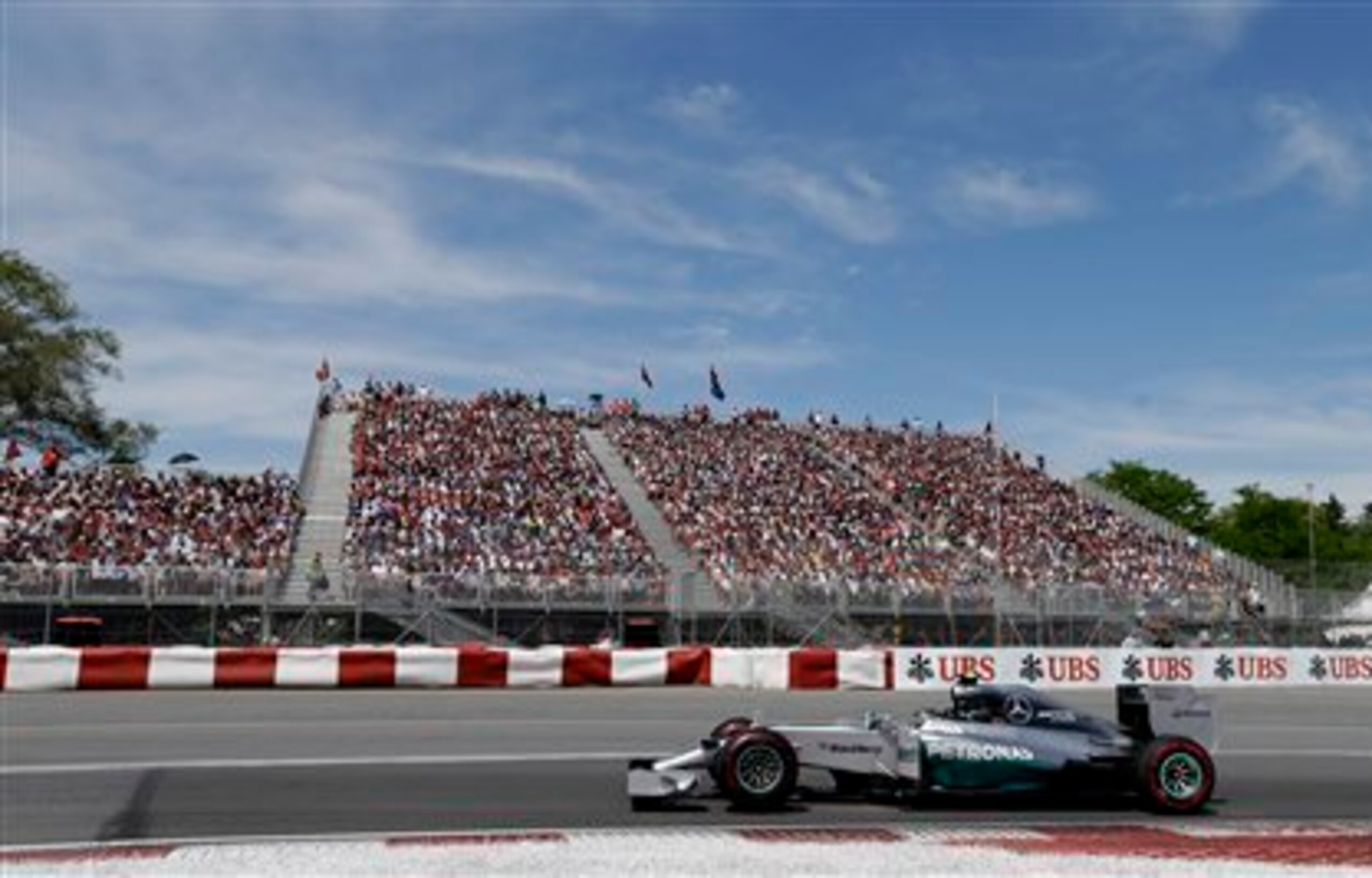
Montreal has a humid continental climate with warm or hot summers and very cold winters. June typically sees daily highs in the region of 19 degrees Celsius, but this can vary wildly—the record high is 35 degrees with a record low of zero.
Such extreme fluctuations can play havoc with race strategy but none are expected this weekend; the forecast is for three days of temperatures almost dead on the long-term average.
Rain may fall in scattered showers on Friday, but Saturday should be bright and clear. A little more cloud is expected for Sunday—while this will not affect the air temperature too much, the track temperature will be lower.
This could play into the hands of Mercedes.
BBC Weather will have the latest.
Odds
5 of 6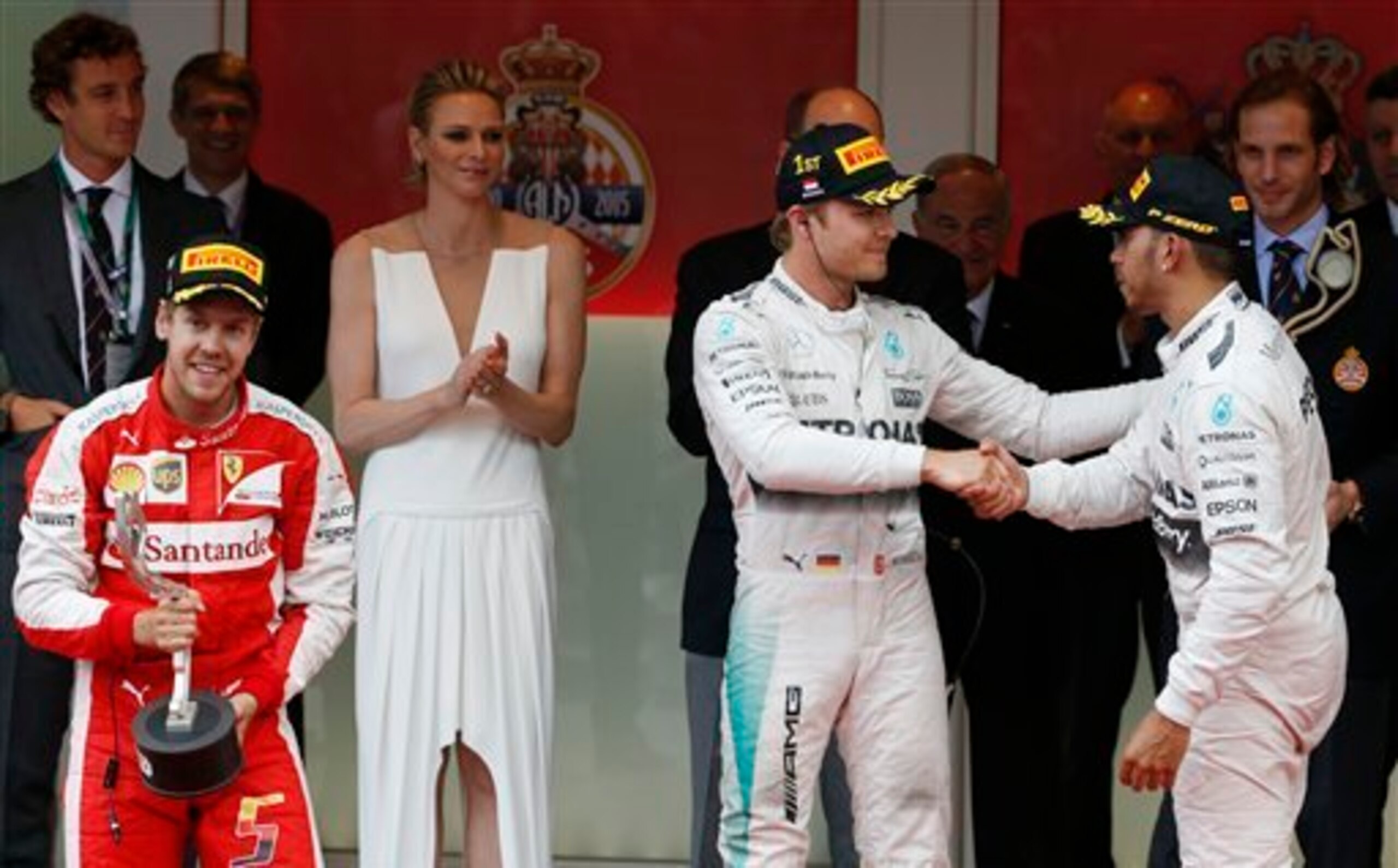
Lewis Hamilton retains his position as pre-qualifying favourite with team-mate Nico Rosberg close behind. Hamilton's odds are shorter than they were for Monaco, as are those of Sebastian Vettel.
The top 10 favourites are:
| Lewis Hamilton | 8-11 |
| Nico Rosberg | 15-8 |
| Sebastian Vettel | 8-1 |
| Kimi Raikkonen | 24-1 |
| Valtteri Bottas | 100-1 |
| Felipe Massa | 150-1 |
| Daniel Ricciardo | 150-1 |
| Daniil Kvyat | 500-1 |
| Carlos Sainz Jr. | 500-1 |
| Max Verstappen | 750-1 |
Selected Others
The safety car came out twice during 2014's race and is odds-on to do the same again this year. It's 1-2 to appear at some point during the race (6-4 for no appearance).
Two drivers unlikely to be leading any potential snake behind the AMG GT S are Fernando Alonso and Pastor Maldonado. They are the only two drivers in half-decent cars without a single point so far—Maldonado is 6-4 to break his duck and Alonso is 5-6.
And following his morale-crushing third place in Monaco, Lewis Hamilton is 3-1 to hit back with a hat-trick of pole, fastest lap and the race win. Nico Rosberg is 8-1 and Sebastian Vettel 80-1.
All odds sourced from Oddschecker.com and correct at the time of publication.
TV and Session Times
6 of 6
As always, the Canadian Grand Prix weekend will consist of three free practice sessions, qualifying and the race.
The session times are as follows:
| Practice 1 | Friday | 10 a.m. |
| Practice 2 | Friday | 2 p.m. |
| Practice 3 | Saturday | 10 a.m. |
| Qualifying | Saturday | 1 p.m. |
| Race | Sunday | 2 p.m. |
All times given are Montreal local time (EDT, UTC -4). The official Formula One website has a useful tool on its homepage to convert them to your own time zone.
TV Times
In the United Kingdom, live coverage of all sessions will be provided by Sky Sports F1 and the BBC. The programming times are as follows (all times BST):
| Practice 1 | Friday | 3 p.m. | 2:45 p.m. | 2:45 p.m. (Two) |
| Practice 2 | Friday | 7 p.m. | 6:45 p.m. | 7 p.m. (Three) |
| Practice 3 | Saturday | 3 p.m. | 2:45 p.m. | 2:55 p.m. (Two) |
| Qualifying | Saturday | 6 p.m. | 5 p.m. | 5 p.m. (One) |
| Race | Sunday | 7 p.m. | 5:30 p.m. | 6:25 p.m. (One) |
In the United States, live coverage is provided by the NBC network across NBC, NBCSN and NBC Sports Live Extra (SLE). The times are as follows (all times EDT):
| Practice 1 | Friday | 10 a.m. | 10 a.m. (SLE) |
| Practice 2 | Friday | 2 p.m. | 2 p.m. (SLE) |
| Practice 3 | Saturday | 10 a.m. | 10 a.m. (SLE) |
| Qualifying | Saturday | 1 p.m. | 1 p.m. (NBCSN) |
| Race | Sunday | 2 p.m. | 1:30 pm (NBC) |
Enjoy the weekend!
.jpg?w=2560 "Bills Browns Football")


.jpg?w=2560 "Players with Shocking Career Earnings 😳")

.jpg?w=2560 "BTJ Suffers Shoulder Injury")