

Is Isaiah Thomas the Starting Point Guard of the Future for Boston Celtics?
Isaiah Thomas has made no secret about his desire to start for the Boston Celtics since joining the team in February.
The 5'9'' speedster has proved himself to be a capable starting point guard throughout his brief NBA career, starting 71 percent of the games he played during his first three seasons with the Sacramento Kings.
During the 2014-15 season, Thomas' success continued but his starting opportunities disappeared. He managed to start in just one of his 67 appearances while splitting time between the Phoenix Suns and Celtics. Thomas was stuck behind two superior players in Phoenix (Eric Bledsoe and Goran Dragic), but Boston elected to start a rookie over him in Marcus Smart.
Thomas excelled in a bench role with both teams, earning a second-place finish for the Sixth Man of the Year award, but his long-term goal has always been to start, as he told Sam Amick of USA Today back in November.
"Every day that I come in, that's what I want to do. That's been my mindset from Day One, since I was a little boy. I mean, everybody wants to be a starter.”
In the midst of a rebuild, it would seem on the surface that Thomas, 26, has a strong chance of achieving that objective in his second year as a Celtic.
He’s signed for the next three seasons for just $19 million, and President of Basketball Operations Danny Ainge has raved about his impact. The Celtics were a much better squad with him on the floor, outscoring opponents by 7.3 points per 100 possessions in his 545 minutes.
That fact, combined with the added benefit of a training camp in the fall to get him fully integrated into Boston’s schemes, seems to make him a prime candidate to move into the starting lineup next season. However, Ainge was not willing to commit to that change at his end-of-season press conference.

“Isaiah is one of the top point guards in the league, so I understand that [desire to start],” Ainge said. “What makes him great is he’s a driven guy that really wants to be recognized as one of the great little guys that has ever played basketball. Right now for our team, I think Isaiah is more suited for a bench role, but ultimately that’s Brad [Stevens]’s decision.”
When pressed on the topic in an interview with Zolak and Bertrand on 98.5 The Sports Hub in Boston (via CBS Boston), Stevens declined to commit.
"I don’t know if we can make that decision until we know what our team looks like. I think we can all speculate and talk about it. Isaiah and I can have back and forth on it and talk about it, but the one thing I have learned about him: Of course, because he’s a really good player, he wants to start. I’ve never met a player that doesn’t want to start, let alone a really good player.
"
So what exactly could keep Thomas out of the starting five? Smart handled point guard duties ahead of Thomas last year with mixed results, but the team seems committed to finding out if the 21-year-old can improve in that department. There's also the possibility of the team bringing in an upgrade from outside the organization to fill the role.
Will these potential obstacles keep Thomas from achieving his dream in Boston? Let’s explore the possibilities before evaluating whether Thomas starting is the right move for the Celtics in the long term.
A Great Fit with Second Unit
The circumstances surrounding the transition of Thomas to a bench player last year were understandable. In Phoenix, Thomas was stuck playing behind a pair of elite point guards in Goran Dragic and Eric Bledsoe.
The Celtics picked up Thomas at the trade deadline when the Suns elected to pull the plug on their three-point guard experiment, but Boston's head coach declined to start the lefty guard after his arrival in Boston.
"I like the way our two guys (Marcus Smart and Avery Bradley) are starting together, and I like what he's done off the bench," Stevens told reporters back on February 25. "So is he capable of being a starter? Absolutely. He's a good player. But we'll cross that bridge if we need to."
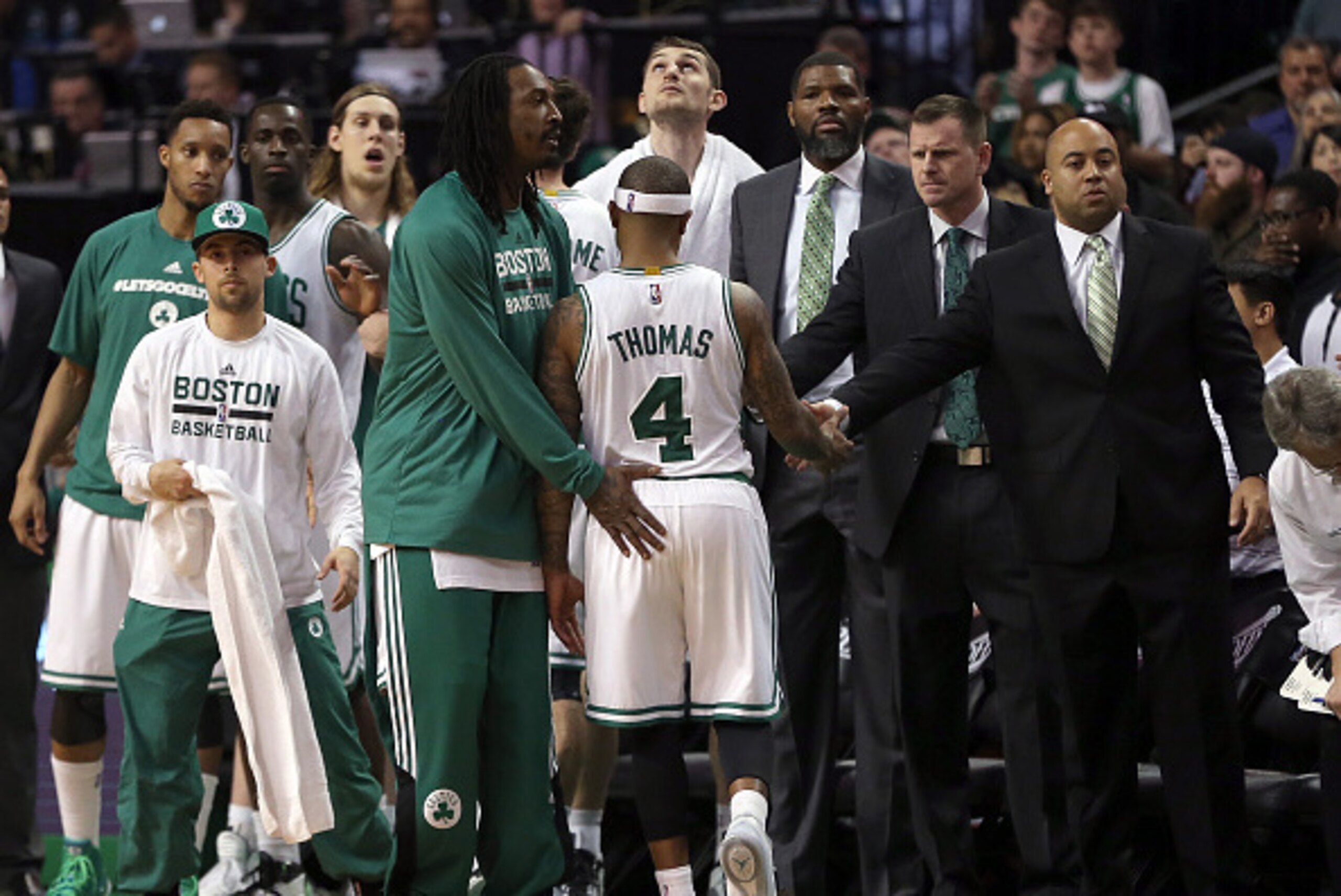
Smart's offensive numbers were subpar during his starting stint, but his size at 6'4'' gave Stevens two above-average defenders in the backcourt to limit the opposition every night. Evan Turner's ball-handling abilities at small forward also helped mask some of Smart's dribbling and shot creation deficiencies.
With the Celtics playing well, Stevens stuck with his initial decision, and Thomas thrived as an offensive spark plug with the second unit, averaging a team-best 19 points in just 26 minutes per game.
The added production from the University of Washington product helped Boston win 19 of its final 29 regular-season games and earn a surprise playoff berth in the Eastern Conference.
Thomas' success with Boston's second unit has Ainge believing the fifth-year guard may be better off following in the footsteps of other talented Celtic players who have come off the bench.
As Ainge explained last week:
"I guess to encourage him to feel like he can still [be an elite player] by coming off the bench, a la John Havlicek, Kevin McHale, Cedric Maxwell and many of the Celtic greats that came off the bench…I know Manu Ginobili wanted to be a starter back in his 20s. I know for sure Kevin McHale wanted to be a starter. Listen, sometimes you’ve got to play the role to win and do what’s best for the team.
"
A Defensive Liability?
For all of the positives Thomas brings offensively with his shot creation, ability to get to the free-throw line and three-point shooting, there’s no denying his limitations on defense. His stature gives most point guards a significant size advantage over him, and Thomas is prone to getting stuck on screens thanks to his 185-pound frame.
“You need guys who play offense and defense, and at his size, defense is sometimes a challenge and puts our team where we have to cover up for some of his mistakes,” Ainge said.
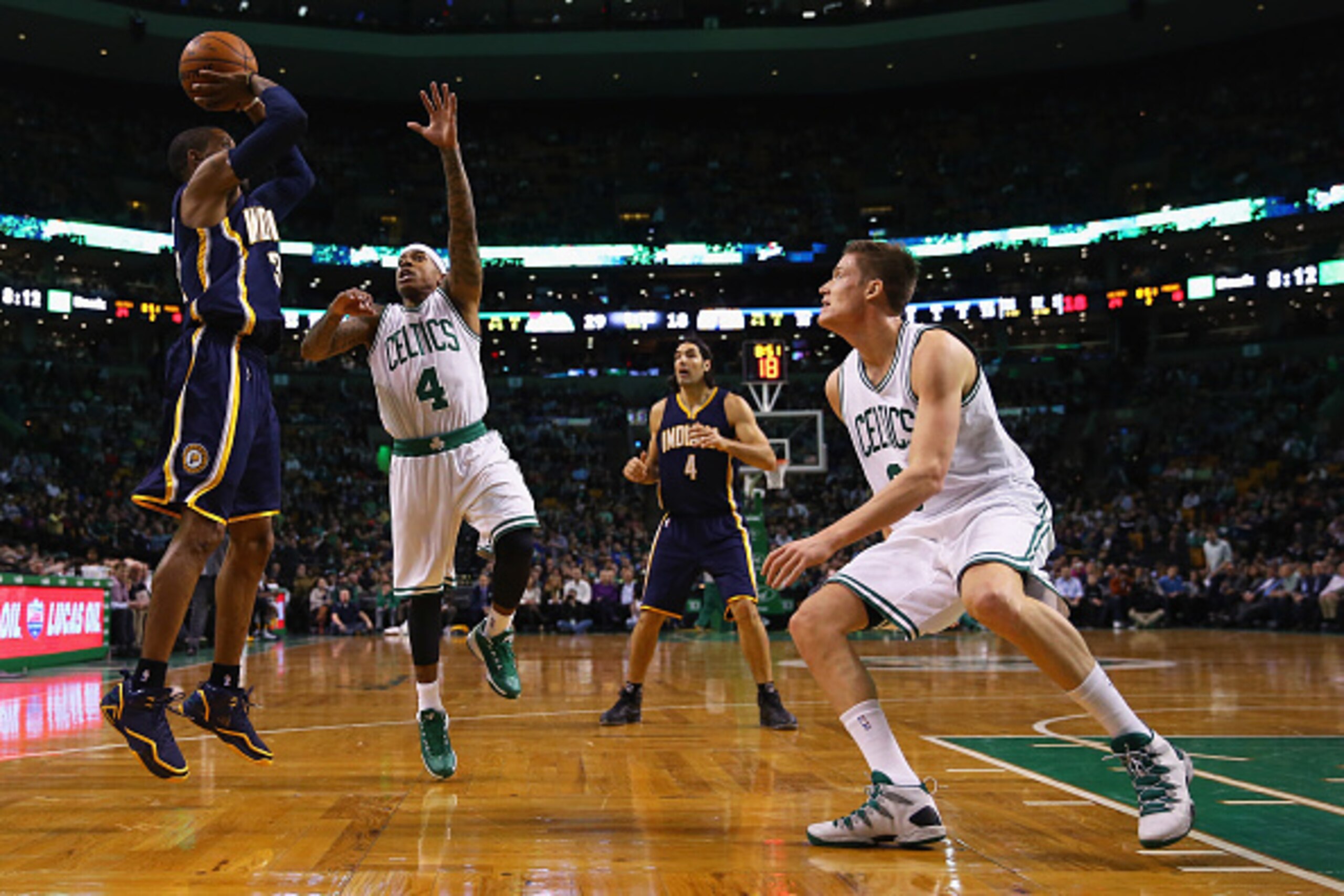
Ainge isn’t the only one who has reservations about his guard’s stature. Thomas told Bleacher Report in April that Sacramento likely sign-and-traded him to Phoenix in free agency last summer because of its desire for a bigger point guard.
As a team, the Celtics did not experience a huge drop-off when Thomas spent time on the floor. Boston allowed 101.9 points per 100 possessions during the 545 minutes Thomas was on the court. That number only improved by 2.6 points when the undersized point guard watched his teammates from the sidelines.
The fact that Thomas primarily played against the opposition’s second unit may have helped ease his impact on Boston’s team defense. With the incredible number of explosive offensive point guards spread throughout the league, handing Thomas those defensive duties every night has to be a scary option for Stevens.
The Celtics also have Smart, a more-than-capable defender at point guard, making any potential switch a daunting proposition.
Boston's Need for Offense
For all of his warts on the defensive end, it’s hard to ignore how much of a positive impact Thomas made for Boston's offense over the final two months of the season.
“I think that what he does is provide an amazing spark off the bench, and he was obviously our best offensive player,” Ainge said.
The numbers back up Ainge’s assertion. With the former Sun running the show, Boston turned into an elite offense, scoring 109.2 points per 100 possession, a whopping 9.5 points better than when he was stuck on the bench.
Meanwhile, a starting unit of Smart-Avery Bradley-Evan Turner-Brandon Bass-Tyler Zeller was one of the worst scoring starting fives in the league, sorely lacking the shot creation Thomas brought to the table. Smart struggled as the team’s primary ball-handler, and it’s still unclear whether he is best served playing off the ball or developing into a true point guard.
Ainge will have to upgrade that starting grouping this offseason, particularly in the frontcourt. However, unless Ainge is able to add some offensive firepower to that unit, the Celtics may be best served by seeing if Thomas can bring a scoring spark to the starting lineup. That possibility becomes more realistic if the team ends up adding a strong defensive player or two in the frontcourt to help cover Thomas’ flaws.
“I think the biggest thing is, who’s around?” Stevens admitted on Zolak and Bertrand. “Who he is playing with? Does he fit well with that group? Does he fit well with the people that are starting or coming off the bench?”
The Wild-Card Option
Ainge’s desire to upgrade his roster this offseason does not preclude the point guard position, despite acquiring Thomas in February. Grantland’s Zach Lowe indicated last week the Celtics should not be counted out from making a surprise run at Ty Lawson via a trade with the Denver Nuggets this summer.

The 5’11’’ point guard is reportedly nearing the end of his tenure in Denver, according to Christopher Dempsey of the Denver Post, after a season marred by turmoil on and off the court. The 27-year-old is a proven talent who could thrive in Stevens' “pace and space” system. He’s also more of a natural distributor than Thomas.
Lowe speculates Ainge could dangle Thomas and additional considerations in a potential deal, but it’s hard to imagine the Celtics giving up more than a late first-round pick for a player who will make $12 million for the next two seasons and has size limitations of his own.
The Celtics could also explore the free-agent market if they don't want to pay Denver's asking price for Lawson, but there don’t seem to be a lot of realistic fits to improve the position through that route. The majority of the young potential upgrades over Thomas are restricted free agents (Reggie Jackson, Brandon Knight, Patrick Beverley), making it likely they will remain with their current teams.
The lack of appealing options outside of Lawson puts the odds in favor of Thomas remaining as Boston’s best option at point guard next year. Ainge’s corresponding offseason moves will provide a better indication of whether Thomas will be a fit with the starting group.
Whatever decision is made, Stevens remains confident Thomas will be willing to put the team’s best interests ahead of his own:
“It’s clear as day to me that he is going to do what is best for the team. He is a team guy and very prideful and very good, but when it’s all done he’s a team guy.”
All statistical information provided by NBA.com/stats, unless otherwise noted. All salary information provided by Basketball-Reference.com

.jpg?w=2560 "Bijan Accepts Godfather Offer ✅")

.jpg?w=2560 "Jets RB Taken To Hospital")
.jpg?w=2560 "Grading Every Team's Season 🔠")