LeBron James Adjusts His Mindset, and It's Just What His 'Shorthanded' Cavs Need
CLEVELAND — He knew. Somehow, he always does. Maybe he saw it on someone's social media stream, if between the final buzzer and his shower, he'd broken briefly from that boycott. But probably not. LeBron James is the rare athlete who has metric memory as well as muscle memory, and so, naturally, he was not surprised when he was reminded that he had taken more shots than in any playoff game since 2009.
"Yeah," James said, sharing a smile with Kyrie Irving as they sat at the podium following a 106-91 victory to tie the second-round series with Chicago at one. "I told him after the game, it's been a while."
TOP NEWS

NBA Power Rankings Entering Preseason 🔢
Wizards Guard Admits Tanking 😨

Blazers Fire New Broadcaster
It's been so long that it's as if he never left. Not once in James' 87 postseason games with the Heat did he attempt more than 28 field goals (in Game 4 of the 2011 second round against Boston). Only one other time, in Game 4 of the 2012 second round, did he attempt 27, and that was one of the games that postseason in which Miami played without Chris Bosh, with circumstances similar to what the Cavaliers encounter now.
Six times during his previous stint in Cleveland, he shot at least 29 times in a postseason contest.
And now make it seven after he took 29 shots on Monday, making 13 of them to score 33 points—with 27 of those shots coming in the first three quarters, through which the Cavaliers built a comfortable lead.
Make a note.
He's continuing, as he tries to take the Cavaliers to a new level, to make a break from some of what defined his Miami days.
Not the lessons he learned about professionalism, process and preparation from veterans such as Shane Battier, who watched Wednesday's game—with three of his former teammates on each side—from the crowd, before delighting James by popping into the Cavaliers' postgame locker room, where the friends hugged and reminisced. James still carries those lessons, and they come across in the way he carries himself and specifically in his speech, as he parrots much of what Heat coaches and players preached.

Even so, he has tapered one of his South Florida obsessions: efficiency. It still matters some, enough that he mentioned it after Wednesday's shootaround, when he said that he expected to be "much sharper" than in Game 1, when he was 9-of-22 from the floor with six turnovers. He added, "I'm a very efficient player, I thrive on being efficient, I take that very seriously, being efficient," and that his "efficiency wasn't up to par, up to my liking."
Yet there's no question that, this season, efficiency hasn't always been his overriding priority. Sometimes, that has been for the better, since at times with the Heat, he seemed to be passing up shots to preserve his percentages, especially during his record runs, such as when he shot at least 60 percent while scoring at least 30 points in six straight games during one stretch.
Sometimes, though, that has been for worse, as he has hoisted early in the shot clock, out of rhythm and off balance. During the regular season, his field-goal percentage of 48.8 was down from 56.7, 56.5, 53.1 and 51.0 the past four seasons, and it was his lowest since 48.4 in 2007-08 with the Cavaliers. And he's now shot no better than 50 percent in all six games this postseason, after making more than half of his attempts in 17 of 20 games last season.
Naturally, the more shots James makes, out of those that he takes, the better it should be for his team. But there are occasions when efficiency can be sacrificed for aggression, when the circumstances demand he set a tone for others to adopt. Wednesday was such an occasion. This series is such an occasion.
Asked how he balances his competing aims, he explained it this way: "For our team now, we're a little shorthanded. So the extra shots that I'm getting right now would be for Kevin [Love]. Even add a couple more extra shots that I'm getting would be for J.R. [Smith]. We're a little shorthanded, so, for me, I kind of have to change my approach. I had to change my approach tonight, knowing how shorthanded we are."
Pause here to take note of something else: his liberal use of the word "shorthanded," which could have been accidental, or it could have been a retort to Bulls coach Tom Thibodeau constantly arguing that the Cavaliers are not.
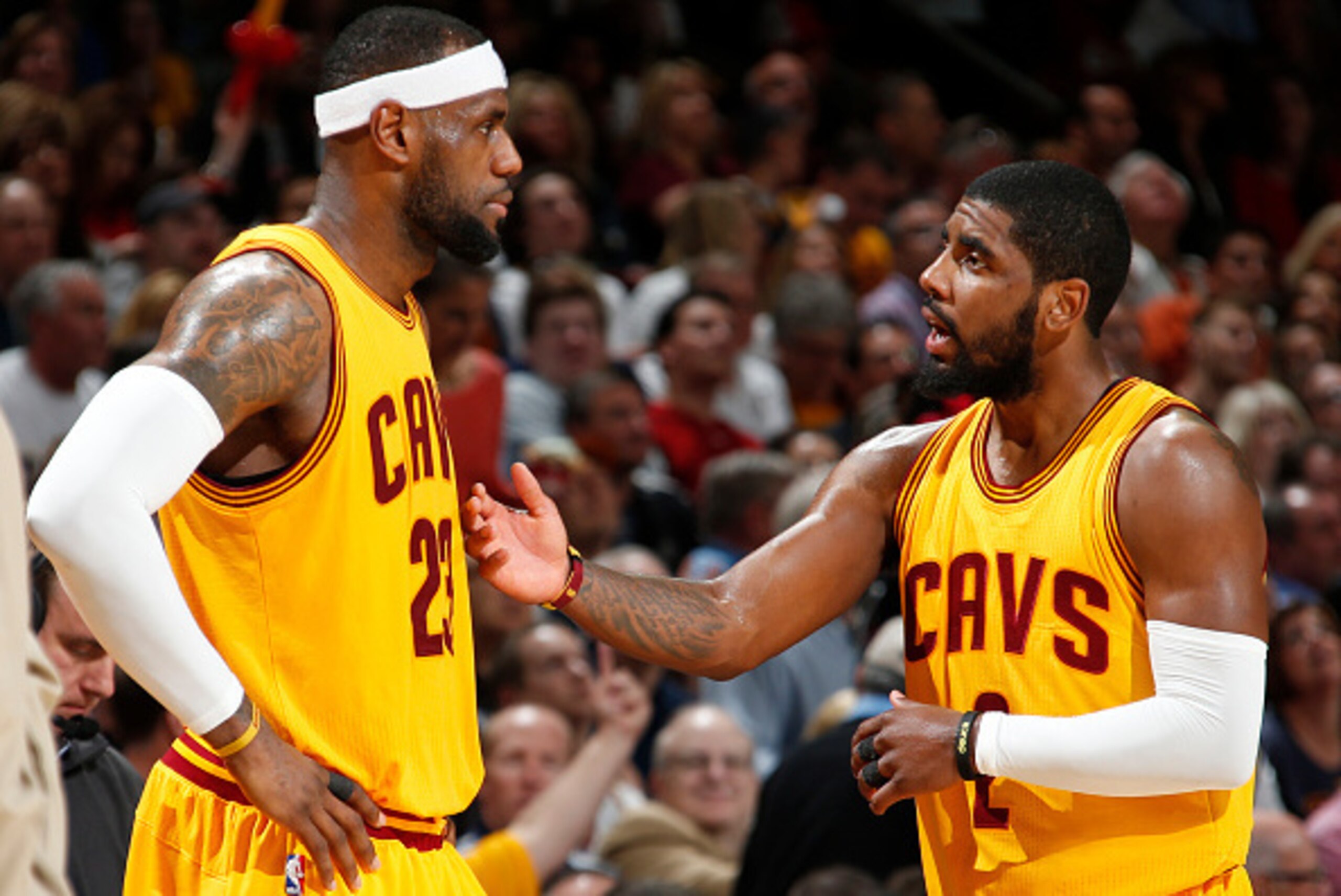
James went on to say that Irving advised him to be ultra-aggressive.
"Which I'm not accustomed to doing," James said. "Especially taking that many shots. I've never been a high volume shooter. But I have to respond to my teammates. What my teammates want me to do, I have to succeed at doing. So if it's a change in mindset for myself, then I have to do it, if that's what my guys want me to do."
Irving made it clear that he did.
"That killer mindset of never stopping," Irving said. "Of just never giving the defense a night off, or any possession. I feel like he definitely did that tonight. There wasn't one possession when he was on the floor, whether it was a pass, a score, a defensive stop, a rebound or anything like that—he was all over it—which we expect him to do. So I feel like when he has that mindset, that killer mindset, not really caring what's going on except for his teammates. He's the greatest player playing in our game right now."
What James showed Wednesday is that he can be that, even when his jump shot is off, as it has been for most of the postseason, and as it was in Game 2—he was 3-of-16 outside of five feet. He can be that, simply through his attacking attitude, making 10-of-13 inside five feet, along with sinking 7-of-9 from the line. He can be that, by putting a team on its heels from the start, so it spends all evening trying to recover.
That's what happened to Chicago on Wednesday, after his initial onslaught. Without question, the Bulls were a little weak on will, seeming satisfied with a split; Derrick Rose called his team "nonchalant." Thibodeau said the difference was "the aggression. We knew their aggression would be better and harder."
It certainly wasn't a secret.
"He did what he said he was going to do," Bulls guard Jimmy Butler said.

It wasn't a secret like the one that prematurely got out—the one about Tristan Thompson starting instead of Mike Miller. That switch was as much for James' comfort and psyche as anything, since he much prefers to start at small forward than power forward, a preference that he made clear in Miami, but which wasn't always accommodated there, especially since he and the Heat were so successful with him manning the 4 spot.
Irving also prefers when James plays small forward, stating after Wednesday's shootaround that he was happy to "get our 3 man back. It was great seeing 'Bron at the 4, but at times, he's getting the rebound just like our bigs, and he's getting it right to me. Our dynamic throughout the whole entire year, and what we've created, is we play off one another. Our bigs get the rebound, me and 'Bron are sprinting to half court already, ready to get our offense started."

As Cleveland coach David Blatt later noted, James ultimately played plenty of power forward Wednesday, as Blatt substituted in smaller players around him. Maybe the change, for the first several minutes—during which James subbed out and then subbed back in with the same four starters—freed his mind to play more aggressively. It likely meant more than the night's other surprise: the return of the cloth around his head—a return that he attributed to a pregame whim. But what mattered most, more than the headband, more than the Bulls finding out about the lineup change and more than the lineup change itself, was that James played with power all night.
With force.
With pace.
"He was aggressive," Jimmy Butler said. "But I wasn't aggressive on defense. It was easy for him. He got to the rim too easily. Lots of layups. Reckless fouling."
What mattered was that James didn't stop, even as, for stretches, his shot stopped falling, even as his shooting percentage started sinking. Efficiency is important, and it should always be. But for these Cavaliers, at this time, their leader's aggression is what will keep them afloat.
Ethan Skolnick covers the NBA for Bleacher Report and is a co-host of NBA Sunday Tip, 9-11 a.m. ET on SiriusXM Bleacher Report Radio. Follow him on Twitter, @EthanJSkolnick.


.jpg?w=2560 "🚨 Tony Romo, CBS Sports Part Ways")
.jpg?w=2560 "Lions Wanted Joey Porter Jr.")
.jpg?w=2560 "McCarthy's 1st Comments on Trade 😲")
.jpg?w=2560 "Rodgers, McCarthy Explain Heated Exchange")