

Is It Panic Time for the Fading Pittsburgh Penguins?
The collapse of the Pittsburgh Penguins over the latter half of 2014-15 NHL season has been spectacular to behold. The team which sat a single point out of first in the Eastern Conference on January 1 has gone four games under 0.500 in the three-plus months since then and now finds itself in serious jeopardy of missing the postseason.
It’s been a stunning transition; looking at the 82-game pace in each segment, essentially the Penguins have gone from being the best team in the league to being the current edition of the Philadelphia Flyers or Colorado Avalanche:
- Penguins through January 1: 23-9-5 (113-point pace)
- Penguins since January 1: 19-17-6 (86-point pace)



What has happened, and what does it mean for the Penguins’ hopes of making the playoffs and then making some noise once they get there?
The first question is whether the drop-off in performance is driven by injuries, and the answer appears to be a resounding “no.” It’s not that the Penguins haven’t had injuries. They have, but the injury situation was actually worse early in the year when the team was winning games.

One way to assess this is to see how many games were played by guys who aren’t really NHL players in the here and now. If we were to make a list of mostly full-time AHL’ers to play games in Pittsburgh this season, we find that for the most part those players saw their action early in the season.
Up front, for example, players such as Scott Wilson, Dominik Uher, Bobby Farnham, Bryan Rust, Jayson Megna and Andrew Ebbett combined for 47 games prior to January 1; the same group has played just 17 games since. The story is similar on the blue line.
Since we can’t just hang Pittsburgh’s problems on injuries, we need to dig deeper. The following is the team’s goal differential in various situations for the two segments of the season:
| Before January 1 | 70 | 27 | 3 | 53 | 5 | 16 |
| Since January 1 | 70 | 22 | 3 | 75 | 3 | 24 |
We’ve seen a small dip on the power play, but it probably is not worth worrying about; the Penguins have gone from putting an elite 58.4 shots per hour on net prior to January 1 to firing 58.3 shots per hour in the time frame since. The team’s shooting percentage has fallen from eighth in the NHL in the first half to 24th in the league in the second half, but given the small number of shots we’re talking about here, it’s probably not worth reading much into that.
The big losses are at even strength, where the Pens went from plus-17 in the first half to minus-five in the second, and on the penalty kill, where the team went from minus-13 to minus-21. There’s a common thread linking the two problems: goaltending.
In both disciplines, Pittsburgh’s save percentage has dropped significantly. At even strength, the team had a 0.934 save percentage at five-on-five and a 0.928 save percentage five-on-four prior to January 1. Since January 1, those numbers are 0.915 and 0.890 respectively.
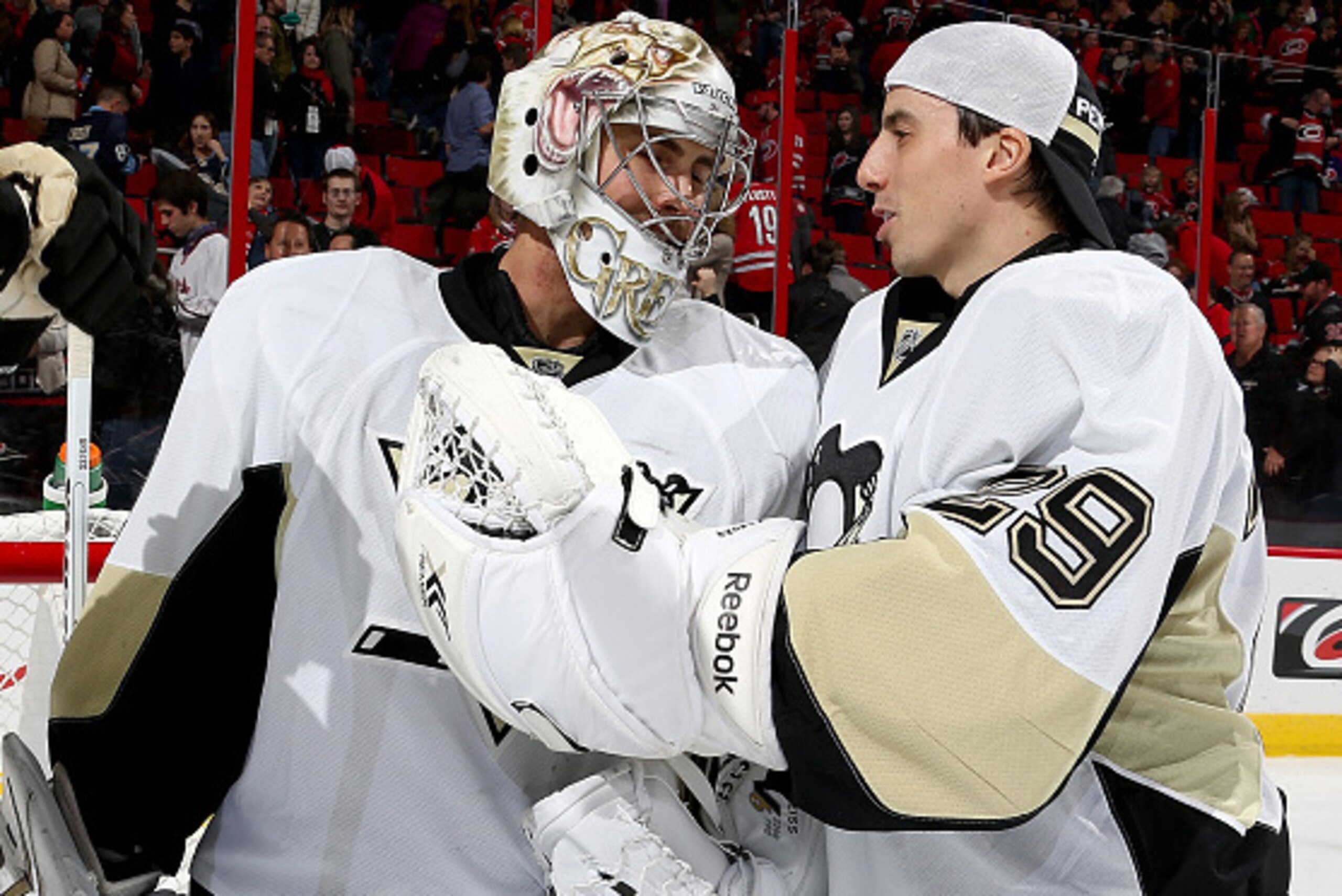
As tempting as it is to place the blame on Marc-Andre Fleury, there is a pretty interesting piece of evidence which suggests that the Penguins defence must shoulder much of the blame. That piece of evidence is the play of backup goalie Thomas Greiss over the same periods.
- Prior to Jan. 1: Fleury, 0.928 SV%; Greiss, 0.919 SV%
- Since Jan. 1: Fleury, 0.911 SV%; Greiss, 0.901 SV%
- Difference: Fleury, minus-0.017; Greiss, minus-0.018
It could be a coincidence that both goalies saw their numbers plummet in the second half, but at the very least it is suggestive that the problem stretches beyond the goaltenders and to the defence more generally. Somehow, Pittsburgh needs to find a way to fix the problem.
It won't be easy to find a solution, and the Penguins have spent the last few months showing that without a quality save percentage they aren’t going to win enough hockey games. Additionally, Fleury’s 0.911 save percentage post-January 1 matches his career numbers exactly; it is entirely possible that whatever was going right for Pittsburgh in the early going simply wasn’t sustainable long-term.
Can the team be better? Certainly. Both the team’s performance over past seasons and its work in the early part of this year show that this roster can perform at an elite level. But with just three games left in the regular season, there isn’t much time for the coaches to make whatever adjustments are necessary.
Statistics courtesy of War-on-Ice.com and NHL.com.
Jonathan Willis covers the NHL for Bleacher Report. Follow him on Twitter for more of his work.
.png?w=2560 "Nikishin Landing Spots")

.jpg?w=2560 "Dak Addresses 'Dumb' Old Romo Tweet 🤣")
.jpg?w=2560 "Bargain Trade Targets After Week 2 Injuries 🏈")

.jpg?w=2560 "Exec: Packers 'Broken' 🫠")