

Dwyane Wade Then vs. Now: How 'Flash' Is Reinventing His Game with Age
At 33 years old and carrying the mileage of 12-plus NBA seasons, Dwyane Wade is not the player he used to be.
This isn't to say that Wade isn't as effective, dominant or potent a scorer. He's still an elite shooting guard capable of carrying the primary offensive load. What's changed is the how and, in particular, the ways in which Wade has adapted his game to stave off Father Time.
Early in Wade's career, he lived off his relentless, basket-attacking mentality. In the 2006 playoffs, he single-handedly carried the Miami Heat to the championship by using his body as a battering ram on the way to the hoop.
TOP NEWS
Brunson Pulls Up to Rucker Park
Ranking Every Team's Trade Assets 📊
Buzz: Kings 'Hesitant' on Kuminga
He shot 97 free throws in six games against the Dallas Mavericks in the Finals that year, good for just a touch more than 16 free-throw attempts per game. To put that in perspective, James Harden currently leads the league in FTAs per game at 10.1, according to NBA.com.
This continual willingness to recklessly throw his body at defenders has taken its toll. Wade has suffered a number of serious and nagging injuries throughout his career, and he hasn't played 70 or more games in a season since the 2010-2011 campaign. Throw in four years of second-banana status with LeBron James and a subpar performance in the 2014 NBA Finals, and the noise signaling his demise sounded off everywhere.
But is Wade truly worse? In some respects, certainly. Multiple deep playoff runs and more than a decade's worth of NBA games will negatively impact any player's athleticism, and Wade is no exception.
His skill level, however, has trended in the opposite direction.
Yet there's still a false correlation being drawn between Wade's athleticism and overall effectiveness. Because his game has always been predicated on explosive leaps and top-notch lateral quickness, the assumption has been that he cannot sustain high levels of play without his bread-and-butter tools.
Sure, he doesn't dunk the ball like he used to. But on a per-minute basis, Wade is mostly the player he used to be. He doesn't score 30 points per game anymore (like he did during the 2008-2009 season) because he both doesn't have to (the existence of Chris Bosh, when healthy, plus Luol Deng and Goran Dragic, limits that necessity) and logistically can't.
In his first season without LeBron since 2009-2010, Wade is averaging 21.6 points on 31.9 minutes per game—which is equivalent to 24.4 points per 36 minutes, or 0.5 points per 36 more than his career average of 23.9.
He's also shooting 48.1 percent from the field, which is only slightly below his career average of 49.1.
In other words, Wade is still putting the ball in the basket at the same level of efficiency. The volume has decreased only because his minutes have as well.
In terms of his tactical approach, the only real difference between then and now is that Wade has improved his touch around the rim, thereby eliminating the need to draw contact and put his body at constant risk.
Brandon Di Perno of Hot Hot Hoops breaks it down further:
"What Wade has now that he didn't have before is a control on possessions. Where Wade used to receive a pass and proceed to sprint towards the rim he now waits, and sizes up his defenders. This is where the jab step has made a world of difference for Wade as he can see how the defender will react, and then either take him down to post up or use a step back to create room for a shot. Wade also has refined his body control and touch from just a few feet out where he can score floaters with ease.
"
It's that last part—the floaters—that has been the biggest change.
How many times have you seen Wade wiggle his way to the rim, only to loft the ball uncomfortably high in the air over the extended hand of a shot-blocker? And how many times have you seen the ball inexplicably fall through the net?
Let's wind it back to 2008-2009, when Wade set a career high with 30.2 points per game. According to Synergy Sports, he attempted 529 shots around the rim. That led the league among non-post-up players, and the next closest player was Brandon Roy at 433.
He also attempted 11 floaters that year. Eleven.
Clearly, his game wasn't about touch. It was about athleticism and power, both of which he had in abundance. This isn't to say he didn't have great finishing ability, because he did. But he challenged shot-blockers and relished contact.
Now let's get back to the present. Only 21.6 percent of Wade's field-goal attempts this season have come around the rim, according to Synergy. That puts him at 316th in the league. That same aggression which propelled his game during the prime of his career has clearly faded.
His floaters, meanwhile, have seen a significant rise. He's already thrown up 100 thus far this season, and his 45 percent success rate is 15th in the league for players who have taken 50 or more, per Synergy.
This difference in shot selection is mostly a function of Wade's newfound commitment to a calculated, less-north-south style of play. In the past, he used one quick crossover, two huge steps and a violent explosion upward to finish.
In this game from 2009 against the New York Knicks, Wade is loosely dribbling the ball at the top of the key as if he's waiting for a ball screen. Then all of a sudden he takes off with a left-to-right crossover from well above the three-point line. Wilson Chandler, his defender, is caught standing basically straight up.
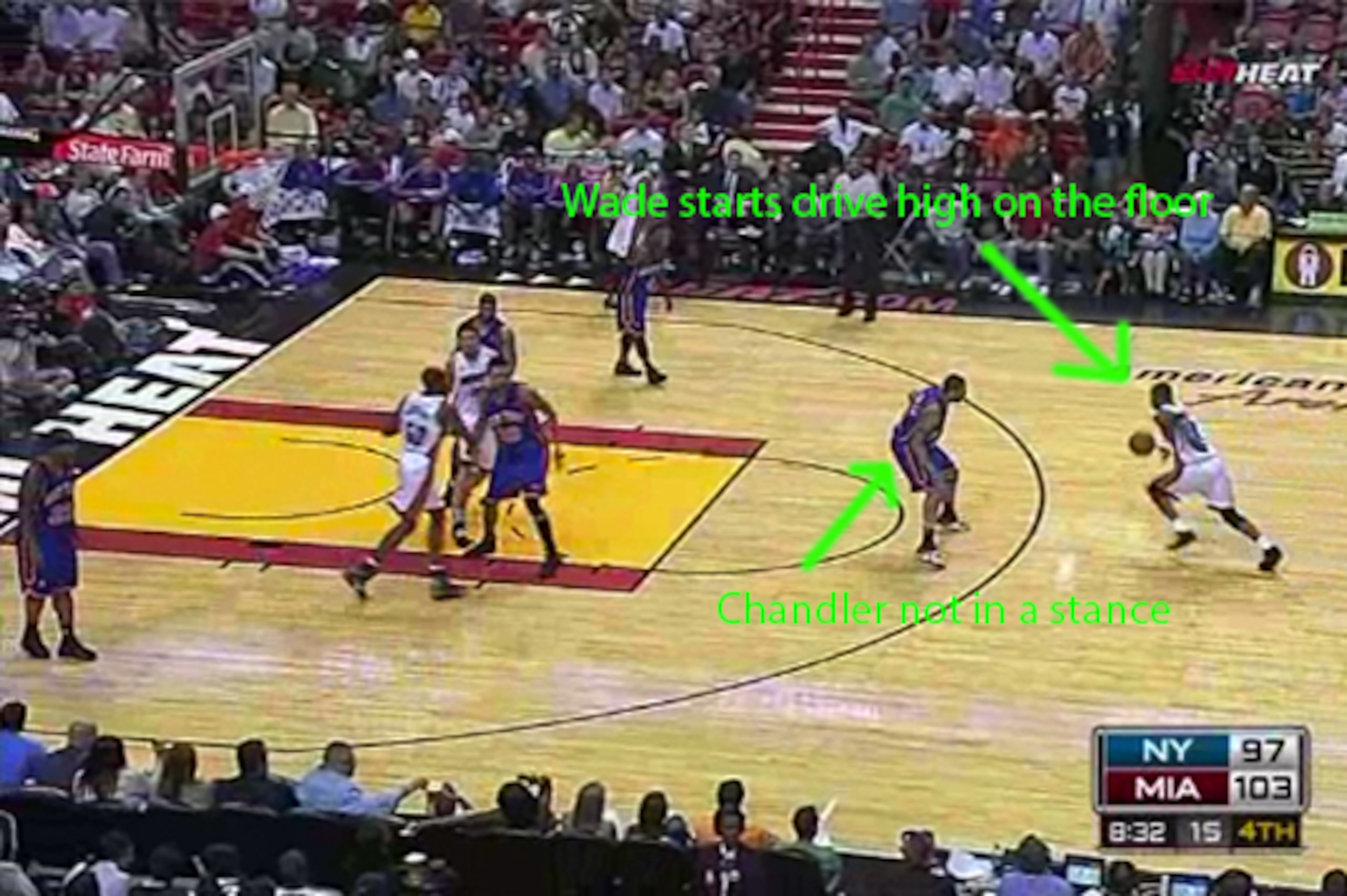
Because Chandler is not in a defensive position, Wade's elite speed carries him all the way to the rim for a layup opportunity. All Chandler can do is body him and hope not to commit a foul.
This move isn't about skill. It isn't about ball-handling, tricky footwork or anything else. It's about pure speed and power. Once Wade gets Chandler on his hip, the defender stands no chance.
The Wade of 2015 is a different beast. He's about creating slivers of space with clever skill and floating up shots through those windows. Because he's less willing to toss himself around like a rag doll, he opts for eight-foot runners instead of seeking two-foot, contact-ridden layups.
The key is that Wade constantly keeps his defender off balance by doing the unexpected. One of his favorite tricks is shooting quick floaters off the pick-and-roll, particularly when the defensive big is dropping back toward the rim and expecting to be challenged at his chin.
On this play against the Portland Trail Blazers, Wade gets an on-ball screen from teammate Hassan Whiteside. More heady ball-handlers try to wrap their dribble around the pick—meaning they slide east-west as they use the screen.
This serves three purposes: First, it naturally pushes the on-ball defender into the screen because he has to fight both around and across it. In essence, Wade forces Arron Afflalo to whip around 270 degrees here.
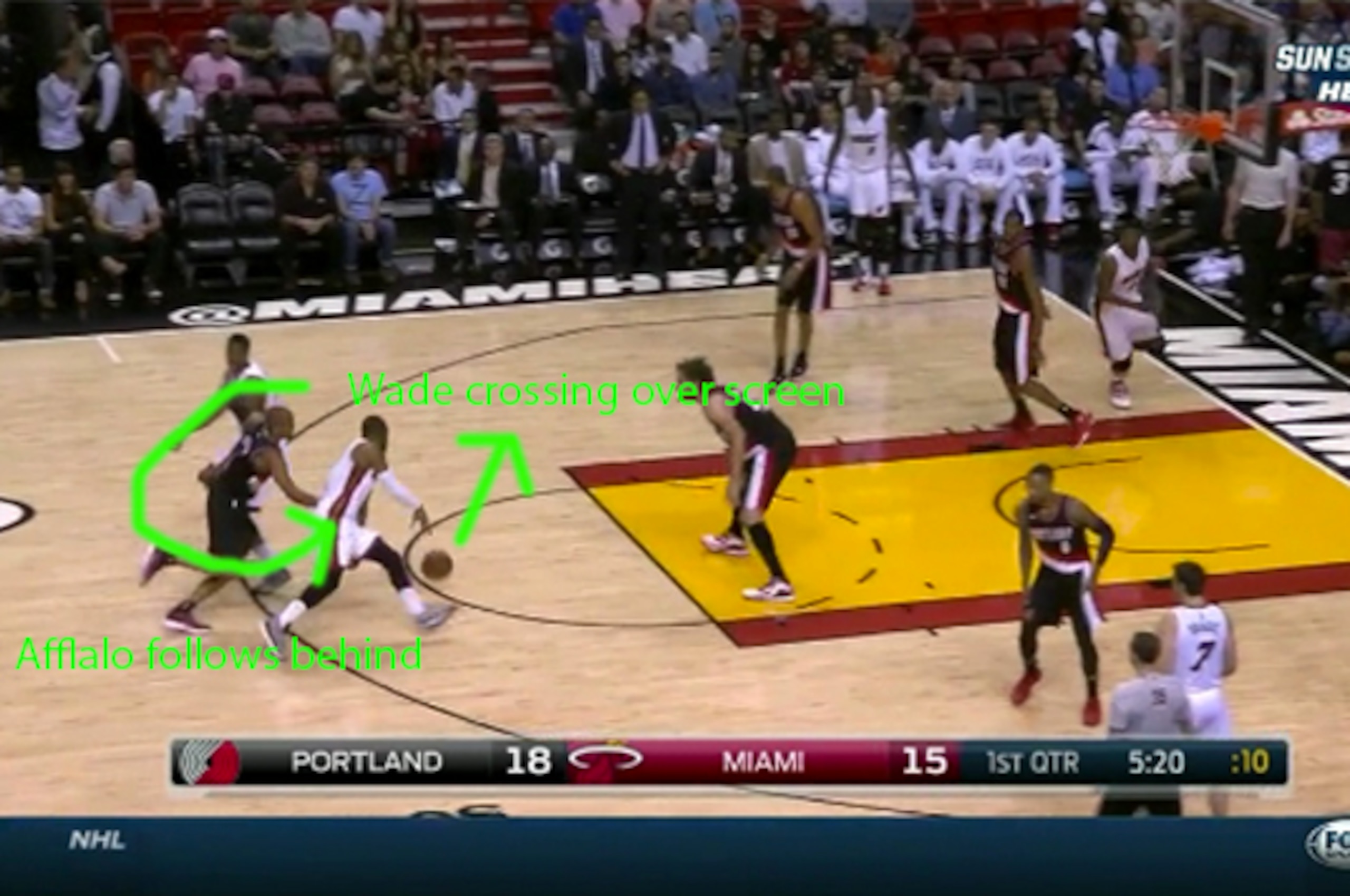
The second is that it makes the defensive big (in this case Robin Lopez) move laterally when he wants to keep dropping vertically. This leaves him more susceptible to changes of direction, particularly those that shift toward the basket. The calmer pace at which he's moving also lends itself to the thinking that a change of speed is coming.
Third, Wade's crisscrossing movement means that Lopez's hands are now involved in helping him stay balanced. This is a crucial point because it means Wade has a brief window of opportunity when Lopez will not be able to contest his shot.
It's in this slot that Wade knocks down a floater.
We also can't sleep on the fact that this right-handed floater from 12 feet while moving left is a difficult shot. Very few players can hit it with any type of consistency, and Wade is one of them.
The final change in Wade's game is where he's initiating his offense from.
In years past, he preferred high pick-and-rolls or isolations that started farther from the hoop. This allowed him to use his greatest assets—speed and athleticism.
Now he's operating out of the post more often.
Back-to-the-basket moves require much more finesse and skill, and it's why dominant post players are such a rare commodity. It's also a common go-to move for scorers on athletic decline, because it allows them to use their immense talents without the physical burden of constant drives to the rim. Michael Jordan and Kobe Bryant made that transition later in their careers, and it extended their primes for a few more years.
This is the perfect change for Wade, who does not have to take a beating from bigs and can use his superior touch against guards who are not used to defending the post. In the 2008-2009 season, Wade attempted 10 field goals from the post, according to Synergy Sports. This season, that number has spiked to 135 post-up FGAs, and we're not even through the entire season yet.
In an interview with Sekou Smith of NBA.com earlier this season, Wade acknowledged how his offensive style has changed:
"I came in as a point guard and now I’m a post-up player [still laughing] … I mean, I do pick and rolls now, but I came in as a point guard and we run most of our post-ups now for me. So you have to understand that the game evolves, the world evolves, the world around you evolves.
"
Wade isn't like most players in that he catches the ball with his back to the basket. He likes to dribble into the post, using half-spins and other guard-like dribble moves to ease into the position he wants. With his defender being worried about a quick explosion to the rim, all he has to do is use simple feints to get to quick hooks and other finesse shots.
Here, against, Dion Waiters of the Oklahoma City Thunder, Wade hits him with a quick between-the-legs dribble as if he's about to drive the ball. Waiters backs up appropriately, allowing Wade the requisite space to flip his body around and get into the post.
Waiters isn't a good defender, let alone capable in the post. All Wade has to do now is give him a bit of contact with a single dribble, then rise up and sink the floating hook.
It's particularly clever because of the speed at which it occurs. Wade isn't exactly making his intentions known by stalking his way toward the hoop. When Enes Kanter, the help defender, first peers over at Wade, he's 20 feet away from the rim and not in a dangerous position to defend.
But all of a sudden, Wade backs into the post, makes one quick move and launches the shot. Kanter cannot get over in time to contest.
The way Wade plays offensive basketball now has a lot more sustainability than his pedal-to-the-metal style from earlier in his career. While he'll never completely eliminate the wear and tear experienced by most ball-dominators, this type of change in play can at least provide some relief.
He's also smarter now and knows how and when to pick his spots. He doesn't have to try to score on every possession. He's a better ball-mover and has solid teammates who can create both for themselves and others.
Whether or not Wade wins another championship remains to be seen, and it will probably be more a result of how Pat Riley builds the Heat roster. But Riley can count on Wade being a high-level piece on any championship contender he puts together.
Barring injury, Wade can likely continue being a top-shelf NBA shooting guard for at least two or three more years.
He's been counted out multiple times before. It would be foolish to do it again.

.jpg?w=2560 "Love Not Playing in HOF Game")

