

Frank Gore Brings Steadying Force to Colts Run Game
All of Indiana, and even some of the national media, is abuzz about big names joining the Indianapolis Colts this season.
The big-name running back, Frank Gore, recently sat down with Josina Anderson of ESPN for a one-on-one interview that aired at prime time on SportsCenter. That's just one example of the attention that these stars garner.
But a weight also comes with that stardom, a weight and pressure to perform. For Gore, it's the pressure to rejuvenate the Colts running game, which has been anemic with Trent Richardson as the focal back over the last two years. With Gore, the Colts are supposed to have balance, something that was dreadfully missed a year ago.
TOP NEWS

New NFL contenders starting to emerge after Week 4
.jpg?w=2560 "Cardinals Giants Football")
NFL investigating 2 referees for separate viral exchanges
.jpg?w=2560 "Hill Injury Update Football")
Report: Chiefs Contact Hill's Agent
The magic number for running backs is 1,000. That is the benchmark yardage number for running backs, even if it doesn't really make sense in a lot of situations. For some, like Nat Newell of the Indianapolis Star, it's the baseline for a successful season for a running back.
"Is Frank Gore still a 1,000-yard back?"
That was the reasoning for Newell and others' initial backlash for the move.
And in reality, Gore isn't likely a 1,000-yard back in 2015. But that's not because he doesn't have anything left, it's because of the situation. Gore isn't a bell-cow back anymore, and he's not getting paid like one. He's a back that belongs in a committee, and that's likely exactly how the Colts will use him.
No, Gore wasn't brought in to be the star that he once was. Instead, Gore has a crucial role to fill as a steadying force for the Colts running game.
Consistent "Plus" Yards
One way to illustrate Gore's tendencies as a back, even an older one, is to break down where he wins.
No, Gore isn't an explosive, big-play threat, and his body isn't young enough to make jaw-dropping plays by avoiding and running through defenders with ease. Gore was 28th out of 42 qualifying backs in Pro Football Focus' Elusive Rating in 2014, for example.
But Gore still produces, and in good-sized chunks.
| Percentage of Attempts (2014) | 20.0% | 43.9% | 31.4% | 4.7% | 36.1% |
| League Rank (32 qualifiers) | 11th | 28th | 7th | 17th | 7th |
"Plus yards" are what I call five yards or more on a rushing attempt. While four yards is often the baseline, the average rushing attempt is slightly higher than four yards—4.16 in 2014, per Pro-Football-Reference.com.
Five yards or more are your chunk plays, your rushing plays that demoralize a defense and consistently put the offense in a more advantageous position.
In this category, Gore was one of the league's best in 2014, despite not being a particularly explosive back. The percentage of runs he had stuffed were a little high, but he more than made up for it with consistent "plus" plays. It's a big part of why Gore finished 11th among 43 qualifying running backs in Football Outsiders' success rate in 2014.
But if we know that Gore's body is declining, how can we be so sure that he'll continue to be effective in Indianapolis?
The biggest reason for me is that the places where Gore wins are not physical, they are cognitive and instinctive. Gore's game isn't reliant on his running over defenders or outracing them to the corner. It's based on patience and a keen understanding of how to use blockers and angles to create space between he and defenders.
This is the biggest difference between Gore and a back like Trent Richardson.
Take a look at this 13-yard run against the San Diego Chargers in Week 16, for example:
For many, the initial penetration in the backfield would lead to panic and the back trying to either plow into the pile for a guaranteed one or two yards or trying to bounce it outside.
But Gore doesn't panic, senses where the left side of the line is moving and stutter-steps for a half-second in the backfield before bursting between the two penetrating defenders into open space. This is exactly the kind of play that the Colts need from Gore, and it will serve younger backs well to learn from him in that regard.
What we see at the end of this play is another quality that Gore possesses, and that's the tendency to do everything in his power to follow his blockers and keep a teammate between himself and defenders for as long as possible.
In this case, the advantage he may or may not have gained is minute. But in other situations, especially near the line of scrimmage, it's critical.
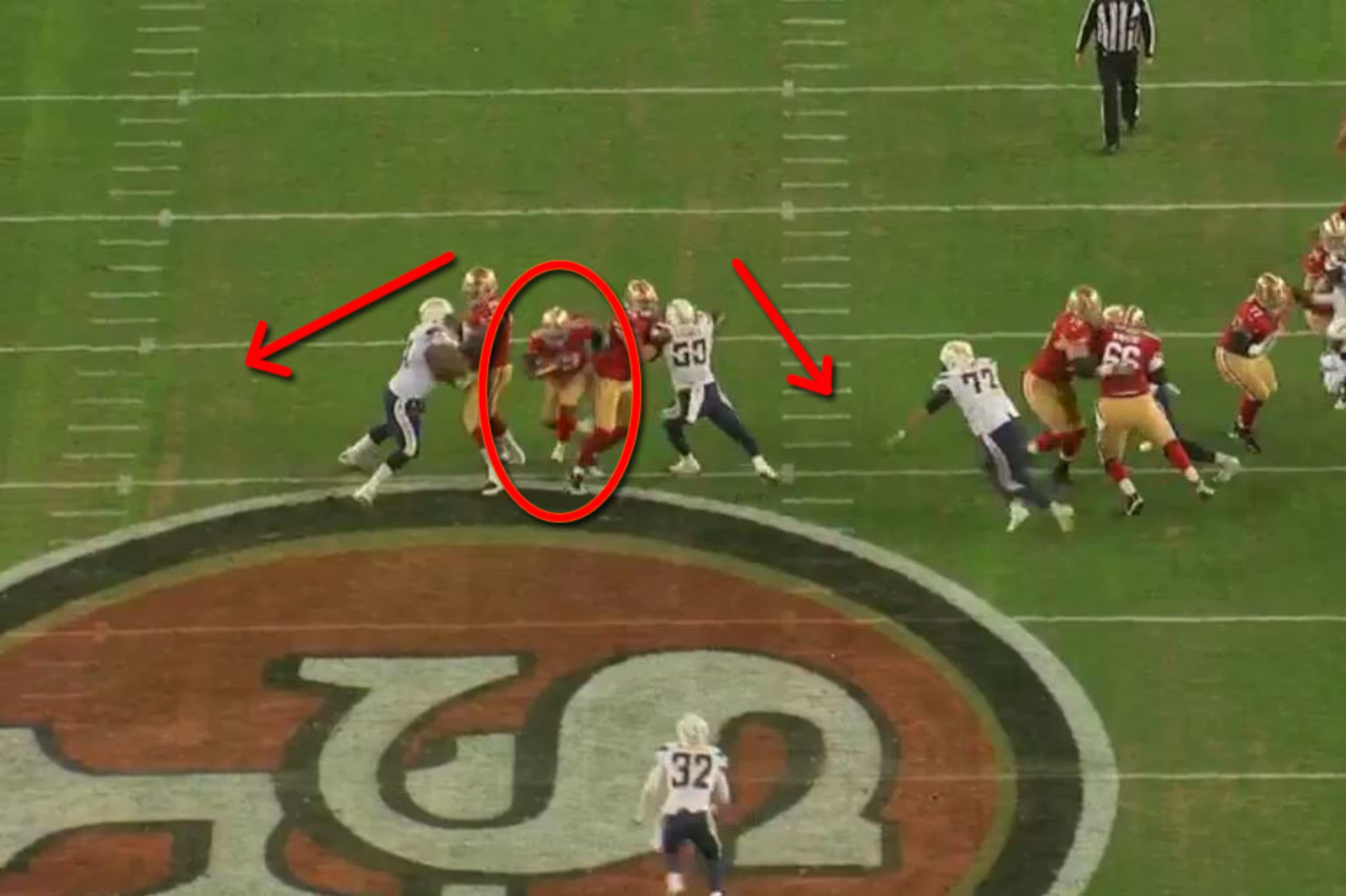
On this particular play, many backs would have tried to go on either side of the linemen, attempting to race past the defenders before they could disengage from their blocks. But Gore knows his limitations. He knows that he's not a particularly fast or explosive back, and trying to reach the edge or run through a disengaging defender would be a risky play.
Instead, he squeezes through the linemen at just the right moment and manages to gain eight yards on the run.
Gore's sense of angles and momentum is what is unique, and it keeps defenders from getting an easy read on him. On some plays, it's Gore ensuring a lineman is between him and a defender. On others, it's Gore angling his run in such a way that linebackers overpursue to a nonexistent running lane, leaving a wide-open lane for Gore to hit with a slight redirection:

Here, Gore takes a draw and starts to cut toward the outside, and both of the Seattle linebackers bite hard to the right. But then Gore disappears behind the offensive lineman and cuts back at the last possible second to leave the defenders completely out of position:
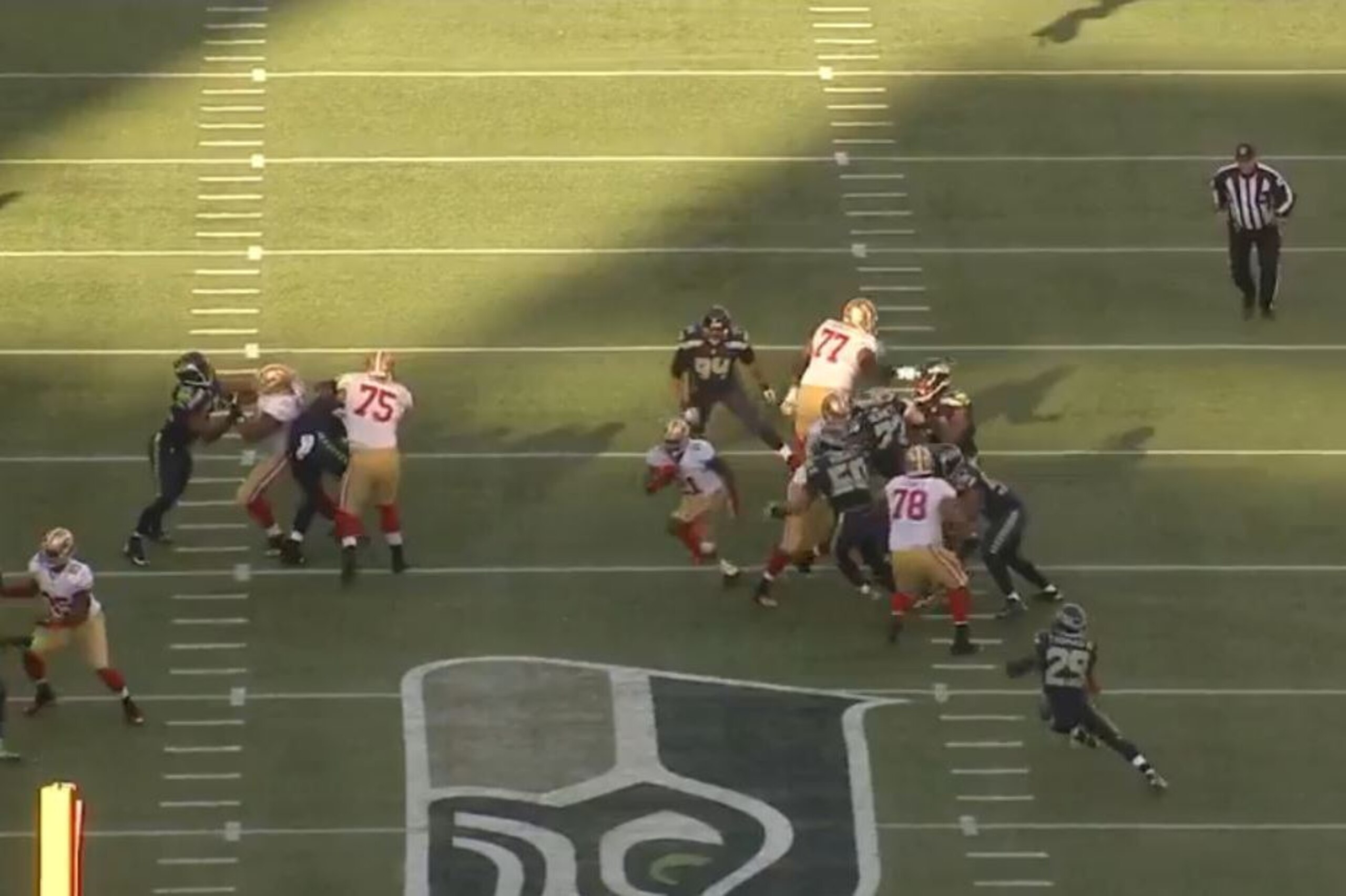
You can view the full play here.
Gore isn't the spring chicken he once was, but he still has the footwork to change direction quickly and keep his balance in tight situations.
All of these clips came from the last few games of the 2014 season, and unless Gore hits a total wall in the offseason, he should have plenty of foot skills to continue to excel.
With Gore's willingness to follow each play and his more than adequate strength through the hole, he doesn't need young speed or explosive burst. He just needs to stay healthy.
And if there's one thing that Gore has done well over the last four years, it's stay healthy.
With an active streak of 60 consecutive starts, Gore is the current league leader in running back starts, according to the NFL Game Statistics and Information System. Of course, as one ages, they start to break down, and Gore isn't immortal.
But the Colts can help restrict that wear and tear by limiting his carries and using him as a part of a committee. This will be especially helpful if the Colts draft a rookie running back.
Even if they don't, however, Gore isn't going to become the Colts' bell cow. The Colts are Andrew Luck's team, with passing as the main weapon of choice. Gore won't be asked to dominate for long stretches, just to be efficient and effective. Throw in his well-tuned pass-blocking skills, and you understand where this is headed.
Gore isn't supposed to carry the offense, but he should help steady the load on Andrew Luck's shoulders.
.jpg?w=2560 "Titans Giants Football")
.jpg?w=2560 "Dolphins Bills Football")




