Sorting out the Toronto Raptors' Rotation Ahead of the NBA Playoffs
Dwane Casey's rotation decisions for the Toronto Raptors have been mired in controversy for the better part of the 2014-15 regular season.
Why isn't Jonas Valanciunas on the floor late in games? Can a balance be found between Terrence Ross' and James Johnson's minutes?
In a perfect world, those and a litany of other issues would be addressed before the team embarks on its second straight trip to the postseason.


Dwane Casey's Approach to His Lineups
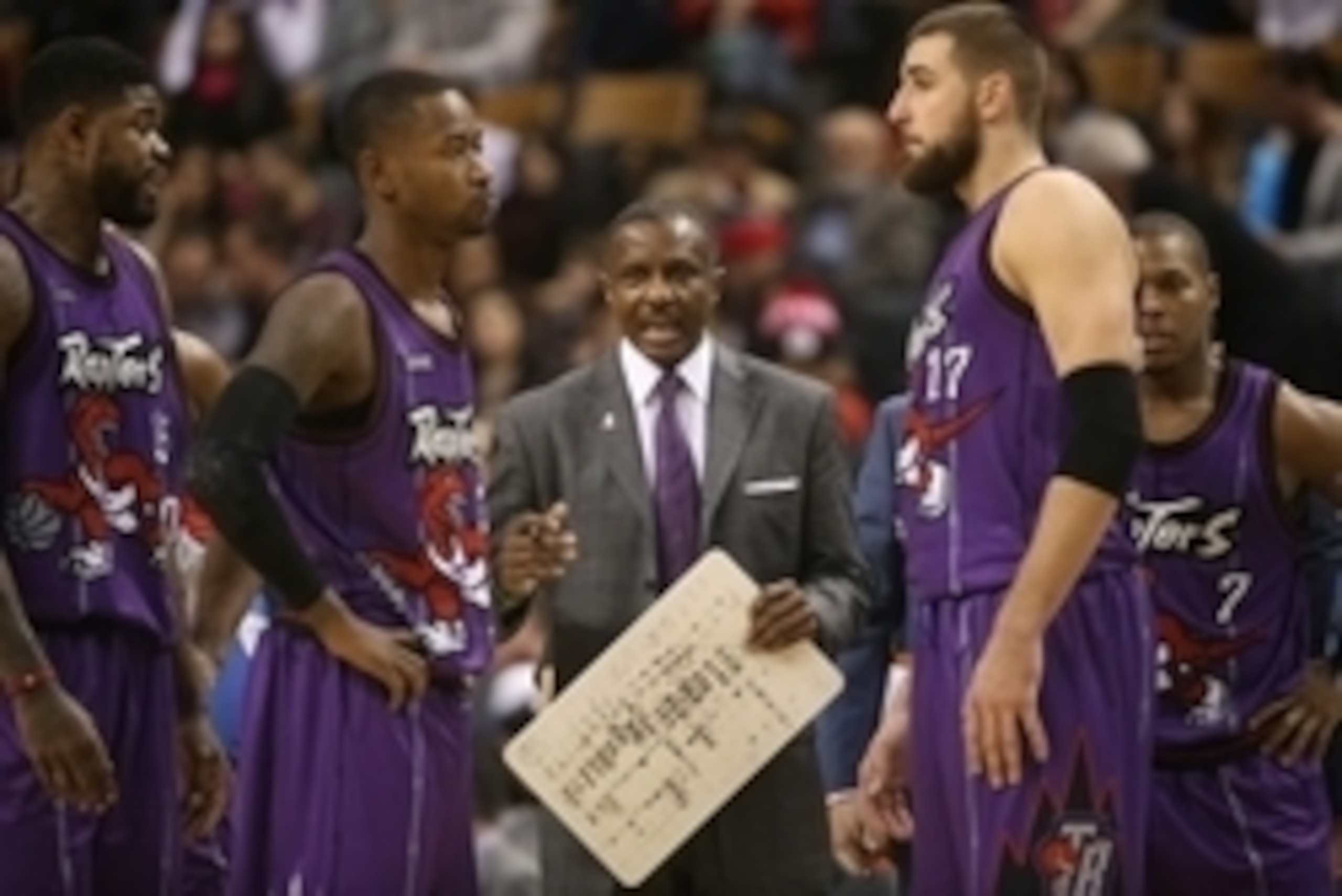
Casey's go-to lineup of Kyle Lowry, DeMar DeRozan, Ross, Amir Johnson and Valanciunas will likely be his starting five for the playoffs. Though that five-man unit has had its problems, the strength of the bench behind it could be its saving grace, as Eric Koreen of the National Post pointed out:
"The Raptors' current starting unit — Kyle Lowry, DeRozan, Terrence Ross, Amir Johnson and Jonas Valanciunas — has been a liability for the Raptors. Heading into Monday’s game at Indiana, it has allowed 0.4 points per 100 possessions more than it has scored. It is also the lineup Dwane Casey has used most often.
For the Raptors, this is not especially surprising: Unlike a lot of the league’s best teams, the Raptors rely on their depth, rather than a small core of rotation players. It is likely that their bench would be their strong suit, regardless of its composition, because those lineups are more talented than their opponents’ benches. As well, developing Ross and Valanciunas as players is a priority for the Raptors, hence their continued presence among the starters. However, they are two of the most uneven players on the roster.
"
Casey has trotted out 11 different starting lineups over the course of the season, the majority of them coming as a result of an injury. There was no need to tinker with a winning formula.
Moving Ross to the bench from Jan. 19 to March 4 was designed to reinvigorate a struggling swingman who was dealing with lapses in confidence. Giving Patrick Patterson the start on Feb. 27 against the Golden State Warriors was simply Casey's way of experimenting and trying new things.

All of the prior adjustments made by the head coach have ultimately led us back to the same starting lineup and a similar rotation with which the Raptors began the year.
Change for the sake of change is unnecessary. Casey knows this. There was always a rationale behind every move he made, even if his moves were few and far between.
His complacency with the rotation doesn't make it an impeccable product, though. He's merely found a comfort level with playing certain guys at certain times in specific lineups.
Whether he's right or wrong in operating this way remains to be seen. That will ultimately be determined in the NBA playoffs as Toronto looks to win the first seven-game series in franchise history.
Perhaps re-evaluating the way he allocates his minutes and placing more faith in some of his players could improve the odds. Then again, maybe Casey is so set in his ways that it's asking too much of him.
Jonas Valanciunas' Role Moving Forward

The Raptors' 113-97 loss to the Portland Trail Blazers on March 15 was the latest example Casey's failure to utilize Valanciunas to the fullest.
The big man had 12 points and seven rebounds on a perfect 6-of-6 from the floor through three quarters. He was facing little resistance from Robin Lopez, who has a reputation around the league for being a quality interior defender.
That should have been enough to warrant some sort of run in the fourth quarter, right?
Not on that day, as Dave Zarum of Sportsnet.ca noted:
"Yet when the Raptors were making their brief fourth-quarter run and starters were brought back on the floor, the big man remained on the bench as his coach favoured the defensive mobility offered by the likes of Patterson instead. By the time Valanciunas did check in, with 3:30 left on the clock, the game was already well out of hand. He managed a pair of boards and another basket in a whopping 1:47 minutes of fourth-quarter action, as moving away from Valanciunas late in games—apparently regardless of his performance—continues to be a theme.
When the Raptors were winning, it was perfectly defensible. Now that they’re not, and with the playoffs around the corner, it’s yet another worrying trend for this club.
"
It's easy to get mesmerized by Valanciunas' long-term potential at the 5. He's become much more adept around the basket, having worked on his arsenal of post moves over a summer with NBA Hall of Famer Hakeem Olajuwon.
Casey may be justified in not using Valanciunas late in games, though, as Koreen explained:
"Valanciunas has the worst net rating of any rotation player on the Raptors. (Interestingly, his presence hurts the team’s offence more than its defence.) The Toronto defence calls for strong hedging on pick-and-rolls and lots of scrambling to chase three-point shooters off of their mark, and Valanciunas' lack of speed works against that strategy.
"
He averages 5.2 minutes in fourth quarters, which is ninth-most on the Raptors. That number was slightly lower against the Brooklyn Nets in the 2013-14 playoffs at 5.1.
While his defensive game remains a work in progress, Valanciunas' size at the rim and ability to crash the glass provide enough immediate value to compensate.
Casey expressed his regret in benching Valanciunas for the fourth quarter in a 103-94 loss to the Charlotte Hornets on March 6, per RaptorsRepublic.com: "We were in scramble mode. I probably should’ve got him back in, but I thought the scramble group of Amir, Patterson and James Johnson was going to give us a little more speed and quickness, but it totalled us on the boards."
Teams tend to run more half-court offensive sets in the postseason as the pace of games slow down. Valanciunas, who averaged a near double-double of 10.9 points and 9.7 rebounds against the Nets, should excel in an environment where he doesn't need to zoom up and down the court as often.
Just don't lose your cool if he's not on the hardwood in crunch time. He'll be there if it's warranted. If not, you can point the finger at Casey.
Terrence Ross or James Johnson?
One of the reasons Masai Ujiri signed Johnson to his two-year, $5 million deal was to have a lockdown defender against some of the NBA's top wings.
His services would have made a world of difference against the Nets in the 2014 playoffs, as Joe Johnson and Paul Pierce combined to average 35.3 points in the series.
The hope was that the 24-year-old Ross could evolve into a defensive weapon, but his regression across the board has put a stop to those plans for the time being.
So why is it that Casey insists on putting the consistent Johnson on the back burner in favor of the unreliable Ross?
| Player | Minutes | Points | FG% | 3P% | Rebounds | OffRtg | DefRtg |
| James Johnson | 20.4 | 8.2 | 59.8 | 23.8 | 3.9 | 107.9 | 101.2 |
| Terrence Ross | 25.2 | 9.8 | 40.5 | 37.8 | 2.9 | 109.4 | 108.3 |
It could have something to do with Ross' mental toughness. Kiyan Sobhani of Raptors Republic elaborated:
"In hindsight, you can conclude that the experiment to demote Ross failed. Nothing wrong with Dwane Casey coming to grips with that reality either. The team started to slump, and Terrence Ross died a little inside.
Ross’ confidence has been battered, and he’s mentally too fragile to handle it. Being around these guys you can see their emotions off the court too. There is a difference between the mental state of Jonas Valanciunas, and that of Terrence Ross. The former gets distraught with lack of playing time but continues to play efficient basketball in his limited minutes; and the latter gets completely rattled emotionally, to the point where he can barely speak, and it dramatically affects his form on the court.
"
"We're not giving up on him," said Casey about Ross on Jan. 18, per Josh Lewenberg of TSN.ca. "He's a young man. All those [young] players, like I've always said, they're going to be up-and-down. We've just got to help him any way we can."
How long does Ross' leash go, though?
He's incredibly one-dimensional on offense, relying heavily on three-pointers for his scoring. According to NBA.com, 55.2 percent of Ross' points come from behind the arc.
What's worse is how much of a wreck he's become defensively. His athleticism and lateral quickness should be enough to make him a passable defender, yet his lack of intensity on that end and low basketball IQ continue to hold him back.
The complete opposite can be said for Johnson, though, as Zach Lowe of Grantland acknowledged: "Johnson remains a non-shooter, but he’s smart about cutting into gaps when defenders drift away from him. He’s a plus defender, and the flailing Raps, down to 24th in points allowed per possession, could use more of him—both on the wing and as a small-ball power forward in the right matchups.
There wouldn't be a debate if Johnson could consistently knock down three-pointers. Having a three-point marksman next to DeRozan and Lowry opens up lanes for the Raptors' two most important players to get to the hoop.
Ross' ability to stretch the floor gives his role with the Raptors a pulse. Otherwise, Johnson would be the one racking up the minutes as the starting small forward.
Casey is all about winning games while developing his young talent. Throwing Ross back in the lion's den in the opening round would accomplish the latter. Putting Johnson in the driver's seat gives the Raptors more of a fighting chance to emerge victorious, if only because he's a proven commodity.
The Ideal Rotation
| Player | Minutes | Points | OffRtg | DefRtg |
| DeMar DeRozan | 40.3 | 23.9 | 106.4 | 110.7 |
| Kyle Lowry | 38.8 | 21.1 | 104.6 | 107.0 |
| Jonas Valanciunas | 28.6 | 10.9 | 99.2 | 115.6 |
| Patrick Patterson | 28.5 | 10.4 | 110.4 | 105.0 |
| Amir Johnson | 27.3 | 11.0 | 101.9 | 113.2 |
| Greivis Vasquez | 27.1 | 10.1 | 108.1 | 98.7 |
| Terrence Ross | 22.5 | 5.0 | 104.7 | 115.7 |
The Raptors will be entering the first round with a deeper roster than they had last year.

They still have a core of seven players who averaged the most minutes in the Brooklyn series, as well as the additions of James Johnson and NBA Sixth Man of the Year candidate Lou Williams.
Johnson is slowly being moved out of the picture, averaging 11.5 minutes over his last five games and receiving a DNP against the Indiana Pacers on March 16. That could change during the postseason, but if there's going to be a casualty of a tighter rotation, it will probably be him.
The Raptors will need Williams' 15.2 points off the bench, so his spot is secure. The Raptors' offensive rating drops from 110.6 to 104.8 when he's off the floor, per NBA.com.
Lowry isn't at risk of seeing his minutes diminish. Casey elected to sit Lowry for three games from Feb. 28 to March 4 to give his All-Star some much-needed rest during the final stretch of the season. That could be the case again in the weeks ahead if Toronto locks down its seeding.
Patterson averaged over a minute more than starter Amir Johnson in the playoffs last year. Expect a similar situation this time around as Casey looks to keep Johnson and his ankles healthy.
It will be put-up-or-shut-up time for Ross, whose future with the team could be riding on how he fares in the opening round. As safe as he appears to be, there has to be a line drawn somewhere.
| Player | Minutes (2013-14) | Projected Minutes (2014-15) |
| DeMar DeRozan | 40.3 | 36.9 |
| Kyle Lowry | 38.8 | 39.2 |
| Jonas Valanciunas | 28.6 | 26.1 |
| Patrick Patterson | 28.5 | 28.5 |
| Amir Johnson | 27.3 | 25.3 |
| Greivis Vasquez | 27.1 | 29.1 |
| Terrence Ross | 22.5 | 18.2 |
| Lou Williams | N/A | 28.4 |
| James Johnson | N/A | 12.1 |
Conclusion
According to John Schuhmann of NBA.com, the Raptors have the easiest remaining schedule in the Eastern Conference, with a cumulative opponent winning percentage of .404. They'll play 12 of their final 15 games against teams with records below the .500 mark; they're 25-7 on the season against those opponents.
This would be the perfect time for Casey to test the waters with any modified lineups, yet the chances of that happening are slim to none. He'll be more focused on getting some of his key players rested up for the journey ahead, rather than shuffle the deck and allow things to go awry.
All statistics are provided by NBA.com/stats and Basketball-Reference.com.
Christopher Walder is a Featured Columnist for the Toronto Raptors at Bleacher Report. He's also a staff writer for Raptors HQ at SB Nation. You may follow him on Twitter at @WalderSports.


.jpg?w=2560 "Goodell Explains Pro Bowl Decision")
.jpg?w=2560 "Steelers Rework DK's Deal")
.jpg?w=2560 "Biggest Draft Risers 📈")