Despite Age, Andre Johnson Can Still Be a Star Receiver in the NFL
Throw a stone into the past 10 years of NFL seasons. Did you hit a Hall of Fame wide receiver? No? Throw a second, because chances are you'll hit one...or one of them will catch it.
Maybe it's simply a cyclical shift, maybe it's the result of a philosophical change at lower levels, or maybe it's the result of rule changes that the NFL has made. Either way, the NFL has been stacked with talent at the wide receiver position over the past decade.
Players such as Randy Moss, Calvin Johnson, Larry Fitzgerald and Terrell Owens will walk into the Hall of Fame someday. Others such as Steve Smith, Anquan Boldin, Wes Welker, Reggie Wayne, Marvin Harrison, Isaac Bruce, Torry Holt and Brandon Marshall aren't locks but will have strong resumes to present.
TOP NEWS

New NFL contenders starting to emerge after Week 4
.jpg?w=2560 "Cardinals Giants Football")
Love's Body Already 'Tired'
Vrabel Trolls CJGJ After WR Shade
Younger talents such as Dez Bryant, A.J. Green, Julio Jones, Antonio Brown and Jordy Nelson have the individual quality but need to build longevity.
Although often overlooked, Houston Texans wide receiver Andre Johnson should be a Hall of Fame inductee at some point in the future. Even in this era of bloated statistical production and heightened level of receiver talent, his credentials are as impressive as anyone's.
According to Pro Football Reference, Johnson has seven Pro Bowl selections and two first-team All-Pro selections (13 in total if you include media selections). He also has led the league in receptions twice and in receiving yards twice. Incredibly, he has ranked either first or second in receiving yards per game five times.
While his career isn't over yet, the 33-year-old Johnson already ranks in the top 10 for receptions all-time at ninth overall and in the top 15 in receiving yards at 12th overall.
His achievements are eye-catching, but they alone don't do his performances over the years justice. Unlike most hyperproductive players, Johnson didn't spend most of his career playing with great quarterbacks in pass-heavy offenses.
For the majority of his career, he has either played with an incompetent quarterback or in a run-oriented offense. There were stretches when he suffered both at the same time.
The former University of Miami wide receiver was the third overall pick in the 2003 draft. He was the second first-round pick in the history of the Texans, an expansion franchise that had selected quarterback David Carr the previous year. While Johnson lived up to his potential, Carr couldn't sniff his over his six years in Houston.
Carr's failures were linked to the overall quality of the roster, which ultimately led to the firing of head coach Dom Capers.
Gary Kubiak took over the head coaching role in 2006 and replaced Carr with Matt Schaub for the 2007 season. Schaub and Kubiak brought competence to the offensive side of the ball, combining to create an average offense. Johnson was still not working with a great quarterback, but Schaub could at least provide him with consistent opportunities to make plays.
From 2006 to 2013, Johnson caught at least 100 passes during every season when he didn't miss games through injury.
There's no doubt that Schaub is the best quarterback that Johnson has ever played with. Over his 12 seasons in Houston, the Texans have had 13 quarterbacks attempt a pass during the regular season. The list after Schaub is a litany of players who were only worthy of being backups at the time.
| Matt Schaub | 2007 | 2013 | 90 | 88 |
| David Carr | 2003 | 2006 | 60 | 59 |
| Sage Rosenfels | 2006 | 2008 | 20 | 10 |
| Case Keenum | 2012 | 2014 | 10 | §0 |
| Ryan Fitzpatrick | 2014 | 2014 | 12 | §1 |
| T.J. Yates | 2011 | 2013 | 13 | 4 |
| Tony Banks | 2003 | 2005 | 15 | 2 |
| Ryan Mallett | 2014 | 2014 | 3 | 1 |
| Dave Ragone | 2003 | 2003 | 2 | 1 |
| Jake Delhomme | 2011 | 2011 | 1 | 0 |
| Tom Savage | 2014 | 2014 | 2 | 0 |
| Matt Leinart | 2011 | 2011 | 2 | 1 |
| Rex Grossman | 2009 | 2009 | 1 | 0 |
Playing with these kinds of quarterbacks is always going to hamper a wide receiver's production. Johnson's statistical output is even more impressive when you consider the context in which he achieved it.
It should be noted that these quarterbacks and the lack of a viable starting receiver across from him likely meant that Johnson got more opportunities. The quality of those targets obviously suffered, though.
For Johnson to reach his potential as a receiver, he should have left the Texans years ago. Instead, he is going to have to settle for a better-late-than-never situation.
The Texans have decided to move on from the greatest player in their short history (side note: J.J. Watt is on track to take that mantle from him in the future). The team has given him permission to seek a trade, but that seems unlikely because of his sizable contract.
Without an unlikely trade partner, Johnson should become a free agent at some point soon.
Even at this stage of his career, he is still the most talented free agent available on the open market. He obviously doesn't present the most value on a long-term deal, but on a short-term contract he offers the most immediate upside.
Johnson has everything. He is a precise, balanced and quick route-runner. He has the strength, fluidity and ball skills to beat defensive backs at the catch point and adjust to poorly thrown passes with consistency. His physical tools in space aren't what they were five seasons ago, but he is still capable of breaking off big plays when given the opportunity.
Big plays and touchdowns have been the two knocks on Johnson.
Those criticisms have always come across as short-sighted. Whenever a big play or a touchdown occurs, it is the result of a connection between two players. That can be said for every single play a wide receiver makes, but typically big plays and touchdowns are tougher to come by when you have a limited quarterback.
Hence, Johnson's number of big plays and touchdowns through his career can't be measured against those of other receivers in the league.
These two charts look at where Johnson's catchable targets have occurred over the past two seasons. The first chart looks at the 2013 season, Kubiak and Schaub's last in Houston, while the second chart looks at the most recent season, the first under Bill O'Brien.
Both of these charts highlight how Johnson's situation severely hurt his touchdown potential over the past two years.
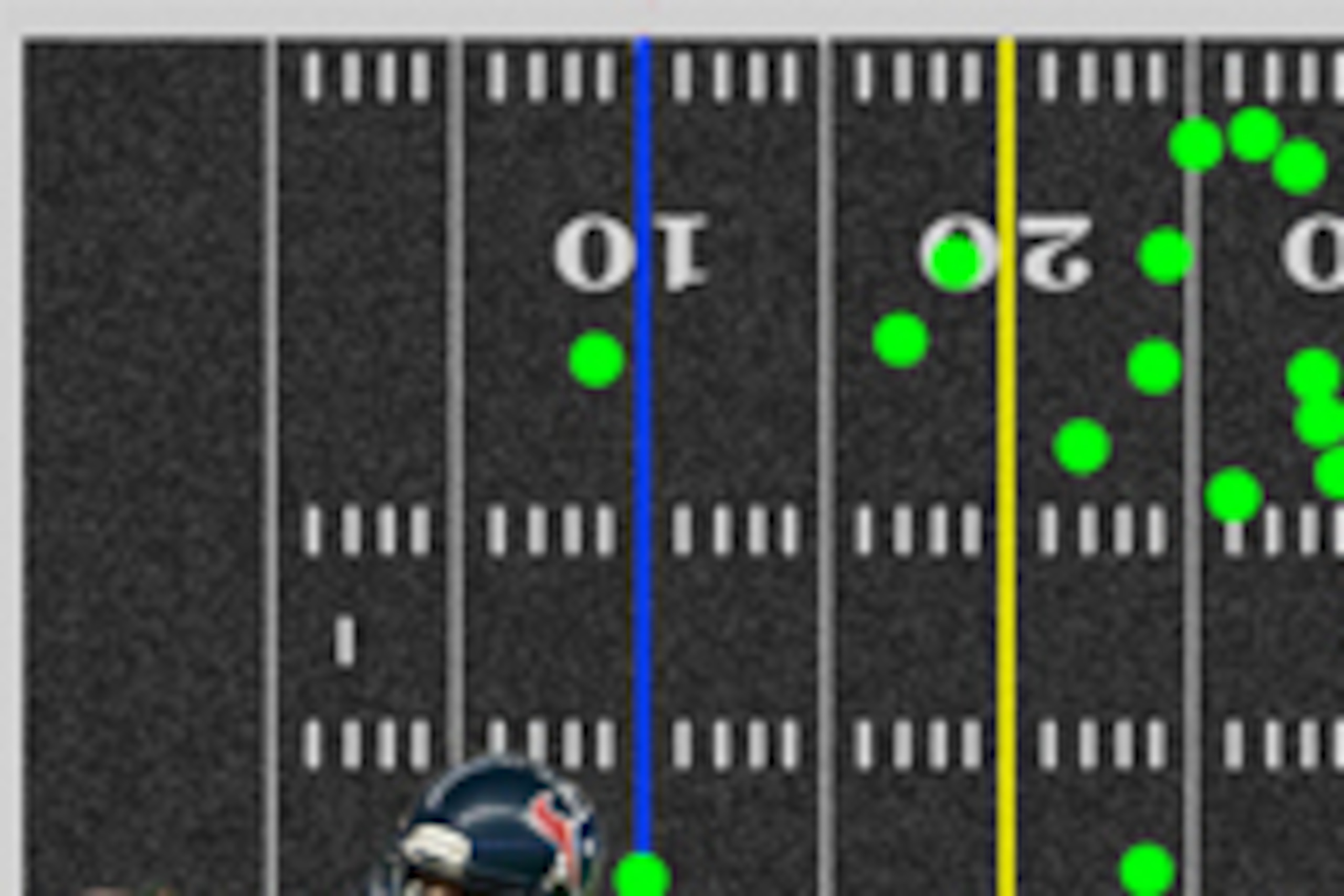
This chart works in a simple way. Every green circle is where the ball landed on a pass thrown toward Johnson that was deemed catchable for the receiver. The orange circles are passes that Johnson caught and turned into touchdowns.
As the chart shows, he only had seven catchable targets in the end zone during the 2013 season.
He converted four of those into touchdowns. The other three resulted in one play where Johnson couldn't catch the ball against tight coverage, one where he dropped the ball while he was wide open and one when a poorly thrown jump ball gave the defensive back a significant advantage at the catch point.
Johnson was only given two other jump balls—both resulted in touchdowns and are highlighted with the orange circles toward the top of the end zone. He's 6'3" and 230 pounds with outstanding ball skills—it took a cautious game plan for his coaches not to use Johnson in those situations more often.
Part of that reluctance may have been the quarterback play, as even both of those converted jump-ball touchdowns came on poorly placed passes. Johnson was still able to beat Vontae Davis and Patrick Peterson for the receptions, though.
When you further break down the chart, you can see the inability/cautiousness of the Texans offense the closer it got to the goal line.
Fifty-seven of his 138 total catchable targets that season landed within 40 yards of his own end zone. Over half of those targets, 72, landed in his own half. Only 59 landed in the opposition's half with just 38 of those within 40 yards of the opposition's end zone. In 16 games, he had just 15 catchable targets in the red zone.

In 2014, Johnson had just three touchdown receptions. Each of those came on catchable targets that landed in the end zone. He had just four total targets in the end zone that were catchable, and the one he didn't catch was a difficult fingertip grab at full extension when he was wide open.
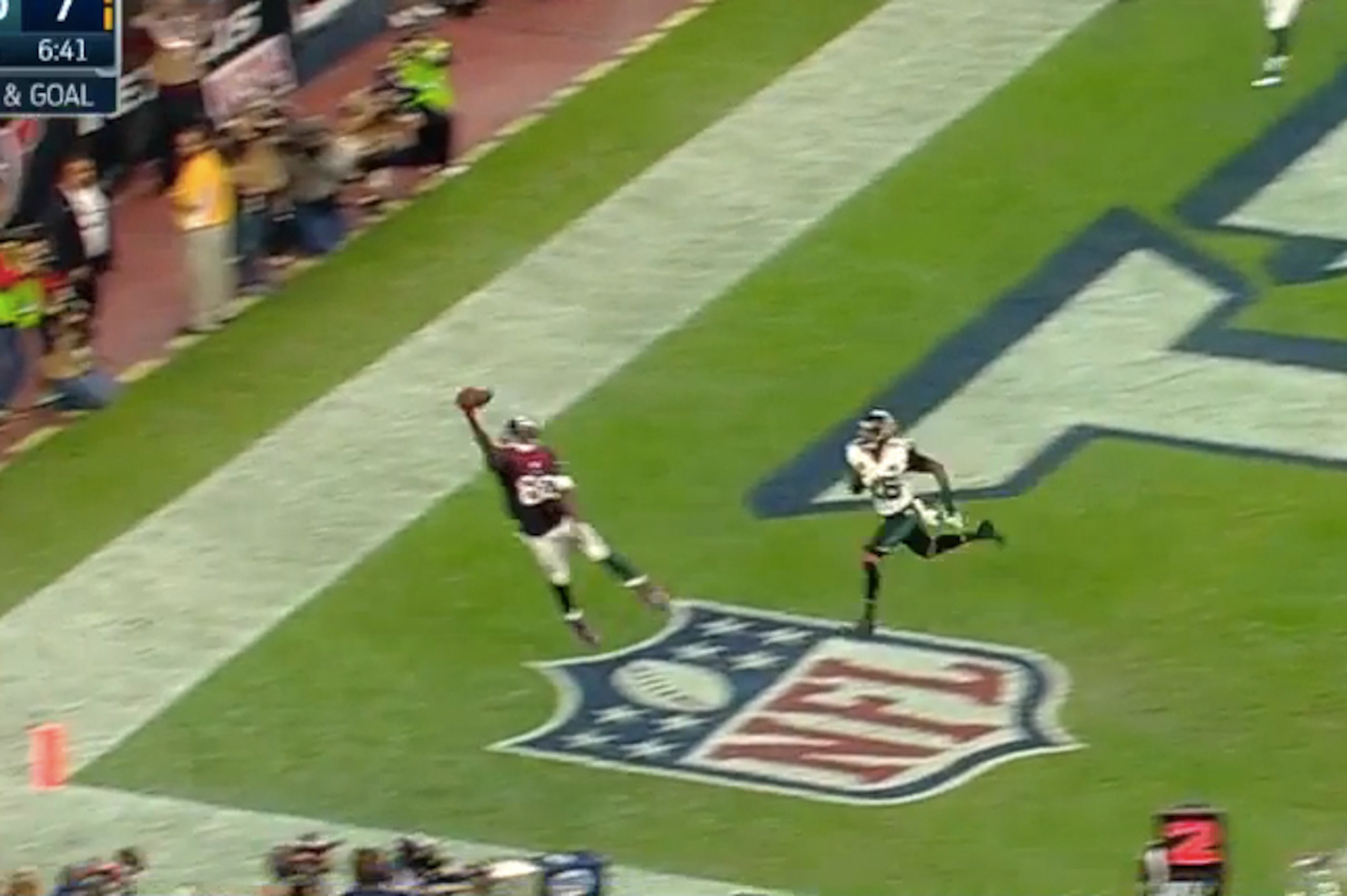
Although Johnson didn't have another catchable target in the end zone, he did let one more touchdown get away from him when he caught the ball on the 1-yard line at the pylon. Instead of securing the football, he allowed a defensive back to punch it free as he fell out of bounds.
Johnson finished the 2014 season with 85 receptions for 936 yards and three touchdowns. He missed one game because of a concussion.
Those numbers came on 104 catchable targets from his quarterbacks. Thirteen (12.5 percent) came within 20 yards of his own goal line. Thirty-six (35 percent) came within 40 yards of his own goal line. Fifty (48 percent) came in his own half. That means that Johnson had 54 catchable targets in the opposition's territory during the 2014 season.
Fourteen of those 54 came outside of the 40-yard line. Sixteen more came outside of the 20-yard line. That means that Johnson had a significantly higher number of red-zone opportunities in 2014 than he had in 2013, despite getting fewer opportunities in the end zone.
Wherever Johnson winds up playing in 2015, he should expect to receive significantly more touchdown opportunities than what he had in Houston over the past two seasons.
That should immediately raise his scoring output to complement his consistency as a possession receiver and his big-play ability. That big-play ability is somewhat reduced at this stage of his career, but it is still evidently there.

Johnson can create separation behind the last level of the secondary, but he primarily relies on his route running and ability to win at the catch point when searching for big plays. On this occasion, he lines up at the top of the screen against Cortez Allen.
The Pittsburgh Steelers cornerback is shaded slightly to the inside of Johnson at the beginning of the play.

Johnson is running a route down the sideline. Allen's inside positioning would likely be enough to tempt most cornerbacks to run toward him before breaking toward the sideline, but Johnson sells his routes better than most cornerbacks.
As he releases from the line of scrimmage, Johnson angles infield before planting his foot hard to push back toward the sideline. This sets Allen up and helps to create more space for Johnson's quarterback to eventually throw into.
The development of Johnson's route has helped to create a situation where he is running toward the sideline with his eyes looking back toward the quarterback while Allen is focused on the receiver. This is the ideal situation for quarterbacks to throw toward their receiver's back shoulder.
Back-shoulder throws typically require precision, but the space outside of Allen gives Ryan Fitzpatrick a relatively wide window to throw into.

While the throw floats somewhat, Johnson is able to slightly push off Allen before cradling the ball into his chest for an easy 20-plus-yard reception. Most receivers who move as well as Johnson does in space can't use their strength like this at the point of contact.
In an ideal world, Johnson would have reached back for the ball to catch it away from Allen, but even when he didn't, he was still able to make a comfortable catch.
Johnson is going to age well as a receiver. His well-rounded athleticism and understanding of how to create space with his precise route running make for a rare combination. His ball skills at the catch point will allow him to be effective even when he can't create separation anymore, similar to what Boldin has done for a few years in San Francisco and Baltimore.
Having spent so long with poor quarterbacks, it wouldn't be a surprise if Johnson took less money to play for a quarterback of his choosing in free agency.
If one of those quarterbacks plays for a championship contender, Johnson could conceivably prove to be the X-factor for the next Super Bowl-winning offense.
.jpg?w=2560 "Cardinals Giants Football")
.jpg?w=2560 "Titans Ravens Football")

.jpg?w=2560 "OBJ Calls Out Giants 😳")
.jpg?w=2560 "Tyreek Deal May Come Soon")