

2015 NBA Draft Notebook: Jahlil Okafor Breaking Mold When Finding Comparisons
Freshman center Jahlil Okafor has been dominant during his freshman season at Duke, where he's established an identity for himself unlike anyone we've seen in years. And it's led to some good debate regarding his outlook as a pro, culminating in recent discussions about his candidacy for the No. 1 pick in the 2015 NBA draft.
With well-defined strengths and weaknesses, he plays a very particular brand of ball—a brand you just don't see much of these days in the NBA.
It's translated to all sorts of production and even more impressive efficiency at Duke:
.png?w=2560 "Los Angeles Lakers v Miami Heat")
| FG Pct | Points | Rebounds | Assists | Blocks | Steals |
| .663 | 18.2 | 9.6 | 1.5 | 1.4 | 0.8 |
But the big question is how Okafor will transition from college to the NBA. In looking for the best comparison, we'll start by sorting out those players who come closest to matching up with Okafor physically.
Physical Tools, Athleticism
You can't break down Okafor without starting with his physical tools, which ultimately help define him.
Listed at 6'11", 270 pounds with a 7'5" wingspan and 9'2" standing reach, there are only a handful of distinguished NBA big men with his blend of size, mass and length. Take a look at the current players who have similar builds and bodies as Okafor:
| Weight (lbs) at NBA combine | Current NBA Weight | Height | Wingspan | Standing Reach | |
| Okafor | 270 | N/A | 6'11" | 7'5" | 9'2" |
| DeMarcus Cousins | 292 | 270 | 6'11" | 7'5.75" | 9'5" |
| Jusuf Nurkic | 280 | 280 | 6'11" | 7'2" | 9'1.5" |
| Elton Brand | 260 | 254 | 6'9.5" | 7'5.5" | 9'2" |
| Brook Lopez | 256 | 275 | 7'0" | 7'5" | 9'5" |
| Andre Drummond | 279 | 279 | 6'11" | 7'6" | 9'1.5" |
| Nikola Vucevic | 260 | 260 | 6'11.75" | 7'4.5" | 9'4.5" |
| Andrew Bogut | 251 | 260 | 7'0" | 7'3" | 9'2.5" |
| Al Jefferson | 263 | 289 | 6'10" | 7'2.5" | 9'2" |
| Roy Hibbert | 272 | 290 | 7'2" | 7'4" | N/A |
| DeAndre Jordan | 250 | 265 | 6'11" | 7'6" | 9'5.5" |
| Dwight Howard | 240 | 275 | 6'10.25" | 7'4.5" | 9'3.5" |
Though a number of players added weight after the NBA combine, I'd imagine coaches will plan for Okafor to actually lose a few pounds. The 265-pound range sounds about right.
Okafor measures up pretty closely to Andre Drummond, only the Duke freshman isn't nearly as good of an athlete.
Okafor's mobility and (lack of) explosiveness is closer to DeMarcus Cousins or Nikola Vucevic, which is a step ahead of slower bigs like Roy Hibbert, Greg Monroe and Al Jefferson.
However, Okafor isn't a stiff. He's flashed nimble feet and the strength to play through contact, and it's a combination that's presented him with consistent mismatches against opposing frontcourts.
Offense, Post Game
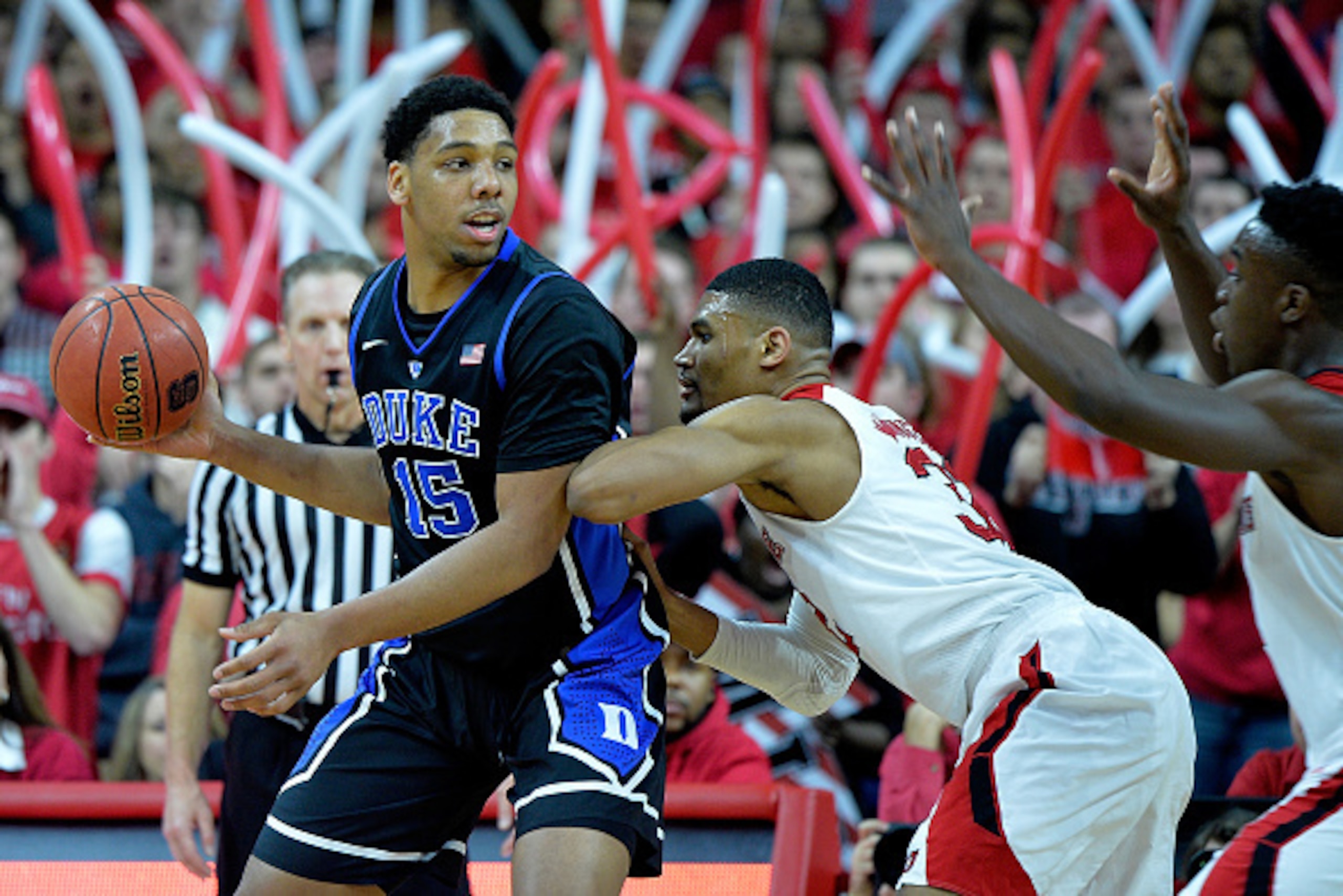
It's no secret Okafor's style of play revolves around his ability to score in the post.
With exceptional footwork, overwhelming power, go-to moves and counter-moves, at 19 years old, there isn't a tougher one-on-one cover when isolated within 12 feet.
Okafor's deep, yet polished, arsenal in the post consists of everything from hooks, flips, spins, up-and-unders and drop steps. He's ultimately at his best backing his man down and knocking the defender off balance with one shoulder, only to spin over the other for a one-handed bank. It's indefensible against smaller opponents. Against stronger defenders, incredible body control and a quick first step allow Okafor to face up, attack and separate with a hop step.
As DraftExpress pointed out back on January 30, rarely does Okafor get a touch outside the paint, as 52 percent (after 20 games) of his half-court touches come off post-ups. Though the numbers are fairly dated, it's only been seven games for Okafor since they've been documented. Odds are they're roughly the same.
You just don't see that many big men in today's NBA game make a living with their back to the rim anymore. Take a look at the most productive and frequently used post scorers, because chances are you'll see Okafor's name in the same mix a year from now.
Nobody is used more frequently in the post than the Charlotte Hornets' Al Jefferson, who also scores an excellent 0.96 points per play.
According to DraftExpress (as of January 30), Jefferson gets 14.8 post touches per game, similar to Okafor's 14.3 post touches per game at Duke.
Sizing them up, Okafor is the smoother, more agile athlete, while Jefferson has a bit deeper range in terms of being able to score away from the basket.
At this stage, 69.4 percent of Okafor's shots come at the rim, per Hoop-Math.com—a result of his ability to get there with ease against inferior competition, along with the fact he just doesn't have much of a jumper in the repertoire. Take a look at his shot chart, via Shotanalytics.com:

As an NBA rookie, Jefferson wasn't much different—63.4 percent of his shots came from within five feet. Fast-forward 10 years, and only 35.3 percent of his shots are taken that close. He's added to his high-post game around the elbows over the years, where he's currently shooting 45.2 percent on 118 made shots (outside the restricted area, inside the paint). And he's added a capable short- to mid-range jumper.
Okafor is ultimately a lot further along at 19 years old than Jefferson was at the same age. He's the better passer and more refined scorer. In fact, Okafor is as good inside 12 feet as anyone we've come across in recent memory.
But to take that next step, chances are he'll have to make some adjustments—like adding a 15-footer—to counter the tougher rim protection in the pros. Super athletes like Dwight Howard and DeAndre Jordan haven't necessarily had to. Players like Jefferson have.
Defense
If anyone is going to pass on Okafor, the reason should have something to do with his defense, as well as the negative effect it could have on his ceiling if he's unable to make improvements.
There just aren't many winning franchise centers whose impact is only felt on offense.
While he's remained a target for opposing ball-handlers in pick-and-roll coverage since early in the season, given his mediocre lateral foot speed and instincts, it's the questions surrounding his rim protection that are ultimately the most troubling.
His 4.3 percent block percentage at Duke is abnormally low for a center with NBA potential. Of all the big men in today's game, only Miles Plumlee, Mason Plumlee and Nikola Vucevic left their final year of college with lower block percentages.
The concern is that, for the most part, the prospects who struggled to swat shots in college have had similar trouble defending in the pros. Block percentage is a number that seems to carry over pretty well from one level to the next, at least at each end of the spectrum. For what it's worth, the current NBA bigs who had the highest block percentages out of college include Hassan Whiteside, Nerlens Noel, Anthony Davis, Joel Embiid, Roy Hibbert, Steven Adams, John Henson, Gorgui Dieng, JaVale McGee and Robin Lopez.
The hopeful news: Okafor has terrific physical tools, and if he can ever figure out how to exploit them, there's obvious room to learn and improve. His wingspan is a good three inches longer than most of the players in the previous chart.
In terms of comparison players who share similar measurements and struggle defending around the rim, Nikola Vucevic and Brook Lopez stand out. Had he gone to college, Jefferson would have likely stood out as well (based on what we've seen through 11 years in the pros).
Like Vucevic (23.5-inch no-step vertical, per DraftExpress) and Lopez (27.5-inch no-step vertical), Okafor does not get off the ground very high. Though he runs well, side-to-side sliding and jumping are not his forte.
Scouts have likely been wondering all year whether Okafor just needs some extra reps and NBA coaching, or whether instinctive defense just isn't part of the package.
Offensive Rebounding
Okafor's activity level on the offensive glass has been tremendous. His 16.8 percent offensive rebounding percentage ranks No. 13 in the country, per Sports-Reference.com. Of notable NBA players, only Kenneth Faried, Cousins, Paul Millsap and Zach Randolph left college with higher ones than Okafor's current mark.
You don't need a high offensive rebounding percentage in college to rebound effectively in the pros. But those who had them typically fared well under the NBA boards.
His giant hands, long arms and ability to move defenders with his body have translated to a whopping 54 putbacks in 28 games. Nearly a fifth (19.3 percent) of his buckets at the rim are actually on second-chance opportunities off misses.
Collecting offensive rebounds and converting them into points is ultimately a big part of his game at the moment. Take a look at who else in the pros does heavy damage off putbacks:
Outside of being big, there isn't a common theme among the top putback machines. It certainly helps to be tall, strong and athletic, which can help to explain Andre Drummond and DeAndre Jordan's production.
But then there's Vuecevic, Jonas Valanciunas, Monroe and Randolph—big guys who, like Okafor, play mostly below the rim.
The question is whether Okafor can put the same pressure on the offensive glass in the pros as he does at Duke. What makes his rebounding outlook especially tricky to predict is the fact his 18.9 percent defensive rebounding percentage is actually well below the norm.
A skeptic might say his offensive rebounding prowess is simply a result of being physically overwhelming when compared to most college big men. I'm in the middle. I'd imagine Okafor will be good for an easy putback bucket a night, but I wouldn't bet on him consistently controlling the glass like Jordan or Drummond do.
Conclusion
When you take into account his immaculate physical tools, rare offensive post polish and strange defensive ineffectiveness, Okafor is ultimately one of the more unique prospects we've seen in a while.
But given his monster frame, identity as a skilled paint scorer, average athleticism and questionable defensive instincts, the Al Jefferson comparison looks the sharpest.

“The kid at Duke is like Al Jefferson at Charlotte," one scout told SNY's Adam Zagoria back in December. "All of his moves are below the basket. He’s an old school, highly-skilled post player."
Jefferson averages 17.1 points and 8.8 boards a game on 47.9 percent shooting—while allowing opponents to shoot 54.3 percent against him at the rim.
Okafor has a little Vucevic in him as well—another post scorer, mediocre rim protector (Vucevic allows opponents to shoot 53.8 percent at the rim) and strong offensive rebounder.
However, still a teenager, Okafor's ceiling is surely higher.
If you're looking to draft him first overall, you do so based on his Jefferson-like post game and the hope he adds a jumper and eventually builds his defensive awareness. General managers who'd rather pass likely question the upside tied to a one-dimensional interior scorer who doesn't defend or stretch the floor.
Notables
- Point guard Emmanuel Mudiay (1996), one of the top prospects eligible for the 2015 draft, played his first game over in China since injuring his ankle back in November. With his team down 2-0 facing elimination in the playoffs, it activated Mudiay in desperation, and the move paid off for both parties. He scored 24 points off the bench in the win, an impressive feat for a teenager who many expected to rest until workouts in June. Mudiay has been in the No. 1 overall conversation since the summer, and despite all the time he's missed in 2015, don't expect his name to go anywhere.
- Kentucky freshman big man Karl-Anthony Towns is now 20-of-23 from the floor over Kentucky's last five games. It's just starting to look easier for him. He's getting off cleaner looks. The only real knock on Towns remains foul trouble. He's averaging 5.7 fouls per 40 minutes. With Knicks president Phil Jackson looking on live, Towns only played four first-half minutes against Arkansas on Saturday after picking up two unnecessary quick ones.
- Ohio State freshman guard D'Angelo Russell showcased his spectacular offensive skills against Purdue on Sunday night, when he put the Buckeyes on his back for a second-half comeback. Russell wasn't particularly efficient in the first half, but his ability to just turn it on when his team needs it is truly unteachable. He knocked down a number of step-backs and pull-ups that were simply unguardable. I doubt he'll go first in the draft, but he's certainly deserving of consideration.
- Freshman power forward Cliff Alexander was held out of Kansas' game on Saturday after the NCAA raised a question over his eligibility. This is bad news for Alexander, who really needed to see the floor to improve his 2015 draft stock. He'd been held to just six total points combined over his previous four games. Alexander is a first-round talent, but if this is it for him, he could have a tough time trying to crack the top 20. There's just too much uncertainty surrounding his undersized 6'8" frame, limited post skills and lack of shooting touch.
- Kentucky freshman forward Trey Lyles could be one of the bigger late-season draft risers. He's scored 36 points over the Wildcats' last two games, flashing everything from mid-range shooting, low-post scoring and impressive finishes around the rim. At 6'10", he has power forward size and a terrific basketball IQ. I'm not sure how much upside is in the tank, but Lyles has a skill set built for the NBA level, even if it's as a role player.

.jpg?w=2560 "Jerry Jones Teases Trade 👀")
.jpg?w=2560 "Shanahan Takes Blame For Accident")
.jpg?w=2560 "HERBERT, BEER ENGAGED💍")
.jpg?w=2560 "Fantasy Football PPR Rankings 📊")
.jpg?w=2560 "🚨Browns Giving Ward $62.2M")
.jpg?w=2560 "Madden Rookie Ratings Revealed")