

Notre Dame Football: Should the Irish Run More in 2015?
SOUTH BEND, Ind. — From start to finish in its 31-28 victory over LSU in the Music City Bowl, Notre Dame featured a run-based offense directed by quarterbacks Malik Zaire and Everett Golson.
In total, the Irish rumbled 51 times for 263 yards and three touchdowns, boasting a grueling ground game against the Tigers.
TOP NEWS

Deion Playbook Found at Hotel

Week 5 AP Top 25 Poll 🔢
Top Overreactions after Week 5 of CFB Season 😧
For some Irish fans, it raised a recurring question: Why doesn’t Notre Dame do that—gash teams with a sustained running attack—more often? Irish head coach Brian Kelly was asked after the game if a run-heavy offense can be Notre Dame’s identity moving forward.
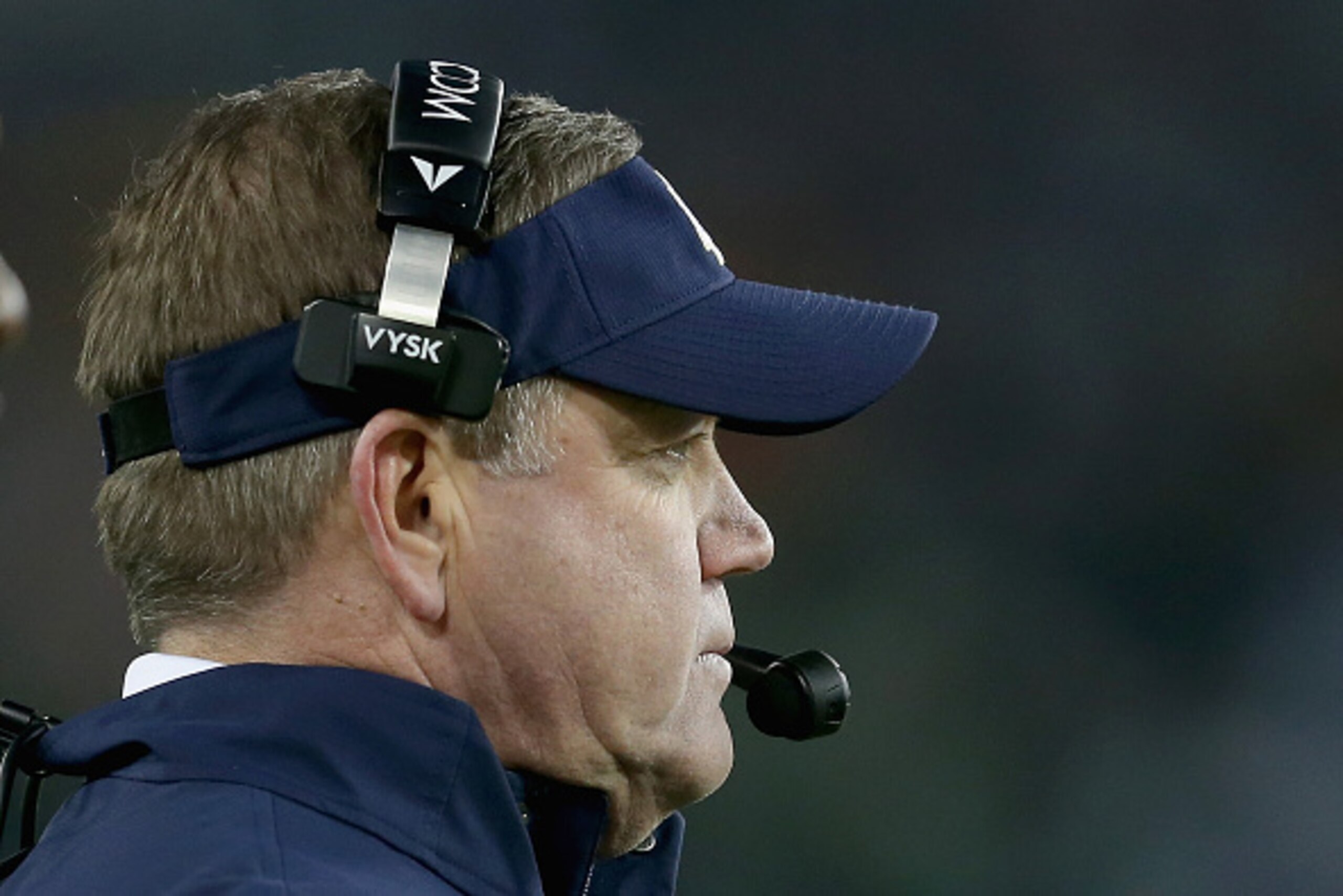
“We had to have a game plan for today,” he said. “We know what we have with both quarterbacks. ... We’re going to continue to utilize [Zaire’s] strength. He’s a very good runner of the football.”
The game plan certainly worked against LSU. But should Notre Dame run the ball more in 2015? Let’s start with the data.
Kelly is 34-5 in his five seasons at Notre Dame when the Irish rush for more yards than their opponent.
Before the Florida State game in October, Notre Dame had compiled a streak of 26 consecutive games in which it did not lose when it tallied at least 30 rushing attempts.
Notre Dame is 33-3 since the start of the 2002 season when it gains at least 200 rushing yards.
Compelling evidence? Maybe. But not so fast.
Of course, such rushing statistics can easily be skewed in many cases, as teams that are leading—comfortably or not—may choose to run more and milk the clock.
We’ll analyze the run-pass breakdowns of other elite teams across the country in comparison to that of Notre Dame, bearing in mind that such successful teams could be more likely to run when leading.
Of the Top 10 teams in the final AP poll, nine averaged more rushing attempts per game than Notre Dame, per CFBStats.com. Only Florida State, with Jameis Winston leading the offense, rushed less than the Irish.
| Team | Rushing Attempts Per Game | National Rank |
| 1. Ohio State | 46 | 16 |
| 2. Oregon | 42.93 | 36 |
| 3. TCU | 39.15 | 63 |
| 4. Alabama | 40.50 | 46 (tie) |
| 5. Michigan State | 45.69 | 17 (tie) |
| 6. Florida State | 32.21 | 113 |
| 7. Baylor | 47.62 | 11 |
| 8. Georgia Tech | 56.43 | 2 |
| 9. Georgia | 42.69 | 40 |
| 10. UCLA | 42.85 | 37 (tie) |
| Notre Dame | 37.23 | 84 |
Viewed through another prism, Notre Dame had a fairly even run-pass balance in 2014. The Irish ran on 49.64 percent of their plays. Eight of the Top 10 teams in the nation rushed more often than Notre Dame, per TeamRankings.com.
| Team | Percentage of Run Plays | National Rank |
| 1. Ohio State | 60.36% | 19 |
| 2. Oregon | 56.96% | 35 |
| 3. TCU | 48.08% | 97 |
| 4. Alabama | 55.29% | 43 |
| 5. Michigan State | 58.43% | 27 |
| 6. Florida State | 45.07% | 109 |
| 7. Baylor | 52.49% | 63 |
| 8. Georgia Tech | 79.05% | 4 |
| 9. Georgia | 62.36% | 16 |
| 10. UCLA | 53.97% | 53 |
| Notre Dame | 49.64% | 85 |
Again, it bears repeating that correlation doesn’t imply causation here. These teams aren’t necessarily winning because they’re running more.
So sliced another way, we can consider Notre Dame’s propensity to run the ball on first down throughout the season. Running on first down could be indicative of Kelly’s commitment to the ground game on any given Saturday.
| Opponent | First-Down Run Percentage |
| Rice | 56.7% |
| Michigan | 59.3% |
| Purdue | 51.4% |
| Syracuse | 53.8% |
| Stanford | 40% |
| North Carolina | 64.1% |
| Florida State | 34.3% |
| Navy | 67.6% |
| Arizona State | 42.1% |
| Northwestern | 57.9% |
| Louisville | 50% |
| USC | 55.2% |
| LSU | 81.3% |
Clearly, Kelly was committed to running the ball against the Tigers, opting for the ground on more than 80 percent of the team’s first downs. Notre Dame also remained committed against Navy and piled up 218 rushing yards and four touchdowns on 39 carries. Against North Carolina, too, the Irish eclipsed the 200-yard mark with a 216-yard showing to go along with four scores on the ground.
Finally, we’ll try to somewhat control the numbers here for winning and losing by large margins. For each game in 2014, we’ll compare Notre Dame’s percentage of rushing plays in the first half with that ratio for the entire game.
In theory, the game plan is more likely to still be intact in the first half and the run-pass breakdown is less likely to be skewed by the score of the game.
| Opponent | First-Half Run Percentage | Full-Game Run Percentage | Rushing Yards | Result |
| Rice | 51.5% | 64.1% | 281 | Win |
| Michigan | 44.7% | 46.2% | 54 | Win |
| Purdue | 45% | 43.6% | 139 | Win |
| Syracuse | 40% | 50% | 161 | Win |
| Stanford | 38.9% | 40% | 129 | Win |
| North Carolina | 40% | 51.9% | 216 | Win |
| Florida State | 45.1% | 36.8% | 157 | Loss |
| Navy | 51.4% | 59.4% | 218 | Win |
| Arizona State | 39.5% | 39.2% | 41 | Loss |
| Northwestern | 54.8% | 50% | 211 | Loss |
| Louisville | 53.8% | 49.1% | 99 | Loss |
| USC | 31.0% | 32.8% | 104 | Loss |
| LSU | 69.8% | 66.2% | 263 | Win |
A look at the numbers shows Notre Dame never really relied on the run against USC. And even though the Trojans put up a quick 35 points before the Irish really settled in, it’s worth noting that Notre Dame dialed up just two runs in its first 10 plays while the game remained scoreless.
The Irish also went into games against Syracuse, Stanford and North Carolina with more of a pass-happy approach.
No statistic is perfect here when analyzing the rushing game, and it’s difficult to determine cause and effect with choices that have so many variables.
The shape of Notre Dame’s offense in 2015 is still to be determined.
Once the quarterback position is settled, Kelly could have a better idea of his plan. Zaire certainly appeared more comfortable running the zone read in his extended work against USC and LSU, and running backs Tarean Folston and Greg Bryant will be talented juniors.
It worked against LSU. Can it work for a full season?
All quotes obtained firsthand unless otherwise noted. Mike Monaco is a lead Notre Dame writer for Bleacher Report. Follow @MikeMonaco_ on Twitter.

_0.png?w=2560)
.jpg?w=2560 "Love's Body Already 'Tired'")

.jpg?w=2560 "NFL investigating 2 referees for separate viral exchanges")
.jpg?w=2560 "Ward Nearly Walks Out of Presser ▶️")
.jpg?w=2560 "Tyreek Deal May Come Soon")

.jpg?w=2560 "OBJ Calls Out Giants 😳")
