

Green Bay Packers: The Pain Will Linger After the Loss to the Seahawks
When it comes to painful losses in the postseason, the Green Bay Packers have had a few over the 81 years the NFL has used a playoff system to determine the league champion.
I'm talking about bitter losses like those in the 4th-and-26 game against the Eagles in the 2003 NFC divisional round, Terrell Owens' last-second touchdown catch against the 49ers in the 1998 NFC Wild Card Round, and Brett Favre's pick in overtime against the Giants in the 2007 NFC title game.
Packer Nation surely remembers those infamous games.
TOP NEWS

New NFL Power Rankings 📊
The Robinsons POUND the Rock 🪨
Takeaways from Falcons' dominant MNF win
There were also some other agonizing defeats.
How about the 1960 NFL Championship Game? That was the only postseason game any team in Green Bay under Vince Lombardi ever lost.
The Packers outgained the Eagles by a large margin in that game but still ended up losing 17-13. Fullback Jim Taylor was tackled inside Eagles' 10-yard line when the game ended.
How about the loss to the Broncos in Super Bowl XXXII, the only Super Bowl loss in team history in five tries?
Now, I know the Packers have won a lot more than they have lost in the postseason. The team has a 31-20 record and has won a NFL-best 13 league championships in it's 93-year history.
But the loss to the Seattle Seahawks this past Sunday in the 2014 NFC title game has to be the most painful one in its postseason history.
It's going to take a long, long time for that wound to heal. The end of the game was like a Twilight Zone episode. The outcome seemed unreal when the game finally ended.
It was a surreal game. The Packers dominated the game for 56 minutes. But even within that domination, they also made a number of errors and miscalculations.
It sure seemed like the Packers were a shoo-in to get to Super Bowl XLIX with a little over five minutes to go in the game.
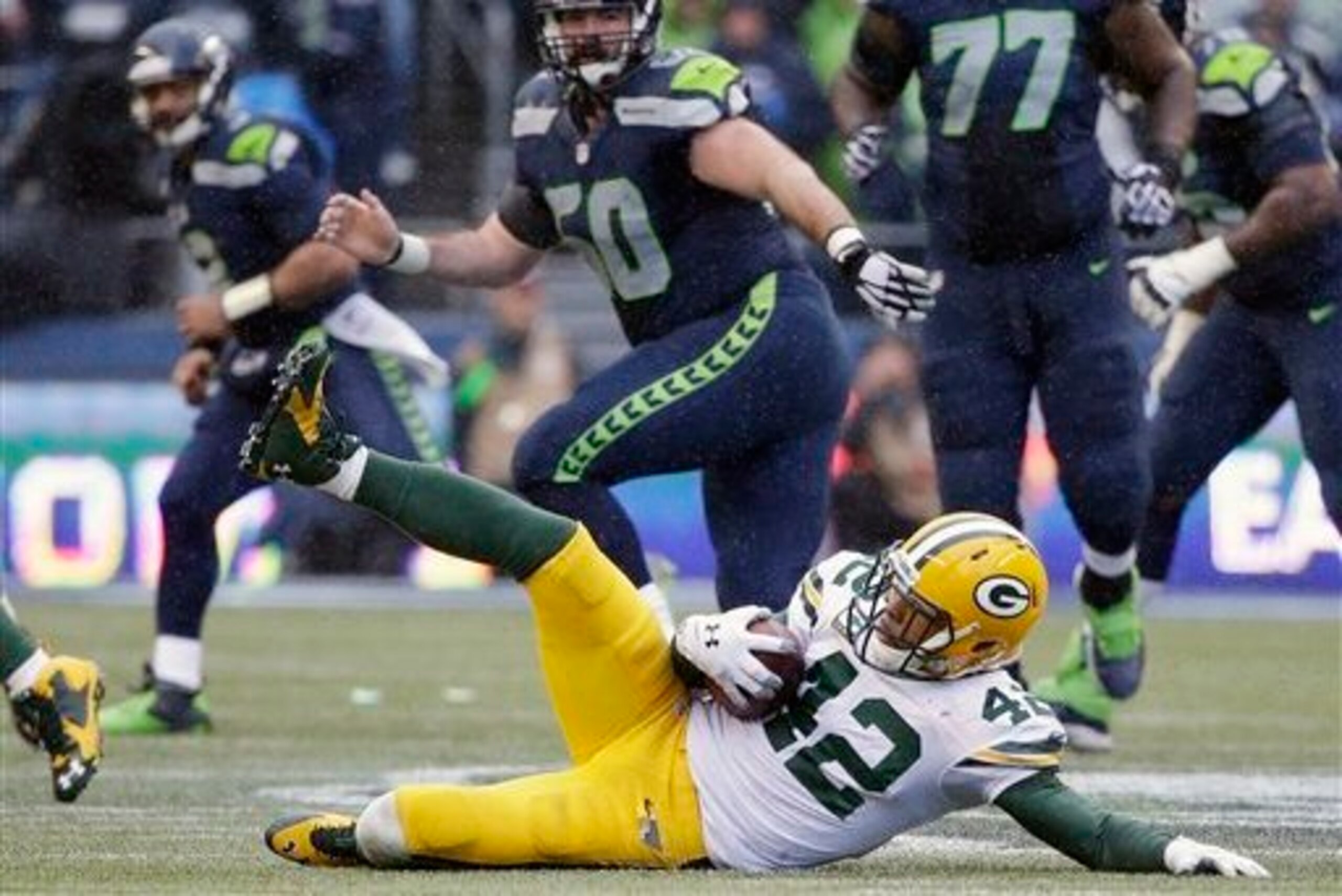
When safety Morgan Burnett intercepted a Russell Wilson pass with 5:13 left in the game, with Green Bay holding a 19-7 lead, the Packers had a 98.2 percent chance of winning the game, according to Joe Posnanski of NBC Sports.
Just think about that for a second: A 98.2 percent chance of winning. Basically, it was Glendale, Arizona (the site of Super Bowl XLIX), here we come.
Instead, it turned into a nightmarish ending for the Packers.
The highly probable victory didn't happen for a myriad of reasons. The list goes on and on, both before the Burnett interception and certainly after it.
By the way, that pick by Burnett was the fourth interception of the game for the Packers. And that was against Wilson, who was the top-rated quarterback (at the time) in NFL history in the postseason.
Wilson's quarterback opponent in the game, Aaron Rodgers, was the second-rated quarterback in NFL history in the postseason. When the game was over, Wilson had dropped to fifth on that postseason list, while Rodgers dropped to third.
It was sort of that type of game for both quarterbacks.
Wilson completed just 14 of 29 passes for 209 yards, with one touchdown pass (in overtime, however) and four picks.
Rodgers completed 19 of 34 throws for 178 yards, with one touchdown pass and two interceptions.
This contest was much more about how each respective defense and special teams played.
The Packers had a number of chances to put the game away before the Burnett interception.
Early in the game, the Packers had two 4th-and-goals from the Seattle 1-yard line. Instead of trying to get six points each time (or at least once), head coach Mike McCarthy decided it was a better course of action to kick a field goal each time.
Rodgers threw two picks in the first half, and both ended drives that would have least given Mason Crosby a chance at a field-goal attempt.
That being said, on the first interception Rodgers threw, it appeared the defensive lineman Michael Bennett was offside and that Rodgers thought he had a free play. But no penalty was called, and Richard Sherman had an interception.
On Rodgers' second pick, it appeared that there was a communication issue. That can't happen in a game like this. Especially in a contest where points were at a premium.
Crosby ended up being automatic in the game, as he successfully booted five field goals in as many attempts. So the odds favored Crosby adding to the score without those interceptions.
As it was, the Packers were up 16-0 at halftime, but the score should have been at least 22-0 or better.
Even though the halftime lead was not as good as it should have been, it seemed like the Packers defense had things under control, as they were making Wilson look like a rookie in his first preseason game.
Wilson's passer rating at halftime? How about an unbelievable 0.0 mark?
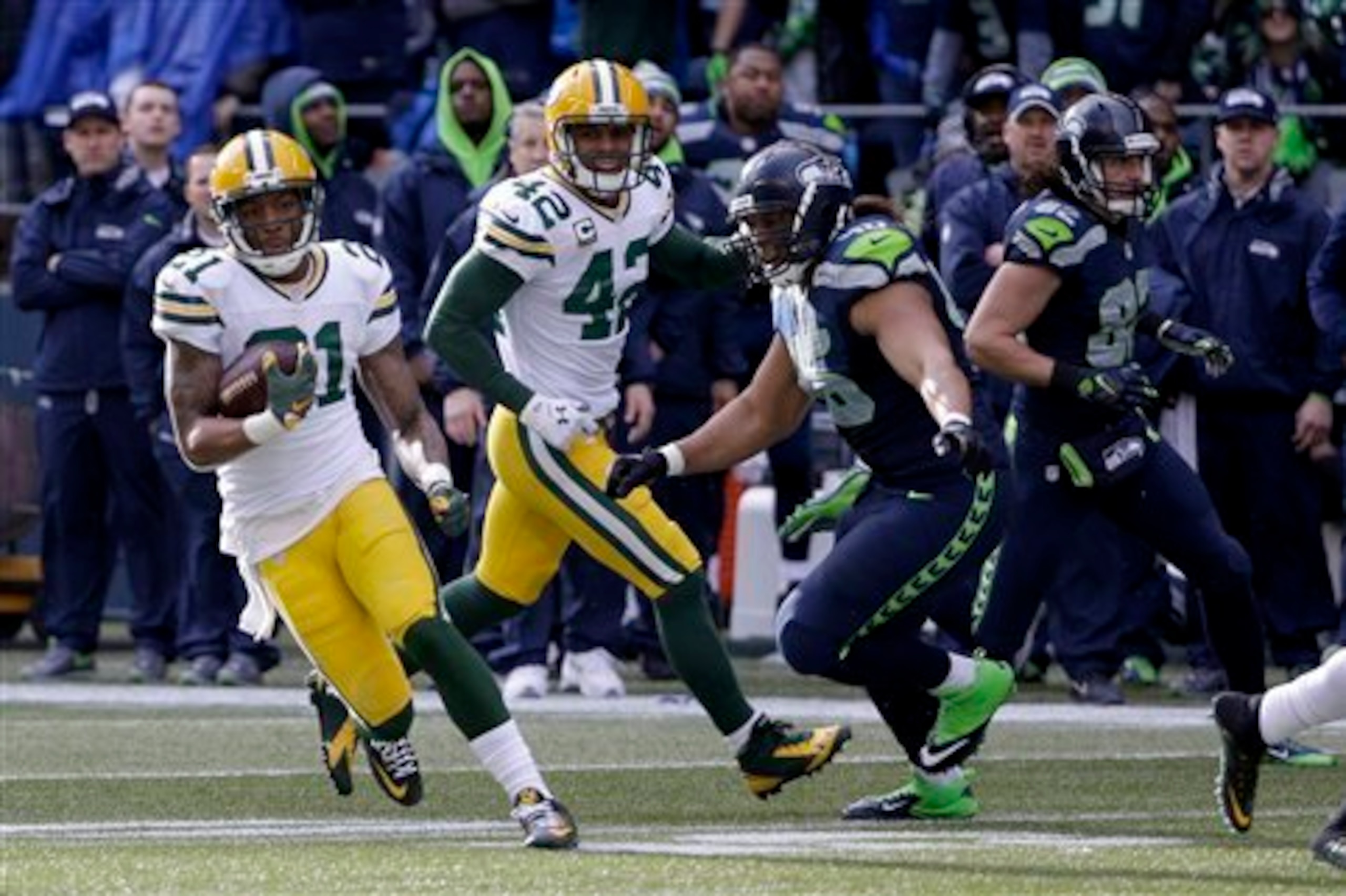
The Packers forced five turnovers and sacked Wilson five times. With stats like those, a win is almost always going to follow.
But it didn't, mostly because of the play of the special teams units.
Now, the special teams did provide five field goals and also forced a fumble. But like it always seems to be with units coached by Shawn Slocum, every step forward was followed by two big steps backward. And man, were they two big steps backward.
The first occurred with the Packers holding a 16-0 lead with 4:44 left in the third quarter. The defense had held, and Seattle was attempting what would have been 36-yard field goal. The first red flag the Packers should have noticed was that offensive tackle Garry Gilliam announced himself as an eligible receiver.
That didn't seem to matter to linebacker Brad Jones and defensive back Davon House, who were on the opposite side of the line for the Packers. Both Jones and House crashed in to block the kick, while Gilliam headed downfield and holder Jon Ryan rolled out.
The only person who could have covered Gilliam was linebacker A.J. Hawk, but Hawk decided to go after Ryan instead. The result? A 19-yard touchdown, and the Seahawks were back in the game trailing 16-7.
The Packers added another Crosby field goal and were up 19-7 when Burnett picked off Wilson with 5:13 left. But before I continue, that interception must also be looked at carefully. It appeared that Burnett had all sorts of room to return the pick. At the very least, he would have gotten deep into Seattle territory and perhaps even had a pick-six for a score.
But instead, after seeing linebacker Julius Peppers waving him down, Burnett slid to the ground at the 43-yard line.
Still, the Packers seemed in great shape. After all, Green Bay had been running a great four-minute offense all season, closing out games against teams like the Jets, Vikings, Patriots, Falcons and Cowboys.
If the Packers got a couple of first downs, the game was basically over. But instead of going downfield, the Packers gave the ball to Eddie Lacy three straight times with eight or nine men in the box, and Lacy lost four yards overall.
Rodgers, the probable NFL MVP for the 2014 season, never got an opportunity to throw the ball on that drive. This against a team that had almost everyone stacked near the line of scrimmage and two injured defensive backs in Sherman (elbow) and Earl Thomas (shoulder).
After a Tim Masthay punt, Seattle got the ball back at their own 31-yard line. But something changed on that drive, as the Seahawks found their mojo on offense while the Packers lost theirs on defense.
Behind Wilson and running back Marshawn Lynch, Seattle stormed down the field, and it was suddenly 19-14 with 2:09 left on the clock.
Still, if the Packers could have corralled the upcoming onside kick, the game would have basically been over with one more first down. The Packers sent in their hands team.

If the kick went to wide receiver Jordy Nelson's side, tight end Brandon Bostick was to block any opposing player from the Seahawks so Nelson could grab the ball. Instead, Bostick decided to try and field the ball himself. And as we all know now, he failed, and the Seahawks recovered.
Next thing we knew, the Packers were down 20-19, and the Seahawks decided to go for two points. Wilson went back to pass and was pressured immediately as he scrambled to his right. He had no choice but to heave a desperation pass across the field to tight end Luke Willson.
Unbelievably, Willson caught the ball for two points when safety Ha Ha Clinton-Dix (who had two interceptions) misjudged the throw.
The Packers quickly got downfield for Crosby to hit a game-tying 48-yard field goal with 14 seconds left in regulation. That field goal would have been a game-winner if not for the extremely fortunate pass from Wilson to Willson.
The Seahawks put the Packers out of their misery on the first drive in overtime as Wilson hit wide receiver Jermaine Kearse with a game-winning, 35-yard touchdown pass.
The Packers were shell-shocked and upset after the horrific loss, as evidenced by what Rodgers said when he talked to reporters after the game.
"You can't let them complete a pass for a touchdown on a fake field goal," Rodgers said, "you can't give up an onside kick, and you can't not get any first downs in the fourth quarter and expect to win. And that's on top of being really poor in the red zone in the first half. Put all of that together, that's how you lose games.
"This was a great opportunity. We were right on the cusp."
Coach McCarthy seemed to be in a state of denial, however, in his comments to the media.
"If you want to question my play-calling...I'm not questioning it.
"I came in here to run the ball. The one statistic I had as far as a target to hit was 20 rushing attempts in the second half, I thought that would be a very important target to hit for our offense."
Well, there is no denying that the Packers suffered perhaps the most heartbreaking loss in the history of their storied franchise.
Two days after that traumatic loss, Rodgers again talked about how disappointing the game was on his radio show.
"I think that's the thing that hits you when you're on the bus," said Rodgers. "You realize just how much you went through to get to that point. We had just a great team, great group of guys, as talented as any we've had, but had that chemistry factor that you need to be a championship team (also).
"I was really proud of our guys and the leadership and the way they played, and that's what makes it so tough. You realize that's the last time that team is going to be together. There's always turnover."

Yes, there will be turnover on the Packers roster, as well as some possible coaching changes.
But for now, all Rodgers can do is think back and reflect on what might have been. When asked what the Packers need to do to get over this very discouraging loss, Rodgers talked about how tough that will be.
"That's the million-dollar question right there," Rodgers said. "You have to be able to refocus, it's getting away whether it's physically or mentally and kind of refreshen [sic] your mind. Every year you get older in the league, your chances get fewer. That's why it stings a little bit more.
"I'd love to play another seven, eight, nine years, but you never know how your body is going to hold up, how the team is going to hold up, the opportunity you're going to have, and we had a great opportunity right in front of us to do something special. There's so much that has to happen between now and getting back to this point. But we'll be ready for it when we get back together."
Rodgers was 100 percent correct: The Packers did have a great opportunity to add to their NFL legacy.
But that opportunity was squandered, and now it will take some time for the pain to subside and for the focus to reappear for the 2015 season.
It's going to take a long time.

.jpg?w=2560 "Rams Eagles Football")
.jpg?w=2560 "Grading WWE Raw 🔠")


.jpg?w=2560 "Injury-stricken Seahawks signing veteran RB")
